
Acknowledgements
Guidelines for Vision Screening in Missouri Schools
The guidelines and recommendations contained within this manual have been developed by the Children’s Vision Commission which was composed of two ophthalmologists, two optometrists, a school nurse, a representative from the a representative from the Department of Elementary and Secondary Education, and a representative from the Missouri State School Boards Association.
- Deborah K. Cook, RN
- Oscar A. Cruz, MD
- Roger D, Dorson, MA, EdD
- Michael C. Frier, OD
- Timothy A. Wingert, OD
- James Luetkemeyer, MD
- Kim Ratcliffe, PhD
With additional reviews by:
- Natalie Botkin, RN, NCSN
- Peggy Karleskint, RN
- Ardith Harmon, MSN, RN
- Teri Hansen, RN, NCSN
- Stacey Whitney, MSN, RN, NCSN
Recommended Practice vision screening tools and optotypes:
- National Center for Children’s Vision and Eye Health – Prevent Blindness
https://nationalcenter.preventblindness.org/ - Recommended Vision Screening tools
https://nationalcenter.preventblindness.org/wp-content/uploads/sites/22/2021/04/ vision_screening_table2021.pdf
Screening practice recommendations during COVID-19 Pandemic:
- American Association for Pediatric Ophthalmology & Strabismus
https://aapos.org/education/allied-health/covid (August 2020) - National Center for Children’s Vision and Eye Health – Prevent Blindness
https://nationalcenter.preventblindness.org/national-center-for-childrens-vision-and-eye-health-publishes-considerations-for-childrens-vision-screening-programs-during-the-covid-19-pandemic/ (August 2020)
Introduction
Guidelines for Vision Screening in Missouri Schools
Forward
The Missouri Department of Health and Senior Services is pleased to provide the attached vision screening protocols, preschool through grade 12, for school districts throughout Missouri. The Children’s Vision Commission, experts from the ophthalmology, optometry and school nursing professions, along with representatives from the Missouri Department of Elementary and Secondary Education and the Missouri School Boards Association, has established these standardized vision screening guidelines. The recommendations described in this manual represent evidence-based methodology and current best practice in the field of vision screening. They are intended to facilitate the identification of children with common vision problems as early as possible, when treatment is most effective, thus supporting educational achievement.
Purpose
The ability to see greatly impacts a student’s ability to learn. Screening for vision problems is an appropriate and important part of school health services, largely carried out by the school nurse. The objective of a vision-screening program is to identify children with possible visual defects at the earliest possible stage. This allows ample time to refer children for diagnosis and treatment. Screening should be done in schools for the following reasons:
- Large numbers of children of many ages are readily accessible
- Can be accomplished in a short period of time with relative ease
- Far less expensive than a comparable service performed in another sector of the health care
system - Allows an ongoing opportunity to observe, assess, and investigate potential areas of concern
- Provides the opportunity to screen children who have been previously identified
Characteristics of Screening Programs
Screening is a brief or limited evaluation of a group of individuals presumed to be normal. The value of early detection of a problem must be weighed against the time and human resources required to conduct the screening. The value of the screening process depends on how well the program is carried out and how the findings are used. Results must be communicated, and follow- up on referrals for those “at risk” must be continued until the problem is resolved in some manner.
Screening program results must be evaluated in terms of:
- Validity – ability to identify those individuals who have the condition and which do not
- Reliability – consistency of results of screening process
- Yield – number of persons identified to be “at-risk”
- Cost – personnel and equipment]
- Acceptance – informed parents agree to the value of screening
- Follow-up – communicating results to parents and assuring the family has resources for
diagnosis and treatment
Evaluation of Vision Screening Programs
To determine the effectiveness of the vision-screening program, careful evaluation ofthe planning, implementation, referral process
and referral outcomes must be completed with each vision screening. Much of this information is essential for reports to the board of
education and the school health advisory committee. Evaluation is an on-going process. Keeping outcome data about the vision-
screening program and referrals helps the school nurse evaluate the effectiveness of the program.
Many questions can be answered from the acquired data. Information that can be gathered in the evaluation process includes the number of students screened, the number of referrals, the types of vision problems identified and utilization of vision insurance.
Screening Schedule and Protocol
Guidelines for Vision Screening in Missouri Schools
Schools develop screening schedules based on a variety of situations; e.g., school board policy, special education plans and tradition.
Detection of visual problems at any age requires observation for signs and symptoms of vision problems and visual acuity screening. Individual children are often referred for vision screening based on signs and symptoms observed by parents and teachers. It is helpful to share the “ABC Checklist for Vision” (Appendix C) or the “Signs and Symptoms” (Appendix C) with school staff and
parents. These tools may help others in making observations and referrals for possible vision problems.
| Grade | Screen | Type of Screening |
|---|---|---|
| All Students new to the district | Recommended | Age appropriate |
| Kindergarten | Recommended | Near and Distance Acuity, Random Dot E (stereoacuity) |
| 1st Grade | Recommended | Near and Distance Acuity, Random Dot E (stereoacuity) |
| 2nd Grade | Recommended | Near and Distance Acuity, Random Dot E (stereoacuity) |
| 3rd Grade | Recommended | Near and Distance Acuity, Random Dot E (stereoacuity) |
| Every other year after 3rd Grade | Recommended as time permits | Distance Acuity (Near Acuity optional) |
Color Vision Testing is not a required or recommended screening procedure. Color deficiency is usually non-progressive, cannot be corrected, and usually does not affect visual acuity or visual function. Therefore, failure is not a cause for a referral. However, it is important to inform parents, teachers, counselors so that educational materials may be adjusted.
Screening Vision in School-Age Children
Guidelines for Vision Screening in Missouri Schools
Visual Acuity
Visual acuity refers to the sharpness of one’s eyesight. The size of all letters in a row is smaller than the row above. Beside each row is a fraction. The top half of the fraction (numerator) stands for how many feet the person is standing from the chart (usually 20 feet). The bottom half of the fraction (denominator) shows how far away a person with normal visual acuity can stand from the chart and still read the symbol.
The 20/20 line is the standard for normal vision. A screening result of 20/100 means that the smallest line the person can read at 20 feet could be read by a person with normal vision at 100 feet.
- Numerator – distance from the subject to the chart, e.g., 20 feet
- Denominator – distance a person with normal vision can see the chart, e.g., 100 feet
- Example: 20/40 – At 20 feet, the eye sees at a 20 foot distance what a normal eye sees at
40 feet.
Visual Acuity Procedures for Distance Screening
Guidelines for Vision Screening in Missouri Schools
Purpose: To screen for clearness of vision when looking in the distance; to detect myopia (nearsightedness), amblyopia (weakness of sight, lazy eye) and astigmatism (blurred vision).
Equipment
- Distance chart for 10 or 20 feet (should include a 20/25 line), appropriate flash cards or chart for young children
- Occluder (e.g., Lollypop” or “Mardi Gras mask”, occluder glasses, adhesive patches)
- Antibacterial wipes.
Note: Ten-foot chart is preferred for young children.
Recommended acuity screening tools: Visual acuity charts should be according to the child’s developmental level. Any of the following types of visual acuity charts may be used:
- Letter charts (for example HOTV, Sloan Letters, Sloan Numbers)
- Symbol charts (for example, HOTV Symbols, LEA SYMBOL)
Location and Setup
- Make sure the room in which you are screening is quiet and has no distractions (e.g. pictures, toys).
- Utilizing a room that is at least 5 foot longer than the distance required for each visual acuity screening and allowing a minimum of 8-10 feet between stations provides less distraction for students and screeners.
- Make sure that the room is well lit and free from glare. Do not shine a spotlight on the charts. Self-illuminated charts are preferred over non-illuminated charts as yellowing shadows are minimized and the letters are well contrasted. However, clean, white wall charts with clear contrast between the letters and background are acceptable.
- Mount the chart at the child’s eye level. Adjust the chart height for the size of the person being screened. A suggestion is to place Velcro on the wall and move the chart as needed.
- Mark off 10 or 20 feet, whichever is appropriate for your chart. The line may be marked with masking tape or paper feet placed on the floor so that the child will be required distance from the chart.
- The child can be seated or standing but the child’s eyes must be in the direct line above the tape or paper feet.
- Ask the child to position their heels on the line or other floor marking. Do not allow the child to lean the torso or head forward. If sitting, be sure that the back legs of the chair are on the line.
Procedure
Before screening for visual acuity, orient the child to the screening. Let the child use both eyes to look at the 20/100 letters or symbols to make sure the child can identify the letters or symbols. It may save time to demonstrate to several children how to perform the screening, but the screener should review it with each child to be sure the child is able to perform the task. Demonstrate how to use the occluder.
Screening Session
- Ask if the child wears glasses. If so, screening should be conducted with glasses. Note on the screening form that the child is wearing glasses.
- Watch carefully to be sure that the child is not peeking, tilting the head or squinting. If at all possible for young children, have someone stay next to the child and watch closely. Children want to do well on the screening and will often peek, tilt the head, or squint to compensate for vision problems.
- Do not allow the child to lean the head or torso forward.
- Begin by screening the right eye, with the left eye occluded.
- Instruct the child to keep both eyes open and read the selected letter or line of letters with the uncovered eye. Do not use a marking device (pencil/pen) as a pointer to avoid leaving distracting marks on the chart.
- Start with the 20/50 line and move down to the 20/20 line. If the student is unable to read the 20/50 line, move upward.
- To receive credit for a line, the child must identify one more than half of the letters/symbols on that line.
- Do not comment either positively or negatively on the child's responses.
- If the child is unsuccessful, he or she must be rescreened within 14-21 days prior to referral.
- It is important to inform the classroom teacher if a child fails the screening so that classroom accommodations can be implemented.
- Record results - A failed screening followed by a failed rescreening should be referred for further evaluation.
Referral Criteria
Beginning in first grade, each eye must see at least the 20/30 line. If not, the student is to be referred.The important exception is a two-line difference between the two eyes. For example: Right 20/20 Left 20/30 should be referred because there is a two-line difference (the second line being the 20/25 line). For younger children, preschool through kindergarten, each eye must see at least the 20/40 line. The important exception is a two-line difference between the two eyes.
Table 1. Referral Criteria: Preschool and Kindergarten
| One Eye | Other Eye | Results |
|---|---|---|
| 20/20 | 20/20 | Pass |
| 20/25* | 20/25 | Pass |
| 20/30 | 20/30 | Pass |
| 20/20 | 20/25 | Pass |
| 20/20 | 20/30 | Refer: two-line difference |
| 20/30 | 20/40 | Pass |
| 20/40 | 20/40 | Pass |
| 20/40 | 20/50 | Refer |
| 20/30 | 20/50 | Refer: two-line difference |
Table 2. Referral Criteria Grades 1-12
| One Eye | Other Eye | Results |
|---|---|---|
| 20/20 | 20/20 | Pass |
| 20/25* | 20/20 | Pass |
| 20/30 | 20/30 | Pass |
| 20/20 | 20/25 | Pass |
| 20/20 | 20/30 | Refer: two-line difference |
| 20/30 | 20/40 | Refer |
| 20/40 | 20/40 | Refer |
Near Point Acuity Screening
Guidelines for Vision Screening in Missouri Schools
Purpose: Near vision cards are used to assess near visual acuity; detect excessive hyperopia/hypermetropia (farsightedness).
Equipment
- Near vision chart chosen according to child’s development level
- Occluder
- Antibacterial wipes
Location and Setup
- Make sure that the room in which you are screening is quiet and has no distractions (e.g. pictures, toys). Providing a minimum of 8-10 feet between stations provides fewer distractions for the student and screeners.
- Make sure that the room is well lit and free from glare. Do not shine a spotlight on the chart.
Procedure
Training Session
Before screening for visual acuity, orient the child to the screening. Let the child use both eyes to look at the 20/100 letters or symbols to make sure the child can identify the letters or symbols. It may save time to demonstrate to several children how to perform the screening but the screener should review it with each child to be sure the child is able to perform the task. Demonstrate how to use the occluder and where to hold the chart.
Screening Session
- Ask if the child wears glasses. If so, screening should be conducted with glasses. Note on the screening form that the child is wearing glasses.
- Position the card 14-16 inches from the child or according to the manufacturer’s recommendations.
- Watch carefully to be sure that the child is not peeking, tilting the head or squinting. If at all possible for young children, have someone stay next to the child and watch closely. Children want to do well on these screenings and will often peek, tilt the head or squint to compensate for vision problems.
- Do not allow the child to lean the head or torso forward.
- Begin by screening the right eye, with the left eye occluded.
- Instruct the child to keep both eyes open and read the selected letter or line of letters with the uncovered eye.
- Start at the 20/50 line and move down to the 20/20 line. If the student is unable to read the 20/50 line, move upward.
- To receive credit for a line, the child must identify one more than half of the letters/symbols on that line.
- Repeat steps 4-6 for the left eye.
- Do not comment either positively or negatively on the child's responses.
- If the child is unsuccessful, he or she must be re-screened within 14-21 days prior to referral.
- It is important to inform the classroom teacher if a child fails the screening so that classroom accommodations can be implemented.
- Record results - A failed screening followed by a failed rescreening should be referred for further evaluation.
Referral Criteria
Beginning in first grade, each eye must see at least the 20/30 line. If not, the student is to be referred. The important exception is a two-line difference between the two eyes. For example: Right 20/20 Left 20/30 should be referred because there is a two-line difference (the second line being the 20/25 line). For younger children, preschool through kindergarten, each eye must see at least the 20/40 line. The important exception is a two-line difference between the two eyes.
Binocularity / Stereoscopic Vision
Guidelines for Vision Screening in Missouri Schools
What is Binocular Vision? Binocular vision has two components; ocular alignment and stereo acuity. Screening binocularity determines how well the two eyes function together.
The purpose of screening binocular vision/stereovision is to determine if the child has adequate binocularity.
Equipment
- Random Dot E (RDE) Stereo test Kit
- Anti-bacterial wipes
RDE Kit Includes:
- Model E slide—demonstration plate with a large, embossed letter “E” used for training purposes only.
- Stereo Blank slide—used for training and screening; contains an array of randomly oriented dots; no “E” appears even with the stereo glasses in place.
- Raised/Recessed E slide—used for screening purposes only; contains an array of randomly oriented dots; when stereo glasses are worn, a large letter “E” appears if the child has normal binocular vision.
- Stereo sunglasses
Procedure
Administering The Test:
- Show the child the Model E slide. Be sure that the child can identify the “E”.
- Place the stereo glasses on the child. Do not remove prescription glasses if the child wears them.
- If the stereo glasses are too large for the child, put a short piece of masking tape on the top of the glasses and use the other end of the tape to hold the glasses on the child’s forehead.
- Be sure that the child keeps his/her head straight up when viewing the slides. Tilting to one side or allowing the glasses to tilt on the nose will interfere with the test.
- Show the child the Model E slide and the Stereo Blank slide. Slightly rotate, without tilting the slides to give optimal viewing.
- Have the child point to the slide with the “E”.
- Practice by mixing up the Model E slide and the Stereo Blank slide behind your back and presenting the slides to the child until you feel the child understands.
Screening Session
- Replace the Model E slide with the Raised/Recessed Stereo E slide.
- Hold the slides 40” from the child at eye level.
- Have the child identify the slide with the “E” on it.
- Continue mixing up the cards behind your back and have the child identify the “E” slide. 5. Repeat this process 5 times.
Referral Criteria
For a pass, the child must locate the Stereo “E” card at least four out of five presentations.
Note: A child who is uncooperative or unable to complete the screening should be referred
Infection Control Considerations for Vision Screenings
Guidelines for Vision Screening in Missouri Schools
Vision screeners and school nurses are responsible for complying with applicable Federal, state, and local laws, regulations, ordinances, executive orders, school board policies, and any other applicable sources of authority, including any applicable standards of practice.
Pediatric Vision Screening Guidance during the COVID-19 Pandemic by the American Association for Pediatric Ophthalmology and Strabismus Vision Screening Committee
Resources for recommended product for disinfection and cleaning: https://www.epa.gov/coronavirus/about-list-n-disinfectants-coronavirus-covid-19-0
Missouri Vision Screening Protocol
Guidelines for Vision Screening in Missouri Schools
Distance Acuity, Near Acuity and Stereopsis
| Function to be Evaluated | Specific Screening | Recommended Screening Procedure | Passing Criterion |
|---|---|---|---|
| Distance Visual Acuity | Letter Charts The chart includes a 20/25 line. It is important to choose a developmentally appropriate chart | Screening Distance: Conditioning: | Preschool: 20/40 Kindergarten: 20/40 Grades 1 – 12: 20/30 To receive credit for a line, the child must identify one more than half of the letters/symbols on that line. |
| Near Visual Acuity | Letter Charts The chart includes a 20/25 line. It is important to choose a developmentally appropriate chart | Screening Distance: Conditioning: | Preschool: 20/40 Kindergarten: 20/40 Grades 1 – 12: 20/30 To receive credit for a line, the child must identify one more than half of the letters/symbols on that line. |
| Stereopsis/Binocular | Random Dot E | Screening distance: Conditioning: Screening procedure: | Child must locate Stereo E on four out of five presentations. Done binocularly with the po |
Rescreening, Referral, and Follow-Up Rescreening
- Rescreening is indicated for any child who fails any part of the initial screening (distance acuity, near point, or binocularity).
- Rescreening is performed to eliminate those children who failed the initial screening due to factors such as fatigue, illness, anxiety, misunderstanding, or distractions during the initial screening.
- The number of students rescreened will typically be about 20% of those initially screened.
- Rescreening should be done within 14-21 days after the initial screening.
- Procedures for rescreening are the same as those for the initial screening.
Referral
- A referral is indicated if the child fails any portion of the rescreening.
- The nurse should notify the parent/guardian in person or by telephone prior to sending a written referral.
- A written referral, using a form that communicates the findings of the screening as well as any additional observations made in the school setting, should be sent to the parent/guardian within one week after the rescreening.
- The referral form should request a written report from the eye care professional with the results of the examination and any recommendations for the school setting.
- A sample referral letter and medical release information form (HIPPA compliant) can be found in Appendix C.
- It is important to notify the classroom teacher if a referral is sent so that classroom accommodations can be implemented.
- To better assist families, the school nurse should be familiar with community resources available for exams and glasses and be able to assist in reminding the parent about follow-up visits, if recommended.
Follow-Up and Tracking
- Most important component of any screening program.
- A tracking system is essential to follow-up those who are referred in order to assure that the child receives the appropriate treatment/services.
- If information about the referral is not received in 3-4 weeks following the referral, a phone call should be made to the parent/guardian.
- The parent/guardian should be contacted periodically until the nurse knows the disposition of the referral.
- The nurse should be aware of community resources for those who need financial assistance.
- All pertinent information regarding the screening results, referral, and results of the professional evaluation as well as recommendations must be documented in the child’s health record.
- It may be determined by the professional examiner that the child does not presently need glasses or other specific treatment. This would not invalidate the referral if a problem were confirmed.
- Following professional diagnosis and treatment, further planning may be needed for the child whose vision cannot be brought to within normal limits. The special education director should be notified so that the student may be evaluated for special programming.
Referral Resources
The school nurse’s role is to identify whether there is a need for financial assistance for those students with incomplete referrals.
MO HealthNet
If a parent indicates there is a financial problem, the first step is to determine if the student is financially eligible for assistance through MO HealthNet. MO HealthNet is based on a national child health insurance for uninsured children. This is a program for medical, dental and vision insurance.
Access to these programs is through the Family Support Division (FSD) of the Department of Social Services. Children eligible for free and reduced lunch programs may often meet the financial criteria. If the parent/guardian does not have a Medicaid card for the student and is interested in exploring their eligibility for MO HealthNet, they should be referred to MO HealthNet for Kids.
For More information, call 855- FSD-INFO (855-373-4636) to speak with a team member; or visit myDSS.mo.gov to start a chat.
These programs will provide an eye exam every two years, and frames and lenses if needed. New lenses may be obtained on an annual basis if there is a medical necessity. Some schools have personnel who have been trained to facilitate an application for MO HealthNet.
Prevention of Blindness Program
A resource available to all citizens in Missouri is the Prevention of Blindness Program (POB). This program is entirely funded by the State of Missouri, and all funds are expended through a coordinator in the state office. All individuals in the state who are legal residents, regardless of age, are provided eye care services when they meet the eligibility requirements.
Eligibility requirements include:
- Financial – dependent upon net monthly income, number of individuals in the household, cash and resources other than the family residence. All income generated in the household is taken into consideration.
- Visual – eligibility is based on a visual acuity of 20/200 or worse without correction in at least one eye, a progressive eye disease, or a malformation or malfunction of the eye. Visual eligibility determination for the Prevention of Blindness Program can be made after a report is filed in the POB office by an eye care professional that has completed an examination of the client. This examination is to determine the existence or nonexistence of disease of the eye, to check for ocular muscle functions, and to determine whether any other ocular problems exist.
The program provides for the purchase of the following:
- Glasses
- Routine and follow-up eye examinations
- Surgery
- Hospitalization
- Anesthetic fees
Other services include:
- Referrals to other agencies (public and private)
- Counseling
- Purchase of some medication
The Prevention of Blindness Program accepts referrals from any source, utilizing a form that may be obtained from the county Family Support Division office. The nurse may need to assist the parent/guardian in completing the form to avoid unnecessary delays in getting approval for care.
Community-based Programs
- Lions Clubs
In many communities, the Lions Club International provides assistance for vision problems. Some clubs sponsor community eye-screening programs and assistance for adults as well as children.
The nurse has a responsibility to be an advocate for the school-age population and to communicate the need for a resource in the community. If your area has a Lions Club, check with a member to determine if the club has resources available to students in your district and what the procedure is to access the resources. - National Association of School Nurses / Vision Service Plan
The National Association of School Nurses (NASN) collaborates with Vision Service Plan (VSP) Sight for Students program for low-income students not eligible for government programs. Members of NASN can obtain materials for providing up to ten “gift certificates” for vision care. In exchange, they agree to ensure the child is financially eligible, assist the family with completing the application, and assure the family keeps the appointment.
http://www.nasn.org - Informal Community Resources
In addition to these resources, local school health advisory councils often identify informal resources within the community by communicating the need for financial assistance for vision care. School nurses play an important role in collecting the data to identify the needs and advocating for the development of resources.
Recommended Screening Components
Guidelines for Vision Screening in Missouri Schools
National Center for Children's Vision and Eye Health States, and even separate school districts within states, have varying vision screening procedures and protocols. The following information provides recommendations from currently available evidence-based sources, including the National Expert Panel to the National Center for Children's Vision and Eye Health, Prevent Blindness, and Bright Futures.

Optotype-Based Screening Approach
| Test | Ages | Tools | Optotypes | Pass | Notes and Tips |
|---|---|---|---|---|---|
| Distance Visual Acuity | 3, 4, 5, and 6 years | Tests of distance visual acuity:


| LEA SYMBOLS or HOTV letters response panels for playing matching game. 


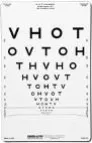
| 3yo – 20/50 line 4 and 5yo – 20/40 line 6yo and older – 20/32 line | Screen annually. Measure 10-foot screening distance between chart and child’s eyes. Place arch of child’s foot on the line when measuring the 10-foot distance, not heels or toes. Screen one eye at a time. Rescreen as soon as possible and no later than 6 months with the same screening tool. Refer to an eye doctor (pediatric optometrist, optometrist, pediatric ophthalmologist, or ophthalmologist) with experience examining young children. Use 9 x 14 Sloan Letters chart in an illuminated cabinet (e.g., ESV1200 below) or place on a wall in a well-lit room. 
|
| Distance Visual Acuity | Beginning at ages 6 or 7 years, depending on when children can identify letters in random order | Tests of visual acuity at 10 feet, using standardized format. If you draw a line around the outside of the optotypes, the line will resemble an upside down pyramid and not a rectangle. No more than 5 optotypes per line, unless using a 9” x 14” chart. Test of visual acuity should be 10 feet, not 20 feet, AND should have a 20/32 (10/16) line, not a 20/30 line. 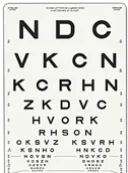
| Sloan Letters Response panel of Sloan Letters for students who use English as a second language and may need to match optotypes. 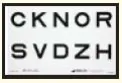
| More than half of optotypes on 20/32 line with each eye (e.g., 3 of 5 optotypes) | Bright Futures recommends vision screening for well-child medical visits at ages 8, 10, 12, and 15 years. Measure 10-foot screening distance between chart and child’s eyes. Place arch of child’s foot on the line when measuring the 10-foot distance, not heels or toes. Screen one eye at a time. Rescreen as soon as possible and no later than 6 months with the same screening tool. Refer to an eye doctor (pediatric optometrist, optometrist, pediatric ophthalmologist, or ophthalmologist) with experience examining school-aged children. Use 9 x 14 Sloan Letters chart in an illuminated cabinet (e.g., ESV1200 below) or place on a wall in a well-lit room. 
|
| Distance Visual Acuity | All ages beginning at age 3 years | Tests of visual acuity at 10 feet for threshold and critical line screening. AAPOS Basic Vision Screening Kit 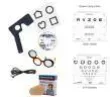
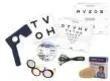
| LEA SYMBOLS® and Sloan Letters Also available with HOTV and Sloan Letters | Follow instructions in kits |
|
Instrument-based screening is appropriate for children ages 1 and 2 years, and as an alternative to optotype-based screening for ages 3, 4, and 5 years. Instrument-based screening can be used for children ages 6 years and older only for children who cannot participate in optotype-based screening. This age range may expand as high quality, peer-reviewed, published research emerges. All individuals, including community groups, screening children ages 6 years and older should follow this guideline until such research emerges.
Donahue, S. P., Baker, C. N., & AAP Committee on Practice and Ambulatory Medicine, AAP Section on Ophthalmology, American Association of Certified Orthoptists, American Association for Pediatric Ophthalmology and Strabismus, American Academy of Ophthalmology. (2016). Procedures for the evaluation of the visual system by pediatricians. Pediatrics, 137(1), e20153597. Retrieved from: http://pediatrics.aappublications.org/content/pediatrics/early/2015/12/07/peds.2015-3597.full.pdf
Instrument-Based Screening Approach
| Test | Ages | Tools | Optotypes | Pass | Notes and Tips |
|---|---|---|---|---|---|
| Screens for estimates of refractive error and eye misalignment | 1 year to 6 years | Welch Allyn® Spot™ Vision Screener 
Plusoptix S12 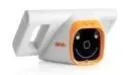
Righton Retinomax 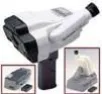
| None | According to device settings | Vision screening instruments do not measure visual acuity. Consult local eye care provider for referral criteria settings in programmable devices. Insufficient data currently exists to support instrument-based screening for ages 6 years and older. Monitor the Prevent Blindness website for additional approved devices: https://preventblindness.org/recommended-tools-and-tests/ |
| Near visual acuity | All | LEA SYMBOLS LEA NUMBERS near chart with cord. 
Sloan Letters near chart with cord. 

| Ages 3 to 6 years: Ages 6 years and older: | 3yo – majority of optotypes on 20/50 line with each eye separately or both eyes open 4yo – majority of optotypes on 20/40 line with each eye separately or both eyes open 5yo – majority of optotypes on 20/40 line with each eye separately or both eyes open 6yo and older – majority of optotypes on 20/32 line with each eye separately or both eyes open | Plus lens testing is not a near visual acuity test. Can conduct full threshold screening (starting at top line and moving down the chart) one eye at a time OR critical line screening with each eye individually, or with both eyes open. Hold cord at child’s temple. Ensure cord remains tight to prevent the child from moving closer to or farther away from the chart. |
| Stereoacuity | All | PASS Test™ 2. 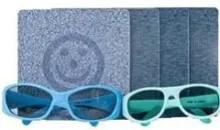
| NA | 3yo – pass Card B (no testing with Card C) 4yo – pass Card B (no testing with Card C) 5yo and older – pass Cards B and C
| If student wears prescription glasses for distance viewing, remove prescription glasses and screen only with polarized glasses. If student wears prescription glasses for near viewing, or full time, place polarized glasses over prescription glasses when screening. You may need a larger set of polarized glasses. If student wears prescription glasses and you do not know the reason, place polarized glasses over prescription glasses when screening. You may need a larger set of polarized glasses. If the child cannot see the 3-D image, then try conducting the test without the child wearing their glasses. Ensure no glare or shadow on cards. Hold cards with edges of fingertips. Tilt cards slightly backward – about a 10-degree tilt. |
| Color Vision Deficiency Screening | Upon entry to school system | Book with pseudoisochromatic plates. | Symbols and numbers | Follow manufacturer instructions | Replace book every 7 years; colors desaturate over time. Use cotton swab or brush for pointing or tracing the image as oil from fingertips will desaturate colors. |
| Occluders | 3 years to 10 years | Adhesive patches, 2-inch wide hypoallergenic surgical tape, or occluder glasses. 
| NA | NA | Unacceptable occluders include: Tissues, hands, paper or plastic cups, paper occluders, adults holding occluders over child’s eyes, and occluder paddles. |
| Occluders | 10 years and older | “Mardi Gras mask” or “Lollypop” occluders 

| NA | NA | Unacceptable occluders include: Tissues, hands, paper or plastic cups, paper occluders, adults holding occluders over child’s eyes. Hold “lollypop” occluders with handle toward temple, not chin. |
APPENDIX A: Screening Vision in Infants and Toddlers
Guidelines for Vision Screening in Missouri Schools
Health and Developmental History Related to Vision
When assessing infants and toddlers, a thorough health and developmental history especially related to vision is important. Some indicators for potential vision problems are prematurity, family history of “lazy eye” or other visual problems. Infection and high fever may also lead to vision difficulties.
Normal Visual Development
Visual function develops in an orderly sequence as follows:
Signs of Potential Vision Problems
The following list of alerting signs and blindisms is a useful guide to identify infants in need of a referral to an eye specialist.*
Alerting signs suggesting referral to an eye specialist:
- Failure to pass screening items, such as those listed in “Visual Development”, other developmental items at a similar level are passed
- Appearance of any strabismus (cross-eyed) after 2 months of age
- Wandering uncoordinated eye movements
- Nystagmus (dancing or jerky eyes)
- Holding items too close (within 6 inches) for visual inspection
- Cocking head habitually to look at items
- Turns head, then eyes, to look at people or object
- Disregard of objects presented in peripheral field
Blindisms (self-stimulating behaviors frequently observed in visually impaired children)
- Prolonged hand watching past developmental age of 5 months (shadowing)
- Staring at lights in preference to people or objects
- Poking at eyes
- Rubbing eyes
- Flicking finger (stimulus presented peripherally)
- Rocking
- Spinning
- Banging head
- Smelling, sniffing, “rooting”
- Prolonged mouthing of objects
After the infancy period, obtain an initial history, or update previous history, including questions about illness, injury, and signs and symptoms of visual problems.
*“Program Planning for the Visually Impaired Child,” by Carol M. Donovan
Knowledge of the sequence of normal visual development will alert the screener to “red flags” in history taking.
Gross Assessment of Vision
In infancy, the screening of vision is usually based on visual fixation and following responses. These are screened by moving an object of visual interest in front of the child and watching to see whether the child’s eyes turn toward the object and follow its movement back and forth in the visual field. The object of visual interest can be a face, a flashlight, or a brightly colored toy.
Although adding sound to the screening might theoretically compromise its purity as a visual stimulus, in practice, a light that rattles or a toy that squeaks is often more effective in gaining an infant’s visual attention. The size of the object and its distance from the face are not critical, since one is not trying to measure quantitative visual acuity.
Full-term, normal infants under ideal circumstances can fix and follow objects at birth, but such responses become more obvious to parents at six weeks to two months of age. If visual fixation and following are not present by four months of age, further eye examination is certainly indicated.
There are a number of screenings that advocate the use of small objects such as cars, animals, etc., but none are standardized screenings. Observing an infant’s or child’s notice of such an object can indicate gross visual acuity. Developmental screenings incorporate vision in the screening where an infant is observed noticing and attempting to pick up a raisin.
The following pages contain specific guidelines for functional assessment of vision in infants and toddlers. Gross vision in children with severe development delays may be assessed using these same techniques.
Red Reflex
| Ages: | Birth to three years |
|---|---|
| Purpose: | To observe for the red reflex in both eyes |
| Description: | The demonstration of the red reflex indicates no interruption of the light pathways |
| Facilities: | Normal or lowered light level in the room |
| Equipment: | Penlight, flashlight or ophthalmoscope |
| Procedure: | Move the light beam across the pupil. Observe from a distance of approximately 10 inches. An orange or red glow should reflect from the fundus through the pupil. Pass: If both pupils reflect the orange or red glow, it is considered normal. Fail: If a partial white or asymmetrical reflex is observed, the child should be referred. A partial red or black reflex may be abnormal or due to misalignment of the light. Several conditions may prevent the red reflex, i.e., cataracts, tumors, retinal abnormalities, opacity of the cornea, retrolental fibroplasia, retinoblastoma, orchorioretinitis. Note: A white pupil warrants immediate referral! |
Blink Reflex
| Ages: | Birth to 1 year |
|---|---|
| Purpose: | This screening is to determine if the infant or child has visual function and responds to the movement of a hand toward their face. |
| Description: | With the blink reflex, blinking occurs automatically when a hand or any object moves toward the face. |
| Facilities: | Normal or lowered light level in the room |
| Procedure: | Problems to avoid: Do not create a wind by moving the hand too quickly as the child may blink in response to the wind rather than the visual stimulus. Pass: The child blinks in response to the hand. Fail: Child does not blink in response to hand Refer for evaluation |
Pupillary Response
| Ages: | Birth to three years. |
|---|---|
| Purpose: | To screen to the degree to which the pupils respond to light. |
| Description: | A pupillary response occurs when the pupil of the eye changes shape or size when the light is presented. |
| Facilities: | Normal or lowered light in room. |
| Equipment: | Bright penlight or flashlight. |
| Procedure: | Observe the condition of the pupil without stimulation. Remove glasses if the child is wearing them (for screener’s benefit). Direct a penlight into the child's eyes from approximately 12-16 inches away and notice whether the pupils constrict or remain unaffected. If no response, use a brighter light source (flashlight) or turn off room lights to provide greater contrast. Pass: Both pupils should react by constricting when light is presented and dilating when the light is removed Fail: If one/both pupils do not respond as expected, or if one pupil is slower to respond than the other on two occasions. If repeat screening is consistent, refer child for evaluation. |
Tracking
| Ages: | 4 months to 3 years (Informal assessment can be done as early as 4 months of age when the child should be developmentally able to fixate and follow an object. By 12 months of age, child should be able to follow an object with both eyes horizontally and vertically, without moving or turning head.) |
|---|---|
| Purpose: | To determine if an infant’s or child’s eye muscles are working together |
| Description: | Tracking is evidenced when a child follows a moving light or object with his or her eyes or head. |
| Equipment: | Penlight, flashlight or brightly colored object |
| Procedure: | Hold light or object 14-16 inches from eye. Move the light or object horizontally 18 inches to the left from the center, then 18 inches to the right from the center. If the child does not follow at 14-16 inches, move closer. Screener may lightly hold child’s head in place while screening. Move light vertically, about 18 inches above, then 18 inches below eye level. Move light in a circle, at least 2 feet in diameter. With each screening, observe for full, smooth eye movements. Pass: Child follows light with eyes completely, to right-left and above-below. Fail: If a cooperative child does not visually follow an object in all directions with smooth eye movements, referral should be made for evaluation. |
Corneal Light Reflex (Hirschberg)
| Ages: | Six months to three years |
|---|---|
| Purpose: | Six months to three years |
| Description: | By noting the similarity or dissimilarity in position of light being reflected in the pupils, the observer is able to detect a constant eye deviation of a lesser degree than possible in the observation screening. This screening is easily done while checking for pupillary reaction |
| Facilities: | Normal or lowered light level in room – minimum number of light sources (windows, overhead lights, etc.) |
| Equipment: | Bright penlight or flashlight |
| Procedure: | Screen with glasses if child has them (glasses may already be correcting problem). Position the child so the penlight is held at arm’s length (12-16 inches), directly in front of the child’s eyes, and the light is directed at the bridge of the nose Instruct the child to look toward the light. The screener observes the pupils for the position of the light reflex in each eye. Pass: The reflection of the penlight appears to be in a similar position in the pupil of each eye (see illustration). Fail: The reflection of the penlight does not appear to be in a similar position in the pupil of each eye (see illustration). If a repeat screening is consistent, the child should be referred for evaluation. Even a slight difference may indicate the presence of strabismus (cross-eyed). |
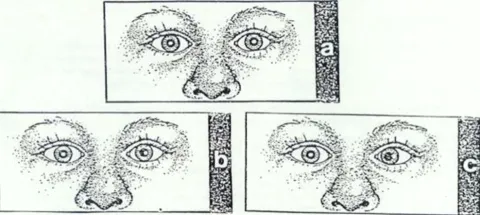
The position of the light on the cornea or pupil may be used to detect strabismus.
- Since light reflexes are symmetrical in both eyes, no strabismus is present.
- An esotropia exists in the left eye since it is turned inward. The light reflex is on the outer half of the right pupil.
- An exaggeration of the degree of esotropia in the left eye is shown by the farther position of the light reflex.
This screening is useful in detecting pseudostrabismus where epicanthal folds may give a child the appearance of crossed eyes.
APPENDIX B: Screening Students for Dual Sensory Loss
Guidelines for Vision Screening in Missouri Schools
Children who are born deaf or who have a profound hearing loss should be screened for the possibility of a genetic disorder, Usher Syndrome. This condition is of very low incidence, but a young person with Usher Syndrome develops retinitis pigmentosa (RP), usually in adolescence. RP is a condition that results in progressive loss of vision and ultimately, total blindness. It is important to identify these students as soon as possible in order to prepare them for the future.
Deaf students may function well using sign language or lip reading, but when they lose their vision, they must have other means of communication. Students identified with Usher Syndrome are often referred to special centers where they learn communication skills and mobility before they totally become blind.
The first screening is done by completing a screening checklist on any student who has a history of congenital deafness or has a significant hearing loss. This will rule out more than 99 percent of the students who should be screened further for vestibular dysfunction, or balance, dark adaptation, and loss of peripheral vision (see page 32).
Screening for Balance
Screening for balance is easy to do. Ask the student to stand with feet together, arms outstretched to the side, and then close their eyes. In this position, younger students may have problems maintaining balance, but older students may only wobble a little.
Next, ask the student to stand with the heel of one foot immediately in front of the other foot, with arms outstretched. They may have some problem with their eyes open, but when asked to close their eyes, they will fall over immediately. It is important to support the sides of their torso until they get their balance, and be ready to catch them if they fall.
If the student fails the balance screening, parents should be contacted to get further history and to ask questions about their observations of the student’s balance and vision. Look particularly for signs of night blindness. The student may have excellent central visual acuity in well-lighted conditions but have difficulty in dim light, twilight or at night.
Screening for Dark Adaptation
Put some red, white and blue objects (poker chips work well) in a jumbled heap on a dark table or carpet. Ask several students to participate. Turn out the lights, leaving just a tiny amount of light in the room. Ask the students to pick up a white object and note how long it takes each one to do it. Next, ask one student to sort the red and blue objects. After the first one completes the task, mix them up again and ask the next student to sort them. Use yourself as a comparison, but be aware that older people may have a longer adaptation time.
Some students with RP may not show any clinical signs of vision loss at night or during the day until mid- adolescence, so night vision should be checked periodically.
Screening Visual Fields
In students over age eight, screen for visual fields. In the early stages of cone dysfunction (a result of retinitis pigmentosa), students can see well at the extreme periphery but then lose sight of the object closer-in while maintaining normal vision centrally. Face the student, asking him to keep looking at your nose. Hold your hands out at three and nine o’clock, then at six and 12 o’clock and in between these two positions. Keep your arms completely still and wiggle just the fingers on one or the other hand, varying the side in an unpredictable pattern. Ask the student to point to the one which is wiggling. If the student is unable to see the wiggling fingers, he may be losing peripheral vision.
Referral
Students who meet the referral criteria should be referred to a pediatric ophthalmologist or retinal specialist. The provider should be given any history that indicates the possibility of Usher Syndrome, results of observations, balance screening, dark adaptation and visual fields.
If a student is identified as having Usher Syndrome, please call the Missouri Deafblind Project (see page 33 for a description of services).
What is Usher Syndrome?
Usher Syndrome is a genetic disorder involving the loss of both sight and hearing. Hearing loss occurs at birth or shortly thereafter. A progressive loss of vision due to retinitis pigmentosa (degeneration of the eye’s retinas) begins later in life, but usually before adolescence. There is no way of knowing the time of onset or rapidity of vision loss, but in almost all cases, the result is legal blindness.
A person with Usher Syndrome has inherited the Usher gene from both parents. Usher Syndrome is an autosomal recessive gene, and both parents must pass the gene to their child in order for the child to have the condition. When both parents have the gene, the chances each child will have Usher Syndrome is one in four. While only approximately three per 100,000 people will have Usher Syndrome, it is estimated that three percent to six percent of people who are congenitally deaf have the condition.
Usher Syndrome accounts for over 50 percent of all cases of deaf-blindness, with approximately 10,000 known cases in the United States. In the general population, anywhere from one in 100 to one in 300 carry the Usher gene.
The two major types of Usher Syndrome are Type I and Type II. The most common is Type I (almost 90 percent of all Usher Syndrome cases) and is deafness with retinitis pigmentosa (RP) symptoms before adolescence. In Type II (almost 10 percent of cases), moderate to severe congenital hearing loss is paired with RP symptoms after adolescence.
Why Is It Important to Diagnose Usher Syndrome as Soon as Possible?
Identifying Usher Syndrome as early as possible is important because:
- The gradual decrease in vision may go unnoticed by an individual who may continue activities, e.g., driving or working in hazardous conditions that cannot be safely done anymore.
- The individual, parents and teachers can plan for educational and vocational experiences and guidance that take into account the eventual visual difficulties. Resources are available for experiences such as mobility training, use of Braille and tactual communication.
- A diagnosis of Usher Syndrome in an older child allows parents to consider genetic counseling.
- People who have Usher Syndrome may also want to consider genetic counseling.
How Is an Individual Identified as Having Usher Syndrome?
Several screenings are used to determine whether a person has retinitis pigmentosa, and that is how a person who has a hearing loss is identified as having Usher Syndrome. These screenings include a visual field screening to assess peripheral vision and screening to evaluate color vision and dark adaptation. However, the definitive screening of retinitis pigmentosa is electroretinography (ERG), which has been found to be 95 percent accurate. ERG is the measurement of the electricity given off by nerve impulses in the retina. This painless screening is done by having the patient wear special contact lenses while looking at flashing lights.
The following is provided by the Missouri Deafblind Project in cooperation with the Missouri School for the Blind and the Missouri School for the Deaf.
Missouri Deafblind Project
Purpose
The purpose of the Missouri Deafblind Project is to develop partnerships, coordinate service networking and provide systematic training. Technical assistance, training and resources are available for the students identified as deaf and blind on the Missouri Deafblind Census, their families and service providers. Leadership and support is provided by the Missouri School for the Blind Outreach Team. Services are coordinated with local education agencies, adult service providers and Deafblind task forces to enhance networking and build expertise in the community.
Services
- On-site technical assistance and consultation from the outreach team
- In-service training on specific content areas
- Active state and local Deafblind task forces
- Transition assistance including personal futures planning
- Missouri Deafblind Census
- Parent training including a home program for children, birth through five years
- Family workshops including Family Learning Vacation and Families Together, Inc.
- Early childhood training, such as VIISA and INSITE workshops
- Deafblind coursework, such as Hand-in-Hand
- Mentor program
- Usher screening resources
- Loan library of resources on effective practices
- Deafblind newsletter
All services are free. For additional information regarding the Missouri Deafblind Project, contact:
Director, Outreach Services
Missouri School for the Blind3815 Magnolia Avenue
St. Louis, MO 63110
314-776-4320, ext. 250
https://msb.dese.mo.gov/
USHER Screening Check List
APPENDIX C: Sample Forms
Guidelines for Vision Screening in Missouri Schools
Letter Template For Report To Parents
Checklist For Vision including Observation and History, and Signs or Symptoms of Eye Problems
Referral Tracking System (Sample)
School Vision Referral Template
HIPAA Compliant Authorization Exchange of Health & Education Information
School Vision Screening Form Including School Functional Vision Assessment Form
APPENDIX D: Resources
Guidelines for Vision Screening in Missouri Schools
Numerous companies market vision screening equipment. Possible sources for charts, card screeners, and vision screening equipment include:
- Good‐Lite Company
1‐800‐562‐5200
www.good-lite.com - School Health
1‐800‐323‐1305
www.schoolhealth.com - MacGill School Health
1‐800‐323‐2841
www.macgill.com - School Nurse Supply
1-800-485-2737
www.schoolnursesupplyinc.com - Moore Medical
1-800.234.1464
www.mooremedical.com - School Kids Healthcare
1-866-558-0686
www.schoolkidshealthcare.com
Additional informational Websites:
- Information for parents, teachers, and students
www.kidshealth.org
Primary vision information websites:
- Healthy People 2030
Sensory or Communication Disorders Objectives
www.healthypeople.gov
Links to national organizations concerned with the eye and vision:
- National Eye Institute
www.nei.nih.gov
For Information about eye conditions, research results, and vision education resources. Free materials are available upon request. - Prevent Blindness America
www.preventblindness.org
Formerly the National Society for the Prevention of Blindness - Provided community vision education, certified vision screening training, service programs, and national and state research
Websites for general vision education and availability of eye care information:
- American Optometric Association
www.aoa.org
Public vision education and availability of eye care. - Missouri Optometric Association
www.moeyecare.org - American Academy of Pediatrics
www.aap.org
Position statements for professionals and guidelines for child vision care. - Center for Health and Health Care in Schools
http://www.healthinschools.org
Information on child health issues for school health professionals; operated by The George Washington University, School of Public Health and Health Services, Graduate School of Education and Human Development, Washington, D.C. - Medicaid and Medicaid Services
www.medicaid.gov
Information about Medicaid eligibility and current Federal Poverty Guidelines. - The Foundation of the American Academy of Ophthalmology
www.aao.org
Resources for vision education, eye care and community outreach.
Resources for children with visual impairments:
- American Foundation for the Blind
www.afb.org - Vision Impairment and Blindness (National Library of Medicine and NIH)
www.nlm.nih.gov/medlineplus/visionimpairmentandblindness.html