

Guidelines for Vision Screening in Missouri Schools
APPENDIX A: Screening Vision in Infants and Toddlers
Health and Developmental History Related to Vision
When assessing infants and toddlers, a thorough health and developmental history especially related to vision is important. Some indicators for potential vision problems are prematurity, family history of “lazy eye” or other visual problems. Infection and high fever may also lead to vision difficulties.
Normal Visual Development
Visual function develops in an orderly sequence as follows:
Signs of Potential Vision Problems
The following list of alerting signs and blindisms is a useful guide to identify infants in need of a referral to an eye specialist.*
Alerting signs suggesting referral to an eye specialist:
- Failure to pass screening items, such as those listed in “Visual Development”, other developmental items at a similar level are passed
- Appearance of any strabismus (cross-eyed) after 2 months of age
- Wandering uncoordinated eye movements
- Nystagmus (dancing or jerky eyes)
- Holding items too close (within 6 inches) for visual inspection
- Cocking head habitually to look at items
- Turns head, then eyes, to look at people or object
- Disregard of objects presented in peripheral field
Blindisms (self-stimulating behaviors frequently observed in visually impaired children)
- Prolonged hand watching past developmental age of 5 months (shadowing)
- Staring at lights in preference to people or objects
- Poking at eyes
- Rubbing eyes
- Flicking finger (stimulus presented peripherally)
- Rocking
- Spinning
- Banging head
- Smelling, sniffing, “rooting”
- Prolonged mouthing of objects
After the infancy period, obtain an initial history, or update previous history, including questions about illness, injury, and signs and symptoms of visual problems.
*“Program Planning for the Visually Impaired Child,” by Carol M. Donovan
Knowledge of the sequence of normal visual development will alert the screener to “red flags” in history taking.
Gross Assessment of Vision
In infancy, the screening of vision is usually based on visual fixation and following responses. These are screened by moving an object of visual interest in front of the child and watching to see whether the child’s eyes turn toward the object and follow its movement back and forth in the visual field. The object of visual interest can be a face, a flashlight, or a brightly colored toy.
Although adding sound to the screening might theoretically compromise its purity as a visual stimulus, in practice, a light that rattles or a toy that squeaks is often more effective in gaining an infant’s visual attention. The size of the object and its distance from the face are not critical, since one is not trying to measure quantitative visual acuity.
Full-term, normal infants under ideal circumstances can fix and follow objects at birth, but such responses become more obvious to parents at six weeks to two months of age. If visual fixation and following are not present by four months of age, further eye examination is certainly indicated.
There are a number of screenings that advocate the use of small objects such as cars, animals, etc., but none are standardized screenings. Observing an infant’s or child’s notice of such an object can indicate gross visual acuity. Developmental screenings incorporate vision in the screening where an infant is observed noticing and attempting to pick up a raisin.
The following pages contain specific guidelines for functional assessment of vision in infants and toddlers. Gross vision in children with severe development delays may be assessed using these same techniques.
Red Reflex
| Ages: | Birth to three years |
|---|---|
| Purpose: | To observe for the red reflex in both eyes |
| Description: | The demonstration of the red reflex indicates no interruption of the light pathways |
| Facilities: | Normal or lowered light level in the room |
| Equipment: | Penlight, flashlight or ophthalmoscope |
| Procedure: | Move the light beam across the pupil. Observe from a distance of approximately 10 inches. An orange or red glow should reflect from the fundus through the pupil. Pass: If both pupils reflect the orange or red glow, it is considered normal. Fail: If a partial white or asymmetrical reflex is observed, the child should be referred. A partial red or black reflex may be abnormal or due to misalignment of the light. Several conditions may prevent the red reflex, i.e., cataracts, tumors, retinal abnormalities, opacity of the cornea, retrolental fibroplasia, retinoblastoma, orchorioretinitis. Note: A white pupil warrants immediate referral! |
Blink Reflex
| Ages: | Birth to 1 year |
|---|---|
| Purpose: | This screening is to determine if the infant or child has visual function and responds to the movement of a hand toward their face. |
| Description: | With the blink reflex, blinking occurs automatically when a hand or any object moves toward the face. |
| Facilities: | Normal or lowered light level in the room |
| Procedure: | Problems to avoid: Do not create a wind by moving the hand too quickly as the child may blink in response to the wind rather than the visual stimulus. Pass: The child blinks in response to the hand. Fail: Child does not blink in response to hand Refer for evaluation |
Pupillary Response
| Ages: | Birth to three years. |
|---|---|
| Purpose: | To screen to the degree to which the pupils respond to light. |
| Description: | A pupillary response occurs when the pupil of the eye changes shape or size when the light is presented. |
| Facilities: | Normal or lowered light in room. |
| Equipment: | Bright penlight or flashlight. |
| Procedure: | Observe the condition of the pupil without stimulation. Remove glasses if the child is wearing them (for screener’s benefit). Direct a penlight into the child's eyes from approximately 12-16 inches away and notice whether the pupils constrict or remain unaffected. If no response, use a brighter light source (flashlight) or turn off room lights to provide greater contrast. Pass: Both pupils should react by constricting when light is presented and dilating when the light is removed Fail: If one/both pupils do not respond as expected, or if one pupil is slower to respond than the other on two occasions. If repeat screening is consistent, refer child for evaluation. |
Tracking
| Ages: | 4 months to 3 years (Informal assessment can be done as early as 4 months of age when the child should be developmentally able to fixate and follow an object. By 12 months of age, child should be able to follow an object with both eyes horizontally and vertically, without moving or turning head.) |
|---|---|
| Purpose: | To determine if an infant’s or child’s eye muscles are working together |
| Description: | Tracking is evidenced when a child follows a moving light or object with his or her eyes or head. |
| Equipment: | Penlight, flashlight or brightly colored object |
| Procedure: | Hold light or object 14-16 inches from eye. Move the light or object horizontally 18 inches to the left from the center, then 18 inches to the right from the center. If the child does not follow at 14-16 inches, move closer. Screener may lightly hold child’s head in place while screening. Move light vertically, about 18 inches above, then 18 inches below eye level. Move light in a circle, at least 2 feet in diameter. With each screening, observe for full, smooth eye movements. Pass: Child follows light with eyes completely, to right-left and above-below. Fail: If a cooperative child does not visually follow an object in all directions with smooth eye movements, referral should be made for evaluation. |
Corneal Light Reflex (Hirschberg)
| Ages: | Six months to three years |
|---|---|
| Purpose: | Six months to three years |
| Description: | By noting the similarity or dissimilarity in position of light being reflected in the pupils, the observer is able to detect a constant eye deviation of a lesser degree than possible in the observation screening. This screening is easily done while checking for pupillary reaction |
| Facilities: | Normal or lowered light level in room – minimum number of light sources (windows, overhead lights, etc.) |
| Equipment: | Bright penlight or flashlight |
| Procedure: | Screen with glasses if child has them (glasses may already be correcting problem). Position the child so the penlight is held at arm’s length (12-16 inches), directly in front of the child’s eyes, and the light is directed at the bridge of the nose Instruct the child to look toward the light. The screener observes the pupils for the position of the light reflex in each eye. Pass: The reflection of the penlight appears to be in a similar position in the pupil of each eye (see illustration). Fail: The reflection of the penlight does not appear to be in a similar position in the pupil of each eye (see illustration). If a repeat screening is consistent, the child should be referred for evaluation. Even a slight difference may indicate the presence of strabismus (cross-eyed). |
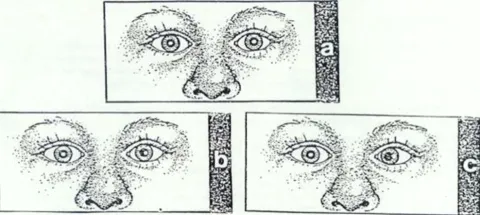
The position of the light on the cornea or pupil may be used to detect strabismus.
- Since light reflexes are symmetrical in both eyes, no strabismus is present.
- An esotropia exists in the left eye since it is turned inward. The light reflex is on the outer half of the right pupil.
- An exaggeration of the degree of esotropia in the left eye is shown by the farther position of the light reflex.
This screening is useful in detecting pseudostrabismus where epicanthal folds may give a child the appearance of crossed eyes.