Foreword
Manual For School Health Programs
Children need to be healthy to learn and educated to be healthy. Health and education must continue working together at the state and local levels to meet Missouri's children's health and educational needs. This collaboration has never been more important.
Missouri has made great progress in integrating health education and health-related services into the everyday school experience. Realizing that a variety of individuals within the school setting and the community can impact the health status of the student, the need for developing a collaborative school health program becomes obvious. No one individual can do it alone, but collectively, a great deal can be accomplished.
The Missouri Department of Health and Senior Services (DHSS) reviewed the 2014 manual and updated it to serve as a helpful tool for identifying priorities for school health programs and assisting school nurses with program management.
Chapter 1: Whole School, Whole Community, Whole Child
Manual For School Health Programs
“Health and education affect individuals, society, and the economy and, as such, must work together whenever possible. Schools are a perfect setting for this collaboration.”
(ASCD & CDC, 2014, p.4)
A school health program must effectively address student health and improve their learning ability. Over the years, schools have used many frameworks to coordinate all the important school health partners to make this happen.
Most recently, the Centers for Disease Control and Prevention (CDC), American Supervision and Curriculum Development (ASCD), and others have merged their organizational models to create the Whole School, Whole Community, Whole Child (WSCC) framework. The model, first released in 2014, provides “a valuable framework designed to help school districts and schools address the needs of the students by strategically and systematically focusing on the whole child,” according to the National Association of Chronic Disease Directors (NACDD, 2017, p. 3).

The Whole School, Whole Community, Whole Child model has 10 components, each important to the framework's success.
Table 1. Components of the WSCC model
| Components of the WSCC Model | |
|---|---|
| Health Education | Formal, structured health education consists of any combination of planned learning experiences that provide students with the opportunity to acquire information and the skills they need to make quality health decisions. |
| Physical Education | Schools can create an environment that offers many opportunities for students to be physically active throughout the school day. A comprehensive school physical activity program (CSPAP) is the national framework for physical education and youth physical activity. |
| Nutrition | The school nutrition environment provides students with opportunities to learn about and practice healthy eating through available foods and beverages, nutrition education, and messages about food in the cafeteria and throughout the school campus. |
| Health Services | School health services intervene with actual and potential health problems, including providing first aid, emergency care and assessment and planning for managing chronic conditions (such as asthma or diabetes). In addition, wellness promotion, preventive services and staff, student and parent education complement care coordination services. |
| Counseling, Psychology, and Social Services | These prevention and intervention services support the mental, behavioral, and social-emotional health of students and promote success in the learning process. |
| Social and Emotional Climate | Social and emotional climate refers to the psychosocial aspects of students’ educational experiences that influence their social and emotional development. |
| Physical Environment | A healthy and safe physical school environment promotes learning by ensuring the health and safety of students and staff. |
| Employee Wellness | Schools are not only places of learning but also worksites. Fostering school employees’ physical and mental health protects school staff and helps support students’ health and academic success. |
| Family Engagement | Families and school staff work together to support and improve students' learning, development, and health. |
| Community Involvement | Community groups, organizations, and local businesses partner with schools, share resources, and volunteer to support student learning, development, and health-related activities. |
(CDC, 2021)
The WSCC model aims to create school environments where students can learn, teachers can teach, and the family and community can contribute to the child's success. The model encircles the child by coordinating policies, processes, and practices to ensure the program has permanence and structure. Improving learning and improving health are also balancing the child and are the ultimate goals of the model.
“Academic achievement and health are closely linked, and healthy students are more ready and able to learn”
(NACDD, 2017, p. 9).
The inner circle of the framework has five tenants from the original American Supervision and Curriculum Development (ASCD) model that represent important ideals for implementing WSCC—safe, healthy, challenged, supported, and engaged.
- Safe means that each student learns in an environment that is physically and emotionally safe for students and adults.
- Healthy means that each student enters school healthy and learns about and practices a healthy lifestyle.
- Each student is challenged academically and is prepared for success in college or further study and employment and participation in a global environment.
- Each student has access to personalized learning and is supported by qualified, caring adults.
- Each student is actively engaged in learning and is connected to the school and broader community (ASCD, n.d.).
The outer ring of the framework emphasizes community partnerships. Collaboration and partnership with community organizations can provide resources that schools might not otherwise have access to. Local public health departments, social service agencies, and businesses, for example, may be able to provide services with the students’ well-being in mind.
The model is a framework that schools can modify and adapt to meet the needs of the district, school, and community to increase sustainability (NACDD, 2017, p.16). School districts may start working on their WSCC program with teams or committees already in place, such as wellness, safety, or school climate committees. Involving the school nurse, as well as other school staff and administrators will improve the success of any programming. For a step-by-step guide and other resources for using the WSCC model, visit CDC, ASCD, and NACDD websites provided in the reference section.
“A unified approach acceptable to the health and education communities is needed to assure that students are healthy and ready to learn.”
(Lewallen, Hunt, Potts-Datema, Zara, Giles, 2015, p. 1)
Missouri School Improvement Program
The Missouri School Improvement Program (MSIP) is designed to promote excellence in the state's public schools. The State of Missouri has a dual responsibility for the quality of education provided to its citizens. First, it must ensure that all schools meet certain basic standards. Second, it must ensure that the schools continue to strive for excellence in an increasingly competitive world.
The Missouri School Improvement Plan (MSIP) involves many components of educational data collection, for which districts are responsible. The Plan’s purpose is to always look for ways to reduce barriers to learning and improve learning outcomes. It looks at a district’s test scores, attendance rates, school climate, and other areas that impact learning. This continuous process helps districts identify areas where they need to improve.
School Nurse’s Role in the WSCC and MSIP Programs
The school nurse’s role in developing a robust school health program in their district or school is to be the leader in the health environment. School nurses are the health experts in a district and, therefore, should practice to the full extent of their job description and practice ability. Not only should the school nurse be “seen” in the health office, but they should also be part of the larger school community—helping to form a school health committee that includes school staff, parents, students, and community members, as all members have a part in WSCC programming. The school nurse can also use the nursing process: assessing, diagnosing, outcome identification, planning, implementation, coordination of care, health teaching and health promotion, and evaluation, in developing WSCC programming, which is critical to the success of any program.
School nurses have an important role in identifying and mitigating factors contributing to absenteeism. National studies have shown that students with chronic health conditions miss more school or are too impacted by their disease condition to participate fully in the educational process. Working with students and their families to identify these issues and to develop individualized health plans (IHPs) has shown success in improving attendance at school. Students with properly managed asthma, diabetes, and seizure disorders can usually stay in school where the school nurse safely manages them.
Knowing that school nurses have the expertise to improve the health of the students they work with and that students who are healthy learn better, it is critical for school nurses to be at the forefront of planning a WSCC program. The school nurse also has the potential to improve a district’s MSIP rating by impacting student attendance, student health, school climate, and, ultimately, student learning.
Establishing or Strengthening a School Health Program
School health programs vary according to community needs and aspirations, but effective programs share these common elements:
- They are carefully planned.
- They focus on modifiable risk factors associated with health and the quality of life.
- They employ multiple methods and approaches developed through collaboration with pertinent stakeholders.
- They address identified needs and differences within target populations.
- Those receiving the program are important contributors in the planning and delivery process.
- Those responsible for the delivery of the program are competently trained.
- They are evaluated regularly and revised or refined as needed.
The following components can lead to an effective, comprehensive school health program:
- Leadership
Leadership at both the district-level school level and district level is critical for ongoing and consistent support of a comprehensive school health program. Ideally, the school principal, the superintendent of schools, and one or more members of the board of education – the people committed to success for all children and who understand the importance of addressing the whole child – will be involved to some degree. At the district level, a person designated as the program manager or coordinator is needed for a successful program. This individual must be able to adequately present school health needs and successes to the school board and community members while utilizing all resources and facilities in the community to foster the health of students. A program manager may be a school nurse, health educator, or a contracted local health department staff. The program manager’s responsibilities include organizing the school health advisory council, review and revision of health-related policies, and enforcement of state laws regarding school health. - School Health Advisory Council
A School Health Advisory Council (SHAC) is an ongoing advisory group composed of individuals selected from segments of the community that may include students, parents, community representatives, and school staff. The role of the SHAC is to collectively provide guidance and support to the school health program. The role of each advisory council member is one of active participation. SHACs are often advisory to an entire school district, but individual school buildings may establish a SHAC if desired.
The general functions of an advisory council may include but are not limited to:- Fulfilling the statutory requirements for supporting at-risk youth, safe school environments, and drug-free schools.
- Gathering information about local needs and resources.
- Prioritizing needs and resources for development of a school health plan.
- Developing a school health plan in conjunction with school officials.
- Providing a forum for students, parent(s)/guardian(s), community members, and school staff to express health-related concerns.
- Facilitating linkages between school and community resources.
- Advocating for the school health program and its participants.
- Facilitating communication with groups interested in school health.
- Helping to find funding sources.
- Assisting in program evaluation.
- Board Policies that are Supportive
In most districts, school board policies already support various components of a school health program. With assistance from school staff, the School Health Advisory Council can identify relevant policies within the district and ensure that clear procedures exist for implementing the policies at each school site. They can also suggest new policies if gaps exist and eliminate policies that are not being enforced and/or are out-of-date. One way of ensuring that current policies are available to school staff, board members, students, and families is to develop and distribute guidelines that consolidate school and district policies and procedures related to all aspects of the school health program. - Existing School-Based and Community-Based Resources
Most schools have numerous elements of a school health program in place. The school health program model serves as a framework for thinking broadly and identifying duplications and gaps. Activities, services, and policies to support existing school health programs can enhance current programs.
- Needs Assessment
The school health coordinator with assistance from the SHAC can use needs assessments to identify gaps in the school’s health program and make decisions about how to strengthen or modify existing health-related efforts. They can prioritize the programmatic needs based on factors such as relative importance for academic achievement; resources required, such as professional development, funding, and time requirements; number of students, family members, or staff that will benefit; and readiness of the school community.
The CDC’s School Health Index (SHI) is a tool to assess both elementary and secondary schools. The SHI assists schools with assessing policies and activities related to tobacco use, physical activity, nutrition services, sexual health, asthma, and safety.
Another assessment tool to consider is the American Academy of Pediatrics’ Enhancing School Health Services through Training, Education, Assistance, Mentorship, and Support Program (TEAMS). TEAMS is a free program that provides training, resources, and technical assistance to school districts and states that are interested in strengthening policies, practices, and infrastructure related to school health services. School districts participating in TEAMS assemble 3-4 member teams, including a district health services/education representative, public health professional (department of health), mental health professional, and pediatrician partner. TEAMS emphasizes the use of school health services policy and protocol to drive long-term sustainable change.- TEAMS grew out of the recognition that:
- Strengthening school health services improves the health of students and leads to better educational outcomes.
- Schools provide a key point of access for health care for many children.
- Children benefit from a coordinated system where school health services, public health departments, and health care providers all work together to optimize care.
- School health programs may also obtain useful data from:
- Statewide Disease and Chronic Conditions Report. [NEEDS LINK]
- Physical fitness, vision, and hearing screenings.
- Local or county health department, which often have local or regional data on pregnancy rates, incidence of sexually transmitted diseases, etc.
- The Youth Risk Behavior Survey (YRBS), administered by the Missouri Department of Elementary and Secondary Education (DESE) during odd-numbered years. YRBS, a survey of randomly selected students in grades 9 through 12, provides useful self-reported data about health behaviors that contribute significantly to the leading causes of death, disability, and social problems among U.S. youth and adults. These include:
- Tobacco use
- Unhealthy dietary behaviors
- Inadequate physical activity
- Alcohol and other drug use
- Sexual behaviors that can result in HIV infection, other sexually transmitted diseases, and unintended pregnancies
- Behaviors that may result in intentional injuries (violence and suicide) and unintentional injuries (motor vehicle crashes)
- TEAMS grew out of the recognition that:
- Plan Development
Cooperative planning ensures the development of a single plan or shared vision, which reduces duplication and increases program effectiveness.
The first step in planning is to define the school health goals and objectives, which should align with the school district’s goals and objectives.- Program goals are broad, general statements of what you hope to achieve during or by the end of the plan’s timeframe.
- Objectives are measurable, attainable, time-referenced statements with results related to the goals. Objectives should contain four major statements:
- What—is the change or event to occur?
- Who—the group in which the change or event occurs (target population, i.e., students, faculty, etc.).
- How much—the change to occur (sometimes expressed in percentages or using the word “all”).
- By when—the time or date the change or event will occur.
- Once the SHAC identifies objectives, they will:
- Select activities or strategies that will accomplish the goals and objectives.
- Develop a mechanism for evaluating how well the activities and strategies worked for accomplishing the goals and objectives.
- Ongoing Evaluation
Evaluation is the process of gathering useful information to help make decisions. The goal of evaluation is to increase the likelihood that the SHAC will make informed decisions. Evaluation begins by identifying meaningful questions that need answers. When identifying how to evaluate activities, think about gathering both quantitative information (how much) and qualitative information (how good).
Types of Evaluation
Process Evaluation
Process evaluations focus on whether programs and activities are operating as intended and if they are serving the target population. SHACs should develop a plan to conduct process evaluations ongoing throughout the year. They can then continually review the data collected and consider program improvements. A process evaluation often collects data such as:
- Details of program operation,
- Demographic characteristics of program participants,
- Collaborative partnerships, and
- Staffing and training conducted.
Impact Evaluation
SHACs should also evaluate activities to measure the impact of the program. Impact evaluation collects data that measures the program’s effectiveness in producing gains in knowledge and changes in the health behaviors that the program targeted. Impact evaluation is based on the specific objectives developed. The SHAC should prepare annual reports on the program’s impact on specific objectives for the school board. Examples of impact evaluation include:
- Pre- and post-tests to measure students’ health knowledge and skills,
- Measuring students’ intent to practice healthy behaviors and
- Measuring health-related behaviors.
Outcome Evaluation
Improved health status is the intended goal of quality school health programs. Outcome evaluation measures changes in health status over time—usually years. For example, if a program successfully delayed the onset of or reduced alcohol use among teenagers, you would expect:
- A reduction of injuries and deaths resulting from motor vehicle crashes,
- A reduction of unintended pregnancies and sexually transmitted diseases and
- A reduction of injuries and death from violent acts.
Suggested Steps for Developing an Evaluation Plan
- Use the measurable objectives the SHAC identified for their plan's short- and long-term goals, to develop a list of what to evaluate.
- Example: Evaluate the effectiveness of the screening program.
- Focus the evaluation on a modest, manageable number of important program-relevant activities.
- Example: The number of students referred for a specific health deficit that receive care because of the screening.
- Determine the standards of acceptability.
- Example: 85 percent referral follow-up rate.
- Develop a timeline or schedule for the evaluation to occur.
- Example: All referrals will be returned by the end of the school year.
School health programs are one of the most efficient strategies a nation might use to prevent major health and social problems. Health and success in school are inextricably intertwined. A successful school health program can have a powerful influence on student health, health-related behaviors, and, therefore, learning.
Chapter 1 References
- American Academy of Pediatrics (2023, February 3). Enhancing school health services through training, education, assistance, mentorship, and support program (TEAMS). Accessed on December 10, 2023 at https://www.aap.org/en/patient-care/schoolhealth/teams-enhancing-school-health-services/
- Association for Supervision and Curriculum Development. (2023). The ASCD whole child approach to education. Accessed on November 26, 2023, at https://www.ascd.org/whole-child
- Association for Supervision and Curriculum Development. (n.d.). Whole child action plan guide. Accessed on November 26, 2023, at https://library.ascd.org/m/1f2720c1c2296a94/original/ASCD-Whole-Child-Action-Plan-Guide.pdf
- Association for Supervision and Curriculum Development, Centers for Disease Control and Prevention. (2014). Whole school, whole community, whole child: A collaborative approach to learning and health. Accessed on November 26, 2023, at http://www.ascd.org/ASCD/pdf/siteASCD/publications/wholechild/wscc-a-collaborative-approach.pdf
- Centers for Disease Control and Prevention. (2021, March 23). Components of the whole school, whole community, whole child. Accessed on December 3, 2023, at https://www.cdc.gov/healthyschools/wscc/components.htm
- Centers for Disease Control and Prevention. (2023, February 9). Whole school, whole community, whole child (WSCC). Accessed on November 26, 2023, at https://www.cdc.gov/healthyschools/wscc/index.htm
- Lewallen, T., Hunt, H., Potts-Datema, W., Zara, S., & Giles, W. (2015). The Whole school, whole community, whole child model: A new approach for improving educational attainment and healthy development for students. Journal of School Health. Accessed on November 11, 2023, at https://doi.org/10.1111/josh.12310
- Missouri Coordinated School Health Coalition. (2017, August). School health advisory guide. Accessed on December 9, 2023 at https://healthykidsmo.org/resources/docs/SHAC/SHAC_Guide.pdf
- Missouri Department of Elementary and Secondary Education. (2023). Missouri school improvement plan. Accessed on December 1, 2023, at https://dese.mo.gov/qualityschools/mo-school-improvement-program
Chapter 2: School Health Services
Manual For School Health Programs
The school nurse is an integral part of the educational process in a school district and delivers essential services. The school nurse assists children and youth in developing their full potential in health and education. While the instructional staff assumes the major responsibility for teaching children, the school nurse provides supportive professional and specialized health services for the school staff and the students.
“Nurses play multiple roles in acute care, community, and public health settings, through which they can influence the medical and social factors that drive health outcomes, health equity, and health care equity,” according to the National Academies of Sciences, Engineering, and Medicine. The report goes on to say, “school nurses, for example, are frontline health care providers, serving as a bridge between the health care and education systems and other sectors as well as links to broader community health issues through the student populations they serve.”
(National Academies of Sciences, Engineering, and Medicine, 2021, p. 2)
Scope and Standards of Practice for Professional School Nursing
A task force developed standards for school nursing practice in 1983 to inform school nurses, school administrators, families, students, school board members, and the public about the practice of school nursing (Yonkaitis & Reiner, 2022). The American Nurses Association, the American Public Health Association, the National Association of Pediatric Associates and Nurse Practitioners, the American School Health Association, and the National Association of School Nurses were represented on the task force. The National Association of School Nurses and the American Nurses Association last revised the standards in 2022.
All school nurses should obtain a personal copy of the School Nursing: Scope and Standards of Practice.
The standards define the personal responsibility of the school nurse. School districts should use the standards to develop job descriptions and quality assurance tools. The document includes the competencies needed in each area to meet the standard and can serve as a blueprint for professional development to attain the competencies. There are two categories: 1) Standards of School Nursing Practice and 2) Standards of Professional Performance. Review the School Nursing: Scope and Standards of Practice for more information on the competencies and how to use them within a job description or activities.
Table 2. Standards of School Nursing Practice
Standards of School Nursing Practice
| Standard | Nurse Activity |
|---|---|
| 1. Assessment | The school nurse collects pertinent data and information relative to the student, family, group, school community, or population. |
| 2. Diagnosis | The school nurse analyzes assessment data of the student, family, group, school community, or population to describe actual or potential diagnoses. |
| 3. Outcomes Identification | The school nurse articulates measurable expected outcomes for a plan individualized to the student, family, school community, or population. |
| 4. Planning | The school nurse develops a collaborative course of action that prescribes strategies to attain expected, measurable outcomes that address the student, family, group, school community, or population. |
| 5. Implementation | The school nurse executes an agreed-upon plan/intervention for the student, family, group, school community, or population. |
| 5A. Coordination of Care | The school nurse aligns care for the student, family, group, school community, or population. |
| 5B. Health Teaching and Health Promotion | The school nurse employs strategies to improve the health and safety of students, families, groups, school communities, or populations. |
| 6. Evaluation | The school nurse systematically appraises progress toward the attainment of student and school population goals and outcomes. |
Table 3. Standards of Professional Performance
Standards of Professional Performance
| Standard | Nurse Activity |
|---|---|
| 7. Ethics | The school nurse integrates ethics into all aspects of practice. |
| 8. Advocacy | The school nurse demonstrates advocacy in all roles and settings. |
| 9. Respectful and Equitable Practice | The school nurse practices cultural humility and inclusiveness. |
| 10. Communication | The school nurse effectively conveys information in all areas of practice. |
| 11. Collaboration | The school nurse collaborates with students, families, and key stakeholders. |
| 12. Leadership | The school nurse leads within their professional practice setting and the profession. |
| 13. Education | The school nurse seeks knowledge and competence that reflects current nursing practice and promotes innovative, anticipatory thinking. |
| 14. Scholarly Inquiry | The school nurse integrates scholarship, evidence, and research findings into practice. |
| 15. Quality of Practice | The school nurse contributes to quality nursing practice. |
| 16. Professional Practice Evaluation | The school nurse appraises one’s own and others’ school nursing practice. |
| 17. Resource Stewardship | The school nurse utilizes appropriate resources to plan, provide, and sustain evidence-based nursing services that are safe, effective, financially responsible, and used judiciously. |
| 18. Environmental Health | The school nurse practices in a manner that advances environmental safety, justice, and health. |
School Health Services Personnel
School health teams include a variety of school health services personnel. The size of the district or school may determine how many health team members there are as well as their roles. . The following are suggested health team members. (See Appendix 2A, 2B, and 2C)
Consulting Physician/Medical Advisory Committee
The American Academy of Pediatrics and the American Medical Association encourages school districts to obtain the services of a local physician(s) to provide guidance for the school health program. School nursing personnel can function in expanded roles with standing orders and protocols (collaborative agreements) from physicians, thus enabling better management of illness and injury in the school setting. Having a physician to consult regarding health and safety issues enhances the district’s ability to protect and maintain the health status of students and staff. Physician services are often provided as a community service, but some school districts may choose to employ or contract with a physician for a specified number of hours per school year. A written contract with a physician allows for scheduled time for the school and improves the quality and consistency of the consulting service. Medical advisory committees assist schools in looking at all aspects of the school health program and making recommendations to the school nurse or School Health Advisory Committee.
Qualifications (Minimum Standards)
- Currently licensed as a health care professional in Missouri, such as a physician or advanced practice nurse.
- Have knowledge of the school-age child, medical-legal issues regarding children and adolescents, and an interest in students’ health and education.
General Responsibilities
- Consult with school personnel as necessary.
- Serve as a resource for medical information related to the school-age child and adolescent.
- Advise in the development of policies and procedures for the health services program.
- Support the district health services policies, procedures, and programs.
- Meet with health services staff annually.
- Sign-off on emergency protocols and standing orders as needed and appropriate.
Registered Professional Nurse (RN)
Qualifications
- Currently licensed to practice in the state of Missouri.
- Currently certified in CPR/basic life support.
General Responsibilities
- Comply with the code of ethics of the nursing profession and uphold and implement school rules, state laws, administrative regulations, and board of education policies.
- Provide leadership in assessing, planning, implementing, and evaluating a school health program.
- Act as manager for the district health services program:
- Utilize the nursing process to address students' special health concerns. This includes developing emergency and health care plans for students with special needs.
- Manage the school health office, including maintaining school health records.
- Provide a system for preventing and controlling communicable diseases, including pandemic events.
- Manage a safe medication administration program.
- Assess, plan, and implement age-appropriate screening programs and follow-up on referrals for identified health needs.
- Assist in training, supervising, and evaluating paraprofessionals/unlicensed assistive personnel (UAP) working in the health program.
- Provide support and resources for the health instruction program.
- Assist in monitoring the school health environment to assure health and safety (i.e., participate in crisis intervention planning, develop emergency action plans for students with special health care needs, monitor injury reporting system, etc.).
- Liaise between home, school, and community health care providers.
- Participate as a member of the school health team, assisting others in carrying out health-related programs (i.e., physical education, school food service, guidance and counseling, employee wellness activities, and family and community involvement).
- Responsible for the identification and reporting of suspected child abuse and neglect.
- Participate as the health professional in staffing meetings, evaluation of students with special health care needs, and student assistance teams.
- Provide leadership in developing/mobilizing community-based school health advisory groups; network with community agencies to identify physical and mental health needs of children, youth, and families; and collaborate to develop programs to meet the identified needs.
- Maintain professional competence through in-service and professional activities (e.g., membership in professional organizations related to school nursing and school health).
The Missouri Nurse Practice Act allows for the delegation of nursing tasks that do not require nursing assessments to properly trained and supervised UAPs. The Missouri Nurse Practice Act implies that if the RN determines the learning needs of the person to whom they are delegating a task, teaches the information needed, assesses the mastery of the tasks, and periodically monitors and supervises the performance, the RN may use his/her professional judgment in delegation. The RN maintains control over the delegated activities. The RN who supervises UAPs must use their professional judgment regarding the level of performance and the ability of the individual when delegating nursing tasks. They should not delegate nursing tasks to an individual for whom they have no authority for evaluation and supervision.
Educational Preparation
A basic nursing program (diploma or associate degree) will prepare the nurse to provide basic nursing functions to assess, plan, intervene, and evaluate health conditions. A nurse with a baccalaureate or master’s level of education brings additional skills to the school setting for assessing, planning, and intervening in population-based programs and for participating in formal health instruction activities.
Reporting
The school nurse reports to the health services coordinator and/or the building principal. In all health-related matters, the school nurse works under the supervision of the school nurse coordinator, the school physician, and/or the school district health officer. In areas without a nurse supervisor or coordinator, the school nurse reports health-related matters to the principal or designee.
Terms of Employment
The school will specify the number of days worked in a school year and the number of hours per day.
Evaluation
Job performance is evaluated in accordance with the board of education/superintendent’s policy for employee evaluation. Developing an evaluation tool using the School Nursing: Scope and Standards may provide a framework for evaluation based on the responsibilities of school nursing rather than those in the education field. A nurse should evaluate clinical practice.
Licensed Practical Nurse (LPN)
Qualifications
- Currently licensed to practice in the state of Missouri.
- Currently certified in CPR/basic life support.
General Responsibilities
- Participate in implementing a school health program.
- Participate in the maintenance of school health records.
- Triage of illness and injury in school setting according to protocols and school district policy.
- Perform health screening according to protocols and school district policy.
- Administer medications and treatments according to school district policy.
- Identify and report suspected abuse and neglect.
- Perform nursing care for children with special health care needs per physician orders.
- Perform other health-related tasks as deemed necessary.
Note: By state law, Chapter 335, LPNs must practice under the supervision of a registered professional nurse or a licensed physician. LPNs are allowed to provide nursing care without direct physical oversight but must be under the supervision of a registered professional nurse or a licensed physician.
Educational Preparation
Graduate of an accredited, licensed practical nursing program.
Terms of Employment
The school will specify the number of days worked in a school year and the number of hours per day.
Paraprofessionals/Unlicensed Assistive Personnel (UAP)
Qualifications
- Current in basic first aid and CPR training.
- Adequate office management skills (i.e., typing, filing, and computer skills).
- Training in issues of confidentiality and infection control.
General Responsibilities
- Provide basic first aid for illness and injury according to written school policy and procedures.
- Maintain health records and perform clerical duties as assigned.
- If trained appropriately, may perform initial screening procedures for vision, hearing, and growth, etc.
- Maintain health office and equipment.
Education and Preparation
The UAP should have a high school diploma or equivalency certificate.
Reporting
The UAP reports to the registered nurse supervisor and building principal.
Terms of Employment
The UAP is often employed on an hourly basis and only on days that school is in session.
Use of Unlicensed Assistive Personnel in the School Setting
The area of school nursing is known for the under-utilization of skills and expertise at all levels of personnel, from the school nurse to the health clerk. For a school nurse to perform clerical tasks and other non-nursing functions is not a cost-effective use of professional expertise. An alternative is to use appropriately prepared unlicensed assistive personnel (paraprofessionals) in the school setting when they are available, whether it is a paid health clerk/aide, a parent volunteer, or a student clerk. These paraprofessionals can make an effective contribution to the school health program, making it possible for the nurse to focus on professional nursing tasks.
The use of unlicensed assistive personnel requires a management approach to school nursing programs. Management has been defined as accomplishing organizational goals through the collaborative efforts of others. Having paraprofessionals available extends the school nurse's ability to serve more students more effectively. The school nurse must be able to assess the program needs and develop and implement a plan through delegation to individuals with the skills to perform these tasks.
Community Health Nurses in Schools
Community health nurses are resources to school nurses and school districts. School health programs and community health programs often have similar goals. Local public health agencies have a responsibility for population-based services, and school nurses are positioned to collaborate with the local public health agency to meet that mandate. When school districts do not have school nurses, they might consider contracting with the local public health agency for the desired services. Such services might include training school personnel in medication administration, assessing students with special health care concerns to determine the level of services needed, and consultation on special health and safety issues.
Guidelines for the New School Nurse
It is both exciting and overwhelming to be a new school nurse. Once hired, the new school nurse should meet with the school or district administrator and review the following:
- The school district’s philosophy for the school health program, including the use of the secretary and/or unlicensed assistive personnel (UAP).
- The written job description for the school nurse.
- The written school health policies and procedures, school health manual, and guidelines.
- Orientation to the buildings and grounds and introduction to key personnel in the district.
- The school calendar, building schedules, and individual class rosters.
The new school nurse should continue programs in operation according to accepted policies and procedures until he/she has an opportunity to assess the program and work with the SHAC and administration to identify desired changes. If there are no current written procedures, the nurse should identify those with top priority and draft them for the superintendent’s review and approval. (See Laws, Rules and Regulations Relating to School)
It is crucial to understand that states/jurisdictions have different laws and rules/regulations about delegation, and it is the responsibility of all licensed nurses to know what their state Nurse Practice Act (NPA), rules/regulations, and policies (NCSBN & ANA, 2019) permit.
When possible, the nurse should accomplish the following activities before school begins:
| Task | Questions to consider | Resources |
|---|---|---|
| ||
|
|
|
|
|
|
|
| |
| ||
|
| |
| ||
|
| |
|
| |
| ||
| ||
|
| |
|
| |
|
|
“The guidelines within the state nurse practice act and the state nursing regulations provide the framework for safe, competent nursing practice. All nurses have a duty to understand their nurse practice act and regulations and to keep up with ongoing changes as this dynamic document evolves and the scope of practice expands.”
(Russell, 2017, p. 22)
Delegation
There are five rights to delegation, according to the National Council of State Boards of Nursing:
- Right task—does the task fall within the job description of the delegated party? Is there a written procedure/policy to follow?
- Right circumstance—is the patient stable and is there a predictable outcome?
- Right person—does the delegated party have the necessary skills/knowledge to perform the task?
- Right directions and communication—has the licensed nurse instructed the delegated party on the task? Is the delegated party able to identify changes in the student’s condition and to communicate changes with the licensed nurse so that the licensed nurse can reassess the student? Has the delegated party accepted the delegation?
- Right supervision and evaluation—is the licensed nurse able to monitor the delegated activity and follow up with the delegated party after the activity to evaluate patient outcomes? (NCSBN & ANA, 2019).
It takes time and practice to become seasoned at delegation. Asking questions, reviewing policies and procedures, reviewing job descriptions, and reviewing state laws and the state’s Nurse Practice Act are all part of the big picture of delegation. The following information will help the school nurse go step by step in asking themselves whether a nursing procedure could be delegated, but it is always the school nurse’s final decision on whether it is safe to do so.
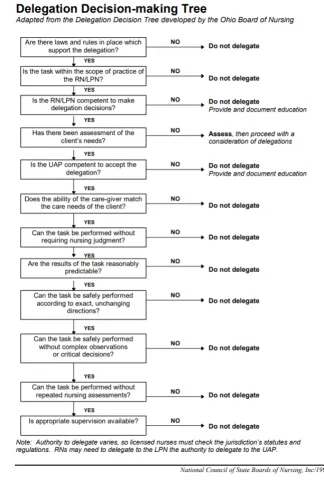
The Delegation Decision-Making Tree, a tool developed by the ANA and modified by other organizations, assists nurses in making delegation decisions. Licensed nurses have ultimate accountability for the management and provision of nursing care, including all delegation decisions.
To use the Delegation Decision-Making Tree, start with a specific client (student), caregiver (UAP) and nursing activity. Beginning at the top of the tree, ask each question as presented in the box. If you answer “no” to the question, follow the instructions listed to the right of the box and arrow. If you answer “yes,” proceed to the next box. If you answer “yes” for any question, the task is delegable.
Recordkeeping
The Missouri Secretary of State’s Office is responsible for updating any changes to the law in the recordkeeping for school districts. The school nurse will need to identify the staff person in charge of the school district’s records and seek instruction from them on the district’s current system. Some districts keep all records electronically in a student information system while other districts still use paper copies. Whatever system the district uses, they must maintain health records according to state and federal laws and keep records available only to those with a need to know.
The Family Educational Rights and Privacy Act (FERPA) pertains to student records developed by a school district, while Health Insurance Portability and Accountability Act (HIPAA) records normally pertain to a clinic or hospital. The Family Educational Rights and Privacy Act (20 U.S.C. § 1232g; 34 CFR Part 99) is a federal law that protects the privacy of student education records. The law applies to all schools that receive funds under an applicable program of the U.S. Department of Education. The Health Insurance Portability and Accountability Act of 1996 is a federal law that requires the creation of national standards to protect sensitive patient health information from being disclosed without the patient’s consent or knowledge. (For more information on these two acts, please see Laws, Rules and Regulations Relating to School.)
Use the following chart to understand the retention of school health records according to Missouri law.
Table 4. Local Records Retention Schedules
Local Records Retention Schedules
| Record Type | Record | Function of the Record | Retention Requirements |
|---|---|---|---|
| Individual Student Records | Cumulative Health Record May include:
| Record specific to a student with health history, immunization records, including immunization exemptions, screening results, etc. | 10 years or age 23 |
| Special Education Records | Records needed for student’s Individualized Education Program (IEP) | Destruction of Information (34 CFR 300.624): The public agency shall inform parents when personally identifiable information collected, maintained, or used under this part is no longer needed to provide educational services to his/her child. The information must be destroyed at the request of the parent subject to the federal requirement that districts retain records for a minimum of three (3) years from the date the child no longer receives special education and related services. | |
| Various Health Records | Emergency Cards (renewed annually) | May contain:
| 1 year |
| Health Care Plans | Summary of nursing plan of care for students with special health needs | 1 year | |
| Immunization “in progress” forms | Documents staff is verifying student is current until next scheduled immunization is due | Until next immunization is complete (Revised 8/09) | |
| Incident Reports | Incident reports–record of internal concerns, medication errors | Stored separately from student records |
(Missouri Secretary of State, 2023; RSMo 167.027)
Resources
Table 5. Resources for School Health Programs
| Resources for School Health Programs |
|---|
Missouri Department of Health and Senior Services (DHSS) [NEEDS LINK] The Department employs a state school nurse consultant to provide consultation to school nurses, school administrators, agencies, and organizations interested in school health, and the public on issues pertaining to health services in schools. Contact the state consultant via phone at 573-522-2822 or e-mail at SHS@health.mo.gov. DHSS has many school health-related materials available on the school health website, free of chare. Schools may copy or adapt for use without permission, any DHSS material. |
Missouri Department of Elementary and Secondary Education (DESE) The following resources are available from DESE’s website:
|
Missouri Department of Social Services (DSS) Guide for Mandated Reporters of Child Abuse and Neglect (2020) |
Missouri Department of Mental Health Find information on the location and types of DMH funded programs available including children’s services |
Missouri State Board of Nursing Find information related to RN/LPN practice on the Boards website under the “Practice” tab. Also find on this site:
|
Local Records Retention Schedules |
Missouri Association of School Nurses The association provides leadership and promotes professional growth to advance the practice of school nursing. |
National Association of School Nurses
|
| PediaLink: American Academy of Pediatrics Education — Where Knowledge Thrives |
| The National Association of Councils on Developmental Disabilities |
| Resha, C., & Taliaferro, V. (2024). Legal Resource for School Health Services. School Nurse.com: Virginia |
Table 6. Resources for Professional Development for School Nurses
| Resources for Professional Development for School Nurses |
|---|
| Using the Standards of School Nursing Practice as a guide, school nurses may identify a need for continuing education (CE) in an area but have difficulty accessing a program due to geography, cost, or time. Online courses are readily available on many topics. School nurses may provide a copy of CE certificates to the school administration, which will be placed in their personnel file. It is evidence that the school nurse is a life-long learner and that the nurse is keeping their knowledge and skills up to date. |
| The Public Health Foundation’s TRAIN.org is a nationwide network of universities focusing on workforce development for individuals working in public health settings, including schools. The St. Louis University School of Public Health Learning Management System (LMS) is part of this network, as is the Centers for Disease Control and Prevention (CDC) and the Federal Emergency Management Agency (FEMA). School nurses can access courses in principles of public health, epidemiology, disease prevention, HIPAA, emergency preparedness and response, etc. Most courses are free, and learners can complete them in segments, take mastery testing and download completion certificates. TRAIN and LMS will track courses completed and provide transcripts. |
| The Department of Mental Health encourages all individuals who might respond to an emergency or disaster to access the National Child Trauma Safety Network course on psychological first aid. This 12-hour interactive course is free of charge, and participants can download a certificate when they complete it. |
| Members of the National Association of School Nurses (NASN) have access to many continuing education opportunities, free of charge. Courses currently available through NASN include education on immunizations, leadership, collaboration, standards of practice, quality improvement, and many others. NASN also has an annual conference at which school nurses can earn CE’s. |
The Centers for Disease Control and Prevention website offers information on health-related topics, including: |
| Nurse.com provides many short courses on all aspects of nursing. |
| Show Me School Health provides school nurses free videos, information, and procedures to help educate school nurses and other staff. |
| School Health Associates, LLC has many videos, procedures, and modules that school nurses can review. |
| The Missouri Association of School Nurses has opportunities for continuing education at their conferences for both members and nonmembers. |
Chapter 2 References
- American Nurses Association. (2012). Decision tree for delegation by registered nurses.
- American Nurses Association. (2012). Principles of delegation. Accessed on December 6, 2023, at https://www.nursingworld.org/
- Center for Disease Prevention and Control. (n.d.). HIPAA. Accessed on December 6, 2023, at https://www.cdc.gov/phlp/publications/topic/hipaa.html
- Missouri Board of Nursing. (n.d.). Delegation decision-making tree. Accessed on December 6, 2023, at https://pr.mo.gov/boards/nursing/delegationtree.pdf
- Missouri Secretary of State. (2023, November) Local records retention schedules. Accessed on December 6, 2023, at https://www.sos.mo.gov/CMSImages/LocalRecords/PublicSchool.pdf
- National Academies of Sciences, Engineering, and Medicine. (2021). The future of nursing 2020-2030: Charting a path to achieve health equity. Washington, DC: The National Academies Press. https://doi.org/10.17226/25982.
- National Association of School Nurses. (2022). School nursing: Scope and standards of practice (4th ed.). NASN.
- National Council of State Boards of Nursing. (n.d.). Delegation. Accessed on December 6, 2023, at https://www.ncsbn.org/nursing-regulation/practice/delegation.page
- National Council of State Boards of Nursing & American Nurses Association. (2019, April 29). National guidelines for nursing delegation. Accessed on December 6, 2023, at https://www.ncsbn.org/public-files/NGND-PosPaper_06.pdf
- Russell, K. A. (2017). Nurse practice acts guide and govern: Update 2017. Journal of Nursing Regulation 8,(3), 18-25. Available at https://www.ncsbn.org/publicfiles/2017_NPA_Guide_and_govern.pdf
- Student special education record deemed permanent record. Revisor of Statutes. (2023). RSMo 167.027. Available at: https://revisor.mo.gov/main/OneSection.aspx?section=167.027&bid=54305&hl=school% u2044IEP
- U.S. Department of Education. (n.d.). Protecting student privacy. Accessed on December 6, 2023, at https://studentprivacy.ed.gov/?src=fpco
- Yonkaitis, C.F., & Reiner, K.L. (2022). School nursing scope and standards: What’s new and important in the fourth edition? NASN School Nurse (Print), 37(5), 277-280.
Appendix 2A: Sample List of Responsibilities for Registered Nurse Supervising LPNs
The nurse supervisor will:
- Health Office Management
- Be available to LPN for consultation by telephone or in person.
- Provide guidelines/protocols for care of illness and injury.
- Review health room logs routinely (frequency determined by RN).
- Review medication and treatment logs on a routine basis and maintain a record of review.
- Consult with LPN concerning students with health and absentee problems.
- Develop or maintain a community resource file for access to care and referrals.
- Special Health Care Needs
- Assess students with special health care needs to determine the level of care needed.
- Identify students needing health care plans (Emergency Action Plans, Individual Health Care Plans, Individualized Health Care Action Plans, Section 504 Accommodation Plans, etc.) and prepare as needed. Provide staff education regarding chronic health conditions as needed.
- Participate in observation of students with ADD/ADHD when requested.
- Develop individualized health care plans (IHP) for students with chronic illness or disability in collaboration with LPN.
- Provide support for/assist the LPN in the implementation activities of IHP or other caregivers, as appropriate.
- Screening Programs
- Determine the frequency of screenings by program and grade after consultation with school administration.
- Assist LPN with initial screening programs, including students with special needs, if needed.
- Rescreen all students identified with possible defects, review health history and consult with parent(s)/guardian(s) as needed in making referral decisions.
- Monitor referral completion rates and assist as needed with parental contact.
- Prepare health information from screenings for IEP staffing as requested.
- Education
- Provides support for/assists LPN to provide in-service to designated school personnel on medication administration.
- Provide classroom instruction on health topics when appropriate and as requested.
- Provide student-specific information to teachers regarding students with special health care concerns.
- Assist teachers in finding health instruction resources.
- Provide input regarding health instruction/curriculum needs.
- Other Duties
- Assess the school environment on a routine basis, including playground equipment, restrooms, etc.
- Support/assist LPNs during illness outbreaks (e.g., data collection and management of health concerns).
- Evaluation
- Meet with LPN to monitor school health nursing activities, including triage of illness and injury, medications and treatments, absenteeism, etc. (frequency determined by RN, suggested minimum is four hours per week).
- Determine and educate the LPN new to school nursing and evaluate competencies on a regular basis.
- Review the results of screening programs to determine a plan for the subsequent school year.
- Meet on a routine basis with the LPN and school administrator to review the program.
- Collaborate with school administrator in performance evaluation of LPN.
Appendix 2B: Sample List of Responsibilities for Licensed Practical Nurse
Under the Supervision of a Registered Nurse
- Health Room Management and Triage
- Maintain cumulative health records.
- Maintain a daily log of all students seen in the health room.
- Follow established policies and procedures for the care of ill and injured students.
- Follow up with students with excessive absences for health reasons and consult RN.
- Send out referral letters for health problems and screening failures after rescreening by RN and making referral decisions, if applicable.
- Follow up on referrals and track referral status.
- Implement a fluoride rinse program and maintain the required record of the program if the district is participating in the fluoride rinse program.
- Maintain health room supplies and equipment.
- Prepare weekly reports of nursing activity for school administration.
- Identify possible abuse and neglect and follow the district reporting procedures.
- Special Health Care Needs
- Participate in developing emergency action plans for students needing emergency provisions.
- Implement individual health care plans, including special care procedures, as approved by RN or physician.
- Provide vision and hearing assessment for students being evaluated for special education placement and report findings to RN and Special Education team, if applicable.
- Provide health information to students and families as needed.
- Screening Programs
- Screen all new students for height/weight, vision, hearing, and dental problems within one week of enrollment.
- Do initial screening for vision and hearing problems per district policy/protocol.
- Education Activities
- Provide health instruction to students, teachers, parent(s)/guardian(s), and community as needed.
- Assist teachers in finding resources for health education.
- Participate in community outreach programs.
- Assist school food service personnel in promoting healthy food choices.
- Assist school personnel with health needs, as indicated.
- Evaluation
- Meet weekly with the nurse supervisor to monitor school health nursing activities, including triage of illness and injury, medications and treatments, absenteeism, etc., and with the school administrator at least monthly regarding the school health program.
- Review medications and treatments at least weekly with the nurse supervisor, if applicable and necessary.
Appendix 2C: Sample Agreement for Supervision
By state law, Chapter 335, LPNs must practice under the supervision of a registered professional nurse or a licensed physician. LPNs can provide nursing care without direct physical oversight but must be supervised by a registered professional nurse or a licensed physician. School Districts may modify this template to include protocols and procedures specific to the individual school district.

Appendix 2D: School Health Facilities and Supplies
The school’s health facilities should accommodate all school health activities, such as emergency care of illness and injury, health appraisals, routine screenings, conferences, private interviews, etc. Lavatory and toilet facilities are essential for infection control. The preferred location is adjoining the administrative offices to facilitate communication and provide for supervision of the health room when the nurse is not present. The facility should be located on the ground floor, near an entrance, to expedite transportation of the sick and injured.
The number of students served and the components of the health services program will determine the number of individual areas in the health facility. There should be space for isolation of students, as well as a resting area. It is also helpful to have a large enough area to conduct routine screenings. A private office and a separate waiting room are desirable.
School health facilities should also allow for storage of health records in locked file cabinets in the health room, which should also be locked when not in use. Staff must also keep medications in locked cabinets. Controlled substances should be kept in locked boxes in a locked cabinet or room. The nurse and administrator should control access to keys. A refrigerator is needed in which to store medication that needs to be refrigerated, and a freezing compartment is helpful for storing readily accessible ice packs.
Table 7. Suggested equipment and supplies for the health room
| Location | Recommended Supplies |
|---|---|
| Reception Area and Office |
|
| Assessment Area |
|
| Infirmary Area |
|
“Emergency Go Bag” Some schools have |
|
Appendix 2E: Suggested School Nursing Activity Calendar
Note: A program this extensive is not appropriate for a new school nurse to implement but may provide ideas for organizing activities.
Chapter 3: Health Plans for Students with Special Health Care Needs
Manual For School Health Programs
The number of children with chronic health conditions is approximately 25 percent of the student body. School care for these students has become increasingly complex. Individual student health-related plans assist school nurses in providing quality health care in school, account for school safety, protect students' rights and reduce health barriers to learning. It is important to understand the professional, ethical and legal foundations of student health plans and their impact on federally mandated education plans.
Federal statutes that pertain to the treatment of children with disabilities support this trend.
Section 504 of the Rehabilitation Act of 1973, as amended through the Americans with Disabilities Amendment Act (ADAA) in 2008, prohibits recipients of federal funds from discriminating against persons with handicapping conditions or persons who are regarded as handicapped. School districts must make reasonable accommodations to make their programs and services available to such students.
Section 504 provisions are important because the definition of children with handicapping conditions is broader than the definition of such children under the Individuals with Disabilities Education Act (IDEA). Thus, a child may be eligible for certain services under Section 504 but not for special education under IDEA. Section 504 does not require an Individualized Education Plan (IEP) but a written plan for accommodation. It is recommended that the district document that a group of individuals familiar with the student’s needs meet and identify the needed services.
IDEA is the second federal statute that pertains to the issue of school health services. This statute requires public school districts to provide a “free appropriate public education (FAPE)” for eligible children of providing special education and related services. Regulations and court decisions have defined related services, including school health services. Criteria for required services include:
- Can be learned in a reasonable amount of time.
- Should not require the presence of a physician, medical judgment from extensive medical training, or an undue amount of time to perform.
- Must be provided or performed during the school day for the pupil to attend school or benefit from his/her educational program.
- Must be ordered by a licensed physician or surgeon.
IDEA’s definition of services includes the variety of procedures described in these guidelines; therefore, school districts have the responsibility to provide them when it is determined necessary for a child with a disability to benefit from the special education program, as documented in the IEP. https://dese.mo.gov/media/pdf/regulation-iv-fapeieplre-0
Quality health care is in students' best interest and safety and supports the optimal educational experience. This health care is best provided in school through assessment, planning, and monitoring by a registered nurse in collaboration with the student’s primary physician. Districts enrolling students with complex medical needs must have access to this type of health care management to provide for the student’s special needs safely.
Students with special needs may require a variety of health-related plans. A registered nurse must develop these plans, including care delegated to other staff. The types of plans include:
- Emergency Action Plan (EAP)
- 504 Accommodation Plan
- Individualized Health Care Plan (IHP)
Emergency Action Plan (EAP)
The needs of a student with a condition that may become life-threatening (i.e., severe allergic response, persistent asthma, diabetes, etc.) require a written plan or protocol for the school district personnel who may be called upon to respond. The Emergency Action Plan (EAP) should include:
- Definition of medical emergency for this student.
- Specific actions staff should take in the emergency, based on the student’s signs and symptoms.
- List of individuals to notify when this emergency occurs.
- Transportation procedures.
As indicated, the school nurse should share these student-specific emergency plans with school personnel, including teaching staff, cafeteria workers, custodians, and bus drivers. Fillable PDF plans can be found for use on the School Health Program website [BROKEN LINK]. If the student is transported daily, the school nurse should provide specific training and plans to the driver(s) responsible for their transportation. See Appendix 3D for a sample Transportation Plan.
Will’s Law—statutory
Individualized Emergency Health Care Plan (IEHC)
The term Individualized Emergency Health Care Plan is used in Will’s Law and has statutory requirements. It is defined in legislation as a document developed by the school nurse in consultation with the parent and other appropriate medical professionals. This plan describes the procedures and specific directions a person will take in an emergency. The parent, school nurse and a school administrator sign this form. In the absence of a school nurse, the administrator signs.
The IEHC provides for effective and efficient planning and protects both the student and the school personnel. Components of the IEHC may include:
- A notice about the student's condition for all school employees interacting with the student.
- Written orders from the student's physician or advanced practice nurse describing the epilepsy or seizure disorder care.
- The student’s symptoms of epilepsy or seizure disorder and recommended care.
- Information about the student’s participation in exercise and sports, including any contraindications to exercise and required accommodations.
- Accommodations for school trips, after-school activities, class parties, and other school-related activities.
- Information for school employees about how to recognize and provide care for epilepsy and seizure disorders, epilepsy and seizure disorder first aid training, when to call for assistance, emergency contact information, and parent contact information.
- Medical and treatment issues that may affect the educational process of the student.
- The student's ability to manage, and the student's level of understanding of, the student's epilepsy or seizure disorder.
- How to maintain communication with the student, the student's parent and health care team, the school nurse or the school administrator or the administrator's designee.
Also, as part of Will’s Law, an Individualized Health Care Plan (IHCP) is defined as:
“a document developed by a school nurse, in consultation with a student's parent and other appropriate medical professionals who may be providing epilepsy or seizure disorder care to the student, that is consistent with the recommendations of the student's health care providers, that describes the health services needed by the student at school, and that is signed by the parent and the school nurse or the school administrator or the administrator's designee in the absence of the school nurse.”
It continues to state: ”Each individualized health care plan shall include but not be limited to the following information:
- A notice about the student's condition for all school employees who interact with the student;
- Written orders from the student's physician or advanced practice nurse describing the epilepsy or seizure disorder care;
- The symptoms of the epilepsy or seizure disorder for that particular student and recommended care;
- Whether the student may fully participate in exercise and sports, and any contraindications to exercise or accommodations that shall be made for that particular student;
- Accommodations for school trips, after-school activities, class parties, and other school-related activities;
- Information for such school employees about how to recognize and provide care for epilepsy and seizure disorders, epilepsy and seizure disorder first aid training, when to call for assistance, emergency contact information, and parent contact information;
- Medical and treatment issues that may affect the educational process of the student;
- The student's ability to manage, and the student's level of understanding of, the student's epilepsy or seizure disorder; and
- How to maintain communication with the student, the student's parent and health care team, the school nurse or the school administrator or the administrator's designee in the absence of the school nurse, and the school employees.”
Individualized Healthcare Plan (IHP)
A student with special health care needs benefits from developing an Individualized Healthcare Plan (IHP) to guide nursing interventions based on a nursing diagnoses. This nursing care plan has student-centered goals and objectives and describes the nursing interventions designed to meet the student’s short- and long-term goals. IHPs are useful when the nurse is assisting the student to:
- Become better educated about their special health care need.
- Develop more self-care activities.
- Address health-related absenteeism.
- Cope more effectively with their condition/disease.
The IHP is for the school nurse’s use and does not require a parent or health care provider’s signature. (See Appendix 3E for a sample format). School nurses often use the IHP as a contract between the student and the nurse to accomplish specific outcomes for the student. Not all students with a special health care need will require an IHP; only those with whom the nurse or UAP provides significant intervention or addresses daily health needs or as part of an IEP or 504 Accommodation Plan.
Section 504 Accommodation Plan
The school nurse is often one of the staff members who identifies the need for a 504 Accommodation Plan to address the health needs of a student on a temporary or permanent (school year) basis. The need may relate to mobility, access to care, classroom adaptations, etc. The nurse may need to advocate for the accommodation. A group of individuals aware of the need for accommodation should develop a plan to ensure the student is getting the best possible access to learning (see Appendix 3F for sample format).
Technical Skills and Services
The RN should provide assessment, planning, and monitoring for all students requiring technical skills and services to meet their health care needs at school. In addition, the RN is responsible for writing and implementing students’ health care plans. Schools may employ an RN or contract with an agency to provide nursing services.
A physician’s written authorization is required for all medical procedures performed at school. School staff should not perform the procedure at school unless clearly necessary and the family cannot reasonably accomplish it outside of school hours. School staff should consult students and parent(s)/guardian(s) on how they perform the procedures at home; however, the school nurse must determine how the procedure will be done at school. An unlicensed, non-medical person cannot perform certain procedures. School personnel, including the nurse, may need additional training for some procedures. If no registered nurse is available, a physician should determine who may safely provide care, and assure the necessary training.
The person delegating the care should periodically monitor and document the quality of the care to ensure the caregiver is correctly following the procedure, completing the required documentation, and reporting concerns appropriately. Special care videos with written procedures are available on Missouri’s Just In Time website. The website is available to Missouri school nurses and is easy to access.
A physician or registered nurse should decide who can provide care based on an assessment of the student’s health status, the complexity of the procedures, and the capability of the proposed caregiver. The caregiver must be provided training and support until they feel competent to provide the care. The person delegating the care must be confident the caregiver has mastered the skills necessary. School staff have the right to refuse to provide special health care procedures, including medication administration, without jeopardizing their position [RSMo 167.621(2).].
Resources
Resources for Special Health Care Needs
- Chronic Health Conditions
- Asthma
- Diabetes
- Epilepsy
- Allergies
- Autism Spectrum
- ADHD
- Sickle Cell
- Resources for Individualized Health Care Plans
- Will, I.S., Arnold, M.W., & Zaiger, D.S. (Eds.). (2017). Individualized healthcare plans for the school nurse: A comprehensive resource for school nursing management of health conditions. Forest Lake, MN: Sunrise River Press.
- Position Statements (related to special health care needs)
- NASN. (2020). Position Statement: Use of Individualized Healthcare Plans to Support School Health Services
- NASN. (2023). Position Statement: Individuals with Disabilities Education Improvement Act and Section 504 – The School Nurse as an Essential Team Member
Chapter 3 References
- Authorization of parent or guardian, prerequisite — administration of medicine, first aid, immunity. Revisor of Statutes. (2010). RSMo 167.621(2). https://revisor.mo.gov/main/OneSection.aspx?section=167.621
- National Association of School Nurses. (2020). Position statement: Use of individualized healthcare plans to support school health services. Accessed at https://www.nasn.org/nasn-resources/professional-practice-documents/position-statements/ps-ihps
- U.S. Department of Education. (2019). Section 1401 (26) (A). Accessed on December 17, 2023, at https://sites.ed.gov/idea/statute-chapter-33/subchapter-i/1401/26/A
Appendix 3B: Sample Letter to Physician Regarding Health Care Plan
(Date)
Dear Dr. _______________________:
The parent/guardian of your patient, [student name/DOB], requested that [school district] provide specialized health care. If district staff must perform this procedure during school hours, we will need a written order on file in the student’s health record.
Attached is a tentative health care plan for this student, including a description of a standardized procedure. Please review these materials, write needed adjustments to the procedure, and provide the requested information to guide us in providing a safe environment for your patient. We will incorporate your comments and adjust the procedure as you direct. School staff will begin providing the care requested when we have the necessary orders and adequately trained personnel in place.
Please feel free to contact _______________________, who is assuming responsibility for the management of the student’s health needs in our school. They can be reached at _______________________.
Sincerely,
Administrator or School Nurse
Transportation Plan for Students with Special Needs
Confidential Individualized Healthcare Plan
Section 504 Accommodation Plan
Chapter 4: Screening Program Recommendations and Standards
Manual For School Health Programs
School health programs should make a health screenings plan considering the need, personnel, referral sources, time, and facilities. Programs must determine priorities for each type of screening based on the ability to complete follow-up for referrals made. It is more desirable to screen fewer students and see referrals resolved than to simply identify numbers of students with possible deficits. Any mass screenings must have parent notification with an opt out option. Screenings for vision, hearing, and dental provide baseline health status data. If time for screenings is limited, consider making students new to the district a priority to gather this baseline data.
All screening programs should include an educational component. Students should understand the value of the screening and the implications of the outcome. Follow-up should include quick notification of parent(s)/guardian(s) and teachers of possible deficits as well as suggestions for interim management and referral sources, if needed.
School health programs should communicate, with parent/guardian permission, any obvious health problem and subsequent plans with school personnel. Schools should recommend that students have a comprehensive health examination and dental check-up prior to starting school for the first time.
Vision
Standards
- Screen at 10 or 20 feet (10 ft. recommended for younger children).
- Use screening chart/cards that include 20/25 line.
- Measure distance and ensure child’s heels are on measured line.
- Screen with glasses on if appropriate.
- Do not use vision testing machines for screening students below Grade 3.
- Rescreen at least once within a month of any screenings indicating a possible concern before referral, and perform additional screenings as indicated.
Recommendations
Prioritize screenings as follows:
- All new students.
- Grades Pre-K, K, 1st, 2nd, and 3rd as recommended in Guidelines for Vision Screening in Missouri Schools.
- Special education students (district compliance plan).
- Referrals from teachers, parent(s)/guardian(s), and student self-referrals.
- Grades 5, 7, 9 and 11 as resources permit
Find education materials to prepare students for vision screening at:
http://ccox.sites.truman.edu/2018/01/26/vision-screening-prep/
https://ccox.sites.truman.edu/2018/08/28/vision-screening-prep-spanish/
Preschool and non-verbal students may require functional screening to determine visual ability. Refer to Screening Infants and Toddlers section of Guidelines for Vision Screening in Missouri Schools. [NEEDS LINK]
Referral
- Refer to Guidelines for Vision Screening in Missouri Schools [NEEDS LINK] for referral criteria.
Hearing
Standards
- Use pure-tone audiometry at 1,000, 2,000, and 4,000 MHz, at 20 db.
- Conduct impedance bridge (tympanometer) screening, when available, giving priority to youngest students.
- Otoscopy (if nurse has assessment skills and equipment).
Recommendations
Base the individuals or grades screened on the availability of trained screeners, the environment available in which to screen, and the ability to complete a high percentage of referrals. Always place emphasis on the youngest population. Consider screening the following groups:
- Students in Pre-K, K, 1st, 2nd, and 3rd grades, and all new students.
- Referrals from teachers, parent(s)/guardian(s), and student self-referrals.
- Special education evaluation requests.
- Students in 7th grade for educational purposes regarding noise exposure if time permits.
Preschool and non-verbal students may require functional hearing screening, refer to Guidelines for Hearing Screening, Missouri Department of Health and Senior Services, (2021).
Find education materials to prepare students for hearing screening at:
http://ccox.sites.truman.edu/2018/01/24/hearing-screening-prep/
https://ccox.sites.truman.edu/2018/08/28/hearing-screening-prep-spanish/
Clean/disinfect equipment according to manufacturer’s instructions between each student. Do not use alcohol on headphones. See Infection and Prevention Control for Audiology Equipment.
Referral
Develop local referral criteria with community health professionals or refer to Guidelines for Hearing Screening.
Oral Health
Standards
Systematic sequence of visual inspection, using tongue blade and illumination:
- Face and neck for lesions and palpate for swollen glands.
- Mucous membranes (lips, tongue, soft and hard palate, tonsillar area, and cheeks) for redness, exudates, swelling, blisters, and growth.
- Teeth and gums:
- Evidence of dental caries
- Broken or chipped teeth
- Gross malocclusion
- Infection or swelling
- Bleeding or inflamed gums
- Changes in color, texture, position of gums, tissue
- Poor oral hygiene
- Foul breath
Recommendations
- As time and resources permit, screen students in grades K-7 who do not report routine professional care, using a visual inspection of the mouth with light and tongue blade.
- Screen secondary students who have not reported routine care.
- Include dental education as part of the inspection process.
Referral
Refer any student with gross oral or dental problems who is not receiving routine, comprehensive oral health care.
Blood Pressure
Standard
The size of the cuff used to determine the blood pressure is the single most important factor. The cuff should cover no more than one-half and no less than one-third the length of the upper arm. The cuff should not cause pressure in the axilla or cover the antecubital space. If the proper-sized cuff is not available, do not do reading. A pediatric stethoscope with a small diaphragm is helpful in hearing blood pressure sounds in younger children. Seat the student in a comfortable position, with arm slightly flexed, abducted and at the level of the student’s heart. Keep the setting as quiet and non-stressful as possible. Explain the procedure to the student and allow younger children to handle the equipment prior to use to help increase comfort.
Recommendations
The American Academy of Pediatrics recommends that children above the age of three have their blood pressure checked annually, during non-school, routine physical examinations. The school is not an ideal setting in which to do mass screenings. Blood pressure screenings that are part of an educational unit on the cardiovascular system or included in a health risk appraisal program, can be effective if done under proper circumstances and with appropriate equipment.
Referral
Children are known to have widely fluctuating blood pressure readings, even within a period of 10 minutes. Recommended “normal blood pressure” readings for children may change with new research, so it is best to check with your school’s physician or local pediatricians to find out the current parameters for children.
Scoliosis Screening
No longer recommended in the school setting.
Tuberculosis Screening
Recommendation
School personnel and K-12 students are at no greater risk for tuberculosis infection than the public; therefore, routine testing is no longer recommended. If a district continues to test, the school nurse may contact the Missouri Department of Health and Senior Services (MDHSS), Bureau of Communicable Disease Control and Prevention, TB Control, 573-751-6113, for guidance.
Local public health departments provide tuberculosis case management and may request a school nurse to assist with Directly Observed Therapy (DOT) for students or school personnel receiving medication for latent tuberculosis infection (LTBI) or active disease after the patient is determined to be non-infectious.
Schools with preschool programs serving children four years of age and younger, should be familiar with the MDESE, Office of Childhood, rules regarding tuberculosis risk assessment and screening for that population.
Resources
Table 9. Resources for Screenings
| Resources for Screenings |
|---|
| Missouri Department of Health and Senior Services. (2021). Guidelines for Hearing Screening in the School Setting [BROKEN LINK] |
| Truman State University. (2018). Hearing Screening Preparations for Kids (Spanish Version) |
| Guidelines for Vision Screening in Missouri Schools [NEEDS LINK] |
| Truman State University. (2018.) Vision Screening Preparations for Kids (Spanish Version) |
| U.S. Preventive Services Task Force. (2017). Screening for Obesity in Children and Adolescents: US Preventive Services Task Force Recommendation Statement, JAMA. 2017; 317(23):2417-2426. doi:10.1001/jama.2017.6803 |
Chapter 4 References
- American Speech and Hearing Association. (n.d.). Infection and Prevention Control for Audiology Equipment. Accessed on December 13, 2023 at https://www.asha.org/siteassets/uploadedfiles/infection-prevention-and-control-foraudiology-equipment.pdf
- Centers for Disease Control and Prevention. (2023). Division of Nutrition, Physical Activity, and Obesity. Accessed on December 13, 2023 at https://www.cdc.gov/nccdphp/dnpao/index.html
- Missouri Department of Health and Senior Services. (2021a). Guidelines for Hearing Screening in the School Setting. Accessed on December 18, 2023 at http://health.mo.gov/living/families/schoolhealth/pdf/HearingScreeningGuidelines.pdf [NEEDS LINK]
- Missouri Department of Health and Senior Services. (2021b). Guidelines for Vision Screening in Missouri Schools. Accessed on December 18, 2023 at https://health.mo.gov/living/families/schoolhealth/pdf/GuidelinesVisionScreening.pdf [NEEDS LINK]
Chapter 5: Infection Control
Manual For School Health Programs
Management of Infectious Diseases
School nurses “are front-line health care providers, serving as a bridge between the health care and education systems and other sectors as well as links to broader community health issues through the student populations they serve. The COVID-19 pandemic has also heightened the need for team-based care, infection control and prevention, person-centered care, and other population-based skills that reflect the strengths of community and public health nurses.”
(National Academy of Medicine, 2021, p. 2)
Vaccinations
(See Vaccinations at Chapter 6: Laws, Rules, and Regulations)
Staying Home When Sick
Students and staff should remain home when gastrointestinal or respiratory illnesses are present. Districts should have a procedure in place for reporting illnesses and communicable diseases to the school nurse. Districts should provide policies and procedures to parents and staff on how to report an illness and when they must stay home. Each district should check with their physician and local public health departments on guidelines for both students and staff. Districts should also consult their human resources department for policies on staff illness.
Proper Ventilation Ventilation is another component of maintaining a healthy environment. Bringing in as much outdoor air as the ventilation system allows and opening windows, when possible, helps to decrease the particles of airborne infectious diseases circulating in a room. To improve air quality, districts should also do routine maintenance and cleaning of their ventilation systems to ensure the system works properly and well-maintained (CDC, 2019). The Environmental Protection Agency has an air quality toolkit for schools.
Hand and Respiratory Hygiene
Handwashing is the number one intervention to prevent illness in schools. The school nurse should instruct students on how and when to wash their hands properly. School nurses can also remind students to cough into a tissue or sleeve. Posters in restrooms and the health office can help emphasize the importance of handwashing (CDC, 2023a).
Staff should know where to obtain gloves and other personal protective equipment (PPE) and be reminded not to touch blood or infectious material. (See Standard Precautions) The school health program should practice and encourage masking when appropriate or advised, such as during an outbreak or when individuals have respiratory symptoms. Examples of body fluids that transmit infection that results in illness include the following:
Table 10. Diseases Spread Through Contact with Body Fluids
| Body Fluid | Diseases Spread Through Contact with Body Fluids |
|---|---|
| Eye discharge | Conjunctivitis (pink eye) |
| Nose or throat discharge | Colds, influenza, parvovirus B19 (Fifth’s disease), COVID-19 |
| Blood | Hepatitis B, C, HIV |
| Feces | Hepatitis A, shigellosis, giardiasis |
| Urine | Cytomegalovirus |
It is important to remember that any person could have disease-causing organisms in their body fluids, even if they have no signs or symptoms of illness. Consequently, school staff should follow the recommendations below in all situations, not just those involving an individual known to have an infectious disease.
In the school setting, staff should take reasonable steps to prevent individuals from having direct skin or mucous membrane contact with any moist body fluid from another person. Specifically, avoid direct contact with all the following:
- Blood (find more detail about preventing exposure to blood or blood-contaminated body fluids in standard precautions).
- All other body fluids, secretions, and excretions, regardless of whether they contain visible blood.
- Non-intact skin (any area where the skin surface is not intact, such as moist skin sores, ulcers or open cuts).
- Mucous membranes.
If someone’s hands or other skin surfaces are contaminated with body fluids from another person, they should wash with soap and water as soon as possible.
In general, staff should wear standard medical vinyl or latex gloves whenever they anticipate direct contact with any body fluid from another person. Staff should make gloves available and easily accessible in any setting where contact with body fluids could take place. Staff should always wash hands immediately after removing gloves. Staff should also have access to pocket masks or other devices for mouth-to-mouth resuscitation.
Mucous membranes cover the eyes and the inside of the nose and mouth, along with certain other parts of the body. In a school setting, avoiding mucous membrane contact with body fluids means, for practical purposes, that one does not get these fluids in one’s eyes, nose, or mouth. Someone can generally accomplish this by not rubbing their eyes with their hands, and not putting their hands or anything touched by unwashed hands (such as food) in one’s mouth. Good handwashing is vital to preventing mucous membrane exposure to disease-causing organisms.
Cleaning/Disinfecting
Each district should review policies and procedures for cleaning and disinfecting the health office, student rooms, equipment, floors, and other student areas. Districts should ensure staff follow cleaning and disinfecting standards. Access updated Centers for Disease Control and Prevention guidelines here.
Districts may need to institute an enhanced cleaning/disinfection routine during an outbreak of illness or communicable disease. The school nurse, administration, and maintenance personnel must all be involved in determining the products and frequency of the service.
The National Association of School Nurses reminds school nurses of the difference between cleaning and disinfecting:
- “Cleaning—using soap (or detergent) and water to physically remove germs, dirt, and impurities from surfaces or objects. This process does not necessarily kill germs, but by removing them, it lowers their numbers and the risk of spreading infection.
- Disinfecting—using chemicals to kill germs on surfaces or objects. (National Association of School Nurses, n.d.)
(See Standard Precautions.)
Management and Containment of Cases or Outbreaks
The school nurse and local public health should work together to prevent or mitigate illness or outbreaks of infectious diseases. The school should follow disease outbreak control measures and reporting required by state laws, the Missouri Department of Health and Senior Services’ rules governing the control of communicable diseases dangerous to public health, and any city or county laws and rules.
Standard Precautions
Bloodborne Pathogens
Using standard precautions (formerly universal precautions) acknowledges that any person’s body fluids, including blood, may be infectious, and includes the need to use personal protective equipment (PPE) such as gloves, masks, or clothing to prevent exposure to body substances. These precautions include:
- Wearing disposable gloves for contact or anticipated contact with any person’s blood or body fluids.
- Wearing protective gown/apron if soiling of clothes is likely.
- Wearing goggles and/or mask as appropriate when splashing of blood/bloody fluids is likely.
- Always washing hands after removing gloves or when hands have come in contact with blood or any body-fluid/excretion.
In addition:
- If any body fluids come into contact with the mucous membrane surfaces of the nose or mouth, immediately flush the area with water. If the mucous membrane surfaces of the eye are contaminated, irrigate with clean water or saline or sterile solutions designed for this purpose.
- Take precautions to avoid injuries with sharp instruments contaminated with blood. Do not recap needles. After use, place disposable syringes, needles, and other sharp items in puncture-resistant, leak-proof containers for disposal; place the puncture-resistant containers as close as practical to the use area. School districts should have a clear procedure for sharps usage and disposal.
- Persons providing health care who have exudative skin lesions or weeping dermatitis should refrain from all direct care, and from handling care equipment, until the condition resolves.
The Missouri Code of State Regulations, 19 CSR 20-20.092, requires public employers in the state of Missouri having employees with occupational exposure to blood or other potentially infectious materials to follow the Occupational Safety and Health Administration standards as codified in 29 CFR 1910.1030.
The rule establishes the current standard of practice for preventing transmission of infectious blood-borne agents in occupational settings and contains public health and risk management policies. School administrators and other school personnel involved in making health policy decisions should become familiar with this rule and consider, in consultation with appropriate legal counsel, adopting the policies that it describes, including the development of an exposure control plan. Exposure control plans should include a statement on providing hepatitis B vaccine to appropriate school staff.
The Occupational Safety and Health Administration (OSHA) guidelines, which is the standard adopted by the Missouri Department of Health and Senior Services also require:
- Persons with assigned occupational duties that may expose them to blood receive the hepatitis B vaccine. Vaccination of all school staff is neither feasible nor necessary. The district should provide staff with potential exposure three doses of hepatitis B vaccine free of charge. Such individuals include:
- The person(s) assigned primary responsibility for providing first aid.
- Special education/early childhood development personnel who may have contact with children infected with hepatitis B. These children may have special behavioral and/or medical problems which increase the likelihood of hepatitis B transmission.
- The person(s) assigned primary responsibility for cleaning up body fluid spills.
If a staff member refuses the offered vaccine, the district should require them to sign a statement indicating they refused the offered vaccine. School nurses (RNs and LPNs) licensed under Chapter 335, RSMo, are required, according to Section 191.694 RSMo, to adhere to standard precautions, including the appropriate use of handwashing, protective barriers, and care in the use and disposal of needles and other sharp instruments.
Procedures for Cleaning Spills of Blood or Other Body Fluids
Please refer to the Prevention and Control of Communicable Disease [NEEDS LINK], Missouri Department of Health and Senior Services, 2011, p. 35-40 for further guidance, including guidance for the use of bleach and other types of disinfecting products.
- Use absorbent floor-sweeping material to cover larger body fluid spills prior to cleaning.
- Wear sturdy, non-permeable gloves and other protective clothing as necessary.
- Use disposable absorbent towels or tissues, along with soap and water, to clean the area of the spill as thoroughly as possible.
- If the gloves worn to clean up the spill are reusable rubber gloves, wash them with soap and running water prior to removal. Place disposable gloves in an impermeable plastic bag. Regardless of the type of gloves used, take care during glove removal to avoid contamination of the hands. However, whether any known contamination occurs, thoroughly wash the hands with soap and water after removing the gloves.
- If the person doing the clean-up has any open skin lesions, take precautions to avoid directly exposing the lesions to the body fluids.
- If direct skin exposure to body fluid accidentally occurs, thoroughly wash the exposed area with soap and water for at least 15 seconds.
- Always keep one or more clean-up kits on hand for blood/body fluid spills in one or more central locations so that they are readily accessible. The clean-up kit should consist of the following items:
- Absorbent floor-sweeping material
- Liquid soap
- Disinfectant
- Small buckets
- Rubber or plastic gloves
- Disposable towels or tissues
- Impermeable plastic bags
Caution: If using diluted bleach solution, do not use the solution for any other purpose than the clean-up described above. Mixing this solution with certain other chemicals can produce a toxic gas. Also, dilute any EPA—approved disinfectant used according to manufacturer’s instructions. It is not appropriate or necessary to add more disinfectant than the directions indicate. Doing so will make the disinfectant more toxic and could result in skin or lung damage to individuals using it.
COVID-19 and Other Pandemic/Endemic Infections
The COVID-19 outbreak of 2019-2022 was one of the worst pandemics the United States and other countries have seen in many decades. Public health, researchers, and health care systems developed and implemented strategies that eventually slowed the pandemic and allowed life to have a sense of normalcy. Although COVID-19 infections continue to this day, most people now have some protection, or immunity, against COVID-19 due to vaccination, previous infection, or both. This immunity, combined with the availability of tests and treatments, has greatly reduced the risk of severe illness, hospitalization, and death from COVID-19 for many people. Students also returned to the classroom with many environmental interventions to prevent and mitigate spread, such as distancing, screening, testing, and enhanced cleaning and disinfecting.
School nurses should also continue to work with their local public health agency to identify the need for enhanced prevention. The CDC is the best resource for finding current information on emerging illnesses and recommended procedures to be ready.
Resources
Table 11. Resources for Infection Control
| Resources for Infection Control |
|---|
| Missouri Department of Health and Senior Services. (2011). Prevention and Control of Communicable Diseases [NEEDS LINK] |
| Missouri Department of Health and Senior Services. (2023). Communicable Diseases |
| National Association of School Nurses. (n.d.) Covid-19 Reference: Cleaning and Disinfection in the Nurse’s Office Space |
| U.S. Department of Labor Occupational Safety and Health Administration (May, 2019) Blood-Borne Pathogens |
| American Academy of Pediatrics. (April, 2024) Red Book: 2024-2027 Report of the Committee on Infectious Diseases 33rd Edition |
References
- CDC. (2023a, August). Hand hygiene in schools and early care and education settings. Accessed at https://www.cdc.gov/clean-hands/prevention/about-hand-hygiene-in-schools-and-early-care-and-education-settings.html?CDC_AAref_Val=https://www.cdc.gov/handwashing/handwashing-school.html
- Centers for Disease Control and Prevention. (2024). Vaccines and immunizations. Accessed at https://www.cdc.gov/vaccines/index.html
- Missouri Department of Health and Senior Services. (2023). Communicable diseases. Accessed at https://www.sos.mo.gov/cmsimages/adrules/csr/current/19csr/19c20-20.pdf
- National Academy of Medicine. (2021, May). The future of nursing 2020–2030: Charting a path to achieve health equity. Accessed at https://nap.nationalacademies.org/resource/25982/Highlights_Future%20of… _final.pdf
- National Association of School Nurses. (n.d.) Covid-19 resources. Accessed at https://www.nasn.org/covid19ref/home
- National Association of School Nurses. (n.d.). Covid-19 reference. Accessed at https://schoolnursenet.nasn.org/covid19ref/glossary/cleaning-and-disinfection-in-the-nurses-office-space
- U.S. Department of Labor Occupational Safety and Health Administration. (2019, May). Blood-Borne pathogens. Accessed at https://www.osha.gov/pls/oshaweb/owadisp.show_document?p_table=STANDARD… 51
- U.S. Environmental Protection Agency. (2023, May). Indoor air quality tools for schools: Preventive maintenance guidance documents. Accessed at https://www.epa.gov/iaqschools/indoor-air-quality-tools-schools-preventive-maintenance-guidance-documents
Chapter 6: Laws, Rules, and Regulations Relating to Schools
Manual For School Health Programs
Federal
Congress enacted the Education for All Handicapped Children Act (Public Law 94-142), also known as the EHA, in 1975, to support states and localities in protecting the rights of, meeting the individual needs of, and improving the results for infants, toddlers, children, and youth with disabilities and their families. The 1990 reauthorization of the landmark law changed its name to the Individuals with Disabilities Education Act (IDEA). Congress last reauthorized the law in 2004 (U.S. Department of Education, 2023). Before IDEA, many children with disabilities were denied access to public education and learning opportunities and were placed in institutions or separate educational sites. With IDEA, public education systems integrated children with disabilities. With this integration, school districts sometimes experience challenges in providing for students with complex disabilities.
The Family Education Rights and Privacy Act (FERPA) requires all school districts to adopt a policy regarding confidentiality of school records and a process for parent(s)/guardian(s), and students who have reached age 18 to access records as appropriate.
Generally, schools must have written permission from the parent or eligible student to release any information from a student's education record. However, FERPA allows schools to disclose those records, without consent, to the following parties or under the following conditions (34 CFR § 99.31):
- School officials with legitimate educational interest.
- Other schools to which a student is transferring.
- Specified officials for audit or evaluation purposes.
- Appropriate parties in connection with financial aid to a student.
- Organizations conducting certain studies for or on behalf of the school.
- Accrediting organizations.
- To comply with a judicial order or lawfully issued subpoena.
- Appropriate officials in cases of health and safety emergencies.
- State and local authorities, within a juvenile justice system, pursuant to specific state law. (U.S. Department of Education, 2021)

View full infographic here.

The Health Insurance Portability and Accountability Act (HIPAA) guarantees privacy of health information and requires written consent to share health information among certain parties. This usually does not pertain to schools but may impact the school nurse when communicating with health care facilities (see Appendix 6A—HIPAA Compliant Form).
The Americans with Disabilities Act and the Rehabilitation Act of 1973 (Section 504) both allow a school to reject or exclude an employee or student who poses a “direct threat” to the health and safety of others. In addition, it requires schools to make reasonable accommodations for students who have disabilities that interfere with life activities, including learning. These students may require the development of a Section 504 Accommodation Plan. Under this law, public school districts have a duty to provide a free and appropriate public education (FAPE) for students with disabilities. A student with a life-threatening food allergy may qualify as disabled under Section 504. This section of the federal law protects public school students with a disability from discrimination.
The Protection of Pupil Rights Amendment (PPRA) (20 U.S.C. § 1232h, 34 CFR Part 98) provides parents of students, certain rights regarding, among other things, participation in surveys, the collection and use of information for marketing purposes, and certain physical exams. The law requires districts to develop and adopt policies, in consultation with parents, to address the protection of student privacy and parents’ rights under PPRA. In addition, LEAs must directly notify parents of these policies at least annually, at the start of each school year, and within a reasonable period after any substantive change to the policies (U.S. Department of Education, 2020). PPRA directs LEAs to send a notice with an opportunity for opting out of any non-emergency, invasive physical examination or screening that is not necessary to protect the immediate health and safety of a student, with some exceptions, the district requires as a condition of attendance.
Missouri State Laws
- Chapter 160, Schools—General provisions
- Section 160.261, RSMo, Safe Schools Act
- Chapter 161, Department of Elementary and Secondary Education
- Section 161.450.1, RSMo, (aka Cade’s Law), Physical fitness challenge
- Section 162.670, RSMo, Special educational Services
- Chapter 167, Pupils and Special Services
- Section 167.166, RSMo, Prohibition on strip searches
- Section 167.181, RSMo, Immunization of school children
- Section 167.191, RSMo, Exclusion of children with communicable diseases
- Section 167.208, RSMo, Allergy prevention and response
- Section 167.621, RSMo, Authorization of medications in schools
- Section 167.625, RSMo (aka Will's Law), Health care plans for students with epilepsy and other seizure disorders
- Section 167.627, RSMo, Possession and self-administration of medications in school
- Section 167.630, RSMo, Administration of an epinephrine auto-syringe
- Section 167.635, RSMo, Asthma-related rescue medications
- Section 167.803, RSMo, Training for school staff caring for students with diabetes
- Section 167.806, RSMo, Diabetes medical management plans
- Section 167.809.1, RSMo, Diabetic care
- Section 167.812.1, RSMo, Diabetic care
- Section 167.818, RSMo, Diabetes self-care at school
- Section 167.821, RSMo, Immunity from liability
- Chapter 170, Instruction—Materials and Subjects
- Section 170.015 RSMo, Sexuality education, drug abuse education, HIV/AIDS education
- Section 170.310 RSMo, Cardiopulmonary resuscitation instruction
- Chapter 178, Special Schools and Instruction and Special Districts
- Chapter 190, Emergency Services
- Section 190.255, RSMo, Opioid antagonist administration
- Section 190.603, RSMo, Outside the hospital do-not-resuscitate orders
- Chapter 191, Health and Welfare
- Section 191.640, RSMo, Blood-borne pathogen standard governing public employers
- Section 191.656, RSMo, HIV confidentiality
- Section 191.775, RSMo, Tobacco use in public schools
- Chapter 210, Child Protection and Reformation (child abuse and neglect, reporting system)
- Section 210.003, RSMo, Immunization of children in day care settings
- Chapter 334, Missouri Medical Practice Act (physician delegation to nurses)
- Chapter 335, Missouri Nurse Practice Act (nursing scope of practice, delegation)
- Additional Related Links
- Section 431.061, RSMo, Minor consent for treatment, care of pregnancy, venereal disease, drug, or substance use without parental consent
- 19 CSR 20-101-060, Rules for prevention, control, and reporting of communicable diseases in schools. Includes blood-borne pathogen standards consistent with OSHA standards as codified in 29 CFR 1910.1030.
- 19 CSR 20-28-010, Establishes minimum requirements for immunizations and school enforcement of the immunization statute
Policies and Procedures
Policy vs Procedure
Most school districts post their policies on their websites. Search tabs titled “Board of Education or BOE Policy " usually reveal these. School Nurses must be knowledgeable of and follow school district policies.
The district’s Board of Education writes school policies. Policies set parameters for decision-making but are broad and leave room for flexibility. They show the “why” behind an action. Procedures, on the other hand, explain the how. They are written to implement policy and provide clear guidance on carrying out responsibilities effectively, ensuring consistency and conformity to established standards.
The district’s board of education is responsible for developing and approving general policies. The district advisory council and/or administrative staff are responsible for writing and approving specific (working) administrative procedures and protocols. Employees must know and adhere to district policies and procedures to protect students, the district, and themselves.
To provide context for the policy, policy developers should include a general statement about the school district’s belief regarding the policy. An administrative procedure should clearly state the staff person responsible, what action they should take, and what they should document. The following are a few basic health policies your district may have.
In Missouri, our school districts receive policy guidance from either the Missouri School Boards Association (MSBA) or the Missouri Association of Rural Education (MARE).
MSBA policies are “lettered” while MARE policies are “numbered”. The box below is a list of some of the important health services policie. The links will take you to the MSBA or MARE websites that host sample policies you can view; it is important to know your policies and protocols.
MSBA vs. MARE
This document includes a sample list of school policies for your information. As a school employee, you must be familiar with your district’s policies and procedures. *The following are boilerplate language each district can adopt, modify, or disregard at its own discretion.
School Wellness Policy
Required Policy for Most Schools
“A local school wellness policy (LWP) is a written document that guides a local education agency’s (LEA) effort to establish a school environment that promotes students’ health, wellbeing, and ability to learn.” The Child Nutrition and Special Supplemental Nutrition Program for Women, Infants, and Children (WIC) Reauthorization Act of 2004 established wellness policy requirements for LEAs participating in the National School Lunch Program and/or School Breakfast Program. The Healthy, Hunger-Free Kids Act of 2010 (HHFKA) further strengthened policy requirements and increased transparency. The responsibility for developing, implementing, and evaluating a wellness policy is placed at the local level, so the LEA can address the unique needs of each school under their jurisdiction. (Missouri Department of Elementary and Secondary Education)
School districts can develop wellness policies to meet the unique needs of each school, but at a minimum must:
- Include goals for nutrition promotion and education, physical activity, and other school-based activities that promote students’ wellness. In developing these goals, local educational agencies must review and consider evidence-based strategies.
- Include nutrition guidelines for all foods sold on each school campus during the school day that are consistent with federal regulations for school meals and Smart Snacks in School nutrition standards.
- Include policies for foods and beverages made available to students (e.g., in classroom parties, classroom snacks parents provide, other foods given as incentives).
- Include policies for food and beverage marketing that allow marketing and advertising of only foods and beverages that meet the Smart Snacks in School nutrition standards.
- Permit parents, students, representatives of the school food authority, teachers of physical education, school health professionals, the school board, school administrators, and the general public to participate in the development, implementation, and update of the local school wellness policy.
- Identify one or more school district or school officials who have the authority and responsibility to ensure each school complies with the policy.
- Inform and update the public (including parents, students, and others in the community) about the local school wellness policy annually.
- At least once every 3 years, assess school compliance with the local school wellness policy, the extent to which the district’s wellness policy compares to model school wellness policies, and progress made in attaining the goals of the local wellness policy. Once completed, the district should make the results available to the public.
Confidentiality
Recommended Policy
All school district employees and volunteers shall universally adhere to the principles of confidentiality and privacy to protect student health information from unauthorized, illegal, or inappropriate disclosure. Districts shall protect student health information regardless of source (i.e., oral, printed, or electronic means) and type of record, record keeping, or method of storage. These requirements of confidentiality apply to all student information including, but not limited to academic, family, social, economic, and health information. Health services personnel shall be knowledgeable about the district’s implementation of the Family Education Rights and Privacy Act (FERPA) (i.e., who can access health records, under what circumstances, and when they may appropriately disclose information). The table below outlines recommendations for district procedures on confidentiality.
Local district procedures on confidentiality should:
- Identify individuals who have access to student health records consistent with the Family Education Rights and Privacy Act (FERPA). This includes staff with a “legitimate educational interest” to fulfill his or her professional responsibilities. Except as FERPA permits, the district may not share information contained in student records, including medical and health information, without informed written consent from the parent(s)/guardian(s).
- Identify the individual charged with maintaining student health records; typically the building principal or their designee. Many principals delegate this responsibility to the school nurse; however, the principal must always have access.
- Include a procedure for settling disputes regarding access to student health records.
- Require district staff to maintain student health records in a secure location, accessible to those with a legitimate educational or medical need to know. Control access to electronic records with user authentication to allow access to the appropriate level of information.
- Require parental consent before releasing student health records unless such release is permitted pursuant to FERPA, the Missouri Sunshine Law (Section 610.010, RSMo), or other applicable state or federal law.
- Include procedures for protecting student health information that is not contained in student records subject to FERPA, such as student health information staff gather for personal records or communicate orally, such as a substitute for that individual. For example, the district may require staff to only communicate student health information in writing and retain it as a student record or prohibit the discussion of health information in the hallways or other common areas where others could overhear such discussions.
- Prohibit or restrict volunteer (non-employee) access to student health records. Have volunteers sign a statement acknowledging their obligation to protect the confidentiality of student records in accordance with the law and school board policy.
- Require staff maintain health records in accordance with the Missouri Secretary of State’s Office records retention schedule. (see Recordkeeping).
- Outline the district’s plan for training staff on confidentiality.
- Include a statement that health personnel are obligated to notify the principal if informed of a condition that could require accommodation under federal law.
- Establish guidelines regarding the transmission of health information via social media.
Care of Illness and Injury
Recommended Policy
The school district shall handle injuries and sudden illness occurring at school, on school property, or during school-sponsored events appropriately. This includes providing first aid and notifying parent(s)/guardian(s). The district is not responsible for subsequent treatment or medical expense incurred after the administration of first aid.
Local district procedures should include:
- A statement that the district will keep emergency contact information on file for each student. Staff will update the information annually and keep information in a location district personnel can readily access. Include:
- Who to contact in case of illness or injury, and an alternate(s) if staff cannot reach the contact person
- Contact’s current contact information,
- Name of the child’s physician or managed care provider,
- Hospital preference, and
- Other significant information such as allergies, religious beliefs, etc., that the parent(s)/guardian(s) determines is appropriate.
- A statement that, in case of an accident or sudden illness, the district will give appropriate first aid or treatment, contact emergency medical services (EMS) personnel if appropriate, and contact the parent(s)/guardian(s) or designated contact. Include a description of the procedure to notify administration if EMS personnel are called to the school. The parent/guardian bears responsibility for the cost of EMS services.
- A statement that the district keeps the names of persons trained in cardiopulmonary resuscitation and individuals to contact in life-threatening situations available in each classroom and posted in other appropriate locations.
- Instructions to staff to file incident reports as soon as possible after witnessing or experiencing an intentional or unintentional injury. Staff completing reports should provide copies of all reports to the building administrator and the nurse.
- Procedures staff should follow in the event of illness at school. Health personnel should have written protocols to follow in evaluating students. The evaluation should include a) history of symptoms with notice of signs and symptoms of a communicable disease, and b) presence of an elevated temperature. Personnel should isolate students until a professional nurse or physician or unlicensed assistive personnel (UAP) using written protocols (should specify source of written protocols) assesses the student.
- A statement that in case of illness during the school day, the school nurse, in consultation with parent(s)/guardian(s) when available, will determine the appropriate course of action including whether the school should release the child from school. The parent/guardian or specified alternate bears responsibility for transportation and supervision of children released from school.
- If the district purchases automated external defibrillators, include an explanation of the district’s plan for training personnel to use the and supervision of trained personnel . If applicable, include how the district will communicate the location of automated external defibrillators and the plan for maintenance of equipment.
- Procedures for involving the school nurse in the district response to bioterrorism threats and other emergency preparedness activities.
Child Abuse and Neglect
Recommended Policy
School personnel are in a unique position to help children, families, and the community in dealing with the issue of child abuse and neglect. The school setting enables teachers and nurses to observe students over time and to identify appearance and behavior that is unusual. Reporting the suspicion of abuse and neglect is mandated by Section 210.115, RSMo, (revised 2013), for all specified caretakers of children. School personnel recognize that reporting suspicion is not an accusation, but rather a request that a process for providing help begins.
Local district procedures should include:
- A statement that the Board of Education requires staff members to comply with the state child abuse and neglect laws and the mandatory reporting of suspected neglect or abuse.
- An explanation of the procedure for reporting. In most cases, the procedure will require staff to report suspicions to a designated individual (usually the principal or nurse) who then becomes responsible for making a report via the Children’s Division Child Abuse and Neglect Hotline Unit (CA/NHU) as law requires.
- A statement of a good faith reporter’s immunity from civil or criminal liability.
- A statement that no policy or procedure precludes any employee from directly reporting abuse or neglect. However, the school official or employee must notify the building principal or designee immediately after making a report.
- A statement that, unless the law otherwise requires, it is not the school official or employee who initiated the report’s responsibility to investigate or prove neglect or abuse.
- Identify the name/position of the person(s) the superintendent designates as the school liaison(s) and inform the local Children’s Division (Missouri Department of Social Services) office of this information. The Children’s Division will communicate with the school liaison when they receive a report regarding a child enrolled in the school.
- A description of the liaison’s responsibilities including the responsibility to develop protocol in conjunction with the chief investigator of the local division office to ensure the information regarding the status of a child abuse or neglect investigation is shared with appropriate school personnel.
- Assurance that all written information the school or school liaison receives is subject to the provision of the Family Rights and Privacy Act (FERPA).
- Assurance that each staff member has access to the child abuse and neglect reporting policy.
- Provision for training and information necessary to assist staff members in identifying possible incidences of child abuse and neglect, including annual updates regarding any changes in the law.
- Procedures for interviewing suspected victims of abuse or neglect at school that is minimally disruptive to the child’s education while still providing the child with needed services.
- An explanation of the procedures staff will follow when a member of the school staff is the suspected abuser.
- Procedures for providing teachers, students, and parent(s)/guardian(s) with a planned program of personal safety awareness and methods for preventing sexual abuse.
For guidelines for mandated reporters see the Mandated Reporter Guidelines.
Screening and Referral Programs
Recommended Policy
Screening is the use of a procedure to examine a large population to determine the presence of a condition or risk factor to identify those who need further evaluation. Screening programs in schools are designed to examine populations at highest risk, at a time when early intervention has the most benefit. Schools should provide parent notification prior to the event with the opportunity to opt out. See Chapter 4 Screenings for the most appropriate screenings for the school setting. Follow-up of referrals for further evaluation is the best measure of the screening program.
Local district procedures should include:
- A definition of screening, including the purpose of screening the targeted populations.
- A plan for assessing the district screening needs based on best practice recommendations, resources for screening and referral, and results of previous screening programs.
- A calendar coordinated with the overall school calendar that reflects the approximate dates for screenings, re-screenings, and follow-up.
- Personnel used in the screening process. To conserve professional time, the school may consider using properly trained lay individuals (volunteers) to perform or assist in screening.
- Assurances that the school will advise parent(s)/guardian(s) of any scheduled health screening with the opportunity to exclude their child and provide screening results.
- The district’s plan for communicating with students (prescreening health education) about the purpose and process for the screening.
- Description of screening follow-up activities including parent notification of results, recommendations for further evaluation, and resources for assistance. Include how staff maintain contact with parent/guardian once they identify a health concern to determine if the parent/guardian acted, the action they took, and how to document referral follow-up in the student’s health record.
- Procedures for parent(s) to use to consult with district staff regarding the results of any screening.
- A requirement that the school nurse notifies appropriate district staff if a screening reveals the possible need for classroom adaptations, special education services, or other accommodations; and a procedure for communicating the information.
- A requirement that the school nurse notifies the special education director if a health screening indicates that a student may need special education services or an accommodation plan.
Special Health Care Needs
Recommended Policy
Pursuant to the Individuals with Disabilities Education Act, the Americans with Disabilities Act and the Rehabilitation Act of 1973, the district will provide health care to allow students with disabilities an equal opportunity to participate in the district’s educational program; and as a related service as is required to allow a child with a disability to benefit from the special educational services the child is receiving. The district’s registered professional nurse(s) is responsible for designing an appropriate, holistic health plan for students with special needs in cooperation with the director of special services and in accordance with the student’s IEP or 504 Accommodation Plan.
Local district procedures should include:
- Procedures identifying the school nurse’s duties in the identification of students who may be eligible for special services. These duties include participation in screenings and observations, providing input regarding necessary health services and the level of personnel required to provide those services, and the development of the health care plans, if appropriate.
- A description of how the nurse will collaborate in identification of all pertinent medical/health information, including sensory competency and health status assessments prior to a scheduled meeting to discuss the student’s special needs.
- Procedures for the nurse to make recommendations for the health care portion of an individualized education program (IEP), if appropriate (special care procedures, physical environment, medication effects, activity limitations, equipment, etc.). For students not served through special education services, but who have significant health needs, the nurse will determine the need for any health care plans.
- Procedures for the nurse’s role in the development of a Section 504 accommodation plan, if needed.
- Procedures for the nurse to review health-related plans at least annually, evaluate the status of health problems and their possible impact on the educational process, and revise goals, objectives, and plans as needed. The plan should include support for the student to self-manage their health condition in the school setting, as age appropriate.
- Description of how the nurse will participate in the implementation of any health care plan, including supervision of the caregiver and education of the student, parent/guardian, and staff regarding the health plan, as indicated.
- Procedures for utilizing the expertise of the nurse in consultation with special education services regarding students who may need homebound instruction.
Do Not Resuscitate (DNR) Orders
Recommended Policy
Students with special health care needs of varying severity are enrolled in school with accommodations for their special needs. School staff members will provide first aid or emergency care to students in case of sudden illness and injury, to the level of their expertise. The district will maintain staff trained in appropriate care and utilize emergency medical services as needed. The district may make special accommodations and plans, in consultation with the school district’s legal team, for students presenting a Do Not Resuscitate Order (DNR).
According to RSMo 190.63:
“A patient under eighteen years of age is not authorized to execute an outside the hospital do-not-resuscitate order for himself or herself but may have a do-not-resuscitate order issued on his or her behalf by one parent or legal guardian or by a juvenile or family court under the provisions of section 191.250. Such do-not-resuscitate order shall also function as an outside the hospital do-not-resuscitate order for the purposes of sections 190.600 to 190.621 unless such do-not-resuscitate order authorized under the provisions of section 191.250 states otherwise.”
Local district procedures should include:
- Procedures staff should follow when a parent presents a DNR order for their child. If consultation with the parent(s)/guardian(s) and the medical provider provides convincing evidence that they recommend and consider appropriate, a DNR order, the school may incorporate an individually designed medical resuscitation plan into the student’s individual health care plan for life-threatening situations. Plan development should include the school nurse, parents, physicians, teachers, and student, when appropriate. The plan shall not deny all life-sustaining activities but shall describe emergency procedures appropriate for this student. The emergency action plan (EAP) should state the procedure staff should follow in the event of respiratory or cardiac arrest. The parent/guardian is responsible for communicating with emergency medical services (EMS) likely to respond to the event to understand their rules and limitations.
- If the student is receiving special education services, the district should convene the IEP committee to review the student’s program and placement to determine appropriateness.
- If the parent of a student not receiving special education services presents a DNR order to the nurse, the nurse will immediately contact the building administrator to request a meeting to develop a response.
Head Lice
Recommended Policy (may be part of the student health services policy)
Head lice infestations are common in school settings. Transmission occurs by direct contact with the head of another infested individual. Indirect spread through contact with combs, brushes, or hats is unlikely. Head lice are often diagnosed in schools, but transmission usually occurs at home or in the community. The presence of nits reflects an infestation of weeks to months. Research has shown routine classroom and school-wide screenings are not cost-effective and ineffective in reducing head lice infestations over time. Head lice do not carry disease, and therefore schools should not exclude otherwise healthy students from school attendance because of nits or lice. A "no-nit" or “no lice” policy stating that students who still have nits or lice in their hair cannot return to school is not necessary and not recommended. The American Academy of Pediatrics and National Association of School Nurses discourage such policies and believe a child should not miss or be excluded from school because of head lice (National Association of School Nurses, 2020).
Local district procedures should include:
- Description of school and community education regarding diagnosis, treatment, and prevention of head lice. Include information sheets in different languages, and the availability of visual aids for families with limited language skills.
- Procedure for notifying parent(s)/guardian(s) of the presence of nits and/or live lice. Schools should not exclude students from school or transportation services. The nurse should instruct parents on how to treat the lice.
Communicable Disease Control
Recommended Policy
School districts share the responsibility for communicable disease control with parent(s)/guardian(s) and community health officials. Schools also share the responsibility for educating staff, parent(s)/guardian(s), and children about the value of immunization, good health practices, and communicable disease control (see Appendix 6B: Policy Guidance on Communicable Diseases).
Immunizations
Recommended Policy
Local district procedures regarding immunizations should:
- Explain the requirements for immunization records as a condition for school admission, including an explanation of what the district considers satisfactory evidence of immunization, and applicable exceptions. Include resources for obtaining needed immunizations.
- Include a procedure for receiving a medical or religious exemption from the requirements.
- Include the procedure for admitting students who have not completed required immunizations but are “in progress” of doing so.
- Include an explanation of the federal law regarding the admission of homeless children and the procedure for addressing the immunization needs of these students. Under the McKinney-Vento Homeless Education Assistance Improvements Act of 2001, schools cannot have any policies that “may act as barriers to the enrollment of homeless children.” The law specifically mentions policies pertaining to immunizations.
- Include assurance that the district will file all reports regarding immunizations as the law requires.
- Explain the steps the district will take when students, who are not otherwise exempted, have not received the proper immunizations. Develop district procedures with the goal of keeping children in school. Exclusion from school should be the action of last resort.
- Describe how the district will monitor compliance with immunization requirements on an ongoing basis, including notifying parent(s)/guardian(s) when an immunization will become due.
See Missouri Secretary of State: Code of State Regulations (mo.gov) Immunizations
Infectious Disease Control
Recommended Policy
Local district procedures addressing infectious disease control should:
- Provide a written exposure control plan and training regarding the plan, including standard precautions for all district staff on an annual basis.
- Require all district personnel to exercise standard precautions to minimize the exposure to infectious diseases resulting from contact with bodily fluids.
- Outline the district’s plan, if any, for providing education regarding communicable disease control, including HIV infection, pursuant to Section 191.668, RSMo.
- Include a statement that the district will allow students with chronic infectious diseases to attend school in accordance with the law (See Appendix 6B Policy Guidance on Communicable Diseases).
- Include a statement that the district will keep all information it receives about a person’s HIV status confidential and only disclose information in accordance with Section 191.656, RSMo.
Administration of Medications in Schools
Recommended Policy
Some students may require medication for chronic or short-term illness during the school day to enable them to remain in school and participate in their education. Unless specifically included in the Individualized Education Program (IEP) of a student receiving special education services or a Section 504 Accommodation Plan, the school district is not obligated to administer medications to students. The superintendent, in collaboration with the district’s school nurses or public health nurses, will establish procedures for administration of all medications pursuant to state and federal laws.
Administration of medication is a nursing activity that a registered professional nurse or licensed practical nurse must perform. A registered professional nurse may delegate the administration of medications to unlicensed assistive personnel provided the delegating nurse trains and supervises the staff member. Nurses must use reasonable and prudent judgment to determine whether to administer medications at school while working in collaboration with parent(s)/guardian(s) and school administration. To protect the health and safety of students, the nurse will clarify, when necessary, any medication order. The district should not administer the first dose of any new medication. The school nurse should not, without clarification from the prescriber, administer any medication if the dosage exceeds the manufacturers’ recommendations.
The district may encourage parents to discuss timing of medication administration with the prescribers to determine appropriateness of the student taking the medication outside of school hours whenever possible. A health professional, licensed to prescribe by a state regulatory body, may recommend that a student with a chronic health condition assume responsibility for their own medication as part of learning self-care (e.g., inhalers used for asthma). Districts may allow self-administration of medication if the student meets certain conditions.
Local district procedures should include:
- Instructions for providing the school district with standing orders, annually, at the beginning of each school year regarding the administration of medications in emergency situations such as a severe allergic reaction or anaphylaxis. The standing order must include the protocol to follow and who may administer the medication. A registered nurse will train designated personnel in the proper administration of the medication. Parent(s)/guardian(s) of students with known severe allergic reactions must supply the medication, which the nurse will store in a secure location with the standing order.
- Procedures staff will follow when a student requires administration of prescription medication at school, including obtaining a physician order. The school nurse is responsible for verifying the physician order, and documenting information regarding the prescription in the student’s health record.
- A requirement that staff administer all medications, prescribed and OTC, only upon written request from a parent/guardian.
- Procedures for allowing privacy for students receiving medication.
- A statement addressing receipt and administration of medications the US Food and Drug Administration (FDA) does not regulate, including herbal or homeopathic preparations, essential oils, cannabidiol (CBD) oil, and medical marijuana.
- A statement that the district will not knowingly administer prescription or OTC medications in amounts exceeding the recommended daily dosage listed in the Physician’s Desk Reference (PDR) or other similarly recognized text.
- Assurance that the district will administer medication in accordance with the student’s Individualized Education Program (IEP) or Section 504 Accommodation plan, if applicable.
- An explanation of the responsibilities of all school personnel in the administration of medications consistent with district policy. Include an explanation of the procedures for training unlicensed assistive personnel (UAP) in the administration of medications, outlining specific procedures and limitations. The nurse is responsible for determining what medications UAPs can safely administer. The nurse should base their decision about delegation following the state nurse practice act and considering on the student’s health status and medication to be administered.
- An explanation of the district’s procedures for permitting students with potentially life-threatening respiratory illnesses to self-administer medications such as a metered-dose inhaler. All such procedures must reflect the requirements of Section 167.627, RSMo and include:
- Written authorization from the parent(s)/guardian(s)
- A medical history of the illness
- A plan for addressing emergency situations (Asthma Action Plan/Emergency Action Plan)
- Written certification from a physician attesting to the student’s need for, and ability to self-administer the medication
- A statement from the district that the district assumes no liability because of injury arising from self-administration
- A requirement that the district renew authorization annually
- A description of the nurse’s role in assuring safe self-administration, including observation of student’s techniques and adherence to prescription
- A procedure for documenting administration of medications, both routine and as needed. This information should be documented on an individual medication record that includes the student’s name, prescriber, pharmacy, prescription number, drug, dose, date, time, and name or initials of persons administering the medication. The record should provide space for the full signature of the individuals administering the medication. Individual medication records may be kept in a “medication notebook,” then filed in the student’s individual health record when completed, at the end of the year, or when the student transfers or withdraws from school. All documentation shall be completed in ink. Many districts now have electronic student medication administration programs. All the necessary student medication information should be part of the program to ensure quality controls.
- Procedures for collection, storage, and delivery of medications including a statement about parent/guardian delivering all medication to the building principal or designee in a properly labeled container from the pharmacy or in manufacturer’s packaging.
- Procedures for governing access to medications. These procedures must be restrictive enough to protect medications from improper distribution, but flexible enough so that medications can be accessed when needed.
- Procedures for medication error reporting, evaluation of the cause of the error, and provision of additional education and coaching to the individual involved in the medication error.
- (If applicable). Notice that schools in the district are equipped with epinephrine premeasured auto-injection devices that can be administered in the event of severe allergic reaction causing anaphylaxis. This notice should include a list of personnel trained in the proper administration of this drug. Epinephrine will only be administered in accordance with written protocols provided by the prescriber (167.630 RSMo).
- (If applicable). Notice that schools in the district are equipped with asthma-related rescue medications that can be administered to any student the school nurse or trained employee believes is having a life-threatening asthma episode based on the training in recognizing an acute asthma episode (167.635 RSMo).
Handling, Storage and Disposal of Medications
Local district procedures should include:
- The school district must provide secure, locked storage for all medications to prevent diversion, misuse, or ingestion by another individual. The person responsible for administering Schedule II controlled substances, (e.g., Ritalin) should inventory them upon receipt, and daily. Maintain the record of the drug in a log, or on the student’s medication record. Any count discrepancies should be reported to the school nurse to enable further investigation. Schools should provide double-locked storage for controlled substances, (i.e., a locked box in a locked cabinet or room). The Missouri Bureau of Narcotics and Dangerous Drugs (BNDD) may be contacted at 573-751-6321 as a resource for assistance regarding record keeping, storage, disposal, etc. of controlled substances.
- Routinely checking expiration dates on any medication.
- Access to stored medications should be limited to the building principal and persons authorized to administer medications. Students who are self-medicating should not have access to other student’s medications. Access to keys should be restricted to the extent possible.
- Written procedure for administration of medication during field trips, including delegation, proper labeling, storage of single dose, and method of documenting administration.
- A parent/guardian may retrieve their student’s medication from the school at any time.
- When possible, schools should return all unused, discontinued, or outdated medication to the parent/guardian, and document the return. With parent/guardian consent, the school nurse may destroy medications if witnessed by another individual and appropriately documented. All medications should be returned/destroyed at the end of the school year.
Role of the School Nurse in Medication Administration
The administration of medications in schools, including over the counter (OTC) medications, is a nursing activity that must be under the control of a registered professional nurse and/or licensed practical nurse. A registered nurse may delegate, train, and supervise the administration of medication by unlicensed assistive personnel who are qualified by education, knowledge, and skill to administer medication. (See Medication Administration in Missouri Schools, Guidelines for Training School Personnel, DHSS, 2020).
It is the registered professional nurse’s responsibility to:
- Document the training, education, competency verification, and supervision of unlicensed personnel who are delegated medication administration. A registered nurse may delegate the training of unlicensed personnel to licensed practical nurses who have demonstrated the competency to provide such training. The nurse must periodically monitor medication administration procedures of those trained.
- Provide product information, safe dosage limits, side effects, drug interactions, adverse reactions, emergency procedures, and other pertinent drug information as indicated.
- Ensure medications originate from an order from an authorized prescriber and are appropriate, labeled, administered as prescribed, and documented appropriately.
- Provide for safe, appropriate storage of medication.
- Monitor the use of OTC medications and discourage the use of medication that might mask health problems or send the wrong message to students regarding drug use.
- Communicate to the parent/guardian and/or authorized prescriber the effect of the medication on the student’s performance and behavior and notify them of frequent requests for medication prescribed “as needed.”
- Establish a procedure to document any situations where the medication is not given as prescribed, (i.e., refusal, vomiting, spilled or lost, etc.).
- Establish a written procedure for dealing with questionable medication orders/requests, including herbal preparations and OTC medications, that includes notifying the parent/guardian about refusal to give medication due to a concern for the student’s safety. The nurse has a right to refuse to administer any medication they believe is not in the best interest of the student, due to dosage, side effects, or other concerns. Board-approved policies should include a statement about nurse refusal. This situation may require the development of a 504 Accommodation Plan if the parent(s)/guardian(s) requests the school to still administer the medication.
Resources
Table 12. Resources for School Health Programs
| Resources for School Health Programs |
|---|
| Missouri Department of Health and Senior Services. (2020). Medication Administration in Missouri Schools: Guidelines for Training School Personnel. [BROKEN LINK] |
| Missouri Department of Health and Senior Services. (2020). Emergency Guidelines for Schools and Childcare. [BROKEN LINK] |
| Missouri Department of Social Services (2020). Guidelines for Mandated Reporters of Child Abuse and Neglect. |
| Smoke Free Schools [NEEDS LINK] |
| U.S. Department of Health and Human Services & U.S. Department of Education. (2020). Joint Guidance on the Application of FERPA and HIAA to Student Health Records. |
| U.S. Department of Education. (2008). Joint Guidance on the Application of FERPA and HIPPA to Student Health. |
References
- Centers for Disease Control and Prevention. (2018). HIPAA vs FERPA infographic 2018. Accessed at: https://www.cdc.gov/phlp/media/pdfs/hipaa-ferpa-infographic-508.pdf
- Centers for Disease Control and Prevention. (2022a). Clinical laboratory improvement amendments. Accessed at https://www.cdc.gov/clia/php/about/?CDC_AAref_Val=https://www.cdc.gov/clia/law-regulations.html
- Centers for Disease Prevention and Control. (2022b). Local school wellness policy. Accessed at https://www.cdc.gov/assessing-improving-schoolhealth/wellness/
- Missouri Department of Elementary and Secondary Education. (n.d.) Wellness. Accessed at https://dese.mo.gov/financial-admin-services/food-nutrition-services/wellness
- National Association of School Nurses. (2020). Head lice management in schools (Position Statement). Accessed at https://www.nasn.org/nasnresources/professional-practice-documents/position-statements/ps-head-lice
- Missouri Revised Statute: Section 610.010 RSMo. (2004). Sunshine law. Accessed at https://revisor.mo.gov/main/ViewChapter.aspx?chapter=610
- Missouri Revised Statute: XIV Section 2. (2022). Marijuana legalization, regulation, and taxation. Accessed at https://revisor.mo.gov/main/OneSection.aspx?section=XIV++++2&constit=y
- U.S. Department of Education. (2020, November). The protection of pupil rights amendment. Accessed at https://studentprivacy.ed.gov/resources/protectionpupil-rights-amendment-ppra-general-guidance
- U.S. Department of Education. (2023). A history of the individuals with disabilities education act. Accessed at https://sites.ed.gov/idea/IDEA-History
- USDA Food and Nutrition Services. (2023, August). Local school wellness policy implementation tools and resources. Accessed at https://www.fns.usda.gov/tn/local-school-wellness-policy-implementation-tools-resources
Authorization For Disclosure Of Consumer Medical/Health Information
Appendix 6B: Policy Guidance on Communicable Diseases
The continuing expansion of knowledge about communicable diseases and expanding statutory and case law on the rights of individuals who may have a communicable disease make it imperative that local boards of education routinely review their policies and procedures for dealing with communicable diseases to make sure they are both legal and effective.
The State Board of Education periodically reviews and updates its policy guidance on communicable diseases and distributes the revised document to public schools. They last revised the policy guidance in 2011. Throughout, the document references the Missouri Department of Health and Senior Services’ Infection Control Procedures for Schools. The State Board of Education recommends that all local boards of education review their policies and procedures and revise as necessary.
Communicable Disease
Student Purpose
The school board recognizes its responsibility to protect the health of students and employees from the risks infectious diseases pose. The board also has the responsibility to uphold the rights of affected individuals to privacy and confidentiality, to attend school, and to be treated in a nondiscriminatory manner.
Immunization
Students cannot enroll and/or attend school unless immunized as Missouri law requires.
Standard Precautions
The district requires all staff to routinely observe standard precautions to prevent exposure to disease-causing organisms, and the district shall provide necessary equipment/supplies to implement standard precautions.
Categories of Potential Risk
Schools should manage students with infectious diseases that may spread in school and/or athletic settings (i.e., chicken pox, influenza, and conjunctivitis) as specified in: a) the most current edition of the Missouri Department of Health and Senior Services Prevention and Control of Communicable Diseases: A Guide for School Administrators, Nurses, Teachers, and Day Care Operators, b) documents referenced in 19 CSR 20-20.030, and c) in accordance with any specific guidelines/recommendations or requirements the county or city health department promulgates.
A student infected with a blood-borne pathogen such as hepatitis B virus (HBV), hepatitis C virus (HCV), or human immunodeficiency virus (HIV) poses no risk of transmission through casual contact to other persons in a school setting. Schools should allow students infected with these viruses to attend school without any restrictions, which are based solely on the infection. The district cannot require any medical evaluation or tests for such diseases.
Exceptional Situations: There are specific types of behaviors (e.g., biting or scratching) or conditions (e.g., frequent bleeding episodes or un-coverable, oozing skin lesions) which could potentially be associated with transmission of both blood-borne and non-blood-borne pathogens. Schools should not allow any student, regardless of whether he or she is known to be infected with such pathogens, to attend school unless these behaviors or conditions are either absent or appropriately controlled to avoid unnecessary exposure. In these exceptional instances, the student may need an alternative educational setting. In certain instances, a designated school administrator may want to convene a review committee with a limited of persons including: 1) parent(s)/guardian(s), 2) medical personnel (student’s physician, the school nurse), 3) building administrator, and 4) superintendent and/or designee. The school may consult with and/or include local health department officials as members of the review team. If the student is identified as having a disability, the school should work through the Individualized Education Program (IEP) process to change placement. In the case of a student who is disabled but not identified under the Individuals with Disabilities Education Act (IDEA), the school should conduct a multidisciplinary team meeting to change of placement.
School districts should establish specific mechanisms to ensure they consistently do the following:
- Report all episodes of biting and all children who exhibit repeated instances of significant aggressive behavior to the designated school administrator.
- Inform the school nurse, and the designated school administrator when appropriate, of any child having recurrent episodes of bleeding or un-coverable, oozing skin lesions.
- Immediately inform the school nurse, and the designated school administrator when appropriate, of any child with an illness characterized by a rash.
- Immediately inform the school nurse, and designated school administrator when appropriate, of any instance with significant potential for disease transmission.
Confidentiality
The superintendent or designee shall ensure the district observes students’ confidentiality rights as the law requires. Missouri law, Section 191.689 RSMo,1994 states the following individuals could be informed of the identity of a student with HIV infection on a “need to know” basis. They are:
- Individuals the school district designates to determine the fitness of an individual to attend school (see recommended review committee membership listed above); and
- Individuals who have a reasonable need to know to provide proper health care.
Examples of people who need to know are the school nurse, review team members, and the IEP team if applicable. Districts should ensure staff store medical records securely. Breach of confidentiality may result in disciplinary action, a civil suit, and/or violation of the Federal Family Rights and Privacy Act (FERPA).
Education – Student
The district should provide all students with age-appropriate education about the prevention and control of communicable diseases, to include the use of standard precautions. Districts should incorporate instruction within a comprehensive school health curriculum in grades K-12.
Reporting and Disease Outbreak Control
The District shall implement reporting and disease outbreak control measures as state and local laws, Department of Health and Senior Services’ rules governing the control of communicable diseases dangerous to public health, and any county or city health department promulgated rules require.
Notification
Superintendents who supply a copy of a board-approved policy that contains provisions substantially like this guideline to the Department of Health and Senior Services (DHSS) shall be entitled to confidential notice of the identity of any district child reported to the department as HIV-infected and known to be enrolled in the district – whether in a public or private school (DHSS cannot comply with this provision.) The parent(s)/guardian(s) are also required to provide such notice to the superintendent.
Review
Districts should periodically review their policies and procedures and make revisions when necessary.
Approved:
Legal references:
Sections 167.191, 191.650-.730 RSMo
Americans with Disabilities Act (42 U.S.C. 12101 et seq.)
PL 94-142 Individuals with Disabilities Education Act of 1973 (20 U.S.C. 1400 et seq.)
PL 92-112, Section 504 of the Rehabilitation Act of 1973
19 CSR 20-20.010 through 20.20.060 and 20.28.010
Communicable Disease – Employee
Purpose
The school board recognizes its responsibility to protect the health of students and employees from the risks infectious diseases pose. The board also has the responsibility to uphold the rights of affected individuals to privacy and confidentiality, to continue their employment, and to be treated in a nondiscriminatory manner.
Standard Precautions
The district requires all staff to routinely observe standard (universal) precautions to prevent exposure to disease- causing organisms, and the district shall provide necessary equipment/supplies to implement universal precautions.
Categories of Potential Risk
Employees with infectious diseases that can be transmissible in school and/or athletic settings (such as, but not limited to, chicken pox, influenza, and conjunctivitis) should be managed as specified in: a) the most current edition of the Missouri Department of Health document entitled: Prevention and Control of Communicable Diseases: A Guide for School Administrators, Nurses, Teachers, and Day Care Operators and b) the documents referenced in 19 CSR 20-20.030 and c) in accordance with any specific guidelines/ recommendations or requirements promulgated by the local county or city health department. A medical release may be required of the employee in certain circumstances.
An employee infected with a blood-borne pathogen such as hepatitis B virus (HV), hepatitis C virus (HCV), or human immunodeficiency virus (HIV) poses no risk of transmission through casual contact to other persons in a school setting. Employees infected with one of these viruses shall be allowed to continue work without any restrictions, which are based solely on the infection.
Exceptional Situations: There are certain specific conditions (for example, frequent bleeding episodes or un-coverable, oozing skin lesions) which could potentially be associated with transmission of both blood-borne and non-blood-borne pathogens. No employee, regardless of whether he or she is known to be infected with such pathogens, should be allowed to continue work unless these conditions are either absent or appropriately controlled in a way that avoids unnecessary exposure.
Specific mechanisms should be in place to ensure the following are consistently done:
- The school nurse, and the designated school administrator when appropriate, should be informed of any staff member who has recurrent episodes of bleeding or who has uncoverable, oozing skin lesions.
- The school nurse, and the designated school administrator when appropriate, should be promptly informed of any employee with an illness characterized by a rash.
- The school nurse, and designated school administrator when appropriate, should be informed promptly of any instance in which the significant potential for disease transmission occurs.
Confidentiality
The superintendent or designee shall ensure the employee’s confidentiality rights are strictly observed in accordance with law. Security of medical records shall be maintained. Breach of confidentiality may result in disciplinary action, and/or a civil suit.
Training – Employee
All employees should receive training annually on universal precautions and the Communicable Disease Policy.
Testing – Employee
Requiring medical evaluations or tests of employees will not normally be authorized under the Americans with Disabilities Act (ADA) and Section 504 of the Rehabilitation Act. Schools may require post-offer, pre-employment, or annual physical examinations if the exam is job-related and if conducted on all employees or applicants for similar positions. Requiring medical evaluations or tests for infection with blood-borne pathogens is not allowed by law.
Reasonable Accommodations
Districts should develop procedures to respond to employee requests for reasonable accommodations when an employee has a disability as defined by Section 504 and/or the ADA.
Reporting and Disease Outbreak Control
Reporting and disease outbreak control measures will be implemented in accordance with state and local laws and Department of Health and Senior Services’ rules governing the control of communicable diseases dangerous to public health, and any applicable rules promulgated by the appropriate county or city health department.
Review
Districts should periodically review their policies and procedures and make revisions when necessary.
Approved:
Legal references:
Sections 167.191, 191.650-.730 RSMo
Americans with Disabilities Act (42 U.S.C. 12101 et seq.)
PL 94-142 Individuals with Disabilities Education Act of 1973 (20 U.S.C. 1400 et seq.)
PL 92-112 Section 504 of the Rehabilitation Act of 1973
19 CSR 20-20.010 through 20.20.060 and 20.28.010
Resources (for appendix):
- Missouri Department of Health and Senior Services. (2007). Blood-Borne Pathogens. [BROKEN LINK]
- Missouri Department of Health and Senior Services. (2011, July). Prevention and Control of Communicable Diseases. [BROKEN LINK]
- Missouri Department of Health and Senior Services. Communicable Disease [NEEDS LINK]
- Missouri Department of Health and Senior Services. Bureau of Immunizations [NEEDS LINK]
This project is/was funded in part by the Missouri Department of Health and Senior Services Title V Maternal Child Health Services Block Grant and is/was supported by the Health Resources Services Administration (HRSA) of the U.S. Department of Health and Human Services (HHS) under grant #B04MC47428, Maternal and Child Health Services for $12,834,718, of which $0 is from nongovernmental sources. This information or content and conclusions are those of the author and should not be construed as the official position or policy of, nor should any endorsements be inferred by HRSA, HHS or the U.S. Government.
This project is supported by the Centers for Disease Control and Prevention of the U.S. Department of Health and Human Services (HHS) as part of a financial assistance award. The contents are those of the author(s) and do not necessarily represent the official views of, nor an endorsement, by CDC/HHS, or the U.S. Government.