
Manual For School Health Programs
Chapter 2: School Health Services
The school nurse is an integral part of the educational process in a school district and delivers essential services. The school nurse assists children and youth in developing their full potential in health and education. While the instructional staff assumes the major responsibility for teaching children, the school nurse provides supportive professional and specialized health services for the school staff and the students.
“Nurses play multiple roles in acute care, community, and public health settings, through which they can influence the medical and social factors that drive health outcomes, health equity, and health care equity,” according to the National Academies of Sciences, Engineering, and Medicine. The report goes on to say, “school nurses, for example, are frontline health care providers, serving as a bridge between the health care and education systems and other sectors as well as links to broader community health issues through the student populations they serve.”
(National Academies of Sciences, Engineering, and Medicine, 2021, p. 2)
Scope and Standards of Practice for Professional School Nursing
A task force developed standards for school nursing practice in 1983 to inform school nurses, school administrators, families, students, school board members, and the public about the practice of school nursing (Yonkaitis & Reiner, 2022). The American Nurses Association, the American Public Health Association, the National Association of Pediatric Associates and Nurse Practitioners, the American School Health Association, and the National Association of School Nurses were represented on the task force. The National Association of School Nurses and the American Nurses Association last revised the standards in 2022.
All school nurses should obtain a personal copy of the School Nursing: Scope and Standards of Practice.
The standards define the personal responsibility of the school nurse. School districts should use the standards to develop job descriptions and quality assurance tools. The document includes the competencies needed in each area to meet the standard and can serve as a blueprint for professional development to attain the competencies. There are two categories: 1) Standards of School Nursing Practice and 2) Standards of Professional Performance. Review the School Nursing: Scope and Standards of Practice for more information on the competencies and how to use them within a job description or activities.
Table 2. Standards of School Nursing Practice
Standards of School Nursing Practice
| Standard | Nurse Activity |
|---|---|
| 1. Assessment | The school nurse collects pertinent data and information relative to the student, family, group, school community, or population. |
| 2. Diagnosis | The school nurse analyzes assessment data of the student, family, group, school community, or population to describe actual or potential diagnoses. |
| 3. Outcomes Identification | The school nurse articulates measurable expected outcomes for a plan individualized to the student, family, school community, or population. |
| 4. Planning | The school nurse develops a collaborative course of action that prescribes strategies to attain expected, measurable outcomes that address the student, family, group, school community, or population. |
| 5. Implementation | The school nurse executes an agreed-upon plan/intervention for the student, family, group, school community, or population. |
| 5A. Coordination of Care | The school nurse aligns care for the student, family, group, school community, or population. |
| 5B. Health Teaching and Health Promotion | The school nurse employs strategies to improve the health and safety of students, families, groups, school communities, or populations. |
| 6. Evaluation | The school nurse systematically appraises progress toward the attainment of student and school population goals and outcomes. |
Table 3. Standards of Professional Performance
Standards of Professional Performance
| Standard | Nurse Activity |
|---|---|
| 7. Ethics | The school nurse integrates ethics into all aspects of practice. |
| 8. Advocacy | The school nurse demonstrates advocacy in all roles and settings. |
| 9. Respectful and Equitable Practice | The school nurse practices cultural humility and inclusiveness. |
| 10. Communication | The school nurse effectively conveys information in all areas of practice. |
| 11. Collaboration | The school nurse collaborates with students, families, and key stakeholders. |
| 12. Leadership | The school nurse leads within their professional practice setting and the profession. |
| 13. Education | The school nurse seeks knowledge and competence that reflects current nursing practice and promotes innovative, anticipatory thinking. |
| 14. Scholarly Inquiry | The school nurse integrates scholarship, evidence, and research findings into practice. |
| 15. Quality of Practice | The school nurse contributes to quality nursing practice. |
| 16. Professional Practice Evaluation | The school nurse appraises one’s own and others’ school nursing practice. |
| 17. Resource Stewardship | The school nurse utilizes appropriate resources to plan, provide, and sustain evidence-based nursing services that are safe, effective, financially responsible, and used judiciously. |
| 18. Environmental Health | The school nurse practices in a manner that advances environmental safety, justice, and health. |
School Health Services Personnel
School health teams include a variety of school health services personnel. The size of the district or school may determine how many health team members there are as well as their roles. . The following are suggested health team members. (See Appendix 2A, 2B, and 2C)
Consulting Physician/Medical Advisory Committee
The American Academy of Pediatrics and the American Medical Association encourages school districts to obtain the services of a local physician(s) to provide guidance for the school health program. School nursing personnel can function in expanded roles with standing orders and protocols (collaborative agreements) from physicians, thus enabling better management of illness and injury in the school setting. Having a physician to consult regarding health and safety issues enhances the district’s ability to protect and maintain the health status of students and staff. Physician services are often provided as a community service, but some school districts may choose to employ or contract with a physician for a specified number of hours per school year. A written contract with a physician allows for scheduled time for the school and improves the quality and consistency of the consulting service. Medical advisory committees assist schools in looking at all aspects of the school health program and making recommendations to the school nurse or School Health Advisory Committee.
Qualifications (Minimum Standards)
- Currently licensed as a health care professional in Missouri, such as a physician or advanced practice nurse.
- Have knowledge of the school-age child, medical-legal issues regarding children and adolescents, and an interest in students’ health and education.
General Responsibilities
- Consult with school personnel as necessary.
- Serve as a resource for medical information related to the school-age child and adolescent.
- Advise in the development of policies and procedures for the health services program.
- Support the district health services policies, procedures, and programs.
- Meet with health services staff annually.
- Sign-off on emergency protocols and standing orders as needed and appropriate.
Registered Professional Nurse (RN)
Qualifications
- Currently licensed to practice in the state of Missouri.
- Currently certified in CPR/basic life support.
General Responsibilities
- Comply with the code of ethics of the nursing profession and uphold and implement school rules, state laws, administrative regulations, and board of education policies.
- Provide leadership in assessing, planning, implementing, and evaluating a school health program.
- Act as manager for the district health services program:
- Utilize the nursing process to address students' special health concerns. This includes developing emergency and health care plans for students with special needs.
- Manage the school health office, including maintaining school health records.
- Provide a system for preventing and controlling communicable diseases, including pandemic events.
- Manage a safe medication administration program.
- Assess, plan, and implement age-appropriate screening programs and follow-up on referrals for identified health needs.
- Assist in training, supervising, and evaluating paraprofessionals/unlicensed assistive personnel (UAP) working in the health program.
- Provide support and resources for the health instruction program.
- Assist in monitoring the school health environment to assure health and safety (i.e., participate in crisis intervention planning, develop emergency action plans for students with special health care needs, monitor injury reporting system, etc.).
- Liaise between home, school, and community health care providers.
- Participate as a member of the school health team, assisting others in carrying out health-related programs (i.e., physical education, school food service, guidance and counseling, employee wellness activities, and family and community involvement).
- Responsible for the identification and reporting of suspected child abuse and neglect.
- Participate as the health professional in staffing meetings, evaluation of students with special health care needs, and student assistance teams.
- Provide leadership in developing/mobilizing community-based school health advisory groups; network with community agencies to identify physical and mental health needs of children, youth, and families; and collaborate to develop programs to meet the identified needs.
- Maintain professional competence through in-service and professional activities (e.g., membership in professional organizations related to school nursing and school health).
The Missouri Nurse Practice Act allows for the delegation of nursing tasks that do not require nursing assessments to properly trained and supervised UAPs. The Missouri Nurse Practice Act implies that if the RN determines the learning needs of the person to whom they are delegating a task, teaches the information needed, assesses the mastery of the tasks, and periodically monitors and supervises the performance, the RN may use his/her professional judgment in delegation. The RN maintains control over the delegated activities. The RN who supervises UAPs must use their professional judgment regarding the level of performance and the ability of the individual when delegating nursing tasks. They should not delegate nursing tasks to an individual for whom they have no authority for evaluation and supervision.
Educational Preparation
A basic nursing program (diploma or associate degree) will prepare the nurse to provide basic nursing functions to assess, plan, intervene, and evaluate health conditions. A nurse with a baccalaureate or master’s level of education brings additional skills to the school setting for assessing, planning, and intervening in population-based programs and for participating in formal health instruction activities.
Reporting
The school nurse reports to the health services coordinator and/or the building principal. In all health-related matters, the school nurse works under the supervision of the school nurse coordinator, the school physician, and/or the school district health officer. In areas without a nurse supervisor or coordinator, the school nurse reports health-related matters to the principal or designee.
Terms of Employment
The school will specify the number of days worked in a school year and the number of hours per day.
Evaluation
Job performance is evaluated in accordance with the board of education/superintendent’s policy for employee evaluation. Developing an evaluation tool using the School Nursing: Scope and Standards may provide a framework for evaluation based on the responsibilities of school nursing rather than those in the education field. A nurse should evaluate clinical practice.
Licensed Practical Nurse (LPN)
Qualifications
- Currently licensed to practice in the state of Missouri.
- Currently certified in CPR/basic life support.
General Responsibilities
- Participate in implementing a school health program.
- Participate in the maintenance of school health records.
- Triage of illness and injury in school setting according to protocols and school district policy.
- Perform health screening according to protocols and school district policy.
- Administer medications and treatments according to school district policy.
- Identify and report suspected abuse and neglect.
- Perform nursing care for children with special health care needs per physician orders.
- Perform other health-related tasks as deemed necessary.
Note: By state law, Chapter 335, LPNs must practice under the supervision of a registered professional nurse or a licensed physician. LPNs are allowed to provide nursing care without direct physical oversight but must be under the supervision of a registered professional nurse or a licensed physician.
Educational Preparation
Graduate of an accredited, licensed practical nursing program.
Terms of Employment
The school will specify the number of days worked in a school year and the number of hours per day.
Paraprofessionals/Unlicensed Assistive Personnel (UAP)
Qualifications
- Current in basic first aid and CPR training.
- Adequate office management skills (i.e., typing, filing, and computer skills).
- Training in issues of confidentiality and infection control.
General Responsibilities
- Provide basic first aid for illness and injury according to written school policy and procedures.
- Maintain health records and perform clerical duties as assigned.
- If trained appropriately, may perform initial screening procedures for vision, hearing, and growth, etc.
- Maintain health office and equipment.
Education and Preparation
The UAP should have a high school diploma or equivalency certificate.
Reporting
The UAP reports to the registered nurse supervisor and building principal.
Terms of Employment
The UAP is often employed on an hourly basis and only on days that school is in session.
Use of Unlicensed Assistive Personnel in the School Setting
The area of school nursing is known for the under-utilization of skills and expertise at all levels of personnel, from the school nurse to the health clerk. For a school nurse to perform clerical tasks and other non-nursing functions is not a cost-effective use of professional expertise. An alternative is to use appropriately prepared unlicensed assistive personnel (paraprofessionals) in the school setting when they are available, whether it is a paid health clerk/aide, a parent volunteer, or a student clerk. These paraprofessionals can make an effective contribution to the school health program, making it possible for the nurse to focus on professional nursing tasks.
The use of unlicensed assistive personnel requires a management approach to school nursing programs. Management has been defined as accomplishing organizational goals through the collaborative efforts of others. Having paraprofessionals available extends the school nurse's ability to serve more students more effectively. The school nurse must be able to assess the program needs and develop and implement a plan through delegation to individuals with the skills to perform these tasks.
Community Health Nurses in Schools
Community health nurses are resources to school nurses and school districts. School health programs and community health programs often have similar goals. Local public health agencies have a responsibility for population-based services, and school nurses are positioned to collaborate with the local public health agency to meet that mandate. When school districts do not have school nurses, they might consider contracting with the local public health agency for the desired services. Such services might include training school personnel in medication administration, assessing students with special health care concerns to determine the level of services needed, and consultation on special health and safety issues.
Guidelines for the New School Nurse
It is both exciting and overwhelming to be a new school nurse. Once hired, the new school nurse should meet with the school or district administrator and review the following:
- The school district’s philosophy for the school health program, including the use of the secretary and/or unlicensed assistive personnel (UAP).
- The written job description for the school nurse.
- The written school health policies and procedures, school health manual, and guidelines.
- Orientation to the buildings and grounds and introduction to key personnel in the district.
- The school calendar, building schedules, and individual class rosters.
The new school nurse should continue programs in operation according to accepted policies and procedures until he/she has an opportunity to assess the program and work with the SHAC and administration to identify desired changes. If there are no current written procedures, the nurse should identify those with top priority and draft them for the superintendent’s review and approval. (See Laws, Rules and Regulations Relating to School)
It is crucial to understand that states/jurisdictions have different laws and rules/regulations about delegation, and it is the responsibility of all licensed nurses to know what their state Nurse Practice Act (NPA), rules/regulations, and policies (NCSBN & ANA, 2019) permit.
When possible, the nurse should accomplish the following activities before school begins:
| Task | Questions to consider | Resources |
|---|---|---|
| ||
|
|
|
|
|
|
|
| |
| ||
|
| |
| ||
|
| |
|
| |
| ||
| ||
|
| |
|
| |
|
|
“The guidelines within the state nurse practice act and the state nursing regulations provide the framework for safe, competent nursing practice. All nurses have a duty to understand their nurse practice act and regulations and to keep up with ongoing changes as this dynamic document evolves and the scope of practice expands.”
(Russell, 2017, p. 22)
Delegation
There are five rights to delegation, according to the National Council of State Boards of Nursing:
- Right task—does the task fall within the job description of the delegated party? Is there a written procedure/policy to follow?
- Right circumstance—is the patient stable and is there a predictable outcome?
- Right person—does the delegated party have the necessary skills/knowledge to perform the task?
- Right directions and communication—has the licensed nurse instructed the delegated party on the task? Is the delegated party able to identify changes in the student’s condition and to communicate changes with the licensed nurse so that the licensed nurse can reassess the student? Has the delegated party accepted the delegation?
- Right supervision and evaluation—is the licensed nurse able to monitor the delegated activity and follow up with the delegated party after the activity to evaluate patient outcomes? (NCSBN & ANA, 2019).
It takes time and practice to become seasoned at delegation. Asking questions, reviewing policies and procedures, reviewing job descriptions, and reviewing state laws and the state’s Nurse Practice Act are all part of the big picture of delegation. The following information will help the school nurse go step by step in asking themselves whether a nursing procedure could be delegated, but it is always the school nurse’s final decision on whether it is safe to do so.
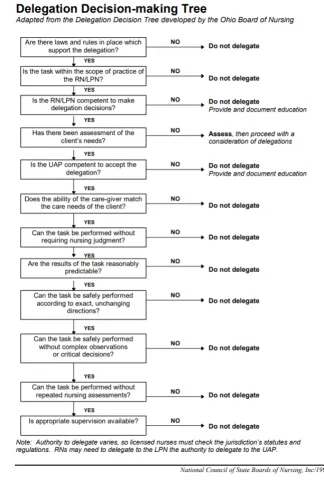
The Delegation Decision-Making Tree, a tool developed by the ANA and modified by other organizations, assists nurses in making delegation decisions. Licensed nurses have ultimate accountability for the management and provision of nursing care, including all delegation decisions.
To use the Delegation Decision-Making Tree, start with a specific client (student), caregiver (UAP) and nursing activity. Beginning at the top of the tree, ask each question as presented in the box. If you answer “no” to the question, follow the instructions listed to the right of the box and arrow. If you answer “yes,” proceed to the next box. If you answer “yes” for any question, the task is delegable.
Recordkeeping
The Missouri Secretary of State’s Office is responsible for updating any changes to the law in the recordkeeping for school districts. The school nurse will need to identify the staff person in charge of the school district’s records and seek instruction from them on the district’s current system. Some districts keep all records electronically in a student information system while other districts still use paper copies. Whatever system the district uses, they must maintain health records according to state and federal laws and keep records available only to those with a need to know.
The Family Educational Rights and Privacy Act (FERPA) pertains to student records developed by a school district, while Health Insurance Portability and Accountability Act (HIPAA) records normally pertain to a clinic or hospital. The Family Educational Rights and Privacy Act (20 U.S.C. § 1232g; 34 CFR Part 99) is a federal law that protects the privacy of student education records. The law applies to all schools that receive funds under an applicable program of the U.S. Department of Education. The Health Insurance Portability and Accountability Act of 1996 is a federal law that requires the creation of national standards to protect sensitive patient health information from being disclosed without the patient’s consent or knowledge. (For more information on these two acts, please see Laws, Rules and Regulations Relating to School.)
Use the following chart to understand the retention of school health records according to Missouri law.
Table 4. Local Records Retention Schedules
Local Records Retention Schedules
| Record Type | Record | Function of the Record | Retention Requirements |
|---|---|---|---|
| Individual Student Records | Cumulative Health Record May include:
| Record specific to a student with health history, immunization records, including immunization exemptions, screening results, etc. | 10 years or age 23 |
| Special Education Records | Records needed for student’s Individualized Education Program (IEP) | Destruction of Information (34 CFR 300.624): The public agency shall inform parents when personally identifiable information collected, maintained, or used under this part is no longer needed to provide educational services to his/her child. The information must be destroyed at the request of the parent subject to the federal requirement that districts retain records for a minimum of three (3) years from the date the child no longer receives special education and related services. | |
| Various Health Records | Emergency Cards (renewed annually) | May contain:
| 1 year |
| Health Care Plans | Summary of nursing plan of care for students with special health needs | 1 year | |
| Immunization “in progress” forms | Documents staff is verifying student is current until next scheduled immunization is due | Until next immunization is complete (Revised 8/09) | |
| Incident Reports | Incident reports–record of internal concerns, medication errors | Stored separately from student records |
(Missouri Secretary of State, 2023; RSMo 167.027)
Resources
Table 5. Resources for School Health Programs
| Resources for School Health Programs |
|---|
Missouri Department of Health and Senior Services (DHSS) [NEEDS LINK] The Department employs a state school nurse consultant to provide consultation to school nurses, school administrators, agencies, and organizations interested in school health, and the public on issues pertaining to health services in schools. Contact the state consultant via phone at 573-522-2822 or e-mail at SHS@health.mo.gov. DHSS has many school health-related materials available on the school health website, free of chare. Schools may copy or adapt for use without permission, any DHSS material. |
Missouri Department of Elementary and Secondary Education (DESE) The following resources are available from DESE’s website:
|
Missouri Department of Social Services (DSS) Guide for Mandated Reporters of Child Abuse and Neglect (2020) |
Missouri Department of Mental Health Find information on the location and types of DMH funded programs available including children’s services |
Missouri State Board of Nursing Find information related to RN/LPN practice on the Boards website under the “Practice” tab. Also find on this site:
|
Local Records Retention Schedules |
Missouri Association of School Nurses The association provides leadership and promotes professional growth to advance the practice of school nursing. |
National Association of School Nurses
|
| PediaLink: American Academy of Pediatrics Education — Where Knowledge Thrives |
| The National Association of Councils on Developmental Disabilities |
| Resha, C., & Taliaferro, V. (2024). Legal Resource for School Health Services. School Nurse.com: Virginia |
Table 6. Resources for Professional Development for School Nurses
| Resources for Professional Development for School Nurses |
|---|
| Using the Standards of School Nursing Practice as a guide, school nurses may identify a need for continuing education (CE) in an area but have difficulty accessing a program due to geography, cost, or time. Online courses are readily available on many topics. School nurses may provide a copy of CE certificates to the school administration, which will be placed in their personnel file. It is evidence that the school nurse is a life-long learner and that the nurse is keeping their knowledge and skills up to date. |
| The Public Health Foundation’s TRAIN.org is a nationwide network of universities focusing on workforce development for individuals working in public health settings, including schools. The St. Louis University School of Public Health Learning Management System (LMS) is part of this network, as is the Centers for Disease Control and Prevention (CDC) and the Federal Emergency Management Agency (FEMA). School nurses can access courses in principles of public health, epidemiology, disease prevention, HIPAA, emergency preparedness and response, etc. Most courses are free, and learners can complete them in segments, take mastery testing and download completion certificates. TRAIN and LMS will track courses completed and provide transcripts. |
| The Department of Mental Health encourages all individuals who might respond to an emergency or disaster to access the National Child Trauma Safety Network course on psychological first aid. This 12-hour interactive course is free of charge, and participants can download a certificate when they complete it. |
| Members of the National Association of School Nurses (NASN) have access to many continuing education opportunities, free of charge. Courses currently available through NASN include education on immunizations, leadership, collaboration, standards of practice, quality improvement, and many others. NASN also has an annual conference at which school nurses can earn CE’s. |
The Centers for Disease Control and Prevention website offers information on health-related topics, including: |
| Nurse.com provides many short courses on all aspects of nursing. |
| Show Me School Health provides school nurses free videos, information, and procedures to help educate school nurses and other staff. |
| School Health Associates, LLC has many videos, procedures, and modules that school nurses can review. |
| The Missouri Association of School Nurses has opportunities for continuing education at their conferences for both members and nonmembers. |
Chapter 2 References
- American Nurses Association. (2012). Decision tree for delegation by registered nurses.
- American Nurses Association. (2012). Principles of delegation. Accessed on December 6, 2023, at https://www.nursingworld.org/
- Center for Disease Prevention and Control. (n.d.). HIPAA. Accessed on December 6, 2023, at https://www.cdc.gov/phlp/publications/topic/hipaa.html
- Missouri Board of Nursing. (n.d.). Delegation decision-making tree. Accessed on December 6, 2023, at https://pr.mo.gov/boards/nursing/delegationtree.pdf
- Missouri Secretary of State. (2023, November) Local records retention schedules. Accessed on December 6, 2023, at https://www.sos.mo.gov/CMSImages/LocalRecords/PublicSchool.pdf
- National Academies of Sciences, Engineering, and Medicine. (2021). The future of nursing 2020-2030: Charting a path to achieve health equity. Washington, DC: The National Academies Press. https://doi.org/10.17226/25982.
- National Association of School Nurses. (2022). School nursing: Scope and standards of practice (4th ed.). NASN.
- National Council of State Boards of Nursing. (n.d.). Delegation. Accessed on December 6, 2023, at https://www.ncsbn.org/nursing-regulation/practice/delegation.page
- National Council of State Boards of Nursing & American Nurses Association. (2019, April 29). National guidelines for nursing delegation. Accessed on December 6, 2023, at https://www.ncsbn.org/public-files/NGND-PosPaper_06.pdf
- Russell, K. A. (2017). Nurse practice acts guide and govern: Update 2017. Journal of Nursing Regulation 8,(3), 18-25. Available at https://www.ncsbn.org/publicfiles/2017_NPA_Guide_and_govern.pdf
- Student special education record deemed permanent record. Revisor of Statutes. (2023). RSMo 167.027. Available at: https://revisor.mo.gov/main/OneSection.aspx?section=167.027&bid=54305&hl=school% u2044IEP
- U.S. Department of Education. (n.d.). Protecting student privacy. Accessed on December 6, 2023, at https://studentprivacy.ed.gov/?src=fpco
- Yonkaitis, C.F., & Reiner, K.L. (2022). School nursing scope and standards: What’s new and important in the fourth edition? NASN School Nurse (Print), 37(5), 277-280.
Appendix 2A: Sample List of Responsibilities for Registered Nurse Supervising LPNs
The nurse supervisor will:
- Health Office Management
- Be available to LPN for consultation by telephone or in person.
- Provide guidelines/protocols for care of illness and injury.
- Review health room logs routinely (frequency determined by RN).
- Review medication and treatment logs on a routine basis and maintain a record of review.
- Consult with LPN concerning students with health and absentee problems.
- Develop or maintain a community resource file for access to care and referrals.
- Special Health Care Needs
- Assess students with special health care needs to determine the level of care needed.
- Identify students needing health care plans (Emergency Action Plans, Individual Health Care Plans, Individualized Health Care Action Plans, Section 504 Accommodation Plans, etc.) and prepare as needed. Provide staff education regarding chronic health conditions as needed.
- Participate in observation of students with ADD/ADHD when requested.
- Develop individualized health care plans (IHP) for students with chronic illness or disability in collaboration with LPN.
- Provide support for/assist the LPN in the implementation activities of IHP or other caregivers, as appropriate.
- Screening Programs
- Determine the frequency of screenings by program and grade after consultation with school administration.
- Assist LPN with initial screening programs, including students with special needs, if needed.
- Rescreen all students identified with possible defects, review health history and consult with parent(s)/guardian(s) as needed in making referral decisions.
- Monitor referral completion rates and assist as needed with parental contact.
- Prepare health information from screenings for IEP staffing as requested.
- Education
- Provides support for/assists LPN to provide in-service to designated school personnel on medication administration.
- Provide classroom instruction on health topics when appropriate and as requested.
- Provide student-specific information to teachers regarding students with special health care concerns.
- Assist teachers in finding health instruction resources.
- Provide input regarding health instruction/curriculum needs.
- Other Duties
- Assess the school environment on a routine basis, including playground equipment, restrooms, etc.
- Support/assist LPNs during illness outbreaks (e.g., data collection and management of health concerns).
- Evaluation
- Meet with LPN to monitor school health nursing activities, including triage of illness and injury, medications and treatments, absenteeism, etc. (frequency determined by RN, suggested minimum is four hours per week).
- Determine and educate the LPN new to school nursing and evaluate competencies on a regular basis.
- Review the results of screening programs to determine a plan for the subsequent school year.
- Meet on a routine basis with the LPN and school administrator to review the program.
- Collaborate with school administrator in performance evaluation of LPN.
Appendix 2B: Sample List of Responsibilities for Licensed Practical Nurse
Under the Supervision of a Registered Nurse
- Health Room Management and Triage
- Maintain cumulative health records.
- Maintain a daily log of all students seen in the health room.
- Follow established policies and procedures for the care of ill and injured students.
- Follow up with students with excessive absences for health reasons and consult RN.
- Send out referral letters for health problems and screening failures after rescreening by RN and making referral decisions, if applicable.
- Follow up on referrals and track referral status.
- Implement a fluoride rinse program and maintain the required record of the program if the district is participating in the fluoride rinse program.
- Maintain health room supplies and equipment.
- Prepare weekly reports of nursing activity for school administration.
- Identify possible abuse and neglect and follow the district reporting procedures.
- Special Health Care Needs
- Participate in developing emergency action plans for students needing emergency provisions.
- Implement individual health care plans, including special care procedures, as approved by RN or physician.
- Provide vision and hearing assessment for students being evaluated for special education placement and report findings to RN and Special Education team, if applicable.
- Provide health information to students and families as needed.
- Screening Programs
- Screen all new students for height/weight, vision, hearing, and dental problems within one week of enrollment.
- Do initial screening for vision and hearing problems per district policy/protocol.
- Education Activities
- Provide health instruction to students, teachers, parent(s)/guardian(s), and community as needed.
- Assist teachers in finding resources for health education.
- Participate in community outreach programs.
- Assist school food service personnel in promoting healthy food choices.
- Assist school personnel with health needs, as indicated.
- Evaluation
- Meet weekly with the nurse supervisor to monitor school health nursing activities, including triage of illness and injury, medications and treatments, absenteeism, etc., and with the school administrator at least monthly regarding the school health program.
- Review medications and treatments at least weekly with the nurse supervisor, if applicable and necessary.
Appendix 2C: Sample Agreement for Supervision
By state law, Chapter 335, LPNs must practice under the supervision of a registered professional nurse or a licensed physician. LPNs can provide nursing care without direct physical oversight but must be supervised by a registered professional nurse or a licensed physician. School Districts may modify this template to include protocols and procedures specific to the individual school district.

Appendix 2D: School Health Facilities and Supplies
The school’s health facilities should accommodate all school health activities, such as emergency care of illness and injury, health appraisals, routine screenings, conferences, private interviews, etc. Lavatory and toilet facilities are essential for infection control. The preferred location is adjoining the administrative offices to facilitate communication and provide for supervision of the health room when the nurse is not present. The facility should be located on the ground floor, near an entrance, to expedite transportation of the sick and injured.
The number of students served and the components of the health services program will determine the number of individual areas in the health facility. There should be space for isolation of students, as well as a resting area. It is also helpful to have a large enough area to conduct routine screenings. A private office and a separate waiting room are desirable.
School health facilities should also allow for storage of health records in locked file cabinets in the health room, which should also be locked when not in use. Staff must also keep medications in locked cabinets. Controlled substances should be kept in locked boxes in a locked cabinet or room. The nurse and administrator should control access to keys. A refrigerator is needed in which to store medication that needs to be refrigerated, and a freezing compartment is helpful for storing readily accessible ice packs.
Table 7. Suggested equipment and supplies for the health room
| Location | Recommended Supplies |
|---|---|
| Reception Area and Office |
|
| Assessment Area |
|
| Infirmary Area |
|
“Emergency Go Bag” Some schools have |
|
Appendix 2E: Suggested School Nursing Activity Calendar
Note: A program this extensive is not appropriate for a new school nurse to implement but may provide ideas for organizing activities.