
Introduction
Summer Food Service Program Manual
Missouri Department of Health and Senior Services Summer Food Service Program Manual

In accordance with federal civil rights law and USDA civil rights regulations and policies, the USDA, its agencies, offices, employees, and institutions participating in or administering USDA programs are prohibited from discriminating based on race, color, national origin, religion, sex, disability, age, marital status, family/parental status, income derived from a public assistance program, political beliefs, or reprisal or retaliation for prior civil rights activity, in any program or activity conducted or funded by USDA (not all bases apply to all programs). Remedies and complaint filing deadlines vary by program or incident.
Persons with disabilities who require alternative means of communication for program information (e.g., Braille, large print, audiotape, American Sign Language, etc.) should contact the state or local agency that administers the program or contact USDA through the Telecommunications Relay Service at 711 (voice and TTY). Additionally, program information may be made available in languages other than English.
To file a program discrimination complaint, complete the USDA Program Discrimination Complaint Form, AD-3027, found online at How to File a Program Discrimination Complaint and at any USDA office or write a letter addressed to USDA and provide in the letter all of the information requested in the form. To request a copy of the complaint form, call (866) 632-9992. Submit your completed form or letter to USDA by:
- Mail: U.S. Department of Agriculture, Office of the Assistant Secretary for Civil Rights, 1400 Independence Avenue, SW, Mail Stop 9410, Washington, D.C. 20250-9410;
- Fax: (202) 690-7442; or
- Email: program.intake@usda.gov.
USDA is an equal opportunity provider, employer, and lender.
Introduction to SFSP
Summer Food Service Program Manual
SFSP serves nutritious meals and snacks to children when school is not in session. Sponsors participating in SFSP must follow program regulations.
How to Contact the Program
For questions about the Summer Food Service Program (SFSP), requests for technical assistance, or instructions on how to schedule training, please contact:
Missouri Department of Health and Senior Services
Community and Public Health
Community Food and Nutrition Assistance
P.O. Box 570
930 Wildwood Drive
Jefferson City, MO 65102
1-888-435-1464
Fax: 573-526-3679
Email: sfsp@health.mo.gov
Additional Contact Information
Training
- Training for the Summer Food Service Program is available online at the SFSP website [NEEDS LINK]. The training consists of four modules. SFSP sponsors must complete all four modules.
- Training will also be provided via WebEx. Contact CFNA to register.
- Online Civil Rights training is also available at the SFSP website [NEEDS LINK].
Introduction
Learning does not end when school lets out, and neither does the need for good nutrition. The United States Department of Agriculture’s (USDA) Summer Food Service Program (SFSP) relies on innovative and collaborative efforts to reach children in need. The USDA encourages collaborations with valued partners at the national, state, and local levels to raise awareness about the nutrition gap children can face when schools close for the summer and to raise awareness about the availability of summer meals to close this gap.
The SFSP was established to ensure that children continue to receive nutritious meals when school is not in session. At approved SFSP sites, free meals that meet federal nutrition guidelines are provided to all children.
The SFSP operates during school vacations, primarily in the summer months – from May through September. It may also provide meals during vacation breaks in schools that are operated on a year-round basis or a continuous school calendar, or during emergency school closures from October through April.
The USDA’s Food and Nutrition Service (FNS) administers the SFSP at the national and regional levels. Within the state of Missouri, the program is administered by the Department of Health and Senior Services-Community Food and Nutrition Assistance (DHSS-CFNA).
Locally, public, or private nonprofit organizations that want to “sponsor” the program apply and, if eligible, are approved by the DHSS-CFNA to operate the program. These sponsoring organizations sign program contracts and are responsible for overseeing program operations. Sponsors receive federal reimbursement from the DHSS-CFNA to cover the administrative and operating costs of preparing and serving meals to children at one or more eligible meal service sites.
As a sponsor interested in administering the SFSP, you are the link that translates this federal benefit into nutritious meals and snacks for children. If you are new to the program, please consider participating as a site or sponsor in this important mission. If you are a returning sponsor, please consider adding sites and activities that will help draw children to your existing program.
Reimbursement Rates
(Rates Change Annually)
Sponsors will receive a payment based on the number of meals served multiplied by the current reimbursement rate. This is the total they will receive and includes a calculation for administrative and operating costs all in this one rate. Payment received is not adjusted based on funds budgeted.
Reimbursement rates are presented as a combined set of rates to highlight simplified cost accounting procedures. Reimbursement is based solely on a “meals times rates” calculation without comparison to actual or budgeted costs.
Sponsors receive reimbursement that is determined by the number of reimbursable meals served, multiplied by the combined rates for food service operations and administration. However, the combined rate is based on separate operating and administrative rates of reimbursement, each of which is adjusted differently for inflation.
For Meals Served at Rural and/or Self-Prep Sites
| Meal | Current Rate |
|---|---|
| Breakfast | |
| Lunch or Supper | |
| Supplement |
For Meals Served at Urban Vended Sites
| Meal | Current Rate |
|---|---|
| Breakfast | |
| Lunch or Supper | |
| Supplement |
Current Meal Reimbursement Rates are also located on the SFSP website [NEEDS LINK] under Applications and Forms.
Calculate Potential Reimbursement for the Budget
| Category | Number/Amount |
|---|---|
| Estimated daily meals to be served | |
| Times the number of days of operation | |
| Times the reimbursement rate for meal type | |
| Equals the potential SFSP reimbursement for meal type |
Perform this calculation for each meal type to be served then add these amounts together. Repeat calculations for sites with different meal types or a different number of days of operation. The sum of all calculations equals the potential reimbursement and should be used to prepare the budget on the application. When you access the web-based system, the meals times rate will be displayed on the web-based budget sheet.
Performance Standards
Financial Viability, Administrative Capability, Program Accountability
To participate in the Summer Food Service Program (SFSP), a sponsor is required to demonstrate financial and administrative capability for program operations and accepts final financial and administrative responsibility for program operations at all sites it proposes to conduct a food service in accordance with the performance standards outlined in SFSP regulations (7 CFR 225.6).
The Department of Health and Senior Services-Community Food and Nutrition Assistance (DHSS-CFNA) must only approve the applications of those sponsors that meet these performance standards and must deny the applications of those sponsors that do not meet the standards. In ensuring compliance with these performance standards, the DHSS-CFNA establishes rules and procedures and makes decisions based on information from internal controls at the federal and state level that includes information obtained during the application process; information from audits and complaints, results of edit checks, claim reviews, monitoring reviews; and notice of civil and criminal action.
Each new and renewing sponsor must submit information sufficient to document they are operating in accordance with the SFSP Performance Standards – Viability, Capability, and Accountability (VCA) outlined in 7 CFR 225.6(d):
- The sponsor must be Financially Viable. The sponsor must expend and account for program funds in accordance with 7 CFR 225.6, FNS Instruction 796-4, Financial Management in the Summer Food Service Program; 2 CFR part 200, subpart D; and USDA regulations 2 CFR parts 400 and 415.
- The sponsor must provide a budget and demonstrate that it has adequate sources of funds available to operate the program, pay employees and suppliers during periods of temporary interruptions in program payments, and pay debts if fiscal claims are assessed against the sponsor. The sponsor must provide documentation to demonstrate financial viability, such as audit documents, financial statements, and other requested documentation prior to approval of an application and at any time requested by the state agency.
- The sponsor must be Administratively Capable. The sponsor must have appropriate and effective management practices in place to ensure that the program will operate in accordance with SFSP regulations. To demonstrate administrative capability, the sponsor must have an adequate number and type of qualified staff to ensure the operation of the program, consistent with SFSP regulations; and have written policies and procedures that assign program responsibilities and duties and ensure compliance with civil rights requirements.
- The sponsor must demonstrate Program Accountability. The sponsor must have internal controls and other management systems in effect to ensure fiscal accountability and ensure that the program will operate in accordance with SFSP requirements. To demonstrate program accountability, the sponsor must demonstrate that the sponsor has a financial system with management controls specified in written operational policies that will ensure that:
- All funds and property received are handled with fiscal integrity and accountability;
- All expenses are incurred with integrity and accountability;
- Claims will be processed accurately, and in a timely manner;
- Funds and property are properly safeguarded and used, and expenses incurred, for authorized program purposes; and
- A system of safeguards and controls is in place to prevent and detect improper financial activities by employees.
The sponsor must maintain appropriate records to document compliance with program requirements, including budgets, approved budget amendments, accounting records, management plans, and site operations.
Management Tools and Resources
Sponsors enter a contract with the Department of Health and Senior Services-Community Food and Nutrition Assistance (DHSS-CFNA) to participate in the SFSP. The following management tools and resources are available on the Missouri SFSP website [NEEDS LINK]:
- SFSP Income Eligibility Guidance for Camps and Enrolled Sites
- United States Department of Agriculture Food Buying Guide for Child Nutrition Programs
- Summer Food Service Program Manual
- “And Justice For All” poster
- SFSP Signs
- USDA Manuals: Administration Guide, Nutrition Guide, Site Supervisor Guide, and Sponsor Monitor’s Guide
Single Audit Compliance
Under 2 CFR 200.501—Audit Requirements, SFSP Sponsors are required to submit a Single Audit within nine months of the close of your fiscal year for any fiscal year in which you expend $1,00,000.00 or more in federal funds.
A Single Audit is when a professional auditor goes over a grantee’s financial management processes, including its financial management system and its compliance with all of its federal grant requirements. It is called a Single Audit because it combines one audit covering all of a grantee’s federal grants. The purpose is to ensure grantees receiving federal grant funds use the funds in compliance with the government’s requirements. It was created to promote sound financial management, promote uniform guidelines for audits and deploy audit resources efficiently.
Failure to Comply will result in a declaration of Seriously Deficient by the state and possible program termination.
Non-Contractible Management Responsibilities
7 CFR 225.15 (a)(3)
Each SFSP sponsor is required to complete a Management Plan annually. The Management Plan is part of the online application and instructs the sponsor to identify who will be responsible for certain management actions.
There are specific management responsibilities that sponsors may not contract out. Sponsors remain legally responsible for ensuring the food service operations meet all requirements specified in the agreement the sponsor signs with the state agency. Sponsors may not contract out management responsibilities of the program, including but not limited to the following tasks:
- Attending the Department of Health and Senior Services-Community Food and Nutrition Assistance (DHSS-CFNA) annual training.
- Locating and recruiting eligible sites.
- Conducting pre-operational visits of sites.
- Competitively procuring food to be prepared or contracting with a vendor for meals to be delivered to your meal sites.
- Monitoring all sites.
- Preparing and submitting claims for reimbursement.
- Conducting a nonprofit food service.
- Ordering meals.
- Assuming official recordkeeping responsibilities.
- Consolidating and submitting claims for reimbursement.
- Training and monitoring administrative and site staff.
- Announcing the availability of meals to the news media.
- Determining income eligibility and maintaining individual income eligibility statements.
- Enforcing corrective action.
- Preparing program applications.
Sponsors should check with the state agency before allowing a Food Service Management Company (FSMC) to undertake any other tasks that may be considered management functions or any tasks that are related to the bulleted items listed above. It is also important to note that an FSMC contract is between the sponsoring organization and the FSMC only, and neither USDA nor the state agency has jurisdiction to enforce it with either party or to resolve any disputes that may arise.
Expansion and Outreach
Summer Food Service Program (SFSP) sponsors may utilize the United States Department of Agriculture’s (USDA) Capacity Builder Map to determine underserved areas and identify locations for new sites. Sponsors can also find their nearest potential community partners, such as multi-family housing units, libraries, faith-based institutions, military bases, schools, and more. The Capacity Builder Map is available on the USDA website under Mapping Tools for Summer Meal Programs.
Families may utilize Missouri’s Geographic Information System (GIS) map to find SFSP sites in their area. This can be found on the SFSP webpage [NEEDS LINK], under "Find an SFSP site near you".
Pre-Operational Site Visit
Pre-operational visits must be conducted by the sponsor for each new site prior to application submission, and the Pre-Operational Site Visit forms must be kept on-site for the Department of Health and Senior Services-Community Food and Nutrition Assistance (DHSS-CFNA) to review. Before sites operate the SFSP, pre-operational visits must be completed for new sites, sites that are new to rural non-congregate meal service, and those sites that experienced operational problems the previous year. These visits are required to determine that the sites have the facilities to provide meal service for the anticipated number of children in attendance and the capability to conduct the proposed meal service. The Pre-Operational Site Visit Form is available on the SFSP webpage.
Pre-operational visits must be conducted by the sponsor for each new site prior to application submission, and the Pre-Operational Site Visit forms must be kept on-site.
Operation Guidelines
The Summer Food Service Program (SFSP) operates during school vacations, primarily in the summer months from May through September. This program may also provide meals during vacation breaks where schools are operated on a year-round basis or a continuous school calendar, or during disaster-related emergency school closures from October through April.
Sponsors are responsible for overseeing program operations and ensuring that all sites adhere to federal regulations. Sponsors receive federal reimbursement from the state agency to cover the administrative and operating costs of preparing and serving meals to eligible children at one or more feeding sites. A sponsor can be very large and have many sites or be small with only one or two sites.
General Site Rules for SFSP Programs
- Meal services are for children 18 years or younger and persons with disabilities over age 18 who participate in school programs for people who are mentally or physically disabled.
- Food provided by the site as part of SFSP cannot be taken from the site (congregate meals); all meals must be eaten on-site (unless prior approval is given by the State).
- Second meals may only be served after all children have received a first meal. Second meals are not allowed for the Rural Non-Congregate option of meal service.
- The maximum number of second meals a sponsor can be reimbursed for is 2% of the sponsors’ total first meals in a claiming period. Therefore, it is critical that sites adjust their meal preparations daily to avoid overproduction of meals.
- Parents may assist their children in carrying or opening meal packages, but may not consume any part of the meal.
- Sponsors with rural sites may request to serve non-congregate meals. All requests will require the completion of an agreement to operate the non-congregate meal service under the stipulations set forth by the state. Requests should be sent to sfsp@health.mo.gov.
Dates and Times of Operation
Meals must only be served during the approved meal times. The approved meal times are the times listed on the approved Site Information Sheet in the Summer Food Service Program (SFSP) application and claims database. You must adhere to your approved meal times and meal dates, or meals will be disallowed. A sponsor may submit changes to a site’s meal service times and meal service dates at any time during the operation of the site. However, it is critical these changes be submitted and approved by the state prior to implementing the changes. Submit changes online via the CNPWeb application.
A site that does not operate or is unable to serve the proposed meals for the approved date and meal time may be closed by the Department of Health and Senior Services-Community Food and Nutrition Assistance (DHSS-CFNA). This includes being inoperable due to a non-disclosed field trip or inclement weather. Regulation 7 CFR 225.6(g)(1)(viii) states that sites will make arrangements for food service during periods of inclement weather. This requirement may be met by providing an alternate location during a weather event. All sponsors that operate sites outdoors must have a plan for serving meals during inclement weather, including excessive heat.
A site may be closed for the following:
- Failure to provide meal service on a date or during a time submitted and approved on the Site Information Sheet.
- Failure to request prior approval for a change in meal types served.
- Failure to request prior approval for a change in serving times.
- Failure to request prior approval for site operation location changes.
- Failure to request prior approval for site operation dates.
- Failure to complete and submit a site application for a site.
- Failure to report field trips prior to the trip date.
- Failure to adhere to the inclement weather policy.
Planning for Extreme Weather Conditions
Concerns for the physical health and safety of children and consideration of extreme weather conditions must be addressed by sponsors. Sponsors must ensure they have made appropriate arrangements for food service during periods of inclement weather. Although all outdoor Summer Food Service Program (SFSP) sites are not required to have an alternate temperature controlled site, sponsors should have a contingency plan for dealing with extreme weather conditions, such as thunderstorms and excessive heat.
If possible, sponsors of open sites should continue operating at the approved location. If due to extreme weather conditions, a sponsor must temporarily close an open site, the sponsor must update their site application in the CNP web-based system and submit for the Department of Health and Senior Services-Community Food and Nutrition Assistance (DHSS-CFNA) approval.
If DHSS-CFNA approves the open site to close, the sponsor must notify the community of the change in meal service and provide information on alternative open sites.
Site Definitions and Eligibility Documentation
Summer Food Service Program (SFSP) Site Types
A site is the place where a child receives a program meal. It may include the indoor or outdoor location where congregate meals are served, a stop on the delivery route of a mobile congregate meal service, or the distribution location or route for a non-congregate meal service. However, a child's residence is not considered a non-congregate meal site for Program monitoring purposes. Once a site is determined eligible, it is eligible for 5 years.
| Site Type | Site Description | Eligibility Documentation |
|---|---|---|
| Open |
|
|
| Restricted Open |
|
|
| Closed Enrolled |
|
|
| Residential Summer Camp and Non-Residential Day Camp |
|
|
| Migrant |
|
|
| Conditional Non-Congregate Sites |
|
|
Approval and Operation of a Rural Non-Congregate Site
The Consolidated Appropriations Act of 2023 established a permanent non-congregate meal service option for rural areas that do not have congregate meal service available.
Sponsors that operate in rural areas can request to operate a rural non-congregate feeding site with the following guidelines noted:
- The site must be indicated as a rural site as determined by USDA Memo SFSP 17-2015, and the organization must provide documentation supporting the rural designation, such as a screenshot of the FNS Rural Map.
- To participate, an organization must be currently in good standing. Meaning that the organization is current with its financial obligations, and, if applicable, has fully implemented all corrective actions within the required period of time as required from a previous review. If the sponsor was not in good standing the previous year and was declared SD in SFSP or CACFP, then the sponsor’s SD status must have been temporarily deferred by a corrective action plan (CAP), and a follow-up review must have occurred to determine that the CAP has been fully implemented.
- When utilizing the non-congregate option, an organization must ensure that the required meal components for each reimbursable meal served meet the meal pattern requirements; ensure that all food items that contribute to a reimbursable meal are clearly identifiable; must ensure that menus are provided; and must ensure that food preparation is minimal (no raw meat).
- To be approved, a rural non-congregate site must be at least 10 miles from any open congregate site that is offering the same meal service.
- To be approved, a rural non-congregate site must not be in operation/will not operate within 15 miles of another non-congregate site. School districts are excluded from this mileage restriction if providing holiday and weekend meals to students at each qualifying school.
- The operation of a site as a rural non-congregate must be documented on the SFSP Site Information Sheet in the Non-Congregate Operations section of the CNPWeb application.
- The capacity of children to be served at the rural non-congregate site must be no greater than one hundred percent of the number of children 0-18 years of age in the service area per the most current census data. Combining and averaging adjacent census block areas may be allowed on a case-by-case basis.
- Parents or Guardians may pick up meals for the child(ren) without the child(ren) present, but the Parent or Guardian must provide the name(s) of the child(ren) who will receive the meals, and the sponsor must keep this documentation on file.
- The sponsor must collect and retain documentation of each child’s name receiving a meal as the meal is distributed.
- The organization must have a procedure in place to ensure that duplicate meals are not distributed to any child and that children only receive the allowable number of meals per day per SFSP regulation.
- Bulk meal pick-up or multiple-day meal pick-up at the rural non-congregate site are the two non-congregate options.
- The organization may only provide bulk meal (non-unitized, grocery-style meals) pick-up for 5 days at a time. Additional days may be added on a case-by-case basis.
- The organization may only provide multiple unitized meal (individual proportioned meals) pick-up for up to 10 days. If an organization wishes to serve only 7 days, it may increase to 10 days if there is a holiday.
- If a site wishes to serve non-congregate meals but does not qualify based on area eligibility, the site could be determined to be a Conditional Rural Non-Congregate site. The site can collect Income Eligibility Forms from participants and claim only those children who meet the income standards. If this option is chosen, the sponsor must submit a copy of the organization's hearing procedures with the application.
- The organization must complete a Pre-Operational site visit and document the visit on the Pre-Operational site review form prior to site approval for all sites that did not participate in the program the prior year, existing sites that are new to non-congregate meal service, and existing sites that exhibited operational problems the prior year.
- If at any time the organization receives a poor review of their rural non-congregate site (claiming more meals than observed, no meal counts available, no trained site on staff, unallowable meals served, meals provided to ineligible participants, and any other findings determined serious), the organization can be restricted to congregate meals only. In addition, depending on the findings, and at the discretion of the state, the site can be terminated, and no future non-congregate sites will be allowed until the organization operates for three years with minimal findings.
- Home deliveries are restricted to sponsors that have a properly equipped delivery vehicle and proper delivery equipment to maintain the temperatures of meals. Meals must not be left on doorsteps. No third-party delivery companies shall be utilized without submitting a delivery plan, a shelf stable menu, and prior consent of the state. The delivery route is the site and must be monitored in its entirety. The sponsor must obtain and have on file written parental consent prior to providing meals to the children. Documentation of each child’s name who is being provided a meal will be collected as the meal is distributed. The sponsor agrees to protect the privacy of participating households’ information. Each stop on the route must be identified as “rural”.
Applications, Procurement, Training, and Civil Rights
Summer Food Service Program Manual
Sponsors must apply and sign a contract to participate in SFSP. Sponsors are also required to complete state agency training and train their staff prior to operating.
Application Process
To apply for the program, potential sponsors must complete the Summer Food Service Program (SFSP) Potential New Sponsor Questionnaire and the SFSP Site Eligibility Questionnaire for each site to determine eligibility for the program. The sponsor will also complete a Network User Access Request form. A sponsor that meets the eligibility requirements will be given online access to complete the SFSP application in the CNP web-based system at mo.cnpus.com/cnp/Login.
Please note that the sponsor is not approved for SFSP operations until the application has been approved by the Department of Health and Senior Services-Community Food and Nutrition Assistance (DHSS-CFNA). CFNA will not pay for meals served prior to approval.
Steps to the application process are outlined on the SFSP website under the heading "Application Process".
Returning sponsors should update the application on the CNP web-based system.
On the CNP web-based system, Sponsors must complete the Sponsor Information Sheet, Budget, and Site Information Sheets prior to completing the Management Plan. Please ensure that all information is accurate.
Budgets should include all reasonable uses of the funds and must include the cost of those doing the paperwork and those cooking/serving the meals and the cost of the Food Service Management Company (FSMC) and/or the cost of food. If a cost is not on the budget, it is not an allowable cost and may be disallowed. Please note that sponsor reimbursement is not based on the budgeted amount. Sponsors should budget with the knowledge of the estimated reimbursement and any other sources of income the sponsor receives.
Management Plans must include your plan of how you will run the program and who will be assigned as responsible individuals. Please note that those listed to Monitor SFSP Sites are those who will be doing the formal monitoring at the sites and cannot be the Site Supervisor listed for that site.
Direct questions on the application process to DHSS-CFNA at SFSP@health.mo.gov or (888) 435-1464.
New Application Checklist [NEEDS LINK]
Application Deadlines
(For complete applications only.)
- April 1-May 1, if you are interested in receiving commodities.
- By May 1, if requesting a June advance.
- The final deadline to submit Potential New Sponsor Questionnaires is May 1.
- The final deadline for new sponsors to submit a fully completed application is May 15.
- The final deadline for returning sponsor renewal completion is 30 days prior to the first day of operation. For example, if SFSP operation begins June 2, a completed application is due no later than May 1.
Be sure to retain a copy of the SFSP uploaded documents for your records!
Site Operation Checklist [NEEDS LINK]
SFSP Sponsor checklist. This is a guide and is not all inclusive.
Meal Preparation and Contracting for Food Service
The best method of meal preparation will depend on factors such as the type of menu desired, the availability of food service equipment, space and personnel, and the budget of the organization.
Meal Preparation Methods
- Self-prep: Self-prep, also referred to as on-site preparation, means a site that prepares the majority of meals that will be served at its site or receives meals that are prepared at its sponsors’ central kitchen. The site does not contract for unitized meals, with or without milk, or for management services. This is the most economical method when the center has a kitchen, sufficient food preparation equipment, and available staff. The sponsor will follow the basic recordkeeping requirements of the Summer Food Service Program (SFSP).
- Central Kitchens: Meals are prepared in a kitchen at one of the sponsor’s physical locations or sites by the sponsor’s employees and delivered to another one or more of the sponsor’s sites. The sponsor will follow the basic recordkeeping requirements of the SFSP plus daily meal delivery tickets, where applicable. Contact the Department of Health and Senior Services-Community Food and Nutrition Assistance (DHSS-CFNA) for specific requirements for your circumstances.
- Vended: Vended site means a site that serves unitized meals, with or without milk, that were procured through a formal agreement or contract with: (a) public agencies or entities such as a school food authority; (b) private, nonprofit organizations; or (c) private, for-profit companies such as a commercial food distributor or food service management company (FSMC). This includes an FSMC that operates within a school.
- Purchasing from a School: Meals may be purchased from a public or private nonprofit school that participates in the National School Lunch Program (NSLP) or the School Breakfast Program (SBP), either in bulk or as individually packaged units. A sponsor who receives meals from a school must enter into a written agreement with that school or district.
- This annual agreement must contain the basic provisions of the non-competitive bid process as required by the program. A sponsor may use the Sponsor Agreement with a School or Affiliated Organization to Furnish Food Service for the SFSP located on the SFSP website. Federal regulations exempt organizations from having to competitively bid for catered meals when those meals are purchased through schools participating in the NSLP or SBP. Signing an agreement with a school to provide meals does not relieve the independent center of its program responsibilities for monitoring and recordkeeping. Additional recordkeeping is required when a sponsor obtains meals from a school; recordkeeping requirements are listed below.
- Purchasing from another Department within the Organization: Organizations that receive meal services obtained through a competitive process by another department of the same organization, such as a university child care center whose meal services are provided by the campus dining hall or campus student union, may also use a non-competitive process to obtain SFSP meals. Such organizations may sign an agreement with the food service caterer contracted by the organization to provide meals for the entire organization. This type of situation is common in large organizations such as hospitals, nursing homes, schools, governmental entities, and universities where food services are centralized. As long as the meals provided to the centralized food service were obtained through a competitive manner within a formal bid process, those same services may be used by the SFSP organization. A sponsor may use the Sponsor Agreement with a School or Affiliated Organization to Furnish Food Service for the SFSP located on the SFSP website when obtaining meals in this manner.
- Purchasing from a Food Service Management Company: Food service management companies are organizations that prepare and deliver meals. An independent center that purchases meals from an FSMC must enter into a written contract with the company. The bid prototypes and SFSP guidance on meeting procurement standards are located on the SFSP website. Ensure that there is no conflict of interest with any FSMC contracts as required in regulation. Signing a contract with an FSMC does not relieve the center of its program responsibilities for monitoring and recordkeeping. Regulations require that a copy of the contract be submitted to DHSS-CFNA before the beginning of program operations under the contract, and all bids totaling over $350,000 shall be submitted for state agency approval before the sponsor accepts and signs any contract. In addition, all bids shall be submitted to the state agency for approval before accepting a bid that exceeds the lowest bid. DHSS-CFNA shall respond to any request for approval within ten working days of receipt (7 CFR 225.15).
- Purchasing from a Commercial Vendor: Commercial vendors are public organizations, hospitals, college cafeterias, etc., private commercial enterprises, caterers, or individuals that provide non-food items or individual food items but not complete meals. A sponsor that purchases from a commercial vendor must enter into a written contract with the vendor following the guidelines for the formal or informal competitive bid process, depending on annual meal expenditures.
- Purchasing from a School: Meals may be purchased from a public or private nonprofit school that participates in the National School Lunch Program (NSLP) or the School Breakfast Program (SBP), either in bulk or as individually packaged units. A sponsor who receives meals from a school must enter into a written agreement with that school or district.
Additional recordkeeping is required when an SFSP sponsor obtains meals from a school. The school or school district that provides meals to sponsors under an agreement must provide the following documentation to the SFSP contractor on a weekly or no less than a monthly basis:
- Food costs to substantiate the reimbursement.
- Daily dated menus using a minimum of a two week menu cycle.
- Daily meal delivery tickets to verify the amount of food and/or number of meals provided to the center.
- Production records.
In addition to the records required under the agreement, the commercial vendor must provide the following documentation to the SFSP sponsor on a daily, weekly, or no more than a monthly basis:
- Documentation of paid invoices to verify contractual accountability.
- Meals per labor hour recordkeeping to document staff allocation.
While completing your Management Plan, keep in mind that Federal regulations prohibit sponsors from contracting out the management responsibilities of the SFSP, including but not limited to:
- Ordering meals.
- Maintaining program records.
- Submitting claims for meal reimbursement.
- Training and monitoring.
- Determining eligibility for free or reduced-price meals.
The sponsor must monitor the conditions set forth in the food service contract and compliance with SFSP requirements. The DHSS-CFNA will not intervene in contract disputes.
It is the responsibility of the sponsor to monitor the requirements of the agreement for compliance with the SFSP requirements. First-occurrence meal disallowances will be taken at the SFSP monitoring reviews in the following instances when:
- There is no or inadequate processed food documentation, such as CN labels.
- There are no production records to indicate the specific food and food amounts prepared and delivered/served.
- The production records indicate that the caterer did not provide enough food to meet the minimum portion requirement.
The procedures for the informal and formal bid processes are available on the SFSP website [NEEDS LINK] - Food Service Management Contracts. These include:
- Bid Packet for Contracts $350,000.00 or less
- Bid Packet for Contracts greater than $350,000.00
- Annual Extension for Contracts greater than $350,000.00
- Sponsor Agreement with a School or Affiliated Organization
Making Changes
Sponsors are required to contact the Department of Health and Senior Services-Community Food and Nutrition Assistance (DHSS-CFNA) to report any site or sponsor changes. Site changes can be entered online in the CNP web-based system. Submit into Pending Approval status.
Prior to starting operation of your program and periodically during operation, check all information on the online forms and correct if there are any changes.
The sponsor must notify DHSS-CFNA if any of the following occur prior to implementing:
- Changes in meal service times.
- Changes in meal types.
- Increases in estimated attendance (i.e., number of children to be served at each meal or snack service).
- Changes in operations such as site temporarily closed, field trips, etc.
- Note: Field Trip with meals served off site must be documented and approved online in order to claim the off-site meal.
- Start/stop date changes.
- Extending site operations.
- Permanent site closing.
- Sites that were approved for operation but never opened.
- Changes in personnel. Report changes to DHSS-CFNA of administrative personnel who serve as contacts. Site supervisory personnel changes must also be reported to DHSS-CFNA.
- Changes in central kitchen. Central kitchen changes require an inspection and approval prior to the use of the new kitchen.
- Changes in food service management companies. These changes require contract approval prior to the start of using the new contractor/vendor.
This information must be updated online and submitted into Pending Approval status. Failure to update this information could cause a claim for reimbursement to be rejected by the claims payment system and result in delayed and/or reduced payment.
The sponsor must notify DHSS-CFNA by 2:00 p.m. the day before the anticipated change is to take place. Failure to meet this deadline may result in disallowed meals. If a change is to occur on a Monday, the sponsor is required to notify DHSS-CFNA by 2:00 p.m. on the preceding Friday.
In emergency situations, such as fire, flood, or transportation breakdowns, contact DHSS-CFNA at 888-435-1464 as soon as possible, once the situation has been assessed.
New Site Opening
The sponsor must submit an SFSP Site Eligibility Questionnaire. New sites may not operate until the site has been approved by DHSS-CFNA. This approval may include a review of the food service management company to ensure additional meals can be prepared.
If the Site Location Changes
If the location of a site changes, the sponsor must submit an SFSP Site Eligibility Questionnaire. Meals served at the new location may not be claimed for reimbursement until the new site location has been approved by DHSS-CFNA.
USDA Donated Food (Commodities)
A complete Summer Food Service Program (SFSP) application must be submitted online and approved by the Department of Health and Senior Services-Community Food and Nutrition Assistance (DHSS-CFNA) before the United States Department of Agriculture (USDA) Donated Foods Agreement/Offer Notice will be issued to the sponsor. The sponsor may request commodities starting April 1 through May 1.
Sponsors are encouraged to read the Food Distribution Unit (FDU) Commodity Newsletter for guidance when ordering commodities for the summer. Sponsors may scan and email or fax the USDA Donated Foods Agreement/Offer Notice to the FDU. Do not mail the original form. The email address and fax number are listed on the notice.
Due to the limited number of commodities, FDU will contact sponsors who order less than eight cases to make special delivery arrangements. If you have questions or need additional information, please contact a Food Distribution Representative at 573-751-4328. Please note that sponsors are required to pay FDU for the delivery of the commodities.
Using National School Lunch Program (NSLP) Commodities in the Summer Food Service Program
Schools participating in the NSLP now operate under single inventory rules, meaning commodities are no longer distinguishable from purchased food items. Accordingly, during the SFSP, schools may use NSLP commodities. However, schools that use a Food Service Management Company (FMSC) to prepare meals cannot use the NSLP commodities separately from purchased food items in order to credit back the value of commodities to schools. Examples of FSMCs are Opaa! and Aramark.
Procurement Methods
Sponsors participating in the Summer Food Service Program (SFSP) who plan to purchase meals, goods, or services from outside sources must follow proper procedures in purchasing these services.
All procurement of food, supplies, goods, and other services with program funds must comply with procurement standards in 7 CFR 225.17, 2 CFR 200.317-326, and Food and Nutrition Services (FNS) Instruction 796-4, Rev. 4. These standards ensure that such materials and services are obtained for the program efficiently and economically and in compliance with applicable laws and executive orders.
Important Terms
- Bid means an offer to perform for a fixed price in accordance with the specifications and conditions set forth in an invitation for bids.
- Food Service Management Company (FSMC): According to 7 CFR 225.2, an FSMC is any entity contracted for preparing unitized meals, with or without milk, or for managing a sponsor’s food service operations in accordance with the limitations outlined in 7 CFR 225.15.
- Procurement means the process of obtaining goods and/or services in accordance with applicable rules and regulations.
- School Food Authority (SFA) means the governing body that is responsible for the administration of one or more schools and has legal authority to operate the National School Lunch Program (NSLP) or School Breakfast Program (SBP) therein or be otherwise approved by FNS to operate the program.
- Vendor means a merchandiser of complete meals, meal components, or raw materials.
Methods of Procurement
There are three types of procurement methods described in this section: informal procurement methods (for micro-purchases and simplified acquisitions); formal procurement methods (through sealed bids or proposals); and noncompetitive procurement methods. For any of these methods, the recipient or subrecipient must maintain and use documented procurement procedures, consistent with the standards of this section and §§ 200.317, 200.318, and 200.319.
- Informal Procurement Methods for Small Purchases: These procurement methods expedite the completion of transactions, minimize administrative burdens, and reduce costs. Informal procurement methods may be used when the value of the procurement transaction under the Federal award does not exceed the simplified acquisition threshold as defined in § 200.1. SFSP sponsor may also establish a lower threshold. Informal procurement methods include:
- Micro-purchases are those purchases that do not exceed $15,000 per transaction. These purchases can be awarded without soliciting competitive quotations if the price is reasonable based on research, experience, purchase history, or other information and the sponsor maintains related documentation on file. The sponsor should also equitably distribute purchases among qualified suppliers rather than buying all supplies from one source.
Simplified Acquisitions (Small Purchases) are those between $15,000 and $350,000 per transaction. These purchases can be made using informal methods, such as price or rate quotations for securing products or services. The methods used must ensure free and open competition. The sponsor must contact at least three reputable companies to obtain price quotations on the meals they plan to serve. This information must be documented and must be submitted to the State Agency for approval before acceptance. These bids must meet all federal regulations including not contracting with a company that poses a conflict of interest.
A bid packet that includes the informal competitive bid procedures and forms for meal service contracts $350,000 or less is available at the SFSP website [BROKEN LINK].
- Large Purchases or Competitive Sealed Bids: When purchases are estimated to exceed the simplified acquisition threshold of $350,000, a sponsor must conduct a price analysis and follow a formal competitive sealed bid process. Bids are publicly solicited from two or more responsible bidders, and a bid opening evaluation must be completed by the Department of Health and Senior Services, Community Food and Nutrition Assistance (DHSS-CFNA). Competitive sealed bid procedures include preparing the invitation for bid, publicly announcing not less than 14 days before bids are opened, notifying the DHSS-CFNA of the time and place at least 14 days before bid opening, publicly opening all bids, and submitting a selected bid to the DHSS- CFNA before accepting the bid. These bids must be approved by the State Agency for approval before the final acceptance. These bids must meet all federal regulations, including not contracting with a company that poses a conflict of interest.
As required by federal regulation, our organization requires each food service management company to obtain a bid bond and a performance bond in the amount of 25% of the value of the contract for which the bid is made. 7 CFR 225.15(m)(5-7)
A bid packet that includes the formal competitive bid procedures and forms for meal service contracts greater than $350,000 is available at the SFSP website [BROKEN LINK] under Food Service Management Contracts.
- Noncompetitive procurement: There are specific circumstances in which the SFSP sponsor may use a noncompetitive procurement method. The noncompetitive procurement method may only be used if one of the following circumstances applies:
- The aggregate amount of the procurement transaction does not exceed the micro-purchase threshold;
- The procurement transaction can only be fulfilled by a single source;
- The public exigency or emergency for the requirement will not permit a delay resulting from providing public notice of a competitive solicitation; or
- After soliciting several sources, competition is determined inadequate.
The sponsor must request in writing to use a noncompetitive procurement method, and the state agency must provide written approval prior to the noncompetitive procurement.
Note that Sponsor Agreements with a School or Affiliated Organization are not “noncompetitive;” they are interagency agreements.
All contracts in excess of $10,000 must contain a clause allowing termination for cause or for convenience by the sponsor including the manner by which it will be affected and the basis for settlement.
Procurement Standards
Sponsors participating in the Summer Food Service Program (SFSP) who plan to purchase meals or services from outside sources must follow proper procedures in purchasing these services.
All procurement of food, supplies, goods, and other services with program funds must comply with procurement standards in all state and local laws and regulations, as well as the Federal Standards identified in 7 CFR 225.17, 2 CFR 200.317-327, and Food and Nutrition Services (FNS) Instruction 796-4, Rev. 4. These standards ensure that such materials and services are obtained for the program efficiently and economically and in compliance with applicable laws and executive orders.
Federal regulations 2 CFR 200 require that all sponsors of federally funded child nutrition programs maintain written procurement documents, which include a code of conduct and procurement procedures. These can be written in two separate documents or combined into one document.
Code of Conduct
Sponsors must maintain written standards of conduct covering conflicts of interest and governing the actions of their employees engaged in the selection, award, and administration of contracts as described in 2 CFR 200.318(c).
- No employee, officer, agent, or board member with a real or apparent conflict of interest may participate in the selection, award, or administration of a contract supported by the Federal award.
- A conflict of interest includes when the employee, officer, agent, or board member, any member of their immediate family, their partner, or an organization that employs or is about to employ any of the parties indicated herein, has a financial or other interest in or a tangible personal benefit from an entity considered for a contract.
- An employee, officer, agent, and board member of the sponsor may neither solicit nor accept gratuities, favors, or anything of monetary value from contractors. However, the sponsor may set standards for situations where the financial interest is not substantial or a gift is an unsolicited item of nominal value.
- The sponsor’s standards of conduct must also provide for disciplinary actions to be applied for violations by its employees, officers, agents, or board members.
If the SFSP sponsor has a parent, affiliate, or subsidiary organization that is not a state, local government, or Indian Tribe, the sponsor must also maintain written standards of conduct covering organizational conflicts of interest. Organizational conflicts of interest mean that because of relationships with a parent company, affiliate, or subsidiary organization, the SFSP sponsor is unable or appears to be unable to be impartial in conducting a procurement action involving a related organization.
Procurement Procedures
Sponsors must maintain and use written procurement procedures that are consistent with state and local laws and regulations, as well as the Federal Standards identified in 2 CFR 200.318-327, 7 CFR 225.17, and Food and Nutrition Services (FNS) Instruction 796-4, Rev. 4, for all procurements made with SFSP funds. The procedures must also conform with procurement requirements that may be established by the State agency, with the approval of FNS, to prevent fraud, waste, and Program abuse.
Sponsors may use their own procurement procedures that reflect applicable State and local laws and regulations, provided that procurements made with Program funds conform with the provisions of this section and with procurement requirements that may be established by the State agency, with the approval of FNS, to prevent fraud, waste, and Program abuse.
The written procurement procedures should include the applicable method(s) of procurement. The following information, as well as additional information found in 7 CFR 225.17, 2 CFR 200.318- 327, and Food and Nutrition Services (FNS) Instruction 796-4, Rev. 4, should also be included in the written procedures as appropriate to the needs of the sponsor:
Oversight of Contractors/Vendors
SFSP sponsors must also maintain oversight to ensure that their contractors perform according to the terms, conditions, and specifications of their contracts or purchase orders.
Avoidance of Unnecessary or Duplicative Items
The sponsor's procedures must avoid the acquisition of unnecessary or duplicative items. Consideration should be given to consolidating or breaking out procurements to obtain a more economical purchase. When appropriate, an analysis should be made between leasing and purchasing property or equipment to determine the most economical approach.
Procurement Arrangements Using Strategic Sourcing
When appropriate for the procurement or use of common or shared goods and services, SFSP sponsors are encouraged to enter into State and local intergovernmental agreements or inter-entity agreements for procurement transactions. These or similar procurement arrangements using strategic sourcing may foster greater economy and efficiency. Documented procurement actions of this type (using strategic sourcing, shared services, and other similar procurement arrangements) will meet the competition requirements of this part.
Use of Excess and Surplus Federal Property
Sponsors are encouraged to use excess and surplus Federal property instead of purchasing new equipment and property when it is feasible and reduces project costs.
Responsible Contractors/Vendors
SFSP sponsors must award contracts only to responsible contractors who possess the ability to perform successfully under the terms and conditions of a proposed contract. The sponsor must consider contractor integrity, public policy compliance, proper classification of employees (see the Fair Labor Standards Act, 29 U.S.C. 201, chapter 8), past performance record, and financial and technical resources when conducting a procurement transaction. See also § 200.214.
Procurement Records
The SFSP sponsor must maintain records sufficient to detail the history of each procurement transaction. These records must include the rationale for the procurement method, contract type selection, contractor selection or rejection, and the basis for the contract price.
The following records will be maintained for a period of three years plus the current year:
- Records of all telephone quotations
- Logs of all emergency and noncompetitive purchases
- All written quotations and bid documents
- Comparison of all price quotations and bids with the effective dates shown
- Log of approval substitutions
Settlement of Contractual and Administrative Issues
The SFSP sponsor is responsible for the settlement of all contractual and administrative issues arising out of its procurement transactions. These issues include but are not limited to, source evaluation, protests, disputes, and claims. These standards do not relieve the sponsor of any contractual responsibilities under its contracts. The Federal agency will not substitute its judgment for that of the sponsor unless the matter is primarily a Federal concern. The sponsor must report violations of law to the Federal, State, or local authority with proper jurisdiction.
Inclusion of Small Businesses, Minority Businesses, Women’s Business Enterprises, Veteran-Owned Businesses, and Labor Surplus Area Firms
Sponsors must follow the practices specified in 2 CFR part 200, subpart D and USDA implementing regulations 2 CFR part 400 and part 415, as applicable, with respect to small businesses, minority businesses, women's business enterprises, veteran-owned businesses, and labor surplus area firms:
- Including qualified minority business enterprises on solicitation lists,
- Soliciting minority business enterprises whenever they are potential sources,
- When economically feasible, dividing total requirements into smaller tasks or quantities to permit maximum participation by these business types,
- Establishing delivery schedules that encourage participation by these business types,
- Using the services and assistance of the Small Business Administration, and the Office of Minority Business Enterprise of the Department of Commerce as required, and
- Requiring a contractor under a Federal award to apply this section to subcontracts.
Contract Cost and Price
The SFSP sponsor must perform a cost or price analysis for every procurement transaction, including contract modifications, in excess of the simplified acquisition threshold of $250,000. The method and degree of analysis conducted depend on the facts surrounding the particular procurement transaction, but as a starting point, the sponsor must make independent estimates before receiving bids or proposals. Costs or prices must be allowable and must comply with 7 CFR 225 and 2 CFR Part 200 Subpart E. The use of “cost plus a percentage of cost” and “percentage of construction costs” methods of contracting is not allowed.
Competition Requirements in Procurement
All SFSP procurement transactions must be conducted in a manner that provides full and open competition and is consistent with the standards of 2 CFR 200.319 and 2 CFR 200.320.
The sponsor must have written procedures for procurement transactions that ensure that all solicitations:
- Are made to ensure objective contractor performance and eliminate an unfair competitive advantage; contractors that develop or draft specifications, requirements, statements of work, or invitations for bids must be excluded from competing on those procurements. Examples of situations that may restrict competition include, but are not limited to:
- Placing unreasonable requirements on firms for them to qualify to do business
- Requiring unnecessary experience and excessive bonding o Noncompetitive pricing practices between firms or between affiliated companies
- Noncompetitive contracts to consultants that are on retainer contracts
- Organizational conflicts of interest
- Specifying only a “brand name” product instead of allowing “an equal” product to be offered and describing the performance or other relevant requirements of the procurement and
- Any arbitrary action in the procurement process.
- Incorporate a clear and accurate description of the technical requirements for the property, equipment, or service being procured. The description may include a statement of the qualitative nature of the property, equipment, or service to be procured. When necessary, the description must provide minimum essential characteristics and standards to which the property, equipment, or service must conform. Detailed product specifications should be avoided if possible. When it is impractical or uneconomical to describe the technical requirements clearly and accurately, a “brand name or equivalent” description of features may be used to provide procurement requirements. The specific features of the named brand must be clearly stated.
- Identify any additional requirements that the offerors must fulfill and all other factors that will be used in evaluating bids or proposals.
The sponsor must ensure that all prequalified lists of persons, firms, or products used in procurement transactions are current and include enough qualified sources to ensure maximum open competition. When establishing or amending prequalified lists, the sponsor must consider objective factors that evaluate price and cost to maximize competition. The sponsor must not preclude potential bidders from qualifying during the solicitation period.
To the extent consistent with established practices and legal requirements applicable to the sponsor, the sponsors are not prohibited from developing written procedures for procurement transactions that incorporate a scoring mechanism that rewards bidders that commit to specific numbers and types of U.S. jobs, minimum compensation, benefits, on-the-job-training for employees making work products or providing services on a contract, and other worker protections. Sponsors are also not prohibited from making inquiries of bidders about these subjects and assessing the responses. Any scoring mechanism must be consistent with the U.S. Constitution, applicable Federal statutes and regulations, and the terms and conditions of the Federal award.
In accordance with 2 CFR 200.320(c), non-competitive procurement may only be used if one of the following circumstances applies:
- The aggregate amount of the procurement transaction does not exceed the micropurchase threshold (see paragraph (a)(1) of this section);
- The procurement transaction can only be fulfilled by a single source;
- The public exigency or emergency for the requirement will not permit a delay resulting from providing public notice of a competitive solicitation;
- The sponsor requests in writing to use a noncompetitive procurement method, and the Federal agency or State agency provides written approval; or
- After soliciting several sources, competition is determined inadequate.
Federal Agency or State Agency Review
The Federal agency or State agency may conduct a procurement review as described in 2 CFR 200.325.
The SFSP sponsor must submit documents when requested for the procurement review.
Bonding Requirements
Large purchases which exceed the simplified acquisition threshold of $350,000 have the following bonding requirements:
- A bid bond must be provided at the bid in an amount not less than five (5) percent and not more than ten (10) percent, as determined by the sponsor, of the value of the contract for which the bid is made.
- A performance bond must be provided in an amount not less than 10 percent or more than 25 percent of the value of the contract for which the bid is made.
Contract Provisions
The sponsor’s contracts must contain the applicable provisions contain the applicable provisions described in Appendix II to Part 200 – Contract Provisions for Non-Federal Contracts Under Federal Awards.
Geographic Preference
Sponsors participating in the Program may apply a geographic preference when procuring unprocessed locally grown or locally raised agricultural products, including the use of “locally grown,” “locally raised,” or “locally caught” as procurement specifications or selection criteria for unprocessed or minimally processed food items. When utilizing the geographic preference to procure such products, the sponsor making the purchase has the discretion to determine the local area to which the geographic preference option will be applied, so long as there are an appropriate number of qualified firms able to compete.
For the purpose of applying the optional geographic preference, “unprocessed locally grown or locally raised agricultural products” means only those agricultural products that retain their inherent character. The effects of the following food handling and preservation techniques shall not be considered as changing an agricultural product into a product of a different kind or character:
- Cooling; refrigerating; freezing.
- Size adjustment made by peeling, slicing, dicing, cutting, chopping, shucking, and grinding.
- Forming ground products into patties without any additives or fillers.
- Drying/dehydration.
- Washing.
- Packaging (such as placing eggs in cartons), vacuum packing and bagging (such as placing vegetables in bags or combining two or more types of vegetables or fruits in a single package).
- Addition of ascorbic acid or other preservatives to prevent oxidation of produce.
- Butchering livestock and poultry.
- Cleaning fish.
- The pasteurization of milk.
Training Requirements
Training is one of the sponsor’s major administrative responsibilities. Sponsors are required to train all staff in Summer Food Service Program (SFSP) requirements each year, prior to operation of their program or any site. Training must be documented with a sign-in sheet of attendees and an agenda showing topics covered. Depending on the size of the organization, a sponsor may have to conduct different types or numbers of trainings. Trainings should be conducted and documented for administrative staff, monitoring staff, and site staff. If a sponsor is collecting an advance from the SFSP, submission of proof of training is required before a second advance will be paid.
Additionally, all staff must be trained in Civil Rights. Online Civil Rights training is available at the SFSP website [NEEDS LINK].
Available for your use in this Summer Food Service Program Manual is the Documentation of Training to Program Personnel form to document the training of staff. A personnel training checklist is included on the back of the form. Be aware that all sites operated by the sponsor must have at least one trained staff person at every site, every day during the meal service. For this reason, it is best to train at least two individuals for each site, if not more, in case one is not available. Sites that operate without at least one trained staff person on-site during the meal service will not be able to receive reimbursement for the meals served on that day.
SFSP sponsors must train all site supervisors!
An SFSP sponsor is required to train the site supervisors for all their sites. The site supervisor is the individual on-site for the duration of the meal service who has been trained by the sponsor and is responsible for all administrative and management activities at the site, including, but not limited to, maintaining documentation of meal deliveries, ensuring that all meals served are safe, and maintaining accurate point-of-service meal counts.
Required Training Topics
- Purpose of the Program
- Meal Pattern Requirements
- Site Eligibility
- Site Operations
- Difference Between Congregate and Non-Congregate Meal Service
- Recordkeeping
- Duties of a Monitor
- Civil Rights
Required before start of program operations and kept onsite for DHSS review. Includes a personnel training checklist for administrative, monitor, and site personnel.
Civil Rights Requirements
All participating sponsors must inform potential participants of the availability of the Summer Food Service Program (SFSP). In addition, all sponsors and their sites are required to:
- Annually, train all staff on the Civil Rights requirements for the SFSP. For your use and convenience, Civil Rights training is available online at the SFSP website [NEEDS LINK].
- Display in a prominent place at the site and in the sponsor’s office, the “And Justice For All” poster developed by the United States Department of Agriculture (USDA) and approved by the Food and Nutrition Service (FNS). Please contact our office for additional posters.
- Make program information available to the public upon request.
- Take reasonable steps to ensure meaningful access to services for limited English proficient persons by providing information in the frequently encountered, non-English language of individuals eligible to be served or likely to be affected by the program.
- Sponsoring organizations must ensure that interpretive services are available and that LEP participants do not have to rely on the use of family, friends, or children as interpreters.
- Ensure that translations are accurate concerning the availability and nutritional benefits of the program.
- Make reasonable modifications in policies and procedures to ensure individuals with disabilities have equal access and effective communication when accessing the program.
- Include the nondiscrimination statement, and instructions for filing a complaint, in your public release and in any program information directed to parents of participants and potential participants.
- Complaint procedures: All civil rights complaints, written or verbal, shall be accepted and forwarded either to the Department of Health and Senior Services-Community Food and Nutrition Assistance (DHSS-CFNA) or directly to the USDA at the address provided in the nondiscrimination statement. Anonymous complaints should be handled as any other complaint. Civil rights complaints should include as many details as possible.
- Right to File: Any person alleging discrimination in one of the protected classes has the right to file a complaint within 180 days of the alleged action.
- Ensure that meals are served to all attending children, regardless of their race, color, national origin, sex (including gender identity and sexual orientation), age, or disability.
- Ensure that all children have equal access to services and facilities at the site regardless of race, color, national origin, sex (including gender identity and sexual orientation), age, or disability.
Ethnic and Racial Data
Sponsors are required to collect ethnicity and race data once a year for the SFSP. Sponsors of residential camps must collect and maintain this information separately for each session of the camp. Visual observation and identification is not an allowable practice to use to collect the data. The preferred method is self-identification and self-reporting. SFSP sponsors should explain the importance of this data to participants as they encourage them to self-identify and self-report. SFSP sponsors may also obtain ethnicity and race data from other sources in which the respondent has self-identified ethnicity and race such as school databases. For sponsor ease, the Monitor Site Review Form has a section for the collection of the required ethnic and racial category data. This data can also be used to complete the Sponsor Information Sheet and Site Information Sheet(s) Ethnicity and Race Data sections.
Outreach and Beneficiary Data Survey
One method that a SFSP site may use to gather the required ethnic and racial data in which the participant or parent of the participant provides this data is by completion of the Outreach and Beneficiary Data Survey. Completion of the survey is voluntary. The data collected is used to improve outreach efforts and to ensure compliance with USDA nondiscrimination requirements. The completion of or lack of completion has no impact on program participation.
The data collected via this voluntary survey is used to improve outreach efforts and ensure compliance with USDA nondiscrimination requirements ONLY.
Meal Service and Meal Pattern Requirements
Summer Food Service Program Manual
Sponsors participating in SFSP must provide meals that meet meal pattern requirements.
Meal Service Requirements
Sponsors may serve one or two meals or snacks a day at meal service sites. Sponsors may choose which combination of meals they would like to serve; however, serving lunch and supper on the same day is not allowed.
Allowable Meal Combinations
- Breakfast Only
- Lunch Only
- Supper Only
- Snack Only
- Breakfast and Lunch
- Breakfast and Snack
- Breakfast and Supper
- Lunch and Snack
- Supper and Snack
- Two Snacks
Meal services can be operated by different sponsors at the same site; however, the maximum number of meals allowed at a site must not be exceeded.
With the Department of Health and Senior Services-Community Food and Nutrition Assistance (DHSS-CFNA) approval, camp or migrant site sponsors may serve up to three meals (including snacks) each day. Allowable meal combinations for camps or migrant site sponsors include:
- Breakfast, Lunch, and Supper.
- Breakfast, Lunch, and Snack.
- Lunch, Supper, and Snack.
- Any combination of meals or snacks that is less than the maximum number allowed.
In addition to serving meals that meet meal pattern requirements, sponsors must comply with the following rules when serving meals at each of their sites:
- The site must serve the same meal to all children.
- Children must eat all meals on site (7 CFR 225.6(i)(15)). A meal may be consumed offsite only if the meal is served on a state agency-approved field trip. Also, at the sponsor’s discretion with a written policy, participating children may be allowed to take one fruit, vegetable, or grain item off-site to eat later and still claim reimbursement for the meal. The food item taken off-site must be from the child’s own meal or left on a *share table by another child who did not want it. Note: Some rural sites may be approved for non-congregate meal service.
- Except for non-congregate meal service, meals claimed as breakfast must be served at or close to the beginning of the day and cannot be served after lunch or supper (7 CFR 225.16(c)(2)).
- All sites (except residential camps and non-congregate meal service) require that a minimum of one hour must elapse between the end of one meal service and the beginning of another (7 CFR 225.16(c)(3)).
- To be reimbursable, meals must have all the required meal components; for guidance, refer to the Summer Food Service Program (SFSP) meal pattern chart.
- All children are served one meal before any second meals are served or any adult meals are served. The purpose of second meals is to reduce waste. In order to count as a reimbursable second meal, it must contain all required meal components.
- Sites must adhere to local sanitation codes and health department regulations.
- Outdoor sites must have alternate arrangements for inclement weather.
- Sites must serve meals on time. Meal service times must be approved, and any changes in meal times must be reported and approved online or by calling 888-435-1464 prior to implementing the change.
- Meals to vended sites may not be delivered sooner than one hour prior to the start of the meal service unless the site has refrigeration or the means to maintain the required safe temperatures of the meal.
- For infant meals, sponsors must receive prior approval from the DHSS-CFNA to serve meals to infants (0 to 11 months of age). All meals served to infants must comply with the Child and Adult Care Food Program (CACFP) infant meal pattern requirements. If your site is going to serve infants, please contact the DHSS-CFNA for further guidance on the approval process.
- For meals for children aged one to six, sponsors must receive prior approval from the DHSS-CFNA to adjust meal portion sizes for younger children. If adjustments are allowed, all meals served to younger children must comply with the age-appropriate CACFP meal pattern requirements.
Share Tables
Sponsors must provide reimbursable meals that meet the Summer Food Service Program (SFSP) meal pattern requirements; however, children may not always want to consume certain food or beverage items included in their meals. SFSP sponsors may utilize “share tables” at their sites to encourage the consumption of nutritious foods while reducing waste.
SFSP sites may create a sharing table or stations where children may return whole items that they choose not to eat. Unopened, unused, whole food items left on a share table are then available to other children who may want additional servings. Other children may take food from the share table if they want additional servings.
- Sponsors must first check that “share tables” comply with state and local health and safety codes.
SFSP sites must follow food safety requirements when choosing to include share tables in their meal service!
Sponsor must establish guidelines for the use of share tables or stations:
- Must follow federal, state, and local health safety codes.
- Must establish clear guidelines for food components that may and may not be shared or reused as part of a reimbursable meal.
- Must be unopened prepackaged items, unused, whole items.
- Leftover, unopened cartons of milk may be left on the share table but must be held at 41 degrees Fahrenheit or below.
- Must supervise the share table at all times to ensure compliance with food safety requirements.
- Promote the share table to children and families and provide guidelines.
- Display signage outlining share table “rules.”
For more information, refer to FNS Memo SFSP 15-2016 “The Use of Share Tables in Child Nutrition Programs” which includes the following guidance:
Share tables allow food or beverage items to be reused in a number of ways, depending on the Program’s preference:
- Children may take an additional helping of a food or beverage item from the share table at no cost;
- Food or beverage items left on the share table may be served and claimed for reimbursement during another meal service (i.e., during an afterschool program when leftover from a school lunch). (MO-SFSP recommends that a log is kept to document food, especially milk, that is used for another meal service);
- Food or beverage items may be donated to a non-profit organization, such as a community food bank, homeless shelter or other non-profit charitable organization ( see SFSP 07-2012, Guidance on the Food Donation Program in Child Nutrition Programs).
Four Meal Components in Menu Planning
Summer Food Service Program nutritional guidelines help ensure that children are provided with healthy foods that meet their growing needs. The four meal components below are used to plan meals and snacks. Additional foods may be served to provide additional nutrients. Specific food information can be found in the United States Department of Agriculture’s Food Buying Guide for Child Nutrition Programs.
- Breakfast must contain the milk, grains/breads and vegetable/fruit components.
- Lunch and Supper meals must contain all four meal components, including two different servings of vegetable/fruit.
- Snacks must contain at least two different meal components.
Four Meal Components in Menu Planning
Meal Pattern Requirements
It is important for the success of the Summer Food Service Program (SFSP) to serve nutritious meals that meet meal pattern requirements and that are appetizing to children. Careful menu planning is necessary to meet this goal. The meal pattern requirements assure well-balanced meals that supply the kinds and amounts of foods that children require to help meet their nutrient and energy needs. The meal pattern establishes the minimum portions of the various meal components that must be served to each child in order for the participating sponsor to receive reimbursement for each meal (7 CFR 225.16(d)).
Breakfast
For a breakfast to be a reimbursable meal, it must contain:
- One serving (eight ounces or ½ pint) of milk. It may be fat-free (skim), low-fat, or whole.
- One serving of a vegetable, fruit, or full-strength juice.
- One serving of grain or bread.
- A meat or meat alternate may also be served but is optional.
Lunch and Supper
For a lunch or supper to be considered a reimbursable meal, it must contain:
- One serving (eight ounces or ½ pint) of milk. It may be fat-free (skim), low-fat, or whole.
- Two or more servings of vegetables and/or fruits, or 100% juice.
- One serving of a grain or bread.
- One serving of meat or meat alternate.
Snack
For a snack to be a reimbursable meal, it must contain two of the four meal components listed below:
- One serving (eight ounces or ½ pint) of milk. It may be fat-free (skim), low-fat, or whole.
- One or more servings of vegetables and/or fruits, or 100% juice*.
- One serving of a grain or bread.
- One serving of meat or meat alternate.
*Juice may not be served when milk is served as the only other component of a snack.
For more information, please refer to the SFSP Meal Pattern Requirements and information on creditable meal components in the SFSP Nutrition Guidance for Sponsors.
Food Chart – Summer Food Service Program
Food Chart – Summer Food Service Program
- Serve as a beverage, or on cereal, or use part of it for each purpose.
- Either volume (cup) or weight (ounces), whichever is less.
- Must be served as a beverage.
- Beans, peas, and lentils may credit as either a vegetable or a meat alternate, but not as both in the same meal. Immature beans and peas, such as green beans, wax beans, and green peas credit as a vegetable component only; they do not credit as a meat alternate.
- Serve two or more kinds. Full-strength juice may be counted to meet not more than one-half of this requirement.
- Serve two food items. Each food item must be from a different food component. Juice may not be served when milk is served as the only other component.
Note: All grain/bread items must be enriched or whole grain, made from enriched or whole grain meal or flour, or if it is a cereal, the product must be whole grain, enriched, or fortified. Bran and germ are credited the same as enriched or whole grain meal or flour.
Milk Purchase Requirement
Fluid milk is a required meal component at all breakfast, lunch, and supper meals. Milk purchase requirements are based on the sponsor’s monthly claim for reimbursement for these meals. Use the following information in order to adequately purchase enough milk to meet the meal pattern requirements for the number of meals you serve:
Common Milk Measurements
| Required Serving Size per Meal | Container Size | Number of Servings per Container |
|---|---|---|
| 8 ounces (oz.) | Half pint (8 oz.) | 1 |
| 8 ounces (oz.) | Gallon jug | 16 |
If you are serving half pint (eight oz.) containers, you must purchase enough half pints to cover serving at least one per meal. If you are purchasing gallon jugs of milk and are pouring eight oz. (required) cups of milk to serve with meals, then you must purchase at least 1 gallon of milk for every 16 meals you serve.
For example: If your claim for reimbursement is a total of 1,527 breakfasts and lunches, then your required milk purchase is as follows:
For gallons:
- 1,527 x 8 ounces = 12,216 ounces of milk needed in total.
- There are 128 ounces of milk per gallon.
- 12,216 divided by 128 = 95.4 gallons of milk needed.
For half pints:
1,527 (meals claimed) = 1,527 half pints (8 oz.)
Using this example, you would be required to have purchased either 95½ gallons or 1,527 half pints of milk to meet the minimum meal pattern requirements for your claim. You must provide proof of purchase of enough milk at the time of a review. If inadequate milk is purchased for the number of meals claimed, disallowances may be made by the Department of Health and Senior Services-Community Food and Nutrition Assistance.
Meal Pattern Substitutions
In order to claim a meal for reimbursement, all required meal components must be served in at least the minimum serving size required per age group(s). Exceptions to this requirement occur under the following circumstances:
Substitution for a Documented “Disability” (42 U.S. Code Sec. 12102)
Meal pattern substitutions (accommodations) must be made when a condition recognized as a “disability” is documented by a recognized medical authority. A participant with a “disability” is any person who has a physical or mental impairment that substantially limits one or more “major life activities,” has a record of such impairment, or is regarded as having such an impairment. For purposes of identifying individuals with disabilities, the list of “major life activities” has expanded to include a category called “major bodily functions.”
Meal sites participating in the Summer Food Service Program (SFSP) are required to make substitutions or modifications to the meal pattern for a participant with a disability that restricts his/her diet. Substitutions must be made on a case-by-case basis and only when supported by a written statement signed by a recognized medical authority (licensed physician, physician’s assistant, or nurse practitioner) which explains the need for substitutions and includes recommended alternate foods. The medical statement must be kept on file and include:
- A description of the participant’s physical or mental impairment that sufficiently allows the program operator to understand how it restricts the participant’s diet.
- An explanation of what must be done to accommodate the child’s disability.
- The food or foods to be omitted from the participant’s diet.
- The appropriate food substitutions.
Note: Reimbursement for meals served with documented food substitutions is claimed at the same reimbursement rate as meals that meet the meal pattern. The site may not charge for the substituted food item—substitutions that exceed program reimbursement are at the sponsor’s expense.
Modifications for Dietary and Cultural Preferences
Meal or meal service modifications, such as food or beverage substitutions, may be made at the sponsor's discretion for children with dietary and cultural preferences that are not considered a disability. Any modification that does not meet the meal pattern requirements is not reimbursable unless supported by a medical statement signed by a recognized medical authority (licensed physician, physician’s assistant, or nurse practitioner). The written statement must contain the information detailed above.
While sponsors are not required to accommodate dietary and cultural preferences, such as vegetarian diets, sponsors are highly encouraged to do so within the existing meal patterns. The SFSP meal pattern allows for a variety of food items within the required meal components and is flexible and adaptable enough to accommodate dietary preferences.
Fluid Milk (Non-Dairy) Substitutions
Schools participating in the SFSP and following the National School Lunch Program meal patterns may offer non-dairy milk substitutes to children who cannot consume fluid milk due to a medical or special dietary need that does not rise to the level of a disability. Schools must receive a written request from a recognized medical authority or a parent or guardian that identifies the child’s medical or dietary reason for needing a milk substitute (7 CFR 210.10(m)). In addition, in order for the meal to be reimbursable, non-dairy beverages served in lieu of fluid milk must be nutritionally equivalent to milk and provide specific levels of calcium, protein, vitamins A and D, magnesium, phosphorus, potassium, riboflavin, and vitamin B-12 (7 CFR 210.10(d)). Schools that decide not to offer milk substitutions for children with medical or special dietary needs must communicate this decision to all households.
Sponsors following the SFSP meal pattern may only serve non-dairy beverages in place of fluid milk when supported by a medical statement from a licensed health care professional.
Acceptable fluid milk substitutes must contain the following nutrients in the quantities specified in order to be considered nutritionally equivalent to fluid cow’s milk:
Fluid Milk Substitute - Minimum Nutrient Requirements*
| Nutrient | Per one (1) cup, 8 fluid ounces |
|---|---|
| Calcium | 276 mg. |
| Protein | 8 gm. |
| Vitamin A | 150 mcg retinol activity equivalents (RAE) |
| Vitamin D | 2.5 mcg |
| Magnesium | 24 mg. |
| Phosphorus | 222 mg. |
| Potassium | 349 mg. |
| Riboflavin | 0.44 mg. |
| Vitamin B-12 | 1.1 mcg. |
*Fluid milk substitutes served to children 1 through 5 years old must be unflavored.
Non-dairy beverages meeting USDA Substitution criteria per eight fluid ounces include:
- 8th Continent: Original Soy Milk
- Silk: Original Soy Milk
- Bettergoods: Plant-Based Original Soymilk
- Pacific Foods: Original Ultra Soy Milk
- Kikkoman: Pearl Organic Soymilk
- Ripple: Original Plant-Based Milk
Note: The Missouri Department of Health and Senior Services-Community Food and Nutrition Assistance (DHSS-CFNA) does not endorse the companies or products listed. This list is not all-inclusive. Read the nutrition facts panel or contact the manufacturer to ensure that product formulations are current.
Meal or meal service modifications, such as food or beverage substitutions, may be made at the sponsor's discretion for children with dietary and cultural preferences.
Processed Food Documentation
Summer Food Service Program (SFSP) sponsors are responsible for ensuring that their menus fulfill meal pattern requirements. Therefore, they must maintain documentation that demonstrates how a food item meets the program requirements in 7 CFR 225.
Some SFSP meal sites choose to purchase commercially processed meat/meat alternate (m/ma) products rather than prepare these main dish items on site, commonly referred to as “homemade” or “cooked from scratch”. If the processed (commercially prepared) food item is not found in the “Food Buying Guide for Child Nutrition Program” (FBG), then documentation should be obtained from the manufacturer prior to purchasing and serving/claiming the food item.
In November 2024, the United States Department of Agriculture (USDA) released an updated policy memo (SFSP 02-2025) regarding the documentation of processed foods, which supersedes previous guidance. This memo details the two types of acceptable documentation approved to verify meal pattern compliance: Child Nutrition (CN) label OR a manufacturer’s Product Formulation Statement (PFS).
The CN label and a manufacturer’s PFS are documents that provide a way for a manufacturer to demonstrate how a processed food product contributes to the meal pattern requirements. Both a CN label and PFS are voluntarily provided by manufacturers at the request of program sponsors.
A CN label is authorized by USDA and provides a warranty of a product’s meal pattern contribution when the processed product is used according to the manufacturer’s instructions. A PFS is typically provided for processed products that do not have a CN label. It is the program operator’s responsibility to request and verify that the supporting documentation for the PFS is accurate.
CN Labels
The Child Nutrition Labeling Program is administered by the United States Department of Agriculture, Food and Nutrition Service (USDA, FNS) in cooperation with the following agencies: Agriculture Marketing Service (AMS), Food Safety and Inspection Service, and National Marine Fisheries Service. Main dish products that contribute to the meat/meat alternate component of the meal pattern requirements are eligible for a CN label. Examples of these products include beef patties, cheese or meat pizzas, meat or cheese and bean burritos, egg rolls, and breaded fish portions.
Advantages of using a CN-labeled product include:
- A CN label statement clearly identifies the contribution of a product toward the meal pattern requirements. It protects Child Nutrition program sponsors from exaggerated claims about a product.
- A CN label provides a warranty against audit claims if the CN-labeled product is used according to the manufacturer’s directions.
- CN labels simplify cost comparisons of like products.
CN-labeled products will always contain:
- The CN logo, which has a distinct border;
- The meal pattern contribution statement;
- A unique 6 digit product identification number assigned by USDA/FNS appearing in the upper right hand corner of the CN label
- The USDA/FNS authorization statement;
- The month and year of the final approval.
- Plus the remaining required label features: product name, inspection legend, ingredient statement, signature/address line, and net weight.
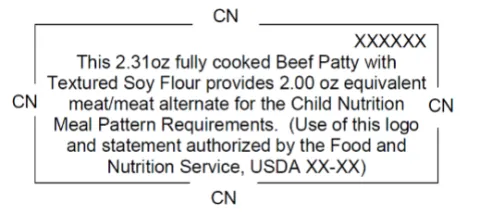
Note: The X’s in the sample CN Logo are only used to demonstrate the placement of the CN identification number and the final date. If you receive a CN-labeled product containing all X’s (all zeroes or non-number symbols) for the CN identification number, the label is not valid. If a CN label is not valid, FNS cannot provide a warranty for its use toward meal pattern requirements.
The CN label is the gold standard for verifying the crediting of menu items and provides a warranty against audit claims when the product is used according to the manufacturer’s instructions.
Acceptable and valid documentation for the CN label includes:
- The original CN label removed from the product carton.
- A photocopy of the CN label shown attached to the original product carton.
- A photograph of the CN label shown attached to the original product carton.
- A CN label copied with a watermark displaying the product name and CN number provided by the vendor and the Bill of Lading (invoice).
CN labels that are photocopied or photographed must be visible and legible.
CN Label Verification System
The CN Label Verification System is available to assist the SFSP sponsors in verifying the status of a CN label as well as the crediting information.
Dates Related to CN Labels
Once authorized, CN labels are valid for five years under the condition that the manufacturer remains an authorized CN producer and the product formulation does not change. The date printed on the CN label is the original date of authorization or the date of the most recent authorization for use of that CN label. This is different from the “Valid Until” date shown on the CN Label Verification Report, which indicates when the current authority to use the label expires. Manufacturers may choose to leave the original authorization date on the label when they receive reauthorization of their CN label so that the label inventories do not go to waste. For example, if a CN label was originally authorized on February 15, 2024, it is valid until February 15, 2029. The manufacturer may resubmit the same product for reauthorization of the CN label. If reauthorization is granted, the “Valid Until” date is updated to five years from the most recent date of the authorization on the CN Label Verification Report, but the date on the CN label may remain as 02/24.
Requirements for Documenting Watermarked CN Labels
A CN label copied with a watermark is used when the CN logo and contribution statement are presented on product information separate from the actual product carton. Manufacturers may provide program sponsors with a watermarked CN label during the bidding process. (Note: original CN labels on product cartons will not have a watermark.) Program sponsors should be aware that product information on the watermarked CN label can be changed. Therefore, program sponsors are encouraged to verify that the watermarked CN label came from a product that was purchased and accurately reflects that product.
A watermarked CN label along with the Bill of Lading (invoice) is acceptable documentation for a state agency monitoring process. Valid and acceptable documentation for the watermarked CN label includes:
- a hard copy of the CN label copied with a watermark displaying the product name and CN number provided by the vendor; or
- an electronic copy of the CN label with a watermark displaying the product name and CN number provided by the vendor
Product Formulation Statements (PFS)
The PFS should only be requested when reviewing a processed product without a CN label. PFSs are written and provided by individual manufacturers and are not commonly seen with SFSP sponsors. It is the sponsor’s responsibility to request and verify that the processed food documentation is accurate prior to purchasing processed products.
PFS templates for each meal component are available on USDA’s CN labeling website. Manufacturers may use PFS templates as a guide to help develop a PFS, which are available at the USDA website. However, they are not required to use the same format as the USDA’s template, but they must present the same information on their company letterhead. It should be noted that a PFS does not provide any warranty against audit claims. Unlike CN labels, a PFS that claims a meal pattern contribution is not a guarantee of USDA meal pattern compliance and can be disputed during an SFSP monitoring review.
The answer to each of the following questions should be yes:
- Is the PFS on signed company letterhead? The signature can be handwritten, stamped, or electronic.
- Does the PFS include product name, product code number, and serving/portion size?
- Do the creditable ingredients listed on the PFS match or have a similar description to the ingredients listed on the product label? For example, if the PFS lists ground beef (not more than 20% fat), the product label should also list ground beef (not more than 20% fat).
- Do the creditable ingredients listed on the PFS match or have a similar description to a food item listed in the USDA Food Buying Guide for Child Nutrition Programs?
- If the product is a meat/meat alternate, does it contain an Alternate Protein Product (APP) such as soy concentrate? If yes, does the manufacturer provide supporting documentation that meets USDA APP requirements?
- Does the PFS demonstrate how creditable ingredients contribute toward the meal pattern requirements?
- Are the manufacturer’s calculations correct and verified?
The PFS should include:
- Weight of raw portion; percent of raw meat or poultry; percent of fat of raw meat.
- Weight of an APP, if applicable; percent of an APP on an as-is basis for the as-purchased product; certification that an APP meets the USDA, FNS requirements.
- Product’s total creditable amount of product per portion towards the meal pattern.
- Certification statement that the PFS is an accurate verification of meal pattern compliance.
- Original signature and title of company official and date.
Helpful Resources:
Additional guidance and technical assistance related to CN labels and PFS may be found on the “Manufacturer Documentation: Child Nutrition Labels and Product Formulation Statements” website and Tips for Evaluating a Manufacturer's Product Formulation Statement | Food and Nutrition Service (usda.gov).
USDA’s CN Labeling Website includes a general background of the CN Labeling Program and provides helpful information for food manufacturers and child nutrition programs. It can be accessed at the USDA website or from the USDA Food Buying Guide for Child Nutrition Programs - Appendix C.
The CN Label Verification Reporting System can also be accessed from the link and from Appendix C. The system was developed to assist state reviewers, program sponsors, and the food industry in verifying the status of a CN label and the validity of a CN label. The system produces two reports monthly:
- CN Label Verification Report includes all information pertaining to the valid CN label, which includes the crediting information (meal pattern contribution statement), label expiration date, and the manufacturer’s establishment number.
- CN Label Manufacturers Report includes contact information for manufacturers that are authorized to produce CN labeled products. This report allows users to link the manufacturer’s list from the CN Label Verification Report.
These reports can be found at the USDA website.
Product Formulation Statement (PFS) – Approved Example:

All documentation regarding processed foods must be maintained in the sponsor files. If no information is available at the time of a monitoring review, meals containing the processed foods may be disallowed.
Offer Versus Serve Meal Service
Allowed for School Sponsors Only!
School sponsors may use the Offer Versus Serve (OVS) meal option. Per Summer Food Service Program (SFSP) regulations, only school sponsors may do so (7 CFR 225.16(f)(1)(ii)). Please note that sites located on college campuses may not use the OVS option.
OVS is an approach to menu planning and meal service that helps school sponsors reduce food waste and costs while maintaining the nutritional value of the meal. When utilizing OVS, the school SFSP sponsor offers all of the components of the meal pattern, but the child is not required to take all of them. Children can choose the food they intend to eat and can decline some of the food offered at the SFSP breakfast, lunch, or supper meals. OVS cannot be used with snack services.
School sponsors may request to use either the National School Lunch Program (NSLP) and the School Breakfast Program (SBP) meal pattern requirements or the SFSP meal pattern requirements. School sponsors that choose to use the NSLP or the SBP meal patterns must follow the meal pattern regulations governing those programs (7 CFR 210 and 7 CFR 220). It is important to note that OVS requirements differ between NSLP/SBP and SFSP.
If a school sponsor is following the SFSP meal pattern and using OVS, they are required to follow the SFSP-OVS meal pattern requirements. If a school sponsor is following the NSLP or SBP and using OVS, they must follow the OVS requirements of those programs.
SFSP-OVS Requirements:
- School sponsors must receive prior approval from the Department of Health and Senior Services (DHSS) to implement OVS. Sponsors may not appeal the denial of an OVS request; however, they may submit another request the next operating year.
- Non-school sponsors may not utilize OVS.
- All required food and meal components in the required serving size must be offered.
Breakfast
The meal pattern for breakfast consists of three meal components:
- One serving of vegetable/fruit.
- One serving of grain/bread.
- One serving of fluid milk.
However, for OVS, four different food items must be offered.
- A child must take three of the four food items and by turn, may only decline one food item.
- The fourth food item can be a vegetable/fruit, grain/bread, or meat/meat alternate.
- All of the food items must be different from each other. For example, two slices of toast would not qualify as two different items.
- All of the meal components must meet the minimum required serving amounts.
Lunch and Supper
The meal pattern for lunch and supper consist of four meal components:
- One serving of meat/meat alternate.
- Two different items of vegetable/fruit.
- One serving of grain/bread.
- One serving of fluid milk.
For OVS at lunch and supper:
- All of the meal components must meet the minimum required serving amounts for at least five food items.
- All of the food items must be different from each other.
- A child must take at least three different meal components.
If a site runs out of a food component, all meals after that point must be disallowed if the site is unable to offer children a complete reimbursable meal.
Combination Foods in OVS
A combination food contains more than one food item from different meal components that cannot be separated. Pizza is an example. Combination foods, served as an entrée or main dish, may be credited as the meat/meat alternate plus a maximum of two of the required meal components, if amounts of each are sufficient to meet the meal pattern requirements.
- Combination foods may not be declined for breakfast because a child may only decline one of the three required items.
- Combination foods containing more than two meal components may not be declined during lunch or supper because a child may only decline two food items.
Serving Local Foods
Local foods can play an important role in creating and promoting a healthy environment for children. A growing body of research demonstrates several positive impacts of serving local foods and providing food education through Child Nutrition Programs like the Summer Food Service Program (SFSP). These positive impacts include increased participation and engagement in meal programs, consumption of healthier options, and support of local economies. There is also a well-established public interest in supporting local and regional food systems and a growing interest in aligning local food sources with summer meal programs.
Serving local foods can improve meal quality and appeal, encourage kids and teens to develop healthy eating habits, and educate them about where their food comes from. Summer is often a time of agricultural abundance, which can reduce food costs. Purchasing local foods can support regional economic development, while also providing wholesome products to kids. Sponsors can purchase local foods directly from farmers, through distributors or Food Service Management Companies, from food hubs, farmers’ markets, Community Supported Agricultures (CSAs), and school or community gardens. For more information on finding, buying, and serving local foods, please visit the United States Department of Agriculture’s Farm to Summer website.
Farm to Summer encompasses a variety of efforts that might include:
- Serving locally sourced foods in summer meals.
- Choosing “edible” meal sites, like farmers’ markets, or school or community gardens.
- Organizing gardening activities; contact garden-based organizations in your area or seek out Master Gardeners to provide free gardening lessons around meal times.
- Taste testing with locally-produced foods.
- Celebrating local foods in kick-offs or other special events.
- Hosting cooking demonstrations with local foods, or sharing recipe cards.
- Taking field trips to farmers’ markets or farms.
- Hosting farmer visits to summer meal sites.
Recordkeeping, Program Costs, Sanitation, and Monitoring
Summer Food Service Program Manual
Maintaining accurate records is vital to ensure SFSP reimbursement accurately reflects the program’s operations. The following pages include required record templates for your use and include detailed information regarding recordkeeping.
5 Day Meal Templates To Track Menus For 5 Days
7 Day Meal Templates To Track Menus For 7 Days
Sample Breakfast Menus
Sample Lunch/Supper Menus
Daily Meal Count for Congregate Meals Including Instructions
Daily Meal Count for Non-Congregate Meals Including Instructions
The meal count record for camps must be completed at the time of the meal service. Sponsor personnel must physically count the children eating at each meal.
Weekly Meal Tracking
This is an optional form. It should be used to consolidate the meal counts for each site, one form per site. The totals from each site’s worksheet should be added to get the sponsor’s monthly claim to
SFSP Enrollment Form For Camps And Closed Enrolled Sites.
Non-Reimbursable Meals
When counting and consolidating meals, please be advised that the following meals are not eligible or allowed for reimbursement:
Meals Served at Unapproved Sites/Times
- Meals served outside of approved timeframes or approved dates of operation.
- Meals served at sites not approved by the state agency.
- Meals consumed off-site without prior approval. Sponsors must notify the Department of Health and Senior Services-Community Food and Nutrition Assistance 24 hours in advance and get approval for all field trips.
- Meals consumed off-site under the Demonstration Project for Non-Congregate Feeding for Outdoor Summer Meal Sites where the site has not been preapproved by application and where a heat advisory, watch, or warning has not been issued for the site in question.
Meal Service Issues
- Meals that do not meet meal pattern requirements.
- Meals not served as a complete unit (except in approved “offer versus serve” sites where complete meals must be offered to participants).
- Meal patterns or types not approved by the state agency.
- More than one meal served to a child at a time (this is not referencing second meals served after all children have been served a first meal).
- Meals that are spoiled or damaged.
Incorrect Claiming Procedures
- Meals that were served to adults. Do not claim meals served to program or nonprogram adults.
- Meals that were not served to children (leftover meals).
- Second meals claimed in excess of 2% of the total of first meals served in a claim period. All second meals served should be shown on the claim for reimbursement. However, reimbursement for second meals will be limited to only 2% of first meals served, or actual second meals served, whichever is less.
- Meals served to ineligible children in camps (those not meeting the income eligibility guidelines for free or reduced-price school meals).
- Meals in excess of the sites’ approved level of meal service (capacity for vended sponsors).
- Meals that were not served.
- Meals served to anyone other than eligible children.
Production Records
Self-preparation Sites and Central Kitchen Operations
Although not required at self-preparation sites or central kitchen operations, production records can be a valuable management and planning tool.
Vended Sites
Food production records are required for sponsors contracted with a Food Service Management Company (vended sites). The minimum requirements for production records are:
- List all food items used. Do not include condiments or seasonings.
- List the serving size for each item served.
- List the total amount of food prepared in specific quantities, such as in pan sizes, pounds, package sizes, can sizes, and weights.
- Maintain production records for all meals and snacks served.
- List the total number of meals served to:
- Eligible children.
- Program adults.
- Non-program adults.
- Ineligible children.
A Daily Vended Meal Receiving Log and a Vended Meal Communication and Credit Log are included in this manual for sponsors to document the date and time food was received at the site, food temperatures, and any problems with the foods received. These forms are also available on the SFSP website.
Food Buying Guide for Child Nutrition Programs
The United States Department of Agriculture’s Food Buying Guide for Child Nutrition Programs, can help you determine the amount of food to purchase based on the number of servings needed and is available under Manuals on the Summer Food Service Program website [NEEDS LINK].
Food Production Record for the Summer Food Service Program
Daily Meal Receiving Log for the Summer Food Service Program
Meal Communication and Credit Log for the Summer Food Service Program
Nonprofit Food Service
Sponsors must maintain a nonprofit food service program as required in 7 CFR 225.6(i) and must be able to account for the receipt, obligation, and expenditure of all Summer Food Service Program (SFSP) funds. Sponsors must ensure that all SFSP reimbursements are being used solely for conducting nonprofit food service operations. In order to do this, the following items are required:
- Sponsors must maintain documentation of all revenues received and expenses paid from the nonprofit account.
- All costs charged to the account must be allowable and properly identified and recorded. The Program Cost Report form is provided on the next page to document program costs. It is also available on the SFSP website.
- When reimbursements exceed costs, the funds must still be spent on allowable SFSP costs. Examples of allowable uses, in order of priority, include:
- Improving the meal service or other aspects of the current SFSP.
- Keeping the excess funds for next year’s SFSP operations.
- Paying for allowable costs of other Child Nutrition Programs.
- Donations received by an SFSP site must be documented and comply with program regulations and those regulations governing the distribution of donated foods in the SFSP (7 CFR 250.61). The Donated Food Log is included in this manual and on the SFSP website.
Form to document program costs.
Donations received by an SFSP site must be documented and comply with program regulations and those regulations governing the distribution of donated foods in the SFSP.
Allowable Costs and Needed Documentation
Operating costs are allowable costs incurred by the sponsor for preparing and serving meals to eligible children and program adults. These costs include, but are not limited to, cost of food used, labor, nonfood supplies, and space for the food service. Rural sites may include costs that are directly incurred in transporting children from rural homes to rural food service sites. All costs must be fully documented and they must represent actual program costs.
Unallowable Costs
Costs for which program funds may not be used include, but are not limited to:
- Bad debts - which are any losses arising from non-collectible accounts and other claims and related costs.
- Repayment of overclaim and other federal debts.
- Contributions and donations including contingency reserves, the United States Department of Agriculture (USDA) donated commodities and other donated food, labor, and supplies.
- Fines or penalties resulting from violations of, or failure to comply with federal, state or local laws and regulations.
- Entertainment and fundraising costs.
- Interest on loans, bond discounts, costs of financing and refinancing operations, and legal and professional fees paid in connection therewith.
- Costs resulting from an under-recovery of costs under other grant agreements.
- Direct capital expenditures or option to purchase rental costs for: acquisition of land or any interest in land; acquisition or construction of buildings or facilities, or the alteration of existing buildings or facilities; non-expendable equipment of any kind; repairs that materially increase the value or useful life of buildings, facilities, or non expendable equipment; and other capital assets, including vehicles.
- Rental cost for periods beyond the close-out date for program operation.
- Costs for excess meals, i.e., meals in excess of legitimate program adult meals and reimbursable meals.
- Any other costs incurred that program officials determine to be in violation of applicable laws or regulations.
- Expenditures for non-creditable foods that are not part of the meal pattern. Sites wishing to serve additional foods that do not meet the Summer Food Service Program (SFSP) meal pattern standards must use non-program funds. If a site chooses to purchase additional food with SFSP funds, the food must be a creditable food under the meal pattern requirements (condiments served with creditable foods are exempt from this restriction). SFSP 06-2012.
- The cost to purchase food (including coffee, etc.) for use outside of the SFSP.
- The cost of meals served in violation of program requirements; e.g. meals served outside approved serving time, meals or meal components consumed off site, second meals served in excess of the two percent tolerance.
- For vended sponsors, the cost of meals delivered by a Food Service Management Company to a non-approved site, or for meals not delivered within the agreed upon delivery time, meals served in excess of the approved capacity, spoiled or unwholesome meals, or meals that do not meet requirements or quality standards.
For more information on the allowable use of program funds, see the USDA Policy Memo SFSP 06-2012, “Serving Additional Foods in the Summer Food Service Program.”
Network User Access and Claims
- Claims are submitted online. Sponsors must have a Summer Food Service Program (SFSP) user ID and password to enter a claim.
- New users must complete a Network User Access Request available at the SFSP website [NEEDS LINK].
- Send the completed form to Department of Health and Senior Services-Community Food and Nutrition Assistance (DHSS-CFNA) by emailing it to SFSP@health.mo.gov.
- Only two user IDs and passwords are allowed per sponsor. Additional access will be considered on a case-by-case basis.
- Notify DHSS-CFNA immediately if a user needs to be changed or deleted from the system. • Online Application Instructions and Online Claiming Instructions are available at the SFSP website [NEEDS LINK].
- To access the web-based system, go to the SFSP website and click on Web Log In Screen [NEEDS LINK].
- Claims will not be paid if submitted more than 60 days after the last day of the claim period.
Deadlines for Original and Revised Claims
| May Claim | June Claim | July Claim | August Claim |
|---|---|---|---|
| July 30 | August 29 | September 29 | October 30 |
Sanitation Requirements
Food safety is a topic that touches everyone. Sponsors must maintain proper sanitation and health standards in conformance with all applicable state and local laws and regulations (7 CFR 225.6(e)(2)(iv)(F)). Some facilities may not be required to meet all state and local health and safety requirements, for example, those that do not prepare food on-site. When inspecting these sites, local sanitarians conduct a routine food safety and sanitation inspection. Staff preparing foods should follow safe food handling practices. Inspectors will focus on items such as cooking and reheating temperatures, cooling procedures, hot and cold holding temperatures, cross-contamination issues, personal hygiene, proper hand-washing practices, and food storage practices. In order to adhere to all state and local sanitation regulations and requirements, contact your local sanitarian. It is of tremendous benefit to establish a rapport with your local sanitarian. They can provide training and technical assistance in all regulations and requirements. To find contact information for your local sanitarian and Local Public Health Agency (LPHA), please visit the LPHA website. [NEEDS LINK]
Time as a Public Health Control
If a summer food service vendor or sponsor intends to handle and serve potentially hazardous foods using time as the only public health control, they must contact their local sanitarian to obtain the necessary guidance for developing their Time as a Public Health Control plan, then the local sanitarian must approve the plan before it is utilized. When using Time as a Public Health Control, a sponsor must develop written procedures that address the requirements of 3-501.19 of the Missouri Food Code. All other local sanitation code requirements must be met as well. The approved procedure must be kept on-site for staff reference.
*The approved procedure must be kept available onsite for staff reference.
Some vendor or sponsor responsibilities that will need to be developed are:
- Develop a procedure that will address:
- Documentation specifying the time frame (four to six hours) that will be used as stated in section 3-501.19.
- Method of marking the product when it is removed from temperature control.
- Monitoring of temperature prior to removal from temperature control. o Method of marking the product with the discard time.
- Disposition of the food at the end of the time period.
- Included in the procedure:
- What food is the procedure being used for?
- The amount of food?
- Who is responsible for monitoring?
- The records that are to be kept and how long will they be kept?
- Provide training to personnel on procedure developed.
- Record how management will monitor and verify that the procedure is being applied properly.
- Assure that products in unmarked containers or packages or those that are marked with a time that exceeds the timeframe specified in the procedure will be discarded.
Local Public Health Agency Inspection Personnel Responsibilities:
- Provide technical assistance to summer food service vendors or sponsors proposing to use time as a public health control.
- Review and comment on proposed procedures during inspection.
- During inspections review and verify application/implementation of procedure by:
- Direct observation,
- Review of at least three randomly selected records from the establishment’s files including the day of inspection,
- Record compliance status on the inspection report, and
- Note any observations, violations, and corrective actions concerning the time as a public health control procedures, on the inspection report.
- Discard products in unmarked containers or packages or products marked with a time that exceeds the timeframe specified in the procedure.
Written procedures are required for potentially hazardous foods that are being held using time only as a public health control method. The written procedure must identify the food(s), the method of tracking the food once it is removed from temperature control, and what action will be taken at the end of the time frame.
Example: Written Procedure for Tracking Temperature
- Foods:
- Macaroni and cheese.
- Hamburgers.
- Milk.
- Tracking:
- Use yellow and red dots.
- Write the time, on the yellow dot, the food was taken out of temperature control.
- Place yellow dot on the left corner of each tray.
- Write the “Discard Time on a red dot (maximum four hours).
- Place red dot on right corner of each tray.
- Food Disposition:
- Monitor time and assure that foods are discarded after four hours.
- Discard expired and unused food in the kitchen garbage.
- Documentation:
- Document all required information on the chart.
- The approval chart must be completed for each day of service.
- The chart will be maintained in the office at the central kitchen for at least 30 days.
| Food | Macaroni & Cheese | Hamburgers | Milk |
|---|---|---|---|
| Employee initials | JS | JS | JS |
| Number of trays | 2 | 4 | 5 |
| Temperature | 140° | 145° | 39° |
| Time taken out of temperature control | 9:30 am | 9:30 am | 9:30 am |
| Time to be discarded or completely served | 1:30 pm | 1:30 pm | 1:30 pm |
| Comments | Completely served | 3 hamburgers discarded in kitchen garbage | 6 cartons of milk poured down sink in kitchen |
__________________________________________
Reviewer’s Signature Date
Monitoring Your Sites
Monitoring is essential to making a program successful. Having knowledgeable, trained monitors will enable program operations to comply with program requirements and run more smoothly. Having an efficient and capable monitoring staff is one of the first steps towards successful operations. A monitor serves as a direct link between the sponsor’s administrative office and the actual meal service sites. Establishing a proper monitoring system will help prevent problems from occurring and will make it easier to correct any problems that arise during the summer. The sponsor must ensure that the monitor’s responsibilities and authority are clear to the monitoring staff and site supervisors.
Monitors must:
- Participate in annual training from the sponsor, and understand program requirements, including civil rights requirements.
- Ensure sites operate according to program guidelines.
- Carry a supply of all necessary forms during site visits and reviews.
- Provide training and technical assistance for site personnel when needed.
- Spend enough time at each site to ensure proper program operations.
Visits and Reviews:
Monitors are required to perform site visits and site reviews at various times throughout program operations. Regulation requires the following site monitoring: 1. A pre-operational site visit prior to opening a new site. 2. A site review within the first two weeks of operation. 3. A site review within the first four weeks of operation.
- Site Visit: Requires the monitor to ensure that the site is adequately set up to provide the planned food service for the number of children expected and to resolve any apparent problems prior to the start of the operation of the SFSP site.
- Site Reviews: Requires the monitor to determine if the site is meeting all the various program requirements. Monitors must observe a complete meal service from beginning to end, including delivery or preparation of meals, the meal service, and clean up after meals.
For your convenience, the Pre-Operational Site Visit form can be found in Module 1 and Site Review forms for both self-prep and vended sites are included in this manual. They are also available on the Summer Food Service Program webpage at the SFSP website under Applications and Forms [NEEDS LINK]. For further information on sponsor monitoring requirements, please see the USDA’s Sponsor Monitor’s Guide also available on our webpage under Manuals.
Monitor Site Review Form (For Self-Preparation Sites)
Monitor Site Review Form (for Vended Sites)
State Agency Monitoring Review Process
Each program will be reviewed for compliance with Summer Food Service Program (SFSP) Regulations 7 CFR 225. Sponsors will also be reviewed to ensure that they follow the guidelines in this manual and the guidelines in the SFSP contract and Scope of Work.
The State agency (SA) must review SFSP sponsors and sites to ensure compliance with the Program regulations. State agencies must:
- Conduct a review of every new sponsor at least once during the first year of operation;
- Annually review every sponsor that experienced significant operational problems in the prior year;
- Review each sponsor at least once every three years;
- Review more frequently those sponsors that, in the determination of the SA, require additional technical assistance; and
- As part of each sponsor review, conduct reviews of at least 10 percent of each reviewed sponsor’s sites, or one site, whichever is greater.
The State and Federal agencies have the authority to conduct a monitoring review at any time, announced or unannounced.
Site reviews will be conducted separately from the sponsor review and will be unannounced. This review will include an observation of meal counting procedures and various aspects of the meal service, including food safety, food items served, and compliance with SFSP regulations. Civil rights compliance will be monitored at both the site reviews and sponsor reviews.
Sponsor reviews will be scheduled after the claim for reimbursement for the month that the site reviews were conducted has been submitted. All original program records must be made available for review by state and/or federal officials within one hour of arrival. Failure to have the SFSP records available will result in findings, corrective action, and/or overclaims; the SA may disallow all summer claims for reimbursement that the SO must repay. The Monitoring Checklist in a subsequent section provides an overview of the major areas that will be evaluated during the sponsor review.
If the reviewer finds that the sponsor did not comply with the CACFP regulations during the site reviews or the sponsor review, the sponsor will be given “findings” for each incident of noncompliance. A subsequent page provides a list of common findings that you can use as a guide to avoid some of the more common operational errors that have occurred with the SFSP.
Some findings may result in the disallowance of meals that were claimed during the month of review. There could be many reasons for this, including, but not limited to:
- Errors in counting and meal consolidation
- Not counting meals at the point of service
- Serving meals that did not include all of the required meal components
- Serving foods that are not creditable
- Not purchasing enough of certain foods, especially milk, for the number of meals that were claimed.
The balance owed to SFSP will be recovered by deducting the funds owed from your remaining monthly SFSP claims for reimbursement payments until paid in full. If funds are owed and all claims have been processed for the summer, the sponsor must remit payment of the amount owed by check or money order. Failure to repay a debt will lead to a sponsor being declared seriously deficient.
Serious Deficiency Process
If serious violations are found during a monitoring review, or a sponsor fails to pay a debt, the sponsor must be determined as Seriously Deficient (SD). USDA regulations define Seriously Deficient (SD) as the status of an institution that has been determined to be non-compliant in one or more aspects of its program operation. An institution that is determined to be currently SD or has been terminated from any federal child nutrition program may not enter into an agreement to participate in the Summer Food Service Program (SFSP).
The individuals noted on the Sponsor and Site Information Sheets on the Application and in the CNP web-based system are considered responsible individuals or responsible principles of the program.
By virtue of the management position, the “responsible person”, has administrative and financial responsibility for the oversight, management, and integrity of the SFSP and compliance with applicable regulations.
As a contracted provider of the SFSP, sponsors must maintain records and provide access to any records or documents to authorized representatives of the Department, State, and Federal government for inspection upon request.
Corrective Action Plan
An SFSP sponsor is responsible for responding to site review and sponsor review findings (instances of non-compliance) by completing a Corrective Action Plan (CAP).
The CAP Process for Site Reviews:
Following the site review, the SA reviewer will discuss the outcome with the site supervisor and the sponsor, if present. A site review form indicating if each requirement was in compliance will be completed. If findings (instances of non-compliance) occurred during the review, additional site review finding form(s) will be completed, and a CAP will be requested.
If the sponsor is present at the time of the site review, the sponsor will be given the opportunity to correct the finding on site, and this will be documented in the CNPWeb E-Review system. If the sponsor is not present at the time of the site review, the sponsor will be notified regarding how to address the findings in the CNPWeb system. The sponsor will address each finding indicated, explaining how each finding will be corrected, who will be responsible for correcting the finding, and the date by which the finding will be corrected.
Each CAP will have a due date. The sponsor will have one week from the date of the site review to respond to the findings. Failure to respond to the review could affect the site and sponsor’s ability to participate in the SFSP. After the SA reviewer has reviewed and approved the CAP, the system will indicate the CAP is approved.
The CAP Process for Sponsor Reviews:
After the SA reviewer has conducted the sponsor review, a review letter will be sent to the sponsor indicating that a review has been conducted and include details of compliance or noncompliance. If findings (instances of non-compliance) occurred during the review, a CAP will be requested.
The letter will include instructions for completing the CAP in the CNPWeb E-Review system. In the CAP, the sponsor will address each finding indicated on the report, explaining how each finding will be corrected, who will be responsible for correcting the finding, and the date by which the finding will be corrected.
Each CAP will have a due date. The sponsor will have three weeks from the date of the review letter to respond to the findings. Failure to respond to the review letter could affect the sponsor’s ability to participate in the SFSP and may result in the sponsor being classified as Seriously Deficient. After the SA reviewer has reviewed and approved the CAP, a closeout letter will be sent to the sponsor.
How to Complete a CAP
Before the center can submit its corrective actions, it must determine what the problem is and why it is occurring.
The CAP must clearly state the following:
- How the problem can be prevented or eliminated. Do not merely restate the finding or assure that the mistake will not happen again. The solution must be a process – specific steps that have been taken to correct the finding and what extra steps will be taken to make sure this problem does not occur again.
- When the problem was corrected.
- Who will be responsible for ensuring the corrections were made and written policies and/or procedures will be maintained.
Recommendations:
- It is critical that the CAP be completed thoughtfully and thoroughly.
- It is wise to send the CAP in early in case corrections are recommended.
An SFSP sponsor is responsible for responding to site review and sponsor review findings (instances of non-compliance) by completing a Corrective Action Plan (CAP).
Monitoring Checklist
During your Summer Food Service Program (SFSP) Review, the Nutritionist or the Department of Health and Senior Services-Community Food and Nutrition Assistance (DHSS-CFNA) representative will review program records for compliance with federal and state regulations. The following checklist should assist in preparation for the review. This list presents an overview of the major areas that will be evaluated. Records for the entire fiscal year should be available for review.
Forms and program requirements can be obtained at the DHSS-CFNA’s SFSP webpage. [NEEDS LINK]
Note: Sponsors must have a claim in Pending Approval before the sponsor monitoring can be held.
Monitoring Checklist
Common Findings
In an effort to assist sponsors in operating the Summer Food Service Program (SFSP) successfully, some common situations from reviews that have resulted in findings have been identified. Use these as a guidepost to avoid some of the more common operational errors that have occurred with the SFSP.
Menu and Meal Service Findings
- All meals served did not meet the minimum meal pattern requirements as outlined in the meal chart.
- The meal contained a non-creditable component. Refer to the United States Department of Agriculture’s Food Buying Guide for Child Nutrition Programs and revise menus to include creditable meal components.
- Menus did not always provide an adequate variety of foods. It is important to provide a variety of foods each day to ensure adequate intake of a wide range of nutrients. Avoid serving the same foods too often.
- Some of the children were not served all of the required meal components. Incomplete meals served to children may not be claimed for reimbursement.
- Meals were served outside of the approved meal times. Meals served outside of the approved meal times may not be claimed for reimbursement. If your meal service times change, you must update the information online and gain approval prior to implementing the change.
- Children were observed taking potentially hazardous foods off site. All potentially hazardous foods must be eaten on site to avoid possible food-borne illness.
- The site did not have a trained person available during the meal service. SFSP regulations require at least one trained person be on site during the meal service. Meals served at sites without trained personnel may not be claimed for reimbursement.
- Children were not at the site the day of the review. Sponsors must notify the Department of Health and Senior Services-Community Food and Nutrition Assistance (DHSS-CFNA) 24 hours in advance of site closings and/or field trips.
- The sponsor did not have Child Nutrition (CN) labels/Product Formulation Statements available to document the meat/meat alternate contribution of processed meat products.
- The amount of food prepared did not always meet minimum serving size requirements. Meals must provide minimum amounts of food as specified in the SFSP meal pattern to be claimed for reimbursement.
Production Record Findings (Vended Meals Only)
- At a vended site, production records did not always indicate the exact amount of each food item used. Production records must indicate, at a minimum, the food items used, the serving size of each food item used, the total amount of each food item prepared in package/container sizes and/or weight, the amount of each food item leftover, and the number of children and adults served.
- At a vended site, production records were not being maintained.
Meal Count Findings
- The site did not maintain a point-of-service meal count. Meals must be counted as they are served to the children.
- The site did not have adequate procedures in place to adjust the number of meals ordered or prepared on a daily basis, resulting in an excess number of leftover meals.
- Leftover meals from the previous day were not properly recorded on the meal count sheets.
- The number of meals served did not match the delivery ticket. The site supervisor is responsible for ensuring the number of meals delivered to the site matches the delivery ticket by taking a physical count of the meals when they arrive at the site.
- Meal counting procedures used by the site did not yield an accurate count of meals served.
- The site is consistently claiming more meals than were served the day of the review. Sites may not claim more meals than are served to children at any time.
- There was an excess child-to-staff ratio at the site. While there is no regulation stipulating a certain child-to-staff ratio, a recommended ratio is 15 children to every program adult.
Sanitation Findings (Contact your local sanitarian for technical assistance)
- Food temperatures were not taken by site personnel when food arrived at the site. Site personnel must take food temperatures to ensure that food has been properly handled and is safe for consumption.
- Site personnel did not use proper procedures to take food temperatures, nor were they aware of the food temperature “safety zone”.
- The expiration date on some of the milk was beyond the “use by” date. Check milk expiration dates to ensure the service of fresh milk. Discard all milk that exceeds the “use by” date.
- Food was not being held at the appropriate temperature. Potentially hazardous food must be held at a temperature of 41˚ F or below or 135˚F or above to avoid bacterial contamination.
- Food was left sitting at room temperature for more than two hours.
- The site did not have adequate facilities or equipment for the safe storage of meals.
- A potentially hazardous food was stored on a shelf above other foods in the refrigerator. To avoid cross-contamination of food in storage, store all potentially hazardous foods on the lower shelves of the refrigerator.
- Employees were not observed washing their hands prior to the service of the meal, or after eating, drinking, using the toilet, or handling raw food.
- Food items in storage had not been properly labeled. Label and date all leftover foods and foods removed from their original containers.
- Food items in storage were not properly wrapped or covered. Use plastic wrap, foil, or a tight fitting lid to cover foods when storing them for later use.
- The refrigerator did not have a thermometer. All refrigerators must have a working thermometer to enable site personnel to monitor the temperature of the equipment. Temperature in the refrigerators and freezers must be monitored on a regular basis.
- Time as a Public Health Control was being utilized without an approved plan.
Appeal Procedure
Appeals of the Department of Health and Senior Services (DHSS) actions are conducted before an independent administrative hearings officer in the DHSS Appeals Unit. To contact the DHSS Appeals Unit, call (573) 522-1699, fax (573) 751-0247, or email DHSS.Appeals@health.mo.gov.
What can be appealed?
A sponsor may appeal any of the following actions the DHSS takes relating to its participation in the Summer Food Service Program (SFSP) or claims for reimbursement (7 CFR 225.6(b)(3) and 7 CFR 225.13):
- Denial of an application for participation.
- Denial of a sponsor’s request for an advance payment.
- Denial of a sponsor’s claim for reimbursement (except when submitted after the deadline [See 7 CFR § 225.9(d)(6)]).
- DHSS’ refusal to forward to USDA’s Food and Nutrition Service (FNS) the sponsor’s requested exception for payment of a late claim or a request for an upward adjustment to a claim.
- Claim against a sponsor for remittance of a payment.
- Termination of a sponsor’s or a site’s participation in the program.
- Denial of a sponsor’s application for a site.
- Denial of a food service management company’s application for registration, if applicable.
- Revocation of a food service management company’s registration, if applicable.
A sponsor cannot appeal decisions the FNS makes relating to late claims for reimbursement or request for upward adjustments under 7 CFR 225.9(d)(6).
How can a sponsor appeal?
- Appeal requests must be in writing.
- A sponsor can either:
- Email the appeal request to SFSP@health.mo.gov
- Fax the appeal request to 573-526-3679; or
- Mail the appeal request to: Missouri Department of Health and Senior Services Community Food and Nutrition Assistance ATTN: SFSP Appeals PO Box 570 Jefferson City, MO 65102
- The DHSS must receive the appeal request no more than 14 calendar days after the sponsor receives the notice of the DHSS’s action.
What should a sponsor include in its appeal request?
- The sponsor’s name, telephone number, and mailing address.
- The name and title (printed or typed) of the sponsor’s contact person or authorized representative.
- The DHSS action(s) that the sponsor is appealing, the reason(s) the sponsor is appealing, and the action(s) the sponsor wants the DHSS to take instead (i.e., the remedy the sponsor is seeking).
- Whether the sponsor is requesting an abbreviated administrative review and/or an administrative hearing.
What are the types of administrative review?
- Abbreviated administrative review: a review of written documentation only.
- In an abbreviated review, both the sponsor and the DHSS submit written documentation and information for the hearing officer to consider when deciding the appeal.
- A sponsor requesting a written review may choose to have an abbreviated administrative review even if it is entitled to a full, in-person hearing.
- To be considered by the hearing officer, the sponsor must submit all written documentation and information in support of its appeal to the hearing officer within seven calendar days of the date it submits its appeal request (7 CFR 225.13(b)(4)).
- A sponsor cannot request an in-person administrative hearing after the abbreviated administrative review has taken place.
- Administrative hearing: an in-person hearing at which the sponsor and the DHSS submit verbal testimony and evidence.
- The Appeals Unit hearing officer can hold a hearing in addition to, or instead of, an abbreviated administrative review only if the sponsor requests a hearing in its appeal request.
Additional information:
- The Appeals Unit hearing officer will send the sponsor a letter giving the date, time, and location of the administrative hearing (if an administrative hearing was requested) and/or the date any written documentation and information in support of the sponsor’s appeal is due and submission information.
- If the sponsor requests an administrative hearing and fails to appear at the hearing, the sponsor waives the right to an in-person appearance before the Appeals Unit hearing officer unless the hearing officer agrees to reschedule the hearing.
- The sponsor may retain private legal counsel or may be represented by another person. 7 CFR 225.13(b)(5).
- The DHSS will have legal counsel representation for both in-person hearings and abbreviated administrative (written) reviews.
- The Appeals Unit hearing officer must make a decision within five business days of either holding an administrative hearing or receiving the written documentation from the sponsor and the DHSS.
Remember these deadlines:
- The DHSS must receive the sponsor’s appeal request within 14 calendar days of the sponsor receiving notice of the DHSS’s actions.
- The sponsor must submit any written documentation to the hearing officer within seven calendar days of submitting the appeal request.
For more information: Call the DHSS at 888-435-1464.
An equal opportunity/affirmative action employer.
Services provided on a nondiscriminatory basis.
Tips For Success
Five Keys to Success in the Summer Food Service Program (SFSP)
- Serve quality meals.
- Keep sound financial records.
- Ensure access to the program.
- Include activities at your meal sites.
- Highlight the program.
Finances
To reach your SFSP goals, understand how much money is available to spend on the program:
- Estimate your total SFSP expenses for the summer.
- Then estimate your total federal reimbursement from SFSP participation. Add funds from other possible sources, such as rebates, state government funding, grants, donations, etc., you will have for the summer.
- Use those numbers and a backward planning technique to plan and reconcile the income and expenses your program will incur for the summer.
- Make sure you are able to cover the necessary program expenses and are able to efficiently operate the SFSP.
- Don’t overestimate participation.
Access
When it comes to transportation challenges, consider:
- Working with rural school districts’ bus operations.
- Collaborating with organizations that have vehicles to help transport children.
- Renting a vehicle, at cost, to use for the program.
- Creating a mobile meal site route!
Remember to discuss non-traditional approaches to meal service with the Department of Health and Senior Services-Community Food and Nutrition Assistance.
Activities
Activities at meal sites draw a higher number of children and provide sustainment for the SFSP. They also provide opportunities to increase the health and development of children during the summer months. Partnerships with schools, parks and recreation departments, and nonprofit organizations can help keep costs down by organizing and supervising these activity programs.
Publicity
While awareness of the SFSP has increased greatly in the past few years, there are still plenty of parents and community stakeholders who are unaware of the program and its benefits to the communities where meal sites are located. Including promotion in your SFSP plan can make a tremendous difference in having a successful program. Promoting your program through the media, social media, and the community will help increase meal participation.
For tips and resources to make your SFSP a success, see the United States Department of Agriculture’s Program Operator page.
Annual Newsletter
The Summer Food Service Program (SFSP) state team is privileged to witness the outstanding achievements and hard work of sponsors across Missouri who provide nutritious meals to children through the SFSP. We would like to recognize your creative, successful strategies in the annual SFSP newsletter. This is your opportunity to brag shamelessly about your program! Don’t be shy!
Any sponsor operating the SFSP is eligible to be recognized for all categories. Due to limited space available, narratives need to be limited to one page and address the questions under the appropriate category. Pictures are highly encouraged! Please include a signed release form for any person appearing in the photos. Please submit your information no later than November 30.
For the annual newsletter, we are highlighting articles that feature sponsors in the following five categories:
- Outstanding Outreach: Are you an SFSP sponsor that uses creative strategies to promote participation of eligible children in your program? Describe in your narrative your efforts and results in promoting your program, including:
- Steps taken to promote your program and reach eligible children, and their impact.
- The most effective techniques used in reaching the children.
- Any challenges or barriers encountered and how they were addressed.
- Any non-program resources (e.g., monetary contributions, in-kind donations, volunteers, partnerships with other organizations) that were utilized in your efforts.
- How children’s participation was sustained over the course of the program.
- What is your anticipated outlook for the next year?
- Magnificent Menus: Are you an SFSP sponsor whose menus utilize food in a nutritional and inventive way? Do your menu items have nutritional content, color, variety, cultural awareness, and have you used inventive food promotions? Send in your summer menus along with a narrative highlighting your effective menu planning techniques. Please include drool worthy photos of your magnificent creations!]
- Greatest Growth: Have you had exponential meal site participation growth from the previous year? If so, please tell us all about it so we can share your strategies!
- Spectacular Staff: Do you have a rock star or an entire team who worked with your SFSP? Were they hard working, creative, dedicated, and committed to upholding the integrity of the SFSP? Did they meet the needs of the children and communities they served? If so, tell us about your rock star(s)!
- Perfectly Partnered: Did your SFSP partner with an organization and create a team that positively impacted a community? Well then, tell us about it so we can celebrate with you! Include the benefits of the partnership you formed, the outstanding outcomes, and how your organizations came to be partners. We love a good partnership!
Requesting Advance Payments
Advances are payments that may be received before the Summer Food Service Program (SFSP) begins to cover administrative and operating costs incurred before the program begins. When determining the amount of the advance payment, the Department of Health and Senior Services-Community Food and Nutrition Assistance (DHSS-CFNA) will make the best possible estimate based on the sponsor’s request and any other available data. These payments are advances on the reimbursement that sponsors will receive for a month of operations and will be deducted from future reimbursement payments.
If a sponsor requests an advance, then the request must reasonably and accurately reflect estimated site attendance and meal reimbursements in accordance with 7 CFR 225.6(a)(3). First advances shall not be paid until the sponsor has a fully executed contract with the DHSS.
Sponsors requesting an advance for the SFSP:
- Must sign and return a fully executed contract with the DHSS to operate as an SFSP sponsor prior to receiving any advance funds.
- Must be in good standing with Missouri Food and Nutrition Programs.
- Cannot miss a payment for Missouri Food and Nutrition Programs’ debt deadline from a previous SFSP operational year.
- Must operate at the site for 10 days of more to request an advance for that site's meals.
If a second or third advance is requested, the sponsor must provide accurate attendance information to the DHSS-CFNA by mid-June for the second advance and by mid-July for the third advance, in accordance with 7 CFR 225.9(c)(1).
Start-up payments are financial assistance for administrative costs made available to a sponsor to enable it to effectively plan a summer food service and establish effective management procedures for such a service. These payments shall be deducted from subsequent administrative cost payments.
The sponsor must request the start-up payment in the Checklist Tab on the CNPWeb Application and Claiming System during the application process. If a sponsor requests a startup payment, the state may approve start-up payments for sponsors who have executed Program agreements. Start-up payments shall not be made more than two months before the sponsor is scheduled to begin food service operations and shall not exceed 20 percent of the sponsor's approved administrative budget. If approved, the amount of the start-up payment shall be deducted from the first advance payment or, if the sponsor does not receive advance payments, from the first reimbursement.
Debt Repayment
In the event overpayments are identified, pursuant to 7 CFR 225.12, the sponsor must agree to a repayment schedule and that such repayments shall be deducted from future claim payments except in the event that no future claim payments are due. For such an event, the sponsor shall remit the full amount of the overpayment pursuant to 7 CFR 225.12, within 30 days of receipt of the notice of the overpayment.
Any and all representatives of the sponsor that sign the contract on behalf of the sponsor shall be aware of the personal responsibility for repayment in the case of an overpayment and acknowledge personal liability for repayment of any overpayment. In addition, all principals of the sponsoring organization are aware of the personal responsibility for repayment in the case of an overpayment and acknowledge the personal liability for repayment of any overpayment.
Expand from Summer Meals to the At-Risk Afterschool Program
Expand from Summer Meals!
If you are a summer meals provider, consider applying to the CACFP to serve meals and snacks during the school year through an afterschool program.
The At-Risk Afterschool Program is a component of the Child and Adult Care Food Program (CACFP). It offers federal funding to Afterschool Programs that serve a meal or snack to children 18 and under in eligible areas. The United States Department of Agriculture’s (USDA) Food and Nutrition Service (FNS) administers the CACFP at the national level. The Department of Health and Senior Services-Community Food and Nutrition Assistance (DHSS-CFNA) administers the program in Missouri.
Many existing SFSP sites are well-positioned to offer afterschool meals during the school year through the At-Risk Afterschool Program. Both organizations and communities benefit when meals are offered to children in eligible communities year-round. Organizations benefit from having the ability to hire year-round staff, a continuous flow of reimbursements providing additional financial stability, and recognition in the community as a stable source of services. Communities benefit by having a partner that provides year-round nutrition services for children and brings increased federal funds into the local economy.
At-Risk Afterschool Eligibility Requirements:
Organizations may apply to participate in the At-Risk Afterschool Program either as an independent afterschool program or through a sponsor. Eligible organizations must meet state and/or local licensing or health and safety standards in order to participate. The following are eligibility requirements that must be met in order to apply and participate in the program.
Program Eligibility: An afterschool program must:
- Be organized primarily to provide care for children after school or on the weekends, holidays, or school vacations during the regular school year.
- Provide organized, regularly scheduled education or enrichment activities in a structured and supervised environment that are open to all children.
- Be located in an attendance area of a school where at least 50 percent or more of the children are eligible for free or reduced-price meals.
Organization Eligibility: At-Risk Afterschool Programs may be operated by:
- Public agencies such as schools or city governments.
- Tax-exempt nonprofit organizations.
- For-profit centers that meet the requirements of serving at least 25 percent of children who are eligible for free or reduced-price meals based on their family income; or receive benefits under title XX of the Social Security Act and the center receives compensation under title XX.
Area Eligibility: As noted above, to be eligible to participate in the At-Risk Afterschool Program, it must be located in an eligible area. This means the site is located in the attendance area of a public school where at least 50 percent of the students are eligible for free and reduced-price meals under the National School Lunch Program (NSLP). This is referred to as area eligibility.
Participant Eligibility: At-Risk Afterschool Programs may claim reimbursement only for meals and snacks served to children who are age 18 or under at the start of the school year. Programs may be either drop-in or enrolled. Children do not have to participate in enrichment activities in order to be served a meal. Reimbursement also may be claimed for participants who turn age 19 during the school year. There is no age limit for persons with disabilities.
Licensing and Health and Safety Requirements: Federal law does not require licensing for centers participating in the At-Risk Afterschool Program. However, states or local jurisdictions may require licensing. In the state of Missouri, afterschool programs must be licensed by the Missouri Department of Health and Senior Services’ Section for Child Care Regulation, or be exempt from licensing requirements. Exempt organizations must, however, submit documentation to show that minimum health and safety standards are being met. At a minimum, documentation must include a fire safety inspection report and a sanitation report. Schools are exempt from the licensing requirement in Missouri.
For more information regarding the At-Risk Afterschool Program please visit USDA’s website at: https://www.fns.usda.gov/cacfp/afterschool-programs
OR
For more information, including how to apply, please visit Missouri’s At-Risk Afterschool Program webpage: www.health.mo.gov/cacfp [NEEDS LINK]
Resources
Summer Food Service Program Manual
There are many resources available to assist sponsors participating in the SFSP. Some of these resources are on the following pages.
Need program, menu, activity, or outreach ideas for your SFSP? Let us help you with your search!
Start Here:
- Department of Health and Senior Services Summer Food Service Program (SFSP) [NEEDS LINK]
- Access to online claims filing.
- GIS map.
- Downloadable copies of Missouri SFSP forms.
- Link to information on other Missouri nutrition programs and activities.
- USDA – SUN Meals
- USDA’s main webpage for SFSP.
- USDA Summer Meals Webinars/Videos
- USDA – Farm to Summer
- Missouri Department of Agriculture – DOA
- Find your local Farmer’s Market! In the Popular Services section, select “Find a Seller or Market” then select Farmer’s Market Map.
- Team Nutrition – Summer Food, Summer Moves
- Summer Food, Summer Moves is a fun, hands-on resource kit designed to get kids and families excited about healthy eating and physical activity during the summer months. The kit is designed for use by summer meal site operators.
- The US Government’s official web portal for nutrition information
- Provides easy online access to government information on food and human nutrition.
- Food and Nutrition Information Center (FNIC)
- Through USDA’s National Agriculture Library, USDA program participants may borrow summer food service reference materials, videos, and training materials free of charge. The site has information on recipes, menu planning, and food safety. Sample nutrition education is also available.
- Institute of Child Nutrition (ICN)
- ICN site provides child nutrition resources, training, and standardized recipes.
- The University of Missouri Extension
- Food preparation
- Food safety
- Health and wellness
- Nutrition
- My Plate
- MyPlate offers ideas and tips to help create a healthy eating style that meets the needs of every age group.
- Federal Food Safety Information
- Gateway to food safety information provided by government agencies.
- No Kid Hungry Center For Best Practices
- This site offers sponsors many different resources including information regarding grants, promotion, and outreach materials, and shared best practices across the nation.
- Midwest Dairy Council
- Promotion - June Dairy Month, June Dairy Month Communications Toolkit.
Outreach Materials
DHSS-CFNA has several different types of SFSP outreach materials available for your use!
These include:
- SFSP Informational Flyer- Food That’s In When School is Out!
- Banners
- Yard Signs
- Window Clings
The SFSP Informational Flyer is available in this manual and at the SFSP website [NEEDS LINK]. Contact DHSS-CFNA at SFSP@health.mo.gov to order banners, signs, and window clings.
Summer Food Service Program
Food That’s In When School Is Out!
What is the Summer Food Service Program (SFSP)?
- The SFSP is a nutrition program federally funded by the United States Department of Agriculture, Food and Nutrition Services (USDA, FNS) and administered by individual states. In Missouri, SFSP is administered through the Missouri Department of Health and Senior Services-Community Food and Nutrition Assistance (DHSS-CFNA).
- The SFSP provides nutritious meals to needy children ages 18 and under during the summer months when school lunch and breakfast programs are not operating or during time of emergency. The program also provides meals to individual’s ages 18-21 who are determined by a state educational agency to be mentally or physically disabled, and who participate in a school program for mentally or physically disabled during the regular school year.
- SFSP sponsors receive financial and technical support to operate and administer the program.
- Meal sites can be approved as congregate sites or as rural non-congregate sites.
What is a sponsor?
- A sponsor is an organization that contracts with DHSS to operate the SFSP.
- Sponsors accept full final administrative and financial responsibility for all sites under their jurisdiction. A site is the location where meals are served to participants.
What types of organizations can sponsor the program?
- Schools, both public and private, who participate in the National School Lunch Program (NSLP).
- Units of local, municipal, county, tribal, or state government.
- National Youth Sports Programs (NYSP) and Upward Bound.
- Private nonprofit organizations.
- Public or private nonprofit camps.
- Public or private nonprofit universities or colleges.
- Hospitals, Federally Qualified Health Centers, and medical clinics.
- Local Public Health Agencies.
What types of sites are approved for operation?
A site can be anywhere that is accessible to and accommodates children and has the necessary facilities to serve meals. Sites can be indoors or outdoors; for example, a school cafeteria, park, or church.
- Open Site – located in an area where at least half of the children are eligible for free or reduced-price meals through NSLP.
- Closed Enrolled Site – at least half of the enrolled participants at the site are eligible for free or reduced-price meals based on properly completed Income Eligibility Forms or located in an area where at least half of the children are eligible for free or reduced-price meals through NSLP.
- Residential Summer Camp – a camp that offers regularly scheduled food service as part of an organized program for enrolled participants.
- Migrant Feeding Site – food service sites that primarily serve children from migrant families, where regularly scheduled meal services are available.
- Conditional Non-Congregate Site - a rural site that qualifies for Program participation because it conducts a non-congregate meal service for eligible children in an area that does not meet the definition of “areas in which poor economic conditions exist” and is not a “camp.”
How are meals provided?
A sponsor may provide meals to children by:
- Preparing meals in a central kitchen or on site at each location; or
- Obtaining complete meals from a Food Service Management Company (vendor), which could be a public agency, a private nonprofit organization, a school district, or a commercial food service management company. Federal, state, and local procurement standards must be met.
What must be served for meals to qualify?
- SFSP sponsors must follow the meal pattern requirements as outlined in the Summer Food Service Program Regulations, 7 CFR 225.16. All meals served in the SFSP must meet these requirements in order to receive reimbursement. The meal pattern establishes minimum portion sizes of various meal components that must be served to each child.
- The four meal components are: milk; vegetable, fruit, or juice; grains or bread; and meat or meat alternate.
- Breakfast – milk; vegetable, fruit, or juice; grain or bread.
- Lunch/Supper – milk; two different vegetables and/or fruits; meat or meat alternate; grain or bread.
- Snack – choose two of the four meal components.
Which meals can be served?
- The type of site operated determines the number and type of meal services that can be approved.
- Sites may be approved for one or two meal service times; for example, lunch only, breakfast and lunch, or lunch and snack.
- Residential and nonresidential camps and sponsors of programs for children of migrant workers may be approved to serve either three meals or two meals and one snack.
How is a sponsor reimbursed?
- Reimbursement is based on claims for reimbursement that the sponsor submits to CFNA. The amount the sponsor is reimbursed is equal to the number of eligible meals served to children multiplied by the current reimbursement rates.
Where are the SFSP reimbursement rates?
View SFSP reimbursement rates here.
What about recordkeeping?
- Sponsors must keep full and accurate records of the number of meals served to children to support each claim for reimbursement.
- Sponsors must maintain records of allowable costs such as food, kitchen labor, nonfood supplies, administrative labor, office supplies, printing, advertising, and travel for site monitoring or training., in order to operation of nonprofit food service.
- Sponsors must maintain all of these records for three full federal fiscal years and the current federal fiscal year.
- These records must be made available upon request to federal and state administering agencies for audit and review purposes
What are a sponsor’s administrative responsibility?
Administrative responsibilities include but are not limited to the following:
- Complete training required by the state administering agency.
- Train all personnel involved in the sponsor’s SFSP and keep records of all trainings conducted.
- Locate eligible sites.
- Hire, train, and supervise staff and volunteers.
- Monitor sites and ensure sites comply with civil rights requirements.
- Keep full and accurate records to substantiate the claim for reimbursement and to demonstrate a nonprofit food service, such as allowable costs and daily records of the number of meals received, prepared and served.
- Prepare and submit claims for reimbursement.
What about monitoring the program?
- Sponsors must provide personnel to monitor sites regularly and document the review.
- The sponsor’s monitors must ensure that its sites operate according to program guidelines and requirements, communicate any problems to the sponsor, and ensure the correction of problems.
Will the program be reviewed?
- New sponsors will receive an administrative review by DHSS-CFNA and/or USDA that will include an administrative review at the sponsor’s office and at least one meal service site. After the first year of operation, sponsors will be reviewed at least every three years.
- Sponsors must make SFSP records available for the administering agency review and must take any corrective actions required by the administering agency.
- Results of an administrative review may affect the amount of reimbursement the sponsor will receive.
- The review will involve an assessment of how the claim for reimbursement was prepared and a review of the supporting records maintained by the sponsor. Site operations will be assessed via an observation of the meal service operation and the recordkeeping of one or more sites.
How do I apply?
- Prospective new sponsors may find information regarding the application process at the SFSP website [NEEDS LINK],
- If you do not have internet access, call toll free 888-435-1464 or Relay Missouri for Hearing and Speech Impaired at 800-735-2966, or email sfsp@health.mo.gov for application information.
The application must be reviewed and approved by DHSS-CFNA before the organization can begin reimbursable meal services.
The sooner you submit the application, the better.
This institution is an equal opportunity provider.
Ensure each meal claimed for reimbursement is served as a complete meal. A complete meal includes all of the required meal pattern components for the meal service type.
A Checklist of Do’s and Don’ts for Site Supervisors
A food product thermometer is a useful tool that is required for all food establishments and regulated child care providers.
Vegetables are a required component for reimbursable meals.
Fruits are a required component for reimbursable meals.
Meats/Meat Alternates (M/MAs) are a required meal component for reimbursable lunches and suppers.