
Summer Food Service Program Manual
Resources
There are many resources available to assist sponsors participating in the SFSP. Some of these resources are on the following pages.
Need program, menu, activity, or outreach ideas for your SFSP? Let us help you with your search!
Start Here:
- Department of Health and Senior Services Summer Food Service Program (SFSP) [NEEDS LINK]
- Access to online claims filing.
- GIS map.
- Downloadable copies of Missouri SFSP forms.
- Link to information on other Missouri nutrition programs and activities.
- USDA – SUN Meals
- USDA’s main webpage for SFSP.
- USDA Summer Meals Webinars/Videos
- USDA – Farm to Summer
- Missouri Department of Agriculture – DOA
- Find your local Farmer’s Market! In the Popular Services section, select “Find a Seller or Market” then select Farmer’s Market Map.
- Team Nutrition – Summer Food, Summer Moves
- Summer Food, Summer Moves is a fun, hands-on resource kit designed to get kids and families excited about healthy eating and physical activity during the summer months. The kit is designed for use by summer meal site operators.
- The US Government’s official web portal for nutrition information
- Provides easy online access to government information on food and human nutrition.
- Food and Nutrition Information Center (FNIC)
- Through USDA’s National Agriculture Library, USDA program participants may borrow summer food service reference materials, videos, and training materials free of charge. The site has information on recipes, menu planning, and food safety. Sample nutrition education is also available.
- Institute of Child Nutrition (ICN)
- ICN site provides child nutrition resources, training, and standardized recipes.
- The University of Missouri Extension
- Food preparation
- Food safety
- Health and wellness
- Nutrition
- My Plate
- MyPlate offers ideas and tips to help create a healthy eating style that meets the needs of every age group.
- Federal Food Safety Information
- Gateway to food safety information provided by government agencies.
- No Kid Hungry Center For Best Practices
- This site offers sponsors many different resources including information regarding grants, promotion, and outreach materials, and shared best practices across the nation.
- Midwest Dairy Council
- Promotion - June Dairy Month, June Dairy Month Communications Toolkit.
Outreach Materials
DHSS-CFNA has several different types of SFSP outreach materials available for your use!
These include:
- SFSP Informational Flyer- Food That’s In When School is Out!
- Banners
- Yard Signs
- Window Clings
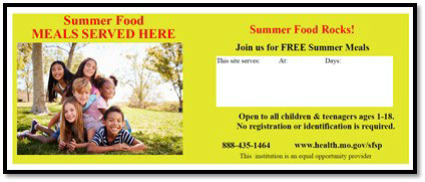
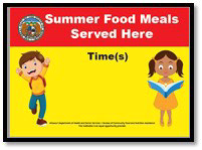
The SFSP Informational Flyer is available in this manual and at the SFSP website [NEEDS LINK]. Contact DHSS-CFNA at SFSP@health.mo.gov to order banners, signs, and window clings.
Summer Food Service Program
Food That’s In When School Is Out!
What is the Summer Food Service Program (SFSP)?
- The SFSP is a nutrition program federally funded by the United States Department of Agriculture, Food and Nutrition Services (USDA, FNS) and administered by individual states. In Missouri, SFSP is administered through the Missouri Department of Health and Senior Services-Community Food and Nutrition Assistance (DHSS-CFNA).
- The SFSP provides nutritious meals to needy children ages 18 and under during the summer months when school lunch and breakfast programs are not operating or during time of emergency. The program also provides meals to individual’s ages 18-21 who are determined by a state educational agency to be mentally or physically disabled, and who participate in a school program for mentally or physically disabled during the regular school year.
- SFSP sponsors receive financial and technical support to operate and administer the program.
- Meal sites can be approved as congregate sites or as rural non-congregate sites.
What is a sponsor?
- A sponsor is an organization that contracts with DHSS to operate the SFSP.
- Sponsors accept full final administrative and financial responsibility for all sites under their jurisdiction. A site is the location where meals are served to participants.
What types of organizations can sponsor the program?
- Schools, both public and private, who participate in the National School Lunch Program (NSLP).
- Units of local, municipal, county, tribal, or state government.
- National Youth Sports Programs (NYSP) and Upward Bound.
- Private nonprofit organizations.
- Public or private nonprofit camps.
- Public or private nonprofit universities or colleges.
- Hospitals, Federally Qualified Health Centers, and medical clinics.
- Local Public Health Agencies.
What types of sites are approved for operation?
A site can be anywhere that is accessible to and accommodates children and has the necessary facilities to serve meals. Sites can be indoors or outdoors; for example, a school cafeteria, park, or church.
- Open Site – located in an area where at least half of the children are eligible for free or reduced-price meals through NSLP.
- Closed Enrolled Site – at least half of the enrolled participants at the site are eligible for free or reduced-price meals based on properly completed Income Eligibility Forms or located in an area where at least half of the children are eligible for free or reduced-price meals through NSLP.
- Residential Summer Camp – a camp that offers regularly scheduled food service as part of an organized program for enrolled participants.
- Migrant Feeding Site – food service sites that primarily serve children from migrant families, where regularly scheduled meal services are available.
- Conditional Non-Congregate Site - a rural site that qualifies for Program participation because it conducts a non-congregate meal service for eligible children in an area that does not meet the definition of “areas in which poor economic conditions exist” and is not a “camp.”
How are meals provided?
A sponsor may provide meals to children by:
- Preparing meals in a central kitchen or on site at each location; or
- Obtaining complete meals from a Food Service Management Company (vendor), which could be a public agency, a private nonprofit organization, a school district, or a commercial food service management company. Federal, state, and local procurement standards must be met.
What must be served for meals to qualify?
- SFSP sponsors must follow the meal pattern requirements as outlined in the Summer Food Service Program Regulations, 7 CFR 225.16. All meals served in the SFSP must meet these requirements in order to receive reimbursement. The meal pattern establishes minimum portion sizes of various meal components that must be served to each child.
- The four meal components are: milk; vegetable, fruit, or juice; grains or bread; and meat or meat alternate.
- Breakfast – milk; vegetable, fruit, or juice; grain or bread.
- Lunch/Supper – milk; two different vegetables and/or fruits; meat or meat alternate; grain or bread.
- Snack – choose two of the four meal components.
Which meals can be served?
- The type of site operated determines the number and type of meal services that can be approved.
- Sites may be approved for one or two meal service times; for example, lunch only, breakfast and lunch, or lunch and snack.
- Residential and nonresidential camps and sponsors of programs for children of migrant workers may be approved to serve either three meals or two meals and one snack.
How is a sponsor reimbursed?
- Reimbursement is based on claims for reimbursement that the sponsor submits to CFNA. The amount the sponsor is reimbursed is equal to the number of eligible meals served to children multiplied by the current reimbursement rates.
Where are the SFSP reimbursement rates?
View SFSP reimbursement rates here.
What about recordkeeping?
- Sponsors must keep full and accurate records of the number of meals served to children to support each claim for reimbursement.
- Sponsors must maintain records of allowable costs such as food, kitchen labor, nonfood supplies, administrative labor, office supplies, printing, advertising, and travel for site monitoring or training., in order to operation of nonprofit food service.
- Sponsors must maintain all of these records for three full federal fiscal years and the current federal fiscal year.
- These records must be made available upon request to federal and state administering agencies for audit and review purposes
What are a sponsor’s administrative responsibility?
Administrative responsibilities include but are not limited to the following:
- Complete training required by the state administering agency.
- Train all personnel involved in the sponsor’s SFSP and keep records of all trainings conducted.
- Locate eligible sites.
- Hire, train, and supervise staff and volunteers.
- Monitor sites and ensure sites comply with civil rights requirements.
- Keep full and accurate records to substantiate the claim for reimbursement and to demonstrate a nonprofit food service, such as allowable costs and daily records of the number of meals received, prepared and served.
- Prepare and submit claims for reimbursement.
What about monitoring the program?
- Sponsors must provide personnel to monitor sites regularly and document the review.
- The sponsor’s monitors must ensure that its sites operate according to program guidelines and requirements, communicate any problems to the sponsor, and ensure the correction of problems.
Will the program be reviewed?
- New sponsors will receive an administrative review by DHSS-CFNA and/or USDA that will include an administrative review at the sponsor’s office and at least one meal service site. After the first year of operation, sponsors will be reviewed at least every three years.
- Sponsors must make SFSP records available for the administering agency review and must take any corrective actions required by the administering agency.
- Results of an administrative review may affect the amount of reimbursement the sponsor will receive.
- The review will involve an assessment of how the claim for reimbursement was prepared and a review of the supporting records maintained by the sponsor. Site operations will be assessed via an observation of the meal service operation and the recordkeeping of one or more sites.
How do I apply?
- Prospective new sponsors may find information regarding the application process at the SFSP website [NEEDS LINK],
- If you do not have internet access, call toll free 888-435-1464 or Relay Missouri for Hearing and Speech Impaired at 800-735-2966, or email sfsp@health.mo.gov for application information.
The application must be reviewed and approved by DHSS-CFNA before the organization can begin reimbursable meal services.
The sooner you submit the application, the better.
This institution is an equal opportunity provider.
Ensure each meal claimed for reimbursement is served as a complete meal. A complete meal includes all of the required meal pattern components for the meal service type.
A Checklist of Do’s and Don’ts for Site Supervisors
A food product thermometer is a useful tool that is required for all food establishments and regulated child care providers.
Vegetables are a required component for reimbursable meals.
Fruits are a required component for reimbursable meals.
Meats/Meat Alternates (M/MAs) are a required meal component for reimbursable lunches and suppers.