PURPOSE OF THIS MANUAL
MISSOURI WISEWOMAN PROGRAM MANUAL
The purpose of this manual is to provide the information and resources needed to implement a successful WISEWOMAN Program and provide services to program-eligible women in Missouri. If you do not find the information you need in this manual, please contact a member of the Missouri WISEWOMAN team toll-free at 866-726-9926.
WISEWOMAN AND SHOW-ME HEALTHY WOMEN PROGRAM OVERVIEW
MISSOURI WISEWOMAN PROGRAM MANUAL
NATIONAL BREAST AND CERVICAL CANCER EARLY DETECTION PROGRAM
National Breast and Cervical Cancer Prevention ( http://www.cdc.gov/cancer/nbccedp/ )
In 1990, the United States Congress passed the Breast and Cervical Cancer Mortality Prevention Act of 1990 (Public Law 101-354) to establish the National Breast and Cervical Cancer Early Detection Program (NBCCEDP). The Centers for Disease Control and Prevention (CDC) authorizes the NBCCEDP to provide grants to states, American Indian/Alaska Native tribes and U.S. Territories. These grants are used to conduct activities for the early detection of cancer.
WISEWOMAN PROGRAM HISTORY
https://www.cdc.gov/wisewoman/
In 1993, Congress amended the NBCCEDP Public Law 101-354 to create the Well-Integrated Screening and Evaluation for Women Across the Nation (WISEWOMAN) Program. The WISEWOMAN Program addresses women’s risk for heart disease and stroke by providing cardiovascular disease (CVD) health screenings and risk reduction education for NBCCEDP participants. The Missouri WISEWOMAN Program started in 2003 and is a sister program to Missouri’s NBCCEDP Program, Show-Me Healthy Women (SMHW), both programs are offered through Missouri DHSS (MDHSS).
SHOW-ME HEALTHY WOMEN
www.health.mo.gov/showmehealthywomen
VISION STATEMENT
Improve the quality of life in Missouri through the cure and elimination of breast and cervical cancers.
MISSION STATEMENT
Support quality screening, diagnostic and treatment services, in accordance with current medical standards of care for breast and cervical cancers for all women in Missouri. This is achieved by education, community outreach and resource development, in partnership with public and private entities, communities and citizens
WISEWOMAN
www.health.mo.gov/wisewoman
VISION STATEMENT
A world where all women can access preventative health services and gain the wisdom and confidence to improve her health.
MISSION STATEMENT
Provide low-income, underinsured or uninsured, 35-64-year-old women with the knowledge, skills and opportunities to improve their diet, physical activity and other life habits to prevent, delay or control cardiovascular and other chronic diseases.
NBCCEDP AND WISEWOMAN SIMILARITIES
NBCCEDP (known in the State of Missouri as Show-Me Healthy Women) shares an established infrastructure with WISEWOMAN to provide integrated services, including:
- Recruiting and working with women eligible for services
- Delivering screening services through an established health care delivery system
- Collecting and reporting minimum data elements (MDEs) used to track, monitor and evaluate program efforts
- Providing professional development opportunities for staff, providers and partners
- Providing public education to raise awareness about the need for women to receive program services
- Assuring that quality care is provided to women participating in the program

WISEWOMAN FOCUS AREAS
MISSOURI WISEWOMAN PROGRAM MANUAL
COMMUNITY-CLINICAL LINKAGES
Community-clinical linkages are connections between community and clinical sectors to improve population health. Public health leaders have prioritized community-clinical linkages as an effective approach to prevent and control chronic diseases. NCCDPHP promotes community-clinical linkages as helping to “ensure that people with or at high risk of chronic diseases have access to the resources they need to prevent, delay or manage chronic conditions once they occur.”

PATIENT ENGAGEMENT
Promoting patient engagement in healthcare helps to improve health outcomes, drive better patient care and achieve lower costs. It combines a patient’s knowledge, skills, ability, and willingness to manage their own care with communications to promote positive behaviors.
BENEFITS OF PATIENT ENGAGEMENT
- Increased knowledge and understanding among patients, encourages them to become actively engaged in their own health, well-being and healthcare choices, leading to improved care
- Physicians are better able to treat patients in the most effective way possible, ultimately becoming more time and cost efficient
- Patient engagement has financial benefits, as it reduces no-shows, aids in increasing revenue and maintains your patient base
DATA AND OUTCOMES
The Missouri WISEWOMAN Program activities centers on data collection. WISEWOMAN providers will enter information into Missouri Health Strategic Architectures and Information Cooperative (MOHSAIC). This information is then compiled by the WISEWOMAN team and reported to CDC for program improvements. Each WISEWOMAN service has specific components that are required for a valid claim. If data is entered incorrectly, the WISEWOMAN team will follow up to validate and/or correct the participant’s information. Invalid data will create a MDE error, which are submitted in a report to CDC biannually for review and correction.
NATIONAL CLINICIAL GUIDELINES
National clinical, diet and lifestyle guidelines, based on a rigorous review process, translate the best available science to practice and assist clinicians and participants in making health care decisions. Clinical practice guidelines on hypertension, cholesterol, diabetes and obesity are developed through collaborative efforts of national organizations, such as the American Heart Association (AHA), American Diabetes Association (ADA) and American College of Cardiology (ACC). CDC and MDHSS recognize that national guidelines are not fixed protocols that must be followed and that a licensed practitioner’s judgment remains paramount.
NATIONAL GUIDELINES GUIDANCE
WISEWOMAN providers should assure the quality of all WISEWOMAN services provided by using standards of care, including following the most current national guidelines, when delivering clinical and preventive services.
EXAMPLES INCLUDE:
- When subcontracting with other organizations for services, providers should specify expectations regarding adherence to national guidelines in contractual agreements, training and program policies
- Providers should provide ongoing professional development and technical assistance on national guidelines and quality assurance regarding the use of national guidelines to their subcontractors or encourage them to attend MDHSS recommended professional development
- Providers should ensure subcontractors participate in professional development and technical assistance regarding national guidelines provided by MDHSS
- Providers should participate in site visits, chart audits and/or data audits conducted by MDHSS and should conduct their own audits to assess quality in the delivery of services
WISEWOMAN PROVIDER CONTRACTS
MISSOURI WISEWOMAN PROGRAM MANUAL
HOW TO BECOME A WISEWOMAN PROVIDER
WISEWOMAN is a sister program to SMHW, therefore, you must be a SMHW provider before you are eligible to become a WISEWOMAN provider. Once you are a SMHW provider, follow these steps to become a WISEWOMAN provider:
- Contact the WISEWOMAN Program Manager by email or at 573-522-2871
- Submit a written request to the WISEWOMAN Program Manager for an amendment to your current SMHW Contract for WISEWOMAN funding
- WISEWOMAN Program Manager will submit a request to CDC for approval
- Once the request is received and CDC approval is obtained, the Program Manager will submit the contract amendment to be processed
- The contract amendment will then require an administrative signature to be fully executed by the State of Missouri system
- Provider staff will be contacted by the WISEWOMAN Education Coordinator to set up WISEWOMAN Provider Training
- After the contract amendment has been fully executed and WISEWOMAN Provider Training has been completed, WISEWOMAN funding will be loaded for provider use
WISEWOMAN CONTRACTUAL AGREEMENTS
The WISEWOMAN and SMHW programs utilize annual contracts with service providers to deliver program services. Contracts are available for SMHW only or for both SMHW and WISEWOMAN services. WISEWOMAN providers are eligible to receive two different types of funding on their annual contracts: one for direct WISEWOMAN services and one for Healthy Behavior Support Services (HBSS).
The contract for direct WISEWOMAN services is an amendment to the provider’s SMHW contract. Providers will be reimbursed for these services by entering claims in MOHSAIC. The contract for HBSS will be listed on the same contract with an allotted amount specified. Providers will be reimbursed for these services through invoice submission. The WISEWOMAN Fiscal Year runs from September 30-September 29, while SMHW’s Fiscal Year is June 30-June 29. Reimbursement and MOHSAIC entry information can be found in their respective sections in the WISEWOMAN Program Manual.
WHAT WE DO:
- Establish annual contracts for screening providers
- Provide an easily accessible Program Manual that describes screening, follow-up, education and reporting
- Follow guidelines based on national guidelines
- Require providers to utilize the Clinical Laboratory Improvement Amendments of 1988 (CLIA) approved laboratories or assure laboratory equipment is CLIA waived
- Provide Regional Program Coordinators (RPCs) for each geographic region to assist providers with training, technical assistance and tracking participants with abnormal values to ensure participants receive appropriate follow-up
- Provide training and technical assistance to provider staff
- Provide participant recruitment, targeting ethnically diverse program-eligible women
- Provide participant educational materials and tools
- Provide required reporting forms and data system for submitting service reports
- Reimburse providers for allowable services according to the Medicare 01 region rates
- Monitor provider services to assure quality standards
- Maintain a central data system for tracking and reporting required data to CDC
- Assist the service providers with participant case management/follow-up and annual evaluation screening efforts
- Provide promotional items, literature and other public educational materials
WISEWOMAN CONTRACT REQUIREMENTS
https://health.mo.gov/living/healthcondiseases/chronic/showmehealthywom…;
SMHW/WISEWOMAN Provider Forms can be located on the DHSS site listed above. Providers are required to complete and sign the SMHW/WISEWOMAN Contract annually, as well as the SMHW/WISEWOMAN Provider Information Update Form annually or within 30 days of any SMHW/WISEWOMAN staff changes.
RECRUIT PARTICIPANTS WITH THE FOLLOWING ACTIVITIES
- Offer WISEWOMAN services to ALL SMHW participants to increase program recruitment and provide materials on screening services to all eligible women attending clinics in the facility
- Display recruitment and educational information in the waiting areas and exam rooms
- Coordinate recruitment activities with DHSS staff, WISEWOMAN Education Coordinator and/or the RPC in your area
ATTEND TRAINING
- New providers of SMHW/WISEWOMAN services MUST participate in an on-site training and orientation session by MDHSS staff upon initial contract application prior to providing services
- Ensure staff is well-trained in program protocols by attending SMHW/WISEWOMAN provider staff training and request training sessions when new staff are hired
- Facilitate attendance/participation of staff members responsible for submission of data forms and clinical services at annual trainings that provide policy and procedure updates and review
- All contracted providers’ staff will need to attend program training annually.
BLOOD PRESSURE PROTOCOL
- All contracted WISEWOMAN providers are required to have a blood pressure protocol for their facility.
TERMINATION OF SMHW/WISEWOMAN PARTICIPATION
Providers who terminate participation in the SMHW/WISEWOMAN Program must submit a letter with the date of termination to MDHSS 30 days before the date of anticipated termination of services. The letter should be mailed to:
MISSOURI DEPARTMENT OF HEALTH AND SENIOR SERVICES
WISEWOMAN CENTRAL OFFICE STAFF
PO BOX 570 JEFFERSON CITY, MO 65102-0570
Providers must continue to report all program service information after termination on the appropriate SMHW/WISEWOMAN forms to complete all outstanding cases. They should also inform participants where they may obtain SMHW/WISEWOMAN services once the provider terminates participation. To accomplish this, a provider should work closely with the RPC in their area and the WISEWOMAN Education Coordinator.
ELIGIBILITY AND ENROLLMENT
MISSOURI WISEWOMAN PROGRAM MANUAL
Wisewoman Eligibility Requirements
- Age 35-64 years
- Uninsured or underinsured
- Low income (at or below 250% of federal poverty level)
- Unable to pay the premium to enroll in Medicare Part B
- Contact WISEWOMAN program staff in this scenario
Income Requirements
SMHW/WISEWOMAN participants must have an income at or below 250% of the federal poverty income guidelines. Adjusted gross income on tax return or net amount on pay stub determines income eligibility.
SMHW/WISEWOMAN FY22 Income Requirements

Insurance Requirements
SMHW/WISEWOMAN providers will use the SMHW/WISEWOMAN Participant Agreement Form (white) to document the insurance status of the participant.
Eligible Health Insurance Status
- No health insurance
- Health insurance does not cover services
- Participant states she is unable to pay deductible
- Have MO HealthNet with spend-down, but have not met spend-down
- Income eligible for Medicare Part B, but unable to pay premium
- Participants eligible to receive Medicare benefits, but not enrolled in Medicare should be encouraged to enroll
- ***Adult Expansion Group (AEG) with ME Code E2- Contact WISEWOMAN program staff to inquire about participant eligibility***
Ineligible Health Insurance Status
- Women with full MO HealthNet (ME Code 05), Adult Expansion Group (AEG) with ME Code E2, Medicare Part B, POS or HMO health coverage are not eligible for services
Participant Eligibility Guidance
Providers should develop plans to recruit SMHW participants into WISEWOMAN. Recruitment plans should reflect the following WISEWOMAN objectives:
- Serve as many eligible women as possible by using the most efficient means
- Reach populations that are at disproportionate risk for cardiovascular disease
WISEWOMAN Enrollment
Enrollment and participation in the WISEWOMAN Program is voluntary. WISEWOMAN participants must complete the SMHW/WISEWOMAN Participant Agreement Form (white), SMHW/WISEWOMAN Patient History Form (green) and must also be provided with the current DHSS Patient Privacy Rights Statement, in accordance with Health Insurance Portability and Accountability Act (HIPAA) regulations, prior to receiving services. The participant must also receive a HIPAA statement from the provider facility and retain proper documentation of this action. Current HIPAA regulations are located at the MDHSS website [NEEDS LINK]. After completing all required paperwork for enrollment, WISEWOMAN participants are eligible for an initial WISEWOMAN Screening Visit to complete Risk Reduction Counseling, followed by continued WISEWOMAN services.
WISEWOMAN PROVIDER MAP
, and the Breast Cancer Awareness

REGIONAL PROGRAM COORDINATORS

TRANSPORTATION SERVICES
Free transportation for all program services is available for SMHW/WISEWOMAN participants to help remove the barrier of access to care. Providers should contact WISEWOMAN Central Office Staff at 866-726-9926 or the RPC assigned to their area and request a travel voucher booklet. Transportation services are available Monday-Friday in most counties and the City of St. Louis, with charges based on urban or county trips and one-on-one or regular route travel. See page 18-19 for a complete list of transportation providers.
TRAVEL VOUCHER INSTRUCTIONS
WHEN A PARTICIPANT CALLS TO MAKE AN APPOINTMENT FOR SMHW/WISEWOMAN SCREENING, DIAGNOSTIC OR EDUCATION SERVICES, PLEASE ASK HER THE FOLLOWING QUESTIONS/COMPLETE THESE STEPS BEFORE MAKING AN APPOINTMENT:
1. DOES THE CLIENT NEED TRANSPORTATION?
- If yes, explain that free transportation is available for SMHW/WISEWOMAN participants
- A transportation provider will pick her up at her home, take her to the clinic and return her to her home
- Check with the transportation provider in your area for the transportation schedule
- Ensure the clients appointment date and time coincides with the transportation provider’s schedule
2. SECURE CLIENT ADDRESS AND TELEPHONE NUMBER
- If the participant does not have a telephone, ask for a neighbor’s telephone number or for another number where she can be reached, as the transportation driver may not be familiar with the participant’s address and may need directions to the residence
3. DOES CLIENT NEED ANY SPECIAL ASSISTANCE?
- If the participant needs an assistant or helper, SMHW/WISEWOMAN will pay for transportation for one extra person
- If a disabled participant needs more than one assistant, call SMHW/WISEWOMAN for approval
- If the client has special medical equipment, such as a wheelchair or oxygen, please inform the transportation provider at the time of scheduling
4. COMPLETE A TRAVEL VOUCHER
- Complete the travel voucher and include the facility name and site code number
- Provider can mail or fax the completed travel voucher to the transportation provider including the date and time of the appointment
- A copy of the voucher may be given to the participant
- Transportation provider will secure the participant’s signature on pickup
5. CANCELLATION OF A VOUCHER
- Notification of cancellation to the transportation provider is required to avoid a penalty charge to SMHW/WISEWOMAN for the cost of a one-way trip
- Provide one business day notice to cancel a voucher
TRANSPORTATION PROVIDERS


Please check the Transportation Services Catalog for other transportation options that may help your clients receive appropriate services: Transportation Services Catalog Transportation Services Provided ( https://health.mo.gov/atoz/pdf/transportationservices.pdf )
INTEGRATED OFFICE VISIT POLICY FOR NBCCEDP AND WISEWOMAN
MISSOURI WISEWOMAN PROGRAM MANUAL
The CDC’s NBCCEDP and WISEWOMAN programs have developed joint policies to provide guidance for an integrated office visit. The intent and benefit of coupling the two programs is to create a stronger link to ensure that as many women aged 35-64 who are enrolled in the NBCCEDP also receive appropriate CVD risk assessment and reduction in states that have both NBCCEDP and WISEWOMAN programs.
ALL OFFICE VISITS FOR WISEWOMAN SCREENINGS ARE EXPECTED TO BE INTEGRATED INTO THE NBCCEDP SCREENING OFFICE VISIT
INTEGRATED OFFICE VISITS
Integrated office visits should occur for women aged 35-64 who are enrolled in the NBCCEDP. Both programs must appropriately reimburse for screening visits and services using the following guidance:
- NBCCEDP funds should be used to reimburse for the integrated office visit and WISEWOMAN funds should NOT be used to pay for these office visits unless they have received CDC approval to conduct non-integrated office visits
- WISEWOMAN funds should be used to reimburse providers for the costs associated with measuring cholesterol, lipids, glucose, A1C or any other applicable labs
- When rescreening for NBCCEDP and WISEWOMAN coincide, this should be an integrated office visit, with reimbursement for the office visit using NBCCEDP funds
- Any non-integrated rescreening or diagnostic office visits for WISEWOMAN services should be paid for with WISEWOMAN funds
WISEWOMAN INTEGRATED SCREENING SERVICES
The following WISEWOMAN clinical screening services are expected to be integrated into the NBCCEDP screening exam office visit:
WISEWOMAN Screening
- WISEWOMAN Assessment Form and Risk Reduction Counseling
- WISEWOMAN Screening Form
- WISEWOMAN Social Determinants of Health Assessment Form
REFERRAL TO WISEWOMAN
Women who are determined by their provider to be at risk for cardiovascular disease (e.g., elevated blood pressure, obesity, smoking, family history of cardiovascular disease, etc.) should be referred to WISEWOMAN for appropriate services. It is expected that state NBCCEDP and WISEWOMAN programs collaborate to develop procedures and policies to ensure needed services are received.
RISK REDUCTION COUNSELING
Risk Reduction Counseling should take place during the WISEWOMAN screening visit, whether it is the participant’s first or annual screening.
FOLLOW-UP SERVICES
Any needed follow-up services for NBCCEDP or WISEWOMAN should be scheduled, as appropriate. These services may occur simultaneously or consecutively depending upon the nature of care needed. Both programs must ensure that a system is in place to monitor the follow-up recommended.
CLINICAL SCREENING SERVICES
MISSOURI WISEWOMAN PROGRAM MANUAL
The WISEWOMAN Program provides free screenings and counseling for women about their risk for heart disease and stroke. WISEWOMAN aims to improve the delivery of heart disease and stroke prevention services by focusing on CVD risk factors, specifically improving blood pressure control. Women are then supported as they participate in evidence-based lifestyle programs, Health Coaching and/or are referred to community resources. WISEWOMAN Clinical Screening Services are funded through the provider’s annual contract amendment.
WISEWOMAN Screening Requirements
ll WISEWOMAN providers must conduct a baseline screening, in accordance with national clinical guidance, for all women enrolling in WISEWOMAN and rescreen WISEWOMAN participants 12-18 months* after their previous WISEWOMAN screening. WISEWOMAN participants should have their demographics and enrollment paperwork obtained prior to a screening by completing the SMHW/WISEWOMAN Participant Agreement Form (white) and the SMHW/WISEWOMAN Patient History Form (green).
*Note: Although a rescreening visit should occur 12-18 months after the previous WISEWOMAN screening visit, an 11-month cutoff has been established to allow flexibility for women who return just before the one-year mark*
Baseline Screening and Rescreening Components
For WISEWOMAN screenings to be considered valid, they must include:
- Demographics—date of birth, race and ethnicity
- Previous cardiovascular disease risk—high cholesterol, hypertension, diabetes, stroke/TIA, heart attack, coronary artery disease, heart failure, vascular disease/peripheral artery disease, congenital heart disease and defects
- Use of medications to lower cholesterol, blood pressure, blood sugar and/or daily aspirin for heart attack and stroke prevention
- Diet—consumption of fruits, vegetables, fish, whole grains, beverages with added sugar and salt/sodium intake
- Physical activity
- Alcohol consumption
- Overall wellness/mental health status
- Tobacco use/smoking status
- Height, weight and BMI
- Two complete blood pressure (BP) measurements [2 systolic blood pressures (SBP) and 2 diastolic blood pressures (DBP)] with an average of the readings
- Laboratory values—total cholesterol, HDL, LDL, triglycerides and a fasting glucose or hemoglobin A1C
WISEWOMAN Clinical Measurements
The clinical screening component of the WISEWOMAN Program is used to assess the presence and evaluate a participant’s cardiovascular risk, provide participant-centered Risk Reduction Counseling and determine appropriate next steps.
Body Mass Index (BMI)
Body Mass Index (BMI) is an indicator of the amount of body fat, for most people, and is used as a screening tool to identify if an adult is at a healthy weight. BMI is a numerical value of a person’s height in relation to their weight. Individuals with a BMI that is considered overweight (≥25kg/m2) are at a higher risk of cardiovascular disease, hypertension and type 2 diabetes.
To Calculate a Participant’s BMI:
- Obtain the participant’s weight in pounds (lbs) and height in inches (in)
- Calculate BMI using a standard BMI chart or table
- Find the appropriate height in the left-hand column labeled “height”
- Move across to a given weight to the number at the top of the column that correlates to the BMI for that height and weight
Waist-To-Hip Ratio
In women, waist–to-hip ratio can be a stronger independent risk factor than BMI (Lapidus et al., 1984). The World Health Organization (WHO) Expert Consultation on Obesity recognizes the importance of abdominal fat mass/abdominal obesity, which can vary considerably within range of total body fat and BMI (WHO, 2000a).
Guidelines on waist and hip measurements:
- Make both measurements with a stretch‐resistant tape that is wrapped snugly around the subject, but not to the point that the tape is constricting
- Keep the tape level and parallel to the floor at the point of measurement
- Ensure that the subject is standing upright during the measurement, with arms relaxed at the side, feet evenly spread apart and body weight evenly distributed
- Measure waist circumference at the end of several consecutive natural breaths, at a level parallel to the floor, midpoint between the top of the iliac crest and the lower margin of the last palpable rib in the mid axillary line
- Measure the hip circumference at a level parallel to the floor, at the largest circumference of the buttocks
*Note: Waist and hip measurements to calculate waist-to-hip ratio are NOT required for WISEWOMAN screenings, but are strongly suggested to help support the understanding of CVD risk factors of individual participants and the overall WISEWOMAN population*
Blood Pressure Guidelines
The Missouri WISEWOMAN Program follows the blood pressure guidelines of the American Heart Association (AHA) and American College of Cardiologists (ACC).
Two complete BP measurements are required for wisewoman services and should be taken using the following steps/techniques to ensure accuracy:
Step 1: Properly prepare the patient
- Have the patient relax, sitting in a chair (feet on floor, back supported) for >5 minutes
- The patient should avoid caffeine, exercise and smoking for at least 30 minutes before measurement
- Ensure patient has emptied her bladder
- Neither the patient nor the observer should talk during the rest period or during the measurement
- Remove all clothing covering the location of cuff placement
- Measurements made while the patient is sitting or lying on an examining table do not fulfill these criteria
Step 2: Use proper technique for BP measurements
- Use a BP measurement device that has been validated and ensure that the device is calibrated periodically
- Support the patient’s arm (e.g., resting on a desk)
- Position the middle of the cuff on the patient’s upper arm at the level of the right atrium (the midpoint of the sternum)
- Use the correct cuff size, such that the bladder encircles 80% of the arm and note if a larger- or smaller-than-normal cuff size is used
- Either the stethoscope diaphragm or bell may be used for auscultatory readings
Step 3: Take the measurements needed for diagnosis and treatment of hypertension
- At the first visit, record BP in both arms and use the arm that gives the higher reading for subsequent readings
- Separate repeated measurements by 1–2 minutes
- For auscultatory determinations, use a palpated estimate of radial pulse obliteration pressure to estimate SBP—inflate the cuff 20–30 mm Hg above this level for an auscultatory determination of the BP level
- For auscultatory readings, deflate the cuff pressure 2 mm Hg per second, and listen for Korotkoff sounds
Step 4: Properly document accurate BP readings
- Record SBP and DBP—if using the auscultatory technique, record SBP and DBP as onset of the first Korotkoff sound and disappearance of all Korotkoff sounds, respectively, using the nearest even number
- Note the time of most recent BP medication taken before measurements, if applicable
Step 5: Average the readings using ≥2 readings obtained on ≥2 occasions to estimate the individual’s level of BP
Step 6: Provide BP readings to patient both verbally and in writing
Reference: Whelton, Paul K., et al. “Correction to: 2017 ACC/AHA/AAPA/ABC/ACPM/AGS/APhA/ASH/ASPC/NMA/PCNA Guideline for the Prevention, Detection, Evaluation, and Management of High Blood Pressure In Adults: A Report of the American College OF CARDIOLOGY/AMERICAN Heart Association Task Force on Clinical Practice Guidelines.” Hypertension, vol. 71, no. 6, June 2018, doi:10.1161/hyp.0000000000000076.
Laboratory Values
- WISEWOMAN labs must be completed 30 days before or after a screening visit
- Lab values must be reviewed verbally and in writing with WISEWOMAN participants with proper documentation by providers
- A complete lipid panel (total cholesterol, HDL, LDL, triglycerides) and a fasting glucose or A1C are required for WISEWOMAN screening
- A participant may have one Comprehensive Metabolic Panel (CMP) or Basic Metabolic Panel (BMP) per year, if medically necessary, and the provider should document the reasoning for the lab draw, as well as any abnormal values found on the CMP or BMP
- If a CMP or BMP is drawn, the provider will not be reimbursed for a glucose, also, as you can obtain the value from the CMP or BMP
- Fasting laboratory tests are preferred over non-fasting, in accordance with national clinical guidelines
- When fasting laboratory tests are not feasible, providers may use non-fasting laboratory tests to maximize screening opportunities
Fasting Lab Guidelines
- Women should fast for 9-12 hours prior to a fasting lab draw
- If a woman has a history of high cholesterol and/or is on lipid-lowering therapy, a fasting lab value is required
- In participants with pre-existing diabetes or for those who are non-fasting, A1C should be performed for glucose testing
- If the participant presents in a non-fasting state, only the values for total cholesterol and HDL will be useable and a follow-up fasting lipid profile is needed
Follow-Up/Repeat Lab Guidelines
- WISEWOMAN will reimburse for a repeat fasting lab within 30 days of the WISEWOMAN Screening if a woman’s non-fasting labs are abnormal, she has a history of high cholesterol and/or she is on lipid-lowering therapy
- If a participant has an abnormal WISEWOMAN Screening, they may have repeat labs drawn 3-6 months following their screening office visit
- If a woman is participating in Health Coaching, an ideal time to repeat labs is during her face-to-face Follow-Up Rescreen
- Repeat labs will be documented using the Diagnostic Form (gray) and submitted as a WISEWOMAN Lab Only claim
*Note: If a participant has a CMP or BMP drawn and there are abnormal findings unrelated to CVD risk and prevention, WISEWOMAN will not reimburse for follow-up labs—if there is a question regarding lab coverage, contact the WISEWOMAN staff*
RISK REDUCTION COUNSELING
MISSOURI WISEWOMAN PROGRAM MANUAL
Risk Reduction Counseling (RRC) is a major component of the WISEWOMAN Program. A participant-centered risk reduction plan should be developed collaboratively by the participant and provider by utilizing Team-Based Care and Bi-Directional Referrals. WISEWOMAN providers should offer options, not directives, and participant goals should be acceptable to the participant, explicit and achievable.
RRC must be initiated in person at the initial SMHW/WISEWOMAN integrated office visit. If lab results are not available at the time of the visit, providers can provide RRC based on other available participant health information and then complete RRC with the participant when lab results are obtained. After RRC requirements are complete, the provider will be reimbursed for services and participants can then be referred to additional WISEWOMAN services.
RISK REDUCTION COUNSELING TOOLS
There are, several approaches and curricula designed to provide the necessary skills for effective client-centered counseling. It is highly recommended that all provider staff conducting RRC be trained in at least introductory level Motivational Interviewing.
COMMON ELEMENTS OF MOTIVATIONAL INTERVIEWING
- Talking with, rather than to, the client
- Responding with sensitivity and considering health literacy or cultural issues that may emerge
- Maintaining a non-judgmental attitude, using active listening, asking open ended questions
- Supporting positive risk reduction changes already made by the client
- Assisting the client in identifying barriers to risk reduction (e.g., knowledge gaps, skills needed, socio-economic and other life circumstances that are barriers to being healthy)

WISEWOMAN Risk Reduction Counseling (Initial Screening) Requirements
- Evaluate and review the patient-reported information on the WISEWOMAN Assessment Form (tan) regarding a woman’s risk for CVD including:
- Previous CVD and risk levels
- Use of medications for HTN, cholesterol and/or diabetes
- Nutritional habits
- Physical activity
- Alcohol use
- Overall wellness/mental health
- Smoking status/tobacco use
- Readiness to change health habits
- Obtain clinical screening measures using the WISEWOMAN Screening Form (light pink) including:
- Height, weight and BMI
- Waist and hip circumference for waist-to-hip ratio (optional)
- Two complete blood pressure (BP) readings with an average reading
- Laboratory tests (complete lipid panel and A1C or fasting glucose) completed 30 days before or 30 days after the screening office visit
*Note: Fasting labs are preferred over non-fasting values (see Laboratory Values for detailed guidelines)*
- Review the results of the screening with the WISEWOMAN participant and provide participant-centered Risk Reduction Counseling on cardiovascular risk
- Refer WISEWOMAN participants for follow-up office visits, if applicable, for abnormal screening results and/or ALERT values including; elevated blood pressure, cholesterol, blood glucose, smoking cessation medication and mental health referrals
- Refer all WISEWOMAN participants who are willing and ready for change to Lifestyle Education Programs (LSPs) including: Health Coaching, Missouri Quitline, Eating Smart-Being Active (ESBA), Take Off Pounds Sensibly (TOPS), Diabetes Prevention Program (DPP), Weight Watchers (WW) and Self-Monitoring Blood Pressure (SMBP)
- Submit a WISEWOMAN Risk Reduction Counseling or WISEWOMAN Initial claim in MOHSAIC for the participant’s initial WISEWOMAN Screening visit for reimbursement of services with all required components
ANNUAL VISIT/RESCREENING
MISSOURI WISEWOMAN PROGRAM MANUAL
WISEWOMAN Annual Visits (Rescreen) have the same required components as Risk Reduction Counseling/Initial Screening, which are to be completed *12-18 months after the previous screening. WISEWOMAN participants should return annually for completion of assessment and screening.
*NOTE: Although a rescreening visit should occur 12-18 months after the previous WISEWOMAN screening visit, an 11-month cutoff has been established to allow flexibility for women who return just before the one-year mark*
WISEWOMAN Rescreen Requirements
- Review the WISEWOMAN SMHW Patient History (green)
- Complete the WISEWOMAN Assessment Form (tan)
- Previous CVD and risk levels
- Use of medications for HTN, cholesterol and/or diabetes
- Nutritional habits
- Physical activity
- Alcohol use
- Overall wellness/mental health
- Smoking status/tobacco use
- Readiness to change health habits
- Complete the WISEWOMAN Screening Form (light pink)
- Height, weight and BMI
- Waist and hip circumference for waist-to-hip ratio (optional)
- TWO complete blood pressure (BP) readings with an average reading
- Laboratory tests (complete lipid panel and A1C or fasting glucose) completed 30 days before or 30 days after the screening office visit
- Assess Social Determinants of Health using the WISEWOMAN Social Determinants of Health Assessment Form (purple) including:
- Technology/Internet Access, Childcare, Food Security, Housing, Transportation, Safety, and Medication Adherence
- Review the results of the screening with the WISEWOMAN participant and provide participant-centered Risk Reduction Counseling on cardiovascular risk
- Refer WISEWOMAN participants for follow-up office visits and to appropriate LSPs
- Submit a WISEWOMAN Annual and Social Determinants of Health claim in MOHSAIC
SOCIAL DETERMINANTS OF HEALTH ASSESSMENT AND FOLLOW UP
MISSOURI WISEWOMAN PROGRAM MANUAL
REQUIREMENTS
A WISEWOMAN screening, whether Risk Reduction Counseling or Annual, require a Social Determinants of Health Assessment (purple) form be completed in its entirety. The following topics are addressed in the assessment: internet access, food security, transportation, childcare, housing, safety, and medication adherence. Once the participant’s responses have been reviewed, if referrals are made for social services, the social service ID’s will need to be documented on the claim. Social Service ID consists of two letters representing recipient’s state, tribal organization, or territory, last two digits from the current year, four-digit code denoting it is a social service (i.e., “SSID”), a two-digit numeric code indicating type of social service referral. See Social Service ID “Cheat Sheet”. The Social Determinants of Health Assessment (purple) form then must be entered into MOHSAIC. Before a WISEWOMAN screening, whether Risk Reduction Counseling or Annual, will be reimbursed, this form must also be entered into MOHSAIC and be approved for reimbursement.
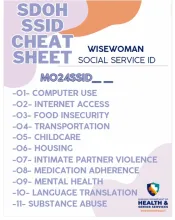
Social service referrals should be followed up on utilizing the Social Determinants of Health Referral and Follow Up (Bottom portion of purple claim only) form. Please note in the claim if participant was able to access resources or if resources were unable to be accessed. A participant may have up to 4 Social Determinants of Health Follow Ups per year. These can be completed over the phone or in-person. Additional referrals may be made during this time as well. Once a Social Determinants of Health Referral and Follow Up has been completed, this must be entered into MOHSAIC.
DIAGNOSTIC AND BLOOD PRESSURE MEDICAL FOLLOW-UP SERVICES
MISSOURI WISEWOMAN PROGRAM MANUAL
WISEWOMAN ALERT Values
WISEWOMAN ALERT Values are clinical measures or laboratory results that require medical follow-up immediately or within 7 days of the WISEWOMAN office visit. Follow-up can be completed the same day, if possible, with a WISEWOMAN Diagnostic Visit. The provider should document the date of the medical work-up on the screening form and note follow-up details. If a woman does not receive a work-up or intends to follow-up with another provider, the WISEWOMAN Education Coordinator should be notified and the follow-up information should be coded appropriately in MOHSAIC. Providers must also enter a claim for any visit including an ALERT Value within 7 days of the date of service (DOS).
WISEWOMAN ALERT Values
- Blood Pressure (BP): SBP >180mmHg and/or DBP >120mmHg
- Blood Glucose (fasting or non-fasting): <50mg/dL or >250mg/dL
*Note: There are no ALERT values for cholesterol or A1C*
ALERT Value Reporting Guidelines
- Record the participant’s BP and lab values on the WISEWOMAN Screening or Diagnostic Form, as appropriate (entering any ALERT value in MOHSAIC will automatically trigger the ALERT box to be completed)
- Record the date of the medical evaluation with a qualified practitioner on the WISEWOMAN Screening or Diagnostic Form
- Code the status of the ALERT value work-up with numerical coding system on the paper form and in MOHSAIC
- The numerical coding system for the status of a work-up is as follows:
- 1. Work-Up Complete: Participant has been seen and diagnosed by a medical provider either the day of the screening visit or within seven (7) days of the screening visit
- 2. Follow-Up/Work-Up by Alternate Provider: Participant intends to see alternate provider within 7 days
- 3. Participant Refused Work-Up: Participant has an ALERT value, but refused work-up
- 4. Work-up Not Completed, Participant Lost to Follow-Up: Participant had an ALERT value, but was lost to follow-up and work-up was not completed
- A participant who did not attend her scheduled work-up within THREE (3) months after a screening visit and could not be reached to reschedule another appointment is considered “lost to follow-up”
Lost To Follow-Up Guidelines
CDC requires specific documentation on ALERT value participants, which is submitted on the WISEWOMAN Screening or Diagnostic Form for the participant. There is a section on the Screening Form and the Diagnostic Form titled “ALERT Value Notes,” where information regarding the participant’s treatment plan and follow-up will be documented.
If a participant is referred to an outside clinician for ALERT value follow-up, the referring WISEWOMAN clinic is responsible for following up with the outside clinic to see if participant attended her appointment and obtain records to report back to the WISEWOMAN Program. Providers should notify the WISEWOMAN Education Coordinator if any participant is “lost to follow-up” and document the information on the appropriate form, including contact attempts.
WISEWOMAN Participant Is Considered “Lost To Follow-Up” When:
- Participant is referred to a medical provider in-house for the ALERT value follow-up and the clinic has three documented phone calls or attempts to reach participant to have ALERT value addressed with the medical provider with no response
- Participant is referred to an outside clinician and the referring WISEWOMAN clinic attempts to make the appointment within seven (7) days and are unable to
Blood Pressure Management
Improving control of hypertension is a major focus of the WISEWOMAN Program. Providers are expected to conduct additional preventive services for participants who have disease level hypertension, which is defined as a woman with an average BP of ≥130/80.
It is required that a WISEWOMAN participant receive follow-up services if they present to the provider with an abnormal or disease level blood pressure. This follow-up can be completed with a Blood Pressure Medical Follow-up, Diagnostic Office Visit or a Health Coaching session to discuss blood pressure management.
Blood Pressure Medical Follow-Up
Blood Pressure Medical Follow-Ups (yellow) are recommended for participants with abnormal disease level hypertension (Stage 2 ≥140/≥90 and ALERT Level ≥180/≥120) identified during a WISEWOMAN screening visit. The WISEWOMAN Program will reimburse up to three 25-minute, face-to-face, in-office Blood Pressure Medical Follow-Ups within 12 months of the participants Initial RRC or Annual screening visit. Two complete blood pressure measurements are required and BP Medical Follow-Ups can be completed by any trained medical staff who has the ability to contact a practitioner, if necessary. BP Medical Follow-Ups should be submitted as a WISEWOMAN First/Second/Third Blood Pressure Medical Follow-Up claim in MOHSAIC.
Diagnostic Office Visit
A Diagnostic Office Visit (gray) is utilized when a participant has an abnormal WISEWOMAN screening. WISEWOMAN will reimburse providers for one 30 minute, face-to-face Diagnostic Office Visit per grant year.
Qualifying Reasons for a Diagnostic Office Visit
- Hypertension (≥130/80)
- Elevated cholesterol
- Elevated blood glucose
- Smoking cessation medication
- Mental health follow-up
Diagnostic Office Visit Guidelines
- Must be a face-to-face visit with a qualified clinician (e.g. physician, physician assistant or nurse practitioner)
- If the screening clinic does not have a qualified clinician on-site, the participant should be referred to an outside provider and it is the responsibility of the referring WISEWOMAN provider to obtain follow-up information for the Diagnostic Office Visit to reimburse the provider
- Must be completed to confirm a diagnosis of hypertension (≥130/80), high cholesterol or diabetes, assess and prescribe medication for smoking cessation or follow-up on mental health concerns
- A participant can still receive a Diagnostic Office Visit if they have a history of any of the qualifying conditions
- Documentation of the reason(s) for the Diagnostic Office Visit must be completed on the WISEWOMAN Diagnostic Form (gray)
- Diagnostic Office Visits should be scheduled within 7 days for any ALERT value
- Diagnostic Office Visits can be completed on the same day as the screening visit, if possible, and do not require additional BP or lab values (the provider can input the values from the screening visit)
- If a Diagnostic Office Visit is completed at a later date, two new complete BP measurements are required
- Document any ALERT values on the WISEWOMAN Diagnostic Form (gray)
- Screening providers must be able to link participants to medical services for medical evaluation and assist participants with access to low-cost or free medication
- Submit a WISEWOMAN Diagnostic claim in MOHSAIC for the participant’s Diagnostic Office Visit for reimbursement of services with all required components
*Note: WISEWOMAN is unable to reimburse for the cost of any medications*
HEALTH COACHING
MISSOURI WISEWOMAN PROGRAM MANUAL
Health Coaching (HC) is a provider-based lifestyle education program (LSP) that applies a collaborative, participant-focused approach to enable participants to take responsibility for their health and well-being. The goal of HC is to help participants increase readiness and gain confidence to make lasting changes for improved health. Health Coaching can be conducted by any trained medical professional (e.g. nurse, dietitian, pharmacist, counselor, community health worker, etc.) involved in implementing Team-Based Care as a WISEWOMAN provider. Utilizing a range of medical professionals is encouraged by the WISEWOMAN program to best serve the participant’s needs and meet their defined goals.
Women will work collaboratively with their health coach to determine a priority area(s) of focus for the brief coaching interventions. Motivational interviewing techniques will be effectively utilized to elicit and strengthen motivation for changing behaviors related to the priority area. Drawing on core components of this counseling approach, health coaches will employ open ended questions, affirmative statements, reflective listening skills and summarizations to effectively capture and resonate change talk and self-motivational statements communicated by the participant.
Principal Tenets of Health Coaching
- Participant-Centered—interaction is collaborative and non-directive
- Participant-Tailored—participants choose the goals that they want to address, quantity and duration of sessions can vary based on participant’s needs and desires, coaching can be done in person or by phone to eliminate barriers to participation
- Whole-Person Approach—all health risks and conditions of an individual are taken into consideration and women are linked to additional community-based resources, as necessary
Health Coaching Priority Areas
WISEWOMAN Health Coaching priority areas include, but are not limited, to the following topics:
- Healthy eating
- Physical activity
- Blood pressure management
- Smoking cessation
- Medication education
- Mental health
Referral to Health Coaching
Health Coaching should be offered and encouraged for all WISEWOMAN participants. However, it is most appropriate for WISEWOMAN participants who:
- Indicate a readiness for change
- Agree that HC is an appropriate HBSS for them
- Prefer to individualize their HBSS
- Desire a condensed program delivery timeline
Health Coaching Guidelines
Risk Reduction Counseling precedes Health Coaching and lays the groundwork for a woman’s priority areas. For participants that show readiness for engagement and motivation to change, an initial Health Coaching session may be conducted in conjunction with a WISEWOMAN Screening/Risk Reduction Counseling. Because Health Coaching differs from RRC, Health Coaching content must be distinct and separate from RRC. Health Coaching should be submitted as a WISEWOMAN Education claim in MOHSAIC or included in the WISEWOMAN Screening (RRC, Initial or Annual) claim submission.
Initiation of Health Coaching
WISEWOMAN participants should be encouraged to schedule an initial Health Coaching session within two weeks of referral, if unable to complete the first Health Coaching in conjunction with RRC, but ultimately may propose a schedule informed by personal goals, learning style and schedule availability. Health Coaching sessions should be staggered in intervals to ensure that participants have sufficient time to institute behavior change, maximize opportunity for application and support self-efficacy.
Delivery of Health Coaching
To minimize known barriers to participant access and maximize participant choice, Health Coaching must be offered both face-to-face and via phone. Health Coaching sessions can range from 15-45 minutes, completed individually or in a group setting.
Requirements for Health Coaching Delivery Methods Include:
- Individual, face-to-face Health Coaching—provided, at a minimum, in a private exam, counseling or conference room located at a WISEWOMAN clinic
- Individual, telephonic Health Coaching—health coach must be, at a minimum, conducting counseling from a private or semi-private room or office in a clinic
- Group, face-to-face Health Coaching—provided, at a minimum, in a private conference room at a clinic with multiple WISEWOMAN participants
Tracking Health Coaching Sessions
Health Coaching sessions conducted by WISEWOMAN providers will be documented using the Health Coaching Reporting Form (peach). Each form is used through the completion of Health Coaching. The form will be incorporated into the WISEWOMAN MOHSAIC database to further support documentation and program evaluation processes. Health Coaching sessions should be completed 2-4 weeks apart, if possible. The WISEWOMAN health coach will document the date, session length, delivery method, topic(s) and comments on the form for Health Coaching sessions 1-3. On the 4th Health Coaching, it is required to complete a face-to-face WISEWOMAN Follow-Up Rescreen (hot pink).
Follow-Up Rescreen Requirements
WISEWOMAN health coaches must follow-up with participants within four weeks of completion of their third Health Coaching session to complete the WISEWOMAN Follow-Up Rescreen (hot pink). This should be submitted as a WISEWOMAN Follow-Up Rescreen claim in MOHSAIC. A Follow-Up Rescreen should be conducted face-to-face and must include the following components:
- Completion of health history assessment questions (also found on the WISEWOMAN Assessment Form) regarding a woman’s risk for CVD including:
- Previous CVD and risk levels
- Use of medications for HTN, cholesterol and/or diabetes
- Nutritional habits
- Physical activity
- Alcohol use
- Overall wellness/mental health
- Smoking status/tobacco use
- Height, weight and BMI
- Two complete blood pressure (BP) readings with an average reading
- *Laboratory tests (if ordered and deemed necessary by a qualified practitioner)
Completion and Continuation of Health Coaching
Completion of Health Coaching consists of three Health Coaching sessions, in addition to, a face-to-face Follow-up Rescreen (hot pink) during the 4th session. Health Coaching should ideally be completed in less than six months. Once a participant has completed one cycle of Health Coaching, further HBSS should be offered to the woman. After a Follow-Up Rescreen, a WISEWOMAN participant can continue Health Coaching sessions for up to 16 sessions/year. A new Health Coaching Reporting Form (peach) will be used to track each cycle of Health Coaching sessions.
HEALTHY BEHAVIOR SUPPORT SERVICES
MISSOURI WISEWOMAN PROGRAM MANUAL
In conjunction with Health Coaching, the WISEWOMAN Program offers Healthy Behavior Support Services (HBSS), including referrals to LSPs and community-based resources, as part of a strategy to improve the health status of individuals participating in the WISEWOMAN Program. These services are funded through the provider’s LOA.
Missouri Tobacco Quitline
The CDC requires that all enrolled WISEWOMAN participants are assessed for tobacco use and that tobacco cessation services are promoted by WISEWOMAN providers. WISEWOMAN participants are assessed for tobacco use with the WISEWOMAN Assessment Form (tan) and referred for cessation services by following these steps:
- Participant will indicate her current smoking status, smoking cessation completion, if applicable, and readiness for behavior change on the WISEWOMAN Assessment Form (tan)
- Participants who report smoking/tobacco use and express interest in quitting, including identifying tobacco cessation as a priority during RRC and/or Health Coaching, should be given a referral to the Missouri Tobacco Quitline or another evidence-based tobacco cessation program
- WISEWOMAN suggests using the Ask, Advise and Refer method:
- Ask every participant at each encounter about tobacco use and document their status
- Advise every tobacco user to quit with a clear, strong, personalized health message about the benefits of quitting
- Refer participants who are ready to quit tobacco within 30 days to the Missouri Tobacco Quitline
- Refer a participant to the Missouri Tobacco Quitline, which is free to anyone in Missouri, by calling 1-800-QUIT-NOW/1-800-784-8669 or registering online at http://www.quitnow.net/missouri
- Select the Tobacco Quitline LSP referral box and document the date of referral
- Smoking/tobacco cessation should be checked as a “topic” on the Health Coaching Reporting Form (peach) and discussion should be documented in the comments section
- A Diagnostic Office Visit can be billed and reimbursed through the WISEWOMAN Program for participants who wish to discuss tobacco cessation medication with a physician or practitioner
*Note: WISEWOMAN funds cannot be used for nicotine replacement therapies, but the Missouri Tobacco Quitline and other tobacco cessation resources often offer these therapies at little to no cost for participants*
Diabetes Prevention Program
The focus of a Diabetes Prevention Program (DPP) is to prevent type 2 diabetes among people at-risk for diabetes. This successful, standardized lifestyle intervention was developed to increase physical activity to a minimum of 150 minutes per week and reduce weight by a minimum of 7 percent, for population meeting eligibility criteria. Individual lifestyle coaches work with participants to help them achieve individualized, clearly defined weight loss and physical activity goals. The program focuses on self-management to achieve long-term improvements in diet and physical activity.
Referral Guidelines for DPP
Refer Wisewoman Participants to DPP Who:
- Indicate a readiness to change
- Agree DPP is an appropriate HBSS
- Have access to a local DPP
- Meet the DPP eligibility requirements as outlined in the CDC Diabetes Prevention Recognition Program Standards and Operating Procedures:
- BMI of ≥25 kg/m2 or ≥22 kg/m2, if Asian
- Elevated blood sugar/glucose is NOT a requirement for participation
- Participant cannot have already been diagnosed with diabetes—if the participant had gestational diabetes, she may be eligible to participate
- Select the DPP LSP referral box and enter the referral date on the WISEWOMAN Screening Form (light pink)
- Fax a paper referral form to the WISEWOMAN Staff at 573-522-3023
- WISEWOMAN staff will send the referral to the appropriate DPP Coordinator
Nationally-Recognized DPP Providers
- Missouri’s recognized DPPs are listed here.
- To become a nationally-recognized program, providers should complete the application at the CDC website.
Criteria and Training to Provide DPP On-Site Include:
- Personnel must meet specific criteria for the responsibilities, skills, knowledge, and qualities to become a DPP Lifestyle Coach
- Lifestyle coaches may have other credentials (e.g. RD, RN and MA), but they are not required
- Diabetes Prevention Coordinator is designated to implement the program, supervise daily operations, provide support and guidance to coaches and ensure the program activities achieve quality performance outcomes
- Coach and coordinator may be the same individual
Course Content of DPP
DPP consists of two phases: a 16-session core curriculum and a 6-session maintenance/post-core phase. The 16-session core curriculum courses are typically delivered once per week and must be completed within 26 weeks. The remaining six post-core classes are each usually delivered once per month.
60-Minute, In-Person Sessions Include:
- Private weigh-in and review of self-monitoring records
- Discussions on various topics
- Identification of barriers
- Action planning
Completion of the DPP is defined as 9 of 16 core sessions and 3 of 6 maintenance/post-core. If a WISEWOMAN provider has a participant interested in DPP participation, but a class is not scheduled to start soon, the provider may choose to refer participants interested in DPP to Health Coaching sessions in the interim. Health Coaching can be conducted as an interim HBSS to keep the participant engaged and motivated until a DPP or other lifestyle program group becomes available. This option should be used if the participant’s screening visit is not conducted around the time that a new DPP class will begin the course.
Reimbursement for DPP
For individuals referred to DPP by the WISEWOMAN Program, the program fee is covered by WISEWOMAN and the reimbursement cap for DPP is $705.00 per year.
Weight Watchers
Weight Watchers (WW) is a diet plan first developed in the 1960s that encourages weight loss by making healthy food and lifestyle choices. The Weight Watchers plan is based upon the idea that dieting is only one part of a healthy lifestyle. The program stresses the importance of overall mental and physical health and well-being.
Weight Watchers does not forbid specific foods or tell people what to eat. There are also no pre-prepared meals or foods to purchase. Instead, people are encouraged to make healthier eating choices and to increase physical activity. Weight Watchers sponsors group meetings in locations throughout the world and online where members can offer each other encouragement, support and tips for making healthier lifestyle choices.
Referral Guidelines for Weight Watchers
- Participant indicates a readiness for change
- BMI >25kg/m2 or >22kg/m2, if Asian
- Participant must sign the Weight Watchers Consent Form at the time of her screening visit to participate in the program
- Select the Weight Watchers priority area box on the WISEWOMAN Screening Form (light pink)
Session Dosage and Delivery
- Weight Watchers participants will receive a 10 week prepayment coupon and an attendance sheet
- Local meeting registration fee will be waived
- Membership kit is provided at the first meeting with resources from Weight Watchers
- In order to receive the second set of ten-week prepayment coupons, the participant must attend and participate in 80% of the first ten meetings
- Once the participant has selected her preferred meeting, she will take the voucher to her next chapter meeting
- Weight Watchers chapter leader will take the voucher and have her complete a Weight Watchers membership application
- Voucher along with the membership application will be sent to the Weight Watchers corporate office
- Participant is responsible for presenting her attendance sheet at each weekly meeting and having the Weight Watchers leader sign off on her attendance
- If attending Weight Watchers online, the participant must share their app log-in information with the WISEWOMAN provider by creating an account with the provider in-person in the clinic
- Once the participant has attended 12 weekly sessions, she will then return to the WISEWOMAN provider clinic for a face-to-face visit, providing the attendance sheet to the health coach, which is faxed to the WISEWOMAN central office staff as a form of completion of the 12 weekly sessions
- Weekly attendance does not need to be recorded following the 12 week check-in, however it is encouraged as a motivator for the participant
Participant Follow-Up and Program Assessment
Participants must agree to actively participate in Health Coaching from the provider. This allows the provider to follow-up with the participant and see that the program is meeting the participant’s needs and address any concerns the participant may have.
Reimbursement for Weight Watchers
Weight Watchers services will be reimbursed every three months. The reimbursement cap for Weight Watchers is currently $800.00/year and it set based on grant budget.
Take Off Pounds Sensibly
Take Off Pounds Sensibly (TOPS) is the short name for TOPS Club, Inc.—the original nonprofit, noncommercial network of weight loss support groups and wellness education organization. Established in 1948 to champion weight loss support and success, TOPS has helped millions of people live healthier lives. TOPS offers tools and programs for healthy living and weight management, with exceptional group fellowship and recognition.
Weekly meetings include private weigh-ins and professionally prepared, informational chapter programs that feature up-to-date information on nutrition, exercise and healthy lifestyles. Programs provide positive reinforcement and motivation to adhere to food and exercise programs. TOPS does not sell foods, endorse products or push a one-size-fits-all meal plan. On the TOPS meal plan, you choose foods you enjoy in moderation. The flexible guidelines help you control calories while eating real food at home or in a restaurant.
Chapter locations vary and include; hospitals, churches, senior center settings, libraries and other community locations. Participants can find the local chapters by going to the website www.tops.org, clicking on “Find a Meeting” tab and entering her home zip code and a travel radius.
Referral Guidelines for TOPS
- Participant indicates a readiness for change
- BMI ≥25kg/m2 or ≥22kg/m2, if Asian
- Must be able to establish a healthy and responsible weight loss goal
- Select the TOPS LSP referral box and enter the referral date on the WISEWOMAN Screening Form (light pink)
- Participant must sign the TOPS Consent Form at the time of her screening visit to participate in the program
- Fax the signed consent form to the WISEWOMAN Staff at 573-522-3023
- Participant is provided with her signed voucher and the attendance/weigh-in sheet to take to her local chapter meetings
Obtaining a TOPS Voucher
Once a provider has recognized a participant qualifies for the TOPS program and the enrollment paperwork is complete, a TOPS voucher will be mailed to the clinic for pick up by the participant. Vouchers are valid for one grant year and the participant must continue to achieve goals and participate in health coaching to obtain additional vouchers. Please note that the membership voucher is not replaceable if lost and cannot be photocopied
Session Dosage and Delivery
- Participants choose to join a local chapter or become an online member
- Weekly meetings provide a supportive, educational environment
- Participants will have the option of attending the local chapter that is best for their schedule and comfort level
- Participants are encouraged to attend several different chapter meetings to find the best suited chapter for them
- Meetings are held at various times of the day and days of the week
- Initial visits are free of charge
- Once the participant has selected her preferred chapter, she will take the voucher to complete a TOPS membership application
- The voucher, along with the membership application, will be sent to the TOPS corporate office
- Participant is responsible for presenting her attendance sheet at each weekly meeting and having the TOPS leader sign off on her attendance
- Once the participant has attended 12 weekly sessions, she will then return to the WISEWOMAN provider clinic for a face-to-face visit
- The WISEWOMAN provider/health coach will obtain the attendance sheet from the participant and fax it to the WISEWOMAN central office staff as a form of completion of the 12 weekly sessions
- At the 12 week face-to-face session with the participant, the WISEWOMAN provider will provide the participant with the book Real Life: The Hands-on Pounds-Off Guide and food cards for her attendance to the TOPS program
- Weekly attendance does not need to be recorded following the 12 week check-in, however it is encouraged as a motivator for the participant
- If at any time the participant stops attending TOPS Chapter meetings regularly, the TOPS Chapter leader or another member may call or email the participant for follow-up
Reimbursement For TOPS
The WISEWOMAN Program will cover the yearly cost for the participant at $32.00 per year. The participant will be responsible for any minimal chapter dues of $5.00 monthly.
Eating Smart-Being Active
Eating Smart-Being Active (ESBA) is a research-based nutrition, food safety and food resource management education curriculum for low-income adults. All participant materials are available in English and Spanish. Curriculum activities include facilitated discussion and hands-on activities to allow participants to be actively engaged in the learning process and apply the newly learned information. Lessons include the latest research-based information from the Dietary Guidelines for Americans 2015-2020 and MyPlate.
Topics Covered Include:
- Physical activity
- Nutrition and healthy lifestyle choices
- Food preparation
- Saving money at the grocery store
- Eating a variety of healthy foods from all the food groups
- Food safety
- Reducing fat, sugar and salt
- Feeding children
ESBA is delivered by the University of Missouri Extension (UME). The UME is part of the national land-grant university and Cooperative Extension System that brings research-based knowledge and information to people in their homes, workplaces and communities to improve the lives of Missourians. The UME puts research into practice by providing high-value education programs and resources in the areas of agriculture and natural resources, home and consumer life, nutrition and health, families and youth, community and leadership, and business and workforce development.
Referral Guidelines for ESBA
- Participant indicates a readiness for change
- Select the ESBA LSP referral box and enter the referral date on the WISEWOMAN Screening Form (light pink)
- Fax the ESBA Referral Form [NEEDS LINK] to the WISEWOMAN Staff at 573-522-3023
- WISEWOMAN staff will send the referral to the appropriate UME
- UME receives the paper referral form and contacts the participant to set up the class and address any barriers the participant may have in regards to attendance
Session Dosage and Delivery
- Consists of 9 lessons, each 90 to 120 minutes in length
- Lessons are designed to be taught in sequential order, building on previous lesson content
- Completion of the ESBA program is defined as attending six (6) sessions, but attending all nine (9) sessions is encouraged
- ESBA provides incentives to the participant once they have completed the minimum of six (6) sessions
- Taught in either a one-on-one or in small group class (2-12 people) setting for maximum interaction among participants
- A variety of learning styles are incorporated into the lessons through the use of handouts, discussions, facilitated dialogue, demonstrations and hands-on performance of skills learned during class
- Curriculum is written for participants who may have a low literacy level
Participant Follow-Up and Program Assessment
- UME provides follow-up with participants who do NOT attend scheduled classes
- UME provides WISEWOMAN staff with a monthly attendance list
- UME makes attempts to call the participant after completion to gain follow-up information regarding the participant’s status and the success of the class
- UME also encourages the participant to follow-up for their annual WISEWOMAN screenings
Reimbursement for ESBA
WISEWOMAN providers do not receive reimbursement for ESBA services as this time. Providers make the referrals to ESBA and ESBA has a contract with MDHSS to provide and administer services. ESBA will send MDHSS an invoice for services provided and MDHSS will then reimburse ESBA.
Other Programs
Any additional HBSS options will require prior approval by the Missouri WISEWOMAN program.
Self-Monitoring Blood Pressure
Self-Monitoring Blood Pressure (SMBP) is the regular measurement of blood pressure by the patient outside the clinical setting, either at home or elsewhere. SMBP requires the use of a home blood pressure measurement device by the patient to measure blood pressure at different points in time. SMBP, plus clinical support, helps people with hypertension lower their blood pressure.
SMBP is a significantly more individualized program that focuses heavily on the participant’s blood pressure, when compared to other lifestyle programs. The individualization of the program allows for it to be adapted to the needs and motivation level of each participant. Coaching will be customized to the participant priority and willingness/ability to make change.
This coaching program is optimal for those who are not able to attend other programs due to barriers, such as transportation, inability to afford gas to travel and time conflicts. Telephone health coaching will be provided if that best accommodates the participant’s needs. The health coaches will help the participant use problem-solving skills to overcome barriers and will be a source of support and encouragement to the participant when working to reach goals. Health coaches will also be able to refer participants to community-based resources for assistance in overcoming barriers.
Referral Guidelines for SMBP
- Participant indicates a readiness for change
- Participants who have presented with disease level hypertension (≥130/80)
- Participants who need to closely monitor their HTN diagnosis (each clinic will utilize appropriate trained clinical staff to address medical issues such as hypertension and determine, based on screening and diagnostic visits, if the participant is a good candidate to enroll in SMBP)
- If the provider determines the participant would benefit from a SMBP program, the clinic will fill out the SMBP Referral Form (white), SMBP Initial Enrollment Form (white) and Patient Participation Agreement (white) then fax the forms to the WISEWOMAN staff at 573-522-3023
- WISEWOMAN clinics may operate SMBP within their clinic or they may refer the participant to a community SMBP Program that works with WISEWOMAN
- If the clinic operates a SMBP, the clinic will then schedule the participant for a follow-up 2-3 days later to recheck the blood pressure and the participant will receive a blood pressure cuff and self-monitoring packet with tracking information
- If the clinic does not operate a SMBP in their community, the WISEWOMAN central office staff will work with the clinic to determine a SMBP partner within the community to offer SMBP services\
Session Dosage and Delivery
- Consists of at least three or more in-person SMBP Blood Pressure Medical Follow-Up visits and three SMBP Health Coaching telephone calls until appropriate blood pressure goal is reached
- If blood pressure is not controlled, additional counseling will be available or other interventions will be considered
- During the in-person BP Follow-Up visits the participant will be trained in appropriate home blood pressure monitoring techniques, receive a home monitoring blood pressure cuff and receive tools to document the readings
- During the SMBP Health Coaching sessions, concerns over medications will be discussed with the participant and shared with the primary care provider, as needed
- Between visits the participant is asked to self-monitor and record their blood pressure twice daily, or as prescribed by physician
- Participant will be asked to bring these results and the device at the BP Medical Follow-Up visits and SMBP Health Coaching sessions in order to ensure proper utilization of the blood pressure device
- After the program has ended, participant will be allowed to keep the blood pressure monitor in order to continue self-monitoring
Participant Follow-Up and Program Assessment
- Within four weeks of completion of SMBP Health Coaching, the participant will receive a face-to-face Post Intervention Assessment to include two clinical BP readings and two SMBP readings and participants will be counseled on the use of community resources and potential challenges/barriers
- Six months after the program is complete, a Post Intervention Follow-Up telephone call will be made to the participant to address the participant’s blood pressure, medication adherence, any further needs the participant may have and reinforcement of community resources
- WISEWOMAN Fourth Follow-Up Assessment will be completed either face-to-face or via the telephone with the participant after the completion of three SMBP Health Coaching sessions
Reimbursement Guidelines for SMBP
Self-Monitoring Blood Pressure has a reimbursement cap dependent upon the budget. Please see the Reimbursement Guidelines section of the manual for specific reimbursement rates and CPT codes.
Community-Based Resources
Community-based resources supplement other HBSS, such as Health Coaching and LSP referrals, to reduce a woman’s CVD risk. For an individual woman, referral to community-based resources may be the most appropriate HBSS. WISEWOMAN participants should be referred to community-based resources to support identified goals. These resources may include programs that support chronic disease management, physical activity, nutrition and tobacco cessation. Providers should develop partnerships to offer community-based resources at low or no cost to women. Reimbursement for community-based resources and barrier-reduction tools will be utilized through LOA funding for HBSS and invoice submission to the WISEWOMAN staff. See the Reimbursement Section for detailed guidelines.
Community-based resources and barrier-reduction tools that are reimbursable through the WISEWOMAN program should only be offered and utilized once a participant shows commitment to the WISEWOMAN program and has attended at least three health coaching sessions within six months of enrollment
| Physical Activity and Nutrition Resources | Barrier-Reduction Tools |
|---|---|
|
|
Fitness Center/Gym Membership and Fitness Classes
Fitness center/gym memberships or fitness classes for committed WISEWOMAN participants are eligible for reimbursement. Fitness center/gym memberships allow for participants to have the opportunity to work out in a safe environment that promotes successful lifestyle changes. Providers would have agreements with local fitness centers/gyms where participants could exercise. The provider would pay the initial fee for the participant and would be reimbursed by the WISEWOMAN Program. If a provider has a fitness center/gym that offers fitness classes on‐site or at another facility, the provider may be reimbursed for the cost of the membership or class cost for the WISEWOMAN participants.
Guidelines for Memberships Include:
- Participants who qualify may have a membership for a three‐month period
- Provider will need to follow-up with the fitness center/gym to assure the participant has attendance of 80% or greater for a three-month period to continue to qualify for an additional three‐month period
- Participants must also be participating in Health Coaching sessions
DATA ENTRY/MOHSAIC
MISSOURI WISEWOMAN PROGRAM MANUAL
WISEWOMAN providers must collect and store data on WISEWOMAN services. The WISEWOMAN Program provides paper forms for WISEWOMAN services. Information gathered on these paper forms represents all WISEWOMAN data that must be manually entered in the Missouri Health Strategic Architectures & Information Cooperative (MOHSAIC) web application. MOHSAIC is an online data system used to collect and manage participant service records for the SMHW and WISEWOMAN programs. It is not an electronic health record (EHR) and should not be used to gather any information beyond required data elements used for cardiovascular screening surveillance. WISEWOMAN forms are located on the DHSS website [NEEDS LINK].
MOHSAIC also tracks funding allocations and expenditures and is linked to the Statewide Advantage for Missouri (SAM II) accounting system for reimbursing providers. Prior to reimbursement, WISEWOMAN staff review all submitted forms to ensure provided services meet program standards. Based on data entered, agency grant activity statements are generated within the MOHSAIC application—making MOHSAIC data entry the only way WISEWOMAN service delivery providers can access grant funds. MOHSAIC submission will automatically generate proper CPT codes for claim reimbursement for WISEWOMAN services.
Uses of Data in the WISEWOMAN Program
- Ensure participant eligibility
- Monitor grant spending and screening goals
- Monitor data across all service delivery providers to ensure volume of data entry errors is minimal
- Ensure clinical quality of services provided meet CDC indicators
- Identify providers in need of funding increases or decreases
Minimum Data Elements
MOHSAIC data is submitted to the CDC for review two times each fiscal year. WISEWOMAN minimum data elements (MDEs) are a set of standardized data variables needed to ensure that consistent and complete information is collected for each WISEWOMAN participant. MDEs serve the purposes of describing, monitoring and assessing individual and program progress, which are captured using MOHSAIC. Each data element has a valid range. If an entry is made that is outside of the valid range, it will create an MDE error and the WISEWOMAN staff will contact providers regarding data in this range while reviewing claim submissions. To assist with entry of accurate data, MOHSAIC will create an error message for providers if an “out of range” value is entered. When this occurs, please contact WISEWOMAN staff to assist with submission.
WISEWOMAN MDE 18.3 Quality Check and Error Values

MOHSAIC Access
The MOHSAIC application is located on the MDHSS Portal at:
http://webapp01.dhss.mo.gov/SMHW/Default.aspx
https://webapp02.dhss.mo.gov/SMHW/Default.aspx
SMHW/WISEWOMAN Providers do not need to install additional software beyond a web browser. MOHSAIC data entry is a WISEWOMAN contract requirement; therefore, it is important that MOHSAIC users at each provider agency site have access to a MOHSAIC-supported web browser.
Requesting Access to MOHSAIC
To apply for access to MOHSAIC for SMHW/WISEWOMAN, follow the instructions below. If assistance is needed regarding MOHSAIC, please contact the WISEWOMAN staff or your RPC.
When an existing MOHSAIC user no longer needs access for WISEWOMAN data entry, the provider must report user’s name to program staff within 15 days.
***If you have an Automated Security Access Processing (ASAP) profile already and you know your login credentials, please skip to STEP 2: Request SMHW Access. If you are unsure if you have an ASAP profile, use the following steps to help determine your status:
- If you already have a local public health agency (LPHA) email account, DHSS health applications and/or Department of Social Services (DSS) prod/mainframe access, you most likely have an ASAP profile
- If you try to create an ASAP profile and you receive a message indicating the first and last name are already in use, please contact the ITSD Call Center for assistance at 1-800-347-0887—this likely means you have an ASAP profile and ITSD can assist with profile updates, password resets, logging into ASAP and/or submitting requests
Step 1: Creating an Automated Security Access Processing User Profile
- Open Internet browser and enter address http://webapp02.dhss.mo.gov/asap_web/ASAPLogin.aspx
- Select “Yes” for any security messages
- Select the “NEW USER” option

- Enter your first name, last name, last four digits of your SSN and preferred first name
- Click the “CREATE USERID” button
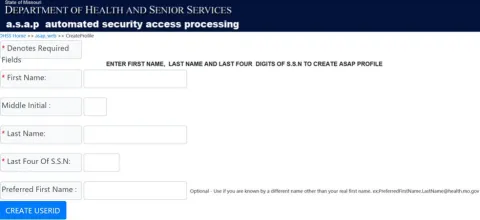
- Make note of your UserID
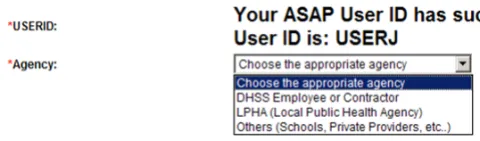
- Select “Others (Schools, Private Providers, etc.)” for the Agency
- Select “DHSS DIVISION OF COMMUNITY HEALTH” for Local Security Officer County
- Select “SHOW ME HEALTHY WOMEN LSO (Paula Fox)” for Local Security Officer

- Type your work street number (it will provide a drop-down list) and select your provider’s address

- Enter your e-mail address, telephone number and fax number

- Enter a password
- Retype your password
- Enter a challenge question (this should be something only you know the answer to)
- Type the response or answer to the challenge question
- Retype the response or answer to the challenge question
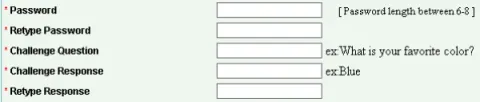
- Select “CREATE PROFILE”

- You should see a message about the profile being successfully created. Please make note of your User ID and password.

Step 2: Request SMHW Access
- Open Internet browser and enter address http://webapp02.dhss.mo.gov/asap_web/ASAPLogin.aspx
- Select “Yes” for any security messages
- Type the User ID and Password you created in Step 1
- Select the “SIGN IN” button
*If ASAP did not prompt you to create a password, your password was automatically set to first initial of first name, first initial of last name and last four digits of your SSN*
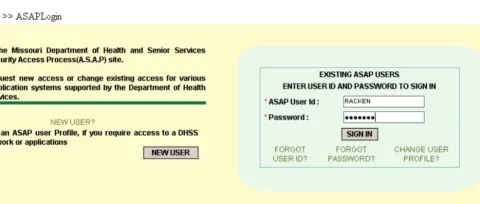
- Select the “Completing for Self” option
- Select the “NEXT” button
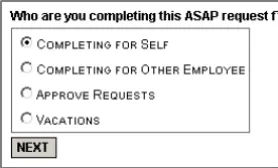
- Select “HEALTH APPLICATIONS” for Area Type
- Select “SHOWMEHEALTHYWOMEN” for Health Area Type
- Select “ADD ACCESS” for Request Type
- Select “SMHWPROVIDER (***FOR USE BY SMHW PROVIDER ONLY)” from the Role drop down list
- Select “NONE” for other role/report type
- Type in any comments (*optional)
- Type in the Effective Date
- If not entering data for additional agencies, leave defaulted to “NO”
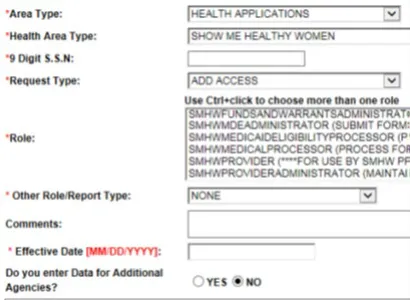
- To select other agencies, select “YES” and pick the county and the agency from the dropdown list
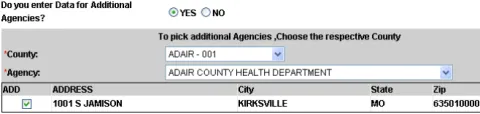
- Select the “I Agree” button
- Select the “Submit Form” button
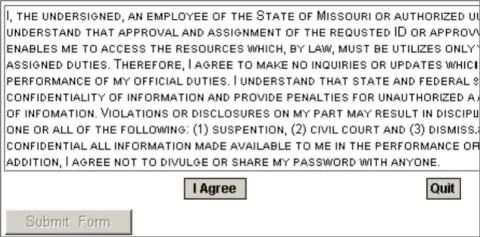
- A message should appear stating the request was successfully completed
- Print a copy of the completed form for agency records

If you experience any problems or have questions while using the ASAP system, please notify the DHSS ITSD call center at 573-751-6388/1-800-347-0887 or support@health.mo.gov.
Navigating MOHSAIC
MOHSAIC Helpful Tips
- Use Internet Explorer browser
- Check compatibility setting (mo.gov and mo.dhss)
- Check text size for screens with overlapping words or adjust zoom setting
- Turn off pop-up blockers (MOHSAIC uses pop-up screens for data information)
Steps to Access/Logging Onto MOHSAIC and SMHW Application
- Open the Internet browser and enter the Web address on the address line: https://healthapps.dhss.mo.gov/smhw/
- If this is the first time to login, a password must be established:
- Use the username and assigned password provided to you by e-mail from SMHW, when approved
- User name is usually the first five letters of last name and first name initial
- Initial password is first and last name initials and last four digits of SSN
- Click on “Change Password”
- If you do not login to MOHSAIC for 30 days, the system will “lock out” and you must call the ITSD Help Desk at 1-800-347-0887 to unlock and enter new password
- After a password is established, the program will ask to change your password every 30 to 60 days
- Password can be numbers, letters or a combination and requires six (6) to eight (8) characters and one numeric value
- Once logged in, your agency name will appear and stay constant throughout the application
- Select the “Login” button to proceed

Entering or Viewing a Participant in MOHSAIC
- Log on to the SMHW application main screen
- Select the “Client” section on the menu bar

- Choose the “Submit New Forms/Billing” tab under the “Client” section
- In the “Submit New Forms/Billing” tab under the “Client” section, type the client’s name (Last, First) and hit


- If the client is already registered, MOHSAIC will auto populate the client’s information— Do not click “return” to allow MOHSAIC adequate time to search
*Note: If the screen returns more names than the screen will hold, use the scroll down bar to see the full screen—if there are more than 15 names on the screen use the double arrow at the bottom of the screen to proceed to the next search result screen* - If the client name appears, select the correct name by clicking on it and verify the name by checking the date of birth (DOB) and DCN number, if available, as the client may be in the system with multiple names

- The client information screen will display the client demographic information
- If any information is missing, add the correct information in the “View/Edit Client Information” screen


- If the client’s name is not in the database, this screen will say “The client was NOT found in MOHSAIC. Click OK to add the client. Click CANCEL to search again.”
- This screen will also allow you to complete an extended search using the client’s DCN or Social Security Number (SSN)
- The search will check the MOHSAIC and DSS databases
- If the participant name is not in the system, the screen appears with the “The client was NOT found in MOHSAIC. Click OK to add the client. Click CANCEL to search again” message to prompt entry of a new client in MOHSAIC


- Select “OK” to add client to MOHSAIC, enter the following information and select “REGISTER AS MEDICAL CLIENT”
- Last name
- First name
- Date of Birth
- Race
- Ethnicity
- Gender
- Social Security Number (SSN) with no spaces or hyphens
- Departmental Participant Number (DCN)
- Phone number
- Address
- If the system does not recognize address, “Address Verification” will pop up
- If the address is correct, enter the county and click “save” or change the address to a valid address and click “save”
- If the county and address match the database, the pop-up box will turn orange
- If not and both fields are correct, call SMHW/WISEWOMAN at 866-726-9926 to request an address fix—typically, this fix will be done overnight
Checking Medicaid Information
- After entering client information, proceed to the “View Medicaid Information” tab under the “Client” section (information is transferred from the DSS database)
- If the client is not on Medicaid, the screen will be empty—this screen is “read only” and will display the current client at the top of the screen
- If a client name is displayed at the top of the screen and the client is on Medicaid, the screen will be filled in, showing all of the participant and guardian information, as well as managed care information
- If there is an open date but no close date, the participant is on some sort of assistance and has an active Medicaid case—a client with ME Code 05 (Full Medicaid) or E2 (AEG) with no end date or during the time of services provided is not eligible for WISEWOMAN services.
- Please remember, when pulling up or entering another client under “Client Demographics,” verify that the client’s address and other personal information is correct—we have encountered several forms that were entered for a different client, but only the client name was changed, leading to duplicate records in the system and resulting in errors on the data submitted to CDC.
Until a software programming change is complete, please make sure the DOB and SSN are correct for the participant form being entered.

Entering Provider and Form Type Information
- Select the “Client” section and “Submit New Forms/Billing” tab
- Search or enter the client, as outlined in the Program Manual
- On the “Provider Information” section, select “Regular Billing”
- Type in the provider’s name and select the appropriate provider— MOHSAIC will generate the provider’s address, when selected
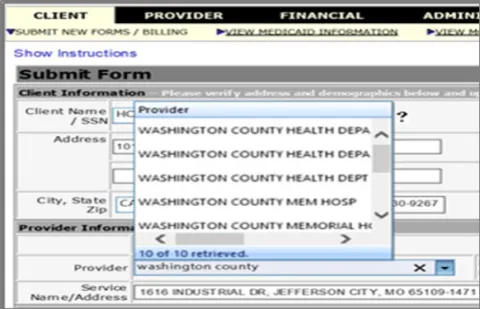
- When entering information in this section is complete, proceed to the next section “Form Type/Version”
- Select “WiseWoman Form” under “Type”
- Select form (Forms for Services Provided On or After September 30, 20_ _) that corresponds to the participant’s DOS and the appropriate grant year under “Version”
- Please note that by default, MOHSAIC software automatically selects the version based on the present date
- To enter a form with a different date of service, select a different version from the drop down box—this is likely to occur during the first few months of a grant year when a provider could be entering multiple versions of the forms

Filling Out A Form
- Verify all of the client and provider information entered on the “Submit New Forms/Billing” screen and click “Create Form” to generate a new WISEWOMAN form (MOHSAIC form screen will match the paper forms provided by WISEWOMAN)
- Enter the current date for “Date Form Received” and the date WISEWOMAN services were completed for “Service Date”
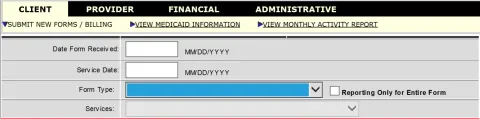
- Use the dropdown box to select the appropriate form type and services
- If content of the drop down box is known, then tab to the empty field and type the first letter and the word will appear
- Once a form type and service is selected, MOHSAIC will generate the corresponding form for completion that matches the WISEWOMAN paper forms

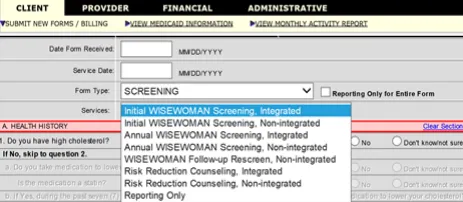
- To fill in the forms use the mouse, tab key or the space bar
- To use the mouse, click on the drop down arrow and then select the appropriate choice
- If using the mouse for buttons, click inside the circle for all forms
- Tab to the next field
- When tabbing and encountering a square radio button, hit the space bar to fill it in
- Tabbing to a radio button will automatically fill in the circle when highlighted
- Hit “Submit” once all information is entered appropriately in the form
Reporting Only Submission
If a WISEWOMAN participant receives cardiovascular screening services that do not meet the requirements for a valid WISEWOMAN screening, a MOHSAIC claim submission can be entered as “Reporting Only.” A Reporting Only claim will have no reimbursement cost for the provider, but will be used to track data on WISEWOMAN participants. By checking the “Reporting Only for Entire Form” box or “Reporting Only” as the service, the WISEWOMAN participant’s data will still be submitted in MOHSAIC, but no reimbursement will be issued.
Examples of Appropriate Reporting Only Claims Include:
- Incomplete screening (e.g. missing labs, only one BP measure, no height/weight)
- Additional labs not covered by the WISEWOMAN Program
- Diagnostic information from an outside provider
- Services covered by another funding source


Provider Contract Information
To Review Provider Contract/Funding Information, Follow These Steps:
- Select the “Financial” section, followed by “Provider Contract Maintenance” tab
- Search for a provider
- This screen tracks and displays the amount of funding given, amount billed, amount paid and amount available
- The billed amount subtracts from the amount available upon submission
- If this information does not correspond with your records, contact the WISEWOMAN Education Coordinator at 866-726-9926
- WISEWOMAN encourages you to monitor your funds through your internal system

Review Pay Status of Forms
There Are Four “Form Status Types” in the Review and Payment Process of the WISEWOMAN Program:
- Submitted By Provider—claim form has been submitted by provider for review
- Approved—claim form has been reviewed by WISEWOMAN staff and approved for reimbursement
- Released To Finance For Payment—claim form has gone through a warrant and electronically transferred
- Check Mailed—payment voucher(s) have been mailed to the providers from the WISEWOMAN central office, outlining the claims and services that have been paid and the amount reimbursed with WISEWOMAN funding
To Search and Review All Submitted Forms for a Specific Participant or Provider, Follow These Steps:
- Select the “Financial” section then the “Review Pay Status of Forms” tab
- Search for either a participant or provider by entering their information and selecting “SUBMIT”
- Searching for a participant/provider will display all forms submitted for that participant/provider and the pay status
- Click on “Form Status” to view specific form statuses or click multiple items to display all the selections
- Entering the date range will display all forms status for the range
- The “Form Type” and “Total Amount Paid” columns show in blue—selecting either one brings up the form or the claim screen to review in a “read only” format


OTHER WISEWOMAN RESOURCES
MISSOURI WISEWOMAN PROGRAM MANUAL
Medication Access References/Resources
- 340b Drug Pricing Program & Pharmacy Affairs - Health Resources and Services Administration (HRSA) requires drug manufacturers to provide outpatient drugs to eligible health care organizations/covered entities at significantly reduced prices
- Federal Trade Commission - Federal Trade Commission (FTC) provides useful consumer information regarding prescription savings programs and generic drugs
- Medicare Information - Information about the specific drug plans available in a particular area and about Medicare drug plans, in general, are available at 1-800-MEDICARE (1-800-633-4227)
- NeedyMeds - NeedyMeds keeps up-to-date information from pharmaceutical companies on client assistance programs
- RxAssist - Funded by The Robert Wood Johnson Foundation, RxAssist is a web-based medication resource center for providers, advocates, consumers and caregivers
- RxHope - RxHope contracts directly with pharmaceutical companies to provide an electronic application process for their client assistance programs and provides this service to physicians and clients free of charge
- State Pharmaceutical Assistance Programs - This website identifies states that have programs to provide pharmaceutical coverage or assistance, primarily to low-income older people or people with disabilities who do not qualify for Medicaid
Cardiovascular Disease References and Resources
Cardiovascular Risk and Blood Pressure
Cholesterol
Diabetes
American Diabetes Association Standards of Medical Care in Diabetes—2017

