
Summer Food Service Program Manual
Meal Service and Meal Pattern Requirements
Sponsors participating in SFSP must provide meals that meet meal pattern requirements.
Meal Service Requirements
Sponsors may serve one or two meals or snacks a day at meal service sites. Sponsors may choose which combination of meals they would like to serve; however, serving lunch and supper on the same day is not allowed.
Allowable Meal Combinations
- Breakfast Only
- Lunch Only
- Supper Only
- Snack Only
- Breakfast and Lunch
- Breakfast and Snack
- Breakfast and Supper
- Lunch and Snack
- Supper and Snack
- Two Snacks
Meal services can be operated by different sponsors at the same site; however, the maximum number of meals allowed at a site must not be exceeded.
With the Department of Health and Senior Services-Community Food and Nutrition Assistance (DHSS-CFNA) approval, camp or migrant site sponsors may serve up to three meals (including snacks) each day. Allowable meal combinations for camps or migrant site sponsors include:
- Breakfast, Lunch, and Supper.
- Breakfast, Lunch, and Snack.
- Lunch, Supper, and Snack.
- Any combination of meals or snacks that is less than the maximum number allowed.
In addition to serving meals that meet meal pattern requirements, sponsors must comply with the following rules when serving meals at each of their sites:
- The site must serve the same meal to all children.
- Children must eat all meals on site (7 CFR 225.6(i)(15)). A meal may be consumed offsite only if the meal is served on a state agency-approved field trip. Also, at the sponsor’s discretion with a written policy, participating children may be allowed to take one fruit, vegetable, or grain item off-site to eat later and still claim reimbursement for the meal. The food item taken off-site must be from the child’s own meal or left on a *share table by another child who did not want it. Note: Some rural sites may be approved for non-congregate meal service.
- Except for non-congregate meal service, meals claimed as breakfast must be served at or close to the beginning of the day and cannot be served after lunch or supper (7 CFR 225.16(c)(2)).
- All sites (except residential camps and non-congregate meal service) require that a minimum of one hour must elapse between the end of one meal service and the beginning of another (7 CFR 225.16(c)(3)).
- To be reimbursable, meals must have all the required meal components; for guidance, refer to the Summer Food Service Program (SFSP) meal pattern chart.
- All children are served one meal before any second meals are served or any adult meals are served. The purpose of second meals is to reduce waste. In order to count as a reimbursable second meal, it must contain all required meal components.
- Sites must adhere to local sanitation codes and health department regulations.
- Outdoor sites must have alternate arrangements for inclement weather.
- Sites must serve meals on time. Meal service times must be approved, and any changes in meal times must be reported and approved online or by calling 888-435-1464 prior to implementing the change.
- Meals to vended sites may not be delivered sooner than one hour prior to the start of the meal service unless the site has refrigeration or the means to maintain the required safe temperatures of the meal.
- For infant meals, sponsors must receive prior approval from the DHSS-CFNA to serve meals to infants (0 to 11 months of age). All meals served to infants must comply with the Child and Adult Care Food Program (CACFP) infant meal pattern requirements. If your site is going to serve infants, please contact the DHSS-CFNA for further guidance on the approval process.
- For meals for children aged one to six, sponsors must receive prior approval from the DHSS-CFNA to adjust meal portion sizes for younger children. If adjustments are allowed, all meals served to younger children must comply with the age-appropriate CACFP meal pattern requirements.
Share Tables
Sponsors must provide reimbursable meals that meet the Summer Food Service Program (SFSP) meal pattern requirements; however, children may not always want to consume certain food or beverage items included in their meals. SFSP sponsors may utilize “share tables” at their sites to encourage the consumption of nutritious foods while reducing waste.
SFSP sites may create a sharing table or stations where children may return whole items that they choose not to eat. Unopened, unused, whole food items left on a share table are then available to other children who may want additional servings. Other children may take food from the share table if they want additional servings.
- Sponsors must first check that “share tables” comply with state and local health and safety codes.
SFSP sites must follow food safety requirements when choosing to include share tables in their meal service!
Sponsor must establish guidelines for the use of share tables or stations:
- Must follow federal, state, and local health safety codes.
- Must establish clear guidelines for food components that may and may not be shared or reused as part of a reimbursable meal.
- Must be unopened prepackaged items, unused, whole items.
- Leftover, unopened cartons of milk may be left on the share table but must be held at 41 degrees Fahrenheit or below.
- Must supervise the share table at all times to ensure compliance with food safety requirements.
- Promote the share table to children and families and provide guidelines.
- Display signage outlining share table “rules.”
For more information, refer to FNS Memo SFSP 15-2016 “The Use of Share Tables in Child Nutrition Programs” which includes the following guidance:
Share tables allow food or beverage items to be reused in a number of ways, depending on the Program’s preference:
- Children may take an additional helping of a food or beverage item from the share table at no cost;
- Food or beverage items left on the share table may be served and claimed for reimbursement during another meal service (i.e., during an afterschool program when leftover from a school lunch). (MO-SFSP recommends that a log is kept to document food, especially milk, that is used for another meal service);
- Food or beverage items may be donated to a non-profit organization, such as a community food bank, homeless shelter or other non-profit charitable organization ( see SFSP 07-2012, Guidance on the Food Donation Program in Child Nutrition Programs).
Four Meal Components in Menu Planning
Summer Food Service Program nutritional guidelines help ensure that children are provided with healthy foods that meet their growing needs. The four meal components below are used to plan meals and snacks. Additional foods may be served to provide additional nutrients. Specific food information can be found in the United States Department of Agriculture’s Food Buying Guide for Child Nutrition Programs.
- Breakfast must contain the milk, grains/breads and vegetable/fruit components.
- Lunch and Supper meals must contain all four meal components, including two different servings of vegetable/fruit.
- Snacks must contain at least two different meal components.
Four Meal Components in Menu Planning
Meal Pattern Requirements
It is important for the success of the Summer Food Service Program (SFSP) to serve nutritious meals that meet meal pattern requirements and that are appetizing to children. Careful menu planning is necessary to meet this goal. The meal pattern requirements assure well-balanced meals that supply the kinds and amounts of foods that children require to help meet their nutrient and energy needs. The meal pattern establishes the minimum portions of the various meal components that must be served to each child in order for the participating sponsor to receive reimbursement for each meal (7 CFR 225.16(d)).
Breakfast
For a breakfast to be a reimbursable meal, it must contain:
- One serving (eight ounces or ½ pint) of milk. It may be fat-free (skim), low-fat, or whole.
- One serving of a vegetable, fruit, or full-strength juice.
- One serving of grain or bread.
- A meat or meat alternate may also be served but is optional.
Lunch and Supper
For a lunch or supper to be considered a reimbursable meal, it must contain:
- One serving (eight ounces or ½ pint) of milk. It may be fat-free (skim), low-fat, or whole.
- Two or more servings of vegetables and/or fruits, or 100% juice.
- One serving of a grain or bread.
- One serving of meat or meat alternate.
Snack
For a snack to be a reimbursable meal, it must contain two of the four meal components listed below:
- One serving (eight ounces or ½ pint) of milk. It may be fat-free (skim), low-fat, or whole.
- One or more servings of vegetables and/or fruits, or 100% juice*.
- One serving of a grain or bread.
- One serving of meat or meat alternate.
*Juice may not be served when milk is served as the only other component of a snack.
For more information, please refer to the SFSP Meal Pattern Requirements and information on creditable meal components in the SFSP Nutrition Guidance for Sponsors.
Food Chart – Summer Food Service Program
Food Chart – Summer Food Service Program
- Serve as a beverage, or on cereal, or use part of it for each purpose.
- Either volume (cup) or weight (ounces), whichever is less.
- Must be served as a beverage.
- Beans, peas, and lentils may credit as either a vegetable or a meat alternate, but not as both in the same meal. Immature beans and peas, such as green beans, wax beans, and green peas credit as a vegetable component only; they do not credit as a meat alternate.
- Serve two or more kinds. Full-strength juice may be counted to meet not more than one-half of this requirement.
- Serve two food items. Each food item must be from a different food component. Juice may not be served when milk is served as the only other component.
Note: All grain/bread items must be enriched or whole grain, made from enriched or whole grain meal or flour, or if it is a cereal, the product must be whole grain, enriched, or fortified. Bran and germ are credited the same as enriched or whole grain meal or flour.
Milk Purchase Requirement
Fluid milk is a required meal component at all breakfast, lunch, and supper meals. Milk purchase requirements are based on the sponsor’s monthly claim for reimbursement for these meals. Use the following information in order to adequately purchase enough milk to meet the meal pattern requirements for the number of meals you serve:
Common Milk Measurements
| Required Serving Size per Meal | Container Size | Number of Servings per Container |
|---|---|---|
| 8 ounces (oz.) | Half pint (8 oz.) | 1 |
| 8 ounces (oz.) | Gallon jug | 16 |
If you are serving half pint (eight oz.) containers, you must purchase enough half pints to cover serving at least one per meal. If you are purchasing gallon jugs of milk and are pouring eight oz. (required) cups of milk to serve with meals, then you must purchase at least 1 gallon of milk for every 16 meals you serve.
For example: If your claim for reimbursement is a total of 1,527 breakfasts and lunches, then your required milk purchase is as follows:
For gallons:
- 1,527 x 8 ounces = 12,216 ounces of milk needed in total.
- There are 128 ounces of milk per gallon.
- 12,216 divided by 128 = 95.4 gallons of milk needed.
For half pints:
1,527 (meals claimed) = 1,527 half pints (8 oz.)
Using this example, you would be required to have purchased either 95½ gallons or 1,527 half pints of milk to meet the minimum meal pattern requirements for your claim. You must provide proof of purchase of enough milk at the time of a review. If inadequate milk is purchased for the number of meals claimed, disallowances may be made by the Department of Health and Senior Services-Community Food and Nutrition Assistance.
Meal Pattern Substitutions
In order to claim a meal for reimbursement, all required meal components must be served in at least the minimum serving size required per age group(s). Exceptions to this requirement occur under the following circumstances:
Substitution for a Documented “Disability” (42 U.S. Code Sec. 12102)
Meal pattern substitutions (accommodations) must be made when a condition recognized as a “disability” is documented by a recognized medical authority. A participant with a “disability” is any person who has a physical or mental impairment that substantially limits one or more “major life activities,” has a record of such impairment, or is regarded as having such an impairment. For purposes of identifying individuals with disabilities, the list of “major life activities” has expanded to include a category called “major bodily functions.”
Meal sites participating in the Summer Food Service Program (SFSP) are required to make substitutions or modifications to the meal pattern for a participant with a disability that restricts his/her diet. Substitutions must be made on a case-by-case basis and only when supported by a written statement signed by a recognized medical authority (licensed physician, physician’s assistant, or nurse practitioner) which explains the need for substitutions and includes recommended alternate foods. The medical statement must be kept on file and include:
- A description of the participant’s physical or mental impairment that sufficiently allows the program operator to understand how it restricts the participant’s diet.
- An explanation of what must be done to accommodate the child’s disability.
- The food or foods to be omitted from the participant’s diet.
- The appropriate food substitutions.
Note: Reimbursement for meals served with documented food substitutions is claimed at the same reimbursement rate as meals that meet the meal pattern. The site may not charge for the substituted food item—substitutions that exceed program reimbursement are at the sponsor’s expense.
Modifications for Dietary and Cultural Preferences
Meal or meal service modifications, such as food or beverage substitutions, may be made at the sponsor's discretion for children with dietary and cultural preferences that are not considered a disability. Any modification that does not meet the meal pattern requirements is not reimbursable unless supported by a medical statement signed by a recognized medical authority (licensed physician, physician’s assistant, or nurse practitioner). The written statement must contain the information detailed above.
While sponsors are not required to accommodate dietary and cultural preferences, such as vegetarian diets, sponsors are highly encouraged to do so within the existing meal patterns. The SFSP meal pattern allows for a variety of food items within the required meal components and is flexible and adaptable enough to accommodate dietary preferences.
Fluid Milk (Non-Dairy) Substitutions
Schools participating in the SFSP and following the National School Lunch Program meal patterns may offer non-dairy milk substitutes to children who cannot consume fluid milk due to a medical or special dietary need that does not rise to the level of a disability. Schools must receive a written request from a recognized medical authority or a parent or guardian that identifies the child’s medical or dietary reason for needing a milk substitute (7 CFR 210.10(m)). In addition, in order for the meal to be reimbursable, non-dairy beverages served in lieu of fluid milk must be nutritionally equivalent to milk and provide specific levels of calcium, protein, vitamins A and D, magnesium, phosphorus, potassium, riboflavin, and vitamin B-12 (7 CFR 210.10(d)). Schools that decide not to offer milk substitutions for children with medical or special dietary needs must communicate this decision to all households.
Sponsors following the SFSP meal pattern may only serve non-dairy beverages in place of fluid milk when supported by a medical statement from a licensed health care professional.
Acceptable fluid milk substitutes must contain the following nutrients in the quantities specified in order to be considered nutritionally equivalent to fluid cow’s milk:
Fluid Milk Substitute - Minimum Nutrient Requirements*
| Nutrient | Per one (1) cup, 8 fluid ounces |
|---|---|
| Calcium | 276 mg. |
| Protein | 8 gm. |
| Vitamin A | 150 mcg retinol activity equivalents (RAE) |
| Vitamin D | 2.5 mcg |
| Magnesium | 24 mg. |
| Phosphorus | 222 mg. |
| Potassium | 349 mg. |
| Riboflavin | 0.44 mg. |
| Vitamin B-12 | 1.1 mcg. |
*Fluid milk substitutes served to children 1 through 5 years old must be unflavored.
Non-dairy beverages meeting USDA Substitution criteria per eight fluid ounces include:
- 8th Continent: Original Soy Milk
- Silk: Original Soy Milk
- Bettergoods: Plant-Based Original Soymilk
- Pacific Foods: Original Ultra Soy Milk
- Kikkoman: Pearl Organic Soymilk
- Ripple: Original Plant-Based Milk
Note: The Missouri Department of Health and Senior Services-Community Food and Nutrition Assistance (DHSS-CFNA) does not endorse the companies or products listed. This list is not all-inclusive. Read the nutrition facts panel or contact the manufacturer to ensure that product formulations are current.
Meal or meal service modifications, such as food or beverage substitutions, may be made at the sponsor's discretion for children with dietary and cultural preferences.
Processed Food Documentation
Summer Food Service Program (SFSP) sponsors are responsible for ensuring that their menus fulfill meal pattern requirements. Therefore, they must maintain documentation that demonstrates how a food item meets the program requirements in 7 CFR 225.
Some SFSP meal sites choose to purchase commercially processed meat/meat alternate (m/ma) products rather than prepare these main dish items on site, commonly referred to as “homemade” or “cooked from scratch”. If the processed (commercially prepared) food item is not found in the “Food Buying Guide for Child Nutrition Program” (FBG), then documentation should be obtained from the manufacturer prior to purchasing and serving/claiming the food item.
In November 2024, the United States Department of Agriculture (USDA) released an updated policy memo (SFSP 02-2025) regarding the documentation of processed foods, which supersedes previous guidance. This memo details the two types of acceptable documentation approved to verify meal pattern compliance: Child Nutrition (CN) label OR a manufacturer’s Product Formulation Statement (PFS).
The CN label and a manufacturer’s PFS are documents that provide a way for a manufacturer to demonstrate how a processed food product contributes to the meal pattern requirements. Both a CN label and PFS are voluntarily provided by manufacturers at the request of program sponsors.
A CN label is authorized by USDA and provides a warranty of a product’s meal pattern contribution when the processed product is used according to the manufacturer’s instructions. A PFS is typically provided for processed products that do not have a CN label. It is the program operator’s responsibility to request and verify that the supporting documentation for the PFS is accurate.
CN Labels
The Child Nutrition Labeling Program is administered by the United States Department of Agriculture, Food and Nutrition Service (USDA, FNS) in cooperation with the following agencies: Agriculture Marketing Service (AMS), Food Safety and Inspection Service, and National Marine Fisheries Service. Main dish products that contribute to the meat/meat alternate component of the meal pattern requirements are eligible for a CN label. Examples of these products include beef patties, cheese or meat pizzas, meat or cheese and bean burritos, egg rolls, and breaded fish portions.
Advantages of using a CN-labeled product include:
- A CN label statement clearly identifies the contribution of a product toward the meal pattern requirements. It protects Child Nutrition program sponsors from exaggerated claims about a product.
- A CN label provides a warranty against audit claims if the CN-labeled product is used according to the manufacturer’s directions.
- CN labels simplify cost comparisons of like products.
CN-labeled products will always contain:
- The CN logo, which has a distinct border;
- The meal pattern contribution statement;
- A unique 6 digit product identification number assigned by USDA/FNS appearing in the upper right hand corner of the CN label
- The USDA/FNS authorization statement;
- The month and year of the final approval.
- Plus the remaining required label features: product name, inspection legend, ingredient statement, signature/address line, and net weight.
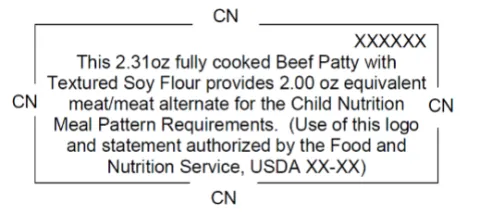
Note: The X’s in the sample CN Logo are only used to demonstrate the placement of the CN identification number and the final date. If you receive a CN-labeled product containing all X’s (all zeroes or non-number symbols) for the CN identification number, the label is not valid. If a CN label is not valid, FNS cannot provide a warranty for its use toward meal pattern requirements.
The CN label is the gold standard for verifying the crediting of menu items and provides a warranty against audit claims when the product is used according to the manufacturer’s instructions.
Acceptable and valid documentation for the CN label includes:
- The original CN label removed from the product carton.
- A photocopy of the CN label shown attached to the original product carton.
- A photograph of the CN label shown attached to the original product carton.
- A CN label copied with a watermark displaying the product name and CN number provided by the vendor and the Bill of Lading (invoice).
CN labels that are photocopied or photographed must be visible and legible.
CN Label Verification System
The CN Label Verification System is available to assist the SFSP sponsors in verifying the status of a CN label as well as the crediting information.
Dates Related to CN Labels
Once authorized, CN labels are valid for five years under the condition that the manufacturer remains an authorized CN producer and the product formulation does not change. The date printed on the CN label is the original date of authorization or the date of the most recent authorization for use of that CN label. This is different from the “Valid Until” date shown on the CN Label Verification Report, which indicates when the current authority to use the label expires. Manufacturers may choose to leave the original authorization date on the label when they receive reauthorization of their CN label so that the label inventories do not go to waste. For example, if a CN label was originally authorized on February 15, 2024, it is valid until February 15, 2029. The manufacturer may resubmit the same product for reauthorization of the CN label. If reauthorization is granted, the “Valid Until” date is updated to five years from the most recent date of the authorization on the CN Label Verification Report, but the date on the CN label may remain as 02/24.
Requirements for Documenting Watermarked CN Labels
A CN label copied with a watermark is used when the CN logo and contribution statement are presented on product information separate from the actual product carton. Manufacturers may provide program sponsors with a watermarked CN label during the bidding process. (Note: original CN labels on product cartons will not have a watermark.) Program sponsors should be aware that product information on the watermarked CN label can be changed. Therefore, program sponsors are encouraged to verify that the watermarked CN label came from a product that was purchased and accurately reflects that product.
A watermarked CN label along with the Bill of Lading (invoice) is acceptable documentation for a state agency monitoring process. Valid and acceptable documentation for the watermarked CN label includes:
- a hard copy of the CN label copied with a watermark displaying the product name and CN number provided by the vendor; or
- an electronic copy of the CN label with a watermark displaying the product name and CN number provided by the vendor
Product Formulation Statements (PFS)
The PFS should only be requested when reviewing a processed product without a CN label. PFSs are written and provided by individual manufacturers and are not commonly seen with SFSP sponsors. It is the sponsor’s responsibility to request and verify that the processed food documentation is accurate prior to purchasing processed products.
PFS templates for each meal component are available on USDA’s CN labeling website. Manufacturers may use PFS templates as a guide to help develop a PFS, which are available at the USDA website. However, they are not required to use the same format as the USDA’s template, but they must present the same information on their company letterhead. It should be noted that a PFS does not provide any warranty against audit claims. Unlike CN labels, a PFS that claims a meal pattern contribution is not a guarantee of USDA meal pattern compliance and can be disputed during an SFSP monitoring review.
The answer to each of the following questions should be yes:
- Is the PFS on signed company letterhead? The signature can be handwritten, stamped, or electronic.
- Does the PFS include product name, product code number, and serving/portion size?
- Do the creditable ingredients listed on the PFS match or have a similar description to the ingredients listed on the product label? For example, if the PFS lists ground beef (not more than 20% fat), the product label should also list ground beef (not more than 20% fat).
- Do the creditable ingredients listed on the PFS match or have a similar description to a food item listed in the USDA Food Buying Guide for Child Nutrition Programs?
- If the product is a meat/meat alternate, does it contain an Alternate Protein Product (APP) such as soy concentrate? If yes, does the manufacturer provide supporting documentation that meets USDA APP requirements?
- Does the PFS demonstrate how creditable ingredients contribute toward the meal pattern requirements?
- Are the manufacturer’s calculations correct and verified?
The PFS should include:
- Weight of raw portion; percent of raw meat or poultry; percent of fat of raw meat.
- Weight of an APP, if applicable; percent of an APP on an as-is basis for the as-purchased product; certification that an APP meets the USDA, FNS requirements.
- Product’s total creditable amount of product per portion towards the meal pattern.
- Certification statement that the PFS is an accurate verification of meal pattern compliance.
- Original signature and title of company official and date.
Helpful Resources:
Additional guidance and technical assistance related to CN labels and PFS may be found on the “Manufacturer Documentation: Child Nutrition Labels and Product Formulation Statements” website and Tips for Evaluating a Manufacturer's Product Formulation Statement | Food and Nutrition Service (usda.gov).
USDA’s CN Labeling Website includes a general background of the CN Labeling Program and provides helpful information for food manufacturers and child nutrition programs. It can be accessed at the USDA website or from the USDA Food Buying Guide for Child Nutrition Programs - Appendix C.
The CN Label Verification Reporting System can also be accessed from the link and from Appendix C. The system was developed to assist state reviewers, program sponsors, and the food industry in verifying the status of a CN label and the validity of a CN label. The system produces two reports monthly:
- CN Label Verification Report includes all information pertaining to the valid CN label, which includes the crediting information (meal pattern contribution statement), label expiration date, and the manufacturer’s establishment number.
- CN Label Manufacturers Report includes contact information for manufacturers that are authorized to produce CN labeled products. This report allows users to link the manufacturer’s list from the CN Label Verification Report.
These reports can be found at the USDA website.
Product Formulation Statement (PFS) – Approved Example:

All documentation regarding processed foods must be maintained in the sponsor files. If no information is available at the time of a monitoring review, meals containing the processed foods may be disallowed.
Offer Versus Serve Meal Service
Allowed for School Sponsors Only!
School sponsors may use the Offer Versus Serve (OVS) meal option. Per Summer Food Service Program (SFSP) regulations, only school sponsors may do so (7 CFR 225.16(f)(1)(ii)). Please note that sites located on college campuses may not use the OVS option.
OVS is an approach to menu planning and meal service that helps school sponsors reduce food waste and costs while maintaining the nutritional value of the meal. When utilizing OVS, the school SFSP sponsor offers all of the components of the meal pattern, but the child is not required to take all of them. Children can choose the food they intend to eat and can decline some of the food offered at the SFSP breakfast, lunch, or supper meals. OVS cannot be used with snack services.
School sponsors may request to use either the National School Lunch Program (NSLP) and the School Breakfast Program (SBP) meal pattern requirements or the SFSP meal pattern requirements. School sponsors that choose to use the NSLP or the SBP meal patterns must follow the meal pattern regulations governing those programs (7 CFR 210 and 7 CFR 220). It is important to note that OVS requirements differ between NSLP/SBP and SFSP.
If a school sponsor is following the SFSP meal pattern and using OVS, they are required to follow the SFSP-OVS meal pattern requirements. If a school sponsor is following the NSLP or SBP and using OVS, they must follow the OVS requirements of those programs.
SFSP-OVS Requirements:
- School sponsors must receive prior approval from the Department of Health and Senior Services (DHSS) to implement OVS. Sponsors may not appeal the denial of an OVS request; however, they may submit another request the next operating year.
- Non-school sponsors may not utilize OVS.
- All required food and meal components in the required serving size must be offered.
Breakfast
The meal pattern for breakfast consists of three meal components:
- One serving of vegetable/fruit.
- One serving of grain/bread.
- One serving of fluid milk.
However, for OVS, four different food items must be offered.
- A child must take three of the four food items and by turn, may only decline one food item.
- The fourth food item can be a vegetable/fruit, grain/bread, or meat/meat alternate.
- All of the food items must be different from each other. For example, two slices of toast would not qualify as two different items.
- All of the meal components must meet the minimum required serving amounts.
Lunch and Supper
The meal pattern for lunch and supper consist of four meal components:
- One serving of meat/meat alternate.
- Two different items of vegetable/fruit.
- One serving of grain/bread.
- One serving of fluid milk.
For OVS at lunch and supper:
- All of the meal components must meet the minimum required serving amounts for at least five food items.
- All of the food items must be different from each other.
- A child must take at least three different meal components.
If a site runs out of a food component, all meals after that point must be disallowed if the site is unable to offer children a complete reimbursable meal.
Combination Foods in OVS
A combination food contains more than one food item from different meal components that cannot be separated. Pizza is an example. Combination foods, served as an entrée or main dish, may be credited as the meat/meat alternate plus a maximum of two of the required meal components, if amounts of each are sufficient to meet the meal pattern requirements.
- Combination foods may not be declined for breakfast because a child may only decline one of the three required items.
- Combination foods containing more than two meal components may not be declined during lunch or supper because a child may only decline two food items.
Serving Local Foods
Local foods can play an important role in creating and promoting a healthy environment for children. A growing body of research demonstrates several positive impacts of serving local foods and providing food education through Child Nutrition Programs like the Summer Food Service Program (SFSP). These positive impacts include increased participation and engagement in meal programs, consumption of healthier options, and support of local economies. There is also a well-established public interest in supporting local and regional food systems and a growing interest in aligning local food sources with summer meal programs.
Serving local foods can improve meal quality and appeal, encourage kids and teens to develop healthy eating habits, and educate them about where their food comes from. Summer is often a time of agricultural abundance, which can reduce food costs. Purchasing local foods can support regional economic development, while also providing wholesome products to kids. Sponsors can purchase local foods directly from farmers, through distributors or Food Service Management Companies, from food hubs, farmers’ markets, Community Supported Agricultures (CSAs), and school or community gardens. For more information on finding, buying, and serving local foods, please visit the United States Department of Agriculture’s Farm to Summer website.
Farm to Summer encompasses a variety of efforts that might include:
- Serving locally sourced foods in summer meals.
- Choosing “edible” meal sites, like farmers’ markets, or school or community gardens.
- Organizing gardening activities; contact garden-based organizations in your area or seek out Master Gardeners to provide free gardening lessons around meal times.
- Taste testing with locally-produced foods.
- Celebrating local foods in kick-offs or other special events.
- Hosting cooking demonstrations with local foods, or sharing recipe cards.
- Taking field trips to farmers’ markets or farms.
- Hosting farmer visits to summer meal sites.