
Vaccine Storage and Handling
Vaccines For Children Provider Manual
Vaccine Storage and Handling
Missouri’s VFC Program follows the guidance in the Centers for Disease Control and Prevention’s Vaccine Storage and Handling Toolkit as a resource to establish the requirements for Missouri’s VFC providers.
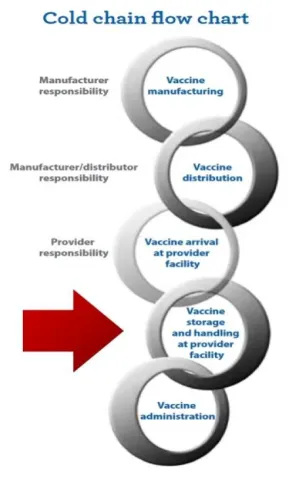
The key to maintaining vaccine at the proper temperature begins with the cold chain. The Cold Chain is an uninterrupted management of the vaccine from the manufacturer until the vaccine ends in the patient’s body. Any break in the link of the cold chain can create reduced potency of the vaccine. Unfortunately, a broken link in the cold chain can cost more than just the actual dollar amount of the vaccine. Time and resources of clinic staff and parents are wasted. Clinic staff will have to call parents of children that have been given vaccine with questionable potency; parents will have to take time off work to bring children back to the clinic to be re-vaccinated. A loss of confidence or lack of confidence in the clinic, nursing staff or the physician could also result from failure to maintain the cold chain

Storage and Handling
Vaccine loss is both costly and preventable. Just ten doses of each routinely recommended child/adolescent vaccine are valued at more than $10,000.00; most VFC providers have far larger inventories. Vaccine must be stored appropriately to maintain efficacy. Failure to store and handle vaccine properly reduces potency, resulting in inadequate immune response and poor protection against disease. The temperature-controlled environment used to maintain and transport vaccines in optimal condition is call the vaccine cold chain. An effective cold chain relies on three main elements:
- Effectively trained personnel
- Reliable storage and temperature monitoring equipment
- Accurate vaccine inventory management
A well-trained staff, familiar with key storage and handling principles, is critical to safeguarding the vaccine supply and the safety of vaccinated patients.
Can you tell the difference?

Vaccine Storage Units
Refrigerators and freezers are available in different grades (household and purpose-built), size, and types (stand-alone and combination refrigerator/freezer). Purpose-built units are sometimes referred to as pharmaceutical grade and are designed specifically for storage of biologics. VFC vaccine storage units must have enough space to store the largest amount of inventory at the busiest point in the year (e.g., flu season) without crowding. The following storage units are acceptable for storing VFC vaccine:
- A purpose-built unit for vaccine storage designed to either refrigerate or freeze (can be compact, under-the-counter style or large units).
- A stand-alone household refrigerator (a self-contained unit that only refrigerates).
- A stand-alone freezer.

A VFC Consultant is able to offer consultation prior to unit purchase to ensure the units meet VFC program requirements. When a VFC provider purchases new vaccine storage units, five days of stable temperatures with a currently calibrated digital data logger thermometer must be documented prior to the VFC Consultant validating the storage unit. Prior to validation, VFC vaccine must not be stored in the unit.
Unacceptable VFC storage units
- Combination refrigerator/freezer units.
- Dormitory or bar-style refrigerators (small combination refrigerator/freezer unit that is outfitted with one external door and has an evaporator plate (cooling coil) located inside the freezer within the refrigerator; this type of unit places vaccine at high risk of freezing)
Storage Unit Placement/Maintenance
Air circulation around the outside of the storage unit is important for vaccine temperature stability. Place a storage unit in a well-ventilated room, leaving space between the unit, ceiling, and walls. Nothing should block the cover of the motor compartment. The unit should be stable and level, with the bottom of the unit raised above the floor. The unit door should open and close smoothly and fit squarely against the body of the unit. If not secured properly, unit doors pose a risk to maintaining appropriate internal temperatures of vaccine storage units. Studies find that most units work best when placed in an area with standard indoor room temperatures, usually between 20ºC-25ºC or 68ºF-77º. Check the manufacturer-supplied owner’s manual for additional guidance on placement and spacing.
Conduct routine maintenance for all vaccine storage units and related equipment:
- Check seals and door hinges.
- Clean coils and other components per manufacturer direction.
- Defrost manual-defrost freezers.
- Clean the interior of each unit to discourage bacterial and fungal growth. Do so quickly to minimize the risk of a temperature excursion.
- Test any back-up generator quarterly and have it serviced annually.
VFC providers with doorless or vending style units must have annual service records for those units.
Power Source/Breaker Box
The unit’s power source must be protected with warning labels. The circuit breaker must also be marked.

Do not use:
- Power strips
- Outlets that can be activated by a wall switch
- Outlets with built in circuits
- Extension cords
Temperature Monitoring Devices


VFC providers must use a digital data logger (DDL) with continuous temperature monitoring capability and a current and valid Certificate of Calibration Testing in each unit storing VFC vaccines. DDLs must be used during routine, on-site vaccine storage, vaccine transport, and temporary vaccine storage.
To meet VFC Program requirements, the DDL must be equipped with:
- A detachable glycol probe
- Audible alarm set for out-of-range temperatures
- Display indicating the current, minimum and maximum temperatures
- An active display outside of the unit to monitor temperature without opening the unit door
- Low battery indicator
- Ability to accurately report temperatures to +/-0.5ºC
- Memory storage of at least 4,000 readings
- User programmable logging interval set for every 15 minutes or less
- Ability to easily download data for review
In addition, VFC providers must have at least one back-up DDL with a valid and current Certificate of Calibration to ensure that temperature assessment and recording may be performed twice each day. A back-up DDL must be readily available in case a DDL in use is no longer working. The back-up DDL is also used for vaccine transport or temporary storage.
Certificate of Calibration Testing
The Certificate of Calibration Testing is a document that attests to the fact that a temperature monitoring device is measuring temperatures accurately. Valid and current Certificates of Calibration Testing must be maintained on all DDLs used in vaccine storage units and the back-up DDL. Calibration testing and traceability must be performed by:
- A laboratory accredited by an ILAC MRA signatory body. Certificates must include the following elements:
- ILAC/MRA signatory body accredited laboratory
- Name of Device (optional)
- Model/Device Number
- Serial Number
- Date of Calibration Testing (report or issue date)
- Confirmation that the instrument passed testing (or instrument in tolerance)
- An entity that provides documentation the calibration testing performed meets ISO/IEC 17025 international standard for calibration testing and traceability. Contact your VFC Consultant for guidance on calibration testing requirements. Certificate must include the following elements:
- Name of Device (optional)
- Model/Device Number
- Serial Number
- Date of Calibration Testing (report or issue date)
- Confirmation that the instrument passed testing (or instrument in tolerance)
- Statement that calibration testing conforms to ISO 17025
Thermometer and calibration information must be entered and/or updated in ShowMeVax under ‘Clinic Tools’, ‘Manage Assets’.
Temperature Probe Placement
The DDL probe must be placed in the central/middle of the storage unit with the vaccines. Do not place the probe in the doors, near or against the walls, close to vents, or on the floor of the vaccine storage unit. Temperatures in these areas of the storage unit differ significantly from the temperature in the area where the vaccine is actually stored. The VFC Program recommends that the probe be anchored in the center of the unit to prevent the probe from being moved (bread ties or electrical zip-ties work very well for the anchoring process).
Temperature Monitoring


VFC vaccines must be stored at the proper temperature at all times. Refrigerators should maintain temperature between 2ºC and 8ºC (36ºF to 46ºF). Colder is not better for a refrigerator unit. The average daily temperature target for a refrigerator is 5ºC. Freezers should maintain temperatures between -50ºC and -15ºC (-58ºF to 5ºF), with a suggested target of -20ºC or colder. Most freezers may safely be set on the coldest setting as freezers do not reach -50ºC unless specifically designed to do so.
Temperature monitoring is the primary responsibility of the Primary VFC Contact or the Back-Up VFC Contact. Temperature must be documented in one of the following methods:
- Enter temperatures twice daily in ShowMeVax (morning and afternoon) from the DDL for each storage unit. DDL reports must be downloaded and reviewed once per month and remain on file at the clinic for a minimum of three years. VFC providers entering temperatures daily into ShowMeVax do not need to keep a paper log.
- Record temperatures on a paper log with AM and PM temperatures, plus minimum and maximum in the AM. Each reading should include the time, date, and name (or initials) for each reading. Paper log must remain on file for a minimum of three years. DDL reports must be downloaded and reviewed once per month and remain on file at the clinic for a minimum of three years. Temperatures must be manually entered into ShowMeVax weekly, bi-weekly or monthly.
- Record temperatures on a paper log with AM and PM temperatures, plus minimum and maximum in the AM. Each reading should include the time, date, and name (or initials) for each reading. Paper log must remain on file for a minimum of three years. DDL reports are downloaded and reviewed once per month and remain on file at the clinic for a minimum of three years. The download from the DDL is uploaded to ShowMeVax or a template is completed and uploaded to ShowMeVax monthly.
If a DDL has the ability to record twice daily readings that include the reviewer’s name, date, and time of review, the VFC provider may use this function to document daily readings in lieu of completing a paper temperature log. DDLs must still be downloaded and reviewed monthly and remain on file at the clinic for a minimum of three years.
For assistance with temperature documentation, please contact the Vaccine Support Team at 866- 256-3166 or by email at VFC-SMVsupport@health.mo.gov. You may also reach out to your VFC Consultant for issues with temperature documentation.
Temperature Excursions
Temperature excursions occur when the actual, minimum or maximum temperature deviates from 2ºC and 8ºC (36ºF to 46ºF) in the refrigerator or deviates from -50ºC and -15ºC (-58ºF to 5ºF) in the freezer. Each excursion must be reported to the VFC Program regardless of the length of time of the excursion.
When a temperature excursion occurs, VFC vaccine must be quarantined until the viability of the vaccine is determined. To quarantine the VFC stock, label the stock in the unit “Do Not Use”. Do not remove the VFC vaccine from the storage unit if the unit is in the recommended temperature range, leave the vaccine in the unit until the viability has been determined. VFC Consultants or the Vaccine Support Team can assist VFC providers with temperature excursions.
If the unit is out of the recommended temperature range, VFC providers must deploy the Emergency Response plan with the quarantined vaccine.
A VFC provider will need to complete an Emergency Response Worksheet and contact vaccine manufacturers for the vaccine viability determination. Once the determination has been completed, all paperwork (manufacturer reports and the Emergency Response Worksheet) must be submitted to the Vaccine Support Team at VFC-SMVsupport@health.mo.gov. Once the paperwork has been received, the help desk will notify the VFC provider to remove the quarantine from the VFC stock.
Power Outage
If a VFC provider experiences a power outage, please contact the utility company. If restoration of power is expected within four hours, do not move the vaccine. Keep the door closed and monitor the temperatures. This brief outage may be less harmful than transporting the vaccine. If a power outage is expected to last more than four hours, implement the Emergency Response Plan for the clinic. If the outage results in a temperature excursion, please see above.
Moving Storage Equipment
VFC providers that are moving a storage unit from one area or room of the current building to another must notify their VFC Consultant of the storage unit move. The breaker box panel labeling must be updated to show the new breaker in the panel if the circuit breaker has changed.
VFC providers moving to a new location must notify the VFC Consultant at least ten days in advance of the move. VFC providers must:
- Move the vaccine to the emergency location for safe storage.
- Document five days of current, minimum and maximum temperatures on a current, calibrated DDL.
- Email the temperature log to the VFC Consultant.
- Email or text pictures showing that the circuit breaker panel is labeled at the new location and that the electrical outlet has a “Do Not Unplug” sticker.
The VFC Consultant will give clearance to the VFC provider to resume storing the vaccine in the storage units.