
Chapter 8: Gravity Distribution Methods and Soil Dispersal Trenches
An Onsite Wastewater Treatment System Owner’s Manual
Chapter 8: Gravity Distribution Methods and Soil Dispersal Trenches
A gravity ONSITE WASTEWATER TREATMENT SYSTEM, also called a standard or conventional system, is the most commonly used system for treating WASTEWATER. These systems consist of a septic tank or other pretreatment component, a distribution system, and a soil treatment system. The distribution system is a network of pipes carrying WASTEWATER from the pretreatment component to the soil treatment system. Except for lagoon systems, WASTEWATER from the pretreatment component must be dispersed below the soil surface for final treatment.
There are several methods for distributing pretreated WASTEWATER to the soil treatment system for the final step in the treatment process. Distribution methods include gravity, dose-to-gravity, and pressure distribution. The best method for a particular site will depend on the slope, available area, and soil properties.
Gravity distribution is defined as using the force of gravity to convey WASTEWATER to one or more components or devices.
Dose-to-gravity distribution is defined as using a pump or siphon to convey WASTEWATER, in discrete amounts over a definite time period, to one or more components or devices.
Pressure distribution is defined as using a pump or siphon to convey WASTEWATER under pressure to one or more components or devices.
The soil provides wastewater treatment by acting as a filter and a biological and chemical treatment media. When the system is operating properly, clean water is recycled into streams, lakes, and groundwater in the area.
How Gravity Soil Dispersal Trenches Work
A standard soil treatment system consists of a series of dispersal trenches; gravity dispersal trenches work by letting gravity convey WASTEWATER from the septic tank into the soil treatment system. For this to occur, the soil treatment area must be below the outlet level of the septic tank.
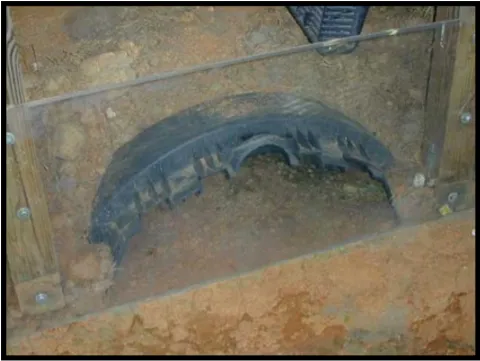
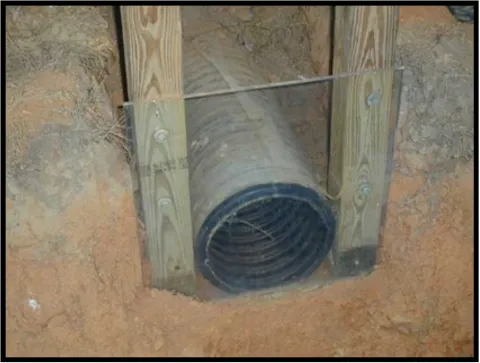
Dispersal trenches are usually 18 inches, up to 30 inches deep; can be up to 100’ feet long; and are traditionally gravel-filled with a 4” diameter perforated pipe running the length of the trench. Trenches may also be constructed using gravelless products, such as open bottom plastic chambers, large diameter filter-wrapped pipe, or bundles of expanded polystyrene aggregate.
The gravel or gravelless products used in gravity dispersal trenches have void space that provides short-term storage for WASTEWATER, especially for occasional periods of higher than normal water use. However, storage is not the main function of dispersal trenches. The most important purpose of dispersal trenches is to allow pretreated WASTEWATER to come into contact with enough soil area – the trench bottoms and sidewalls – to ensure that WASTEWATER can receive satisfactory final treatment.
Dispersal trenches rely on the surrounding soil and the development of a bio-mat for final treatment. When WASTEWATER is introduced into the dispersal trench, a bio-mat begins to form. Bio-mat is a layer of WASTEWATER solids, organic matter, and microorganisms. It acts as a filter providing some treatment. As the bio-mat develops, it slows the rate that WASTEWATER moves into the soil, which helps force WASTEWATER to flow farther along the trench bottom. By slowing WASTEWATER flow into the soil, the bio-mat helps to prevent SATURATED soil conditions under the dispersal trench.
Unsaturated soil, which holds oxygen in the larger pores, is essential for effective treatment of the WASTEWATER. As WASTEWATER moves slowly through unsaturated soil, more filtering of fine solids takes place and the AEROBIC bacteria and organisms in the soil consume disease-causing bacteria and viruses.
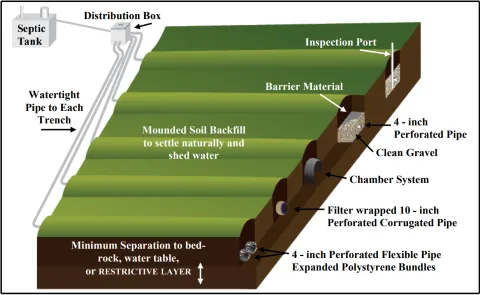
Gravity Distribution and Dispersal Trenches. Four dispersal trench options are shown including perforated pipe and gravel and three gravelless trench products - chambers, filter wrapped large diameter pipe, and expanded polystyrene bundles (EPS).
Distribution is the process of conveying WASTEWATER to one or more components or devices. In a standard gravity distribution system, the force of gravity moves partially treated WASTEWATER from a septic tank to a distribution device to the soil treatment system where final treatment occurs.
A gravity distribution method can be a good option for sites with adequate slope from the residence or business to the soil treatment area. Gravity methods include serial distribution or distribution box (parallel distribution) systems.
Serial Distribution
When serial distribution is used, all WASTEWATER flows to a single dispersal trench. After the first trench is completely filled and is no longer able to disperse the WASTEWATER load, some WASTEWATER flows to the next trench down slope and so on. In a step-down (also called a cross-over) system, the first trench eventually clogs and stays full of WASTEWATER, followed by the second and third until the entire soil treatment system can no longer treat and disperse the WASTEWATER load. Another serial method uses drop boxes to distribute WASTEWATER to trenches in order. Drop box outlets can be capped to give a SATURATED dispersal trench(es) an opportunity to rest and later be put back into use. This method can extend the life of the soil treatment system.
Distribution Box (parallel distribution)
A distribution box, also called a d-box, has one inlet and as many outlets as there are dispersal trenches in the soil treatment system. All dispersal trenches connected to distribution box outlets must be equal in length. Partially treated WASTEWATER flows from the tank into the box and through the different outlets to the dispersal trenches. Because the system relies on gravity, it is important for the outlets to be at the same level. If the distribution box outlets are not exactly level, the flow will not be divided equally between trenches. Leveling devices are available, and are recommended, to adjust the outlet levels. Tipping and weir distribution device options are sometimes used to improve WASTEWATER distribution.
Dose-to-Gravity
Uneven distribution can overload some areas of the soil treatment system, causing it to MALFUNCTION. An option for improving distribution is the dose-to-gravity method. A siphon or pump can be used to dose a predetermined volume of WASTEWATER and help ensure it is more equally divided among the trenches and evenly spread along the trench length.
Siphons are a relatively low-cost technology that can improve the performance of a soil treatment system. In order to function properly, the soil treatment system needs to be located at least 2’ or 3’ feet lower than the siphon. EFFLUENT from the pretreatment tank flows into a dose tank. When enough WASTEWATER is collected, it activates the siphon and the predetermined dose volume flows through the siphon to the soil treatment system. No electric power is necessary; siphons work using air and gravity.
Electric pumps may be used in dose-to-gravity systems to improve the performance of the soil treatment system or because the soil treatment system is located higher than the pretreatment component. Pump-to-gravity systems may dose to a distribution box or replace the distribution box with a pressure distribution manifold. A pressure manifold can be designed to distribute WASTEWATER uniformly even if the dispersal trenches are of different lengths.
More uniform distribution can be achieved using electric pumps in pressure distribution systems including subsurface drip dispersal systems. See Chapter 6 for pump information and Chapters 9 and 10 for pressure distribution systems.
Design and Construction
Effective soil treatment depends on matching the distribution and dispersal methods to the site and soil. The size of the soil treatment system is determined by the amount of WASTEWATER flow anticipated and the soil properties in the soil treatment area. Soil properties and the depth to bedrock or a water table also help determine how deep the dispersal trenches should be. A thorough site evaluation must be conducted when the wastewater treatment system is in the planning stages. Wastewater system failures are often caused by poor choice of the system type and/or location.
Distribution
Drop boxes and distribution boxes are generally made of plastic or concrete.
For serial distribution, drop boxes or step-downs must be installed to completely fill and utilize one dispersal trench before WASTEWATER flows to the next trench.
Drop boxes, distribution boxes, and siphon dose tanks must be located:
- Level on firm bedding material to prevent uneven settling; and
- To be separated from the sewage tank by at least 2 feet of undisturbed soil.
Pump-to-gravity pressure manifold designs vary the number and size of discharge holes and/or the operating pressure settings as needed for differences in trench length or location on a slope.
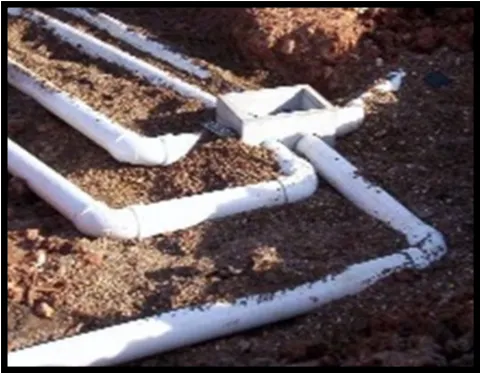
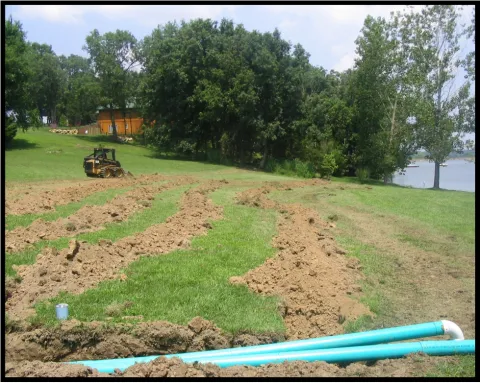
Dispersal Trenches
System sizing must be based on an accurate site/soil evaluation.
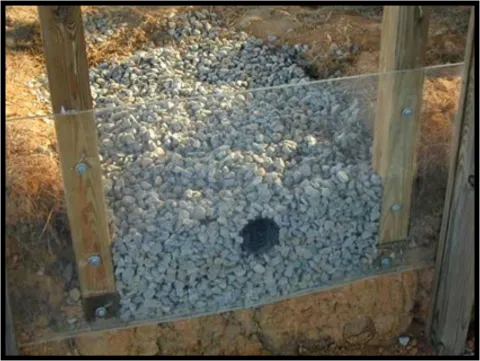
Where dispersal trenches are filled with gravel, it must be clean to prevent clogging at the trench bottom.
Where gravelless dispersal trench products are used, installation must follow manufacturer specifications.
Gravity dispersal trenches must be located:
- To follow the contours of the ground with level bottoms;
- Out of any surface water drainage; and
- To observe required setback distances as specified in 19 CSR 20-3.060, Minimum Construction Standards for On-Site Wastewater Treatment Systems.
Trenches must not be constructed when the soil is too wet.
Images of Gravel and Gravelless Trench Products
Images courtesy of Virginia Department of Health

Maintenance - Inspections, Pumping, Service
Gravity distribution devices are relatively uncomplicated and easy to operate. With a little regular MAINTENANCE and management, many problems can be avoided and the useful life of the soil treatment system extended. Siphon systems are simple to operate. Regular INSPECTIONS are needed to catch and correct problems, such as when a siphon fails to cycle properly and the advantages of dosing are lost. The advantages of a pressure manifold can also be lost if MAINTENANCE is neglected.
Readily available, and yet secure, access to distribution devices will save MAINTENANCE time and money. INSPECTION access to the dispersal trenches, in addition to the distribution devices, allows the system to be managed. Needed adjustments or repairs can be made before a small problem becomes a costly system failure.
Inspections
To assure gravity, or dose-to-gravity, distribution is operating properly, the distribution device must be inspected at least every two years and any time a pretreatment component, such as the septic tank or aeration treatment unit, is inspected and/or pumped. See Chapter 6 for pumps. As applicable, INSPECTIONS must include assuring:
- The distribution device is structurally sound with no corrosion, cracking, or missing parts;
- All access ports, lids, covers, and pipe connections are watertight;
- Lids and covers are locked or otherwise secured to prevent accidental entry;
- The distribution device or siphon dose tank is free of accumulated solids;
- The distribution device is level and/or adjusted to distribute WASTEWATER to the dispersal trenches as designed; and
- If applicable, siphon cycles properly and is not just trickling.
To assure the soil treatment system is operating properly, INSPECTIONS must be conducted at least every two years and any time a pretreatment component, such as the septic tank or aeration treatment unit, is inspected and/or pumped. INSPECTIONS must include assuring the following:
- There are no signs of surfacing EFFLUENT;
- No strong, foul odors are present near the soil treatment area;
- Vegetation is maintained on and around the soil treatment area;
- The surface of the soil treatment area has no areas of depression for surface water to collect;
- No visible damage to the dispersal trenches;
- When inspection ports are available, observe the presence and depth of ponding within each dispersal trench and any root intrusion or obstruction to the system;
- The soil treatment area is not subject to traffic, heavy equipment, or used as pasture for domesticated animals; and
- The soil treatment area is not used for outbuildings and/or structures, such as patios or above-ground swimming pools.
DID YOU KNOW?
WASTEWATER contains bacteria and viruses that cause illness. Contact with untreated WASTEWATER can make people and family pets sick, as well as contaminate nearby wells, groundwater, and drinking water sources.
Pumping/Service
The OWNER or user of the system should schedule for the removal and sanitary disposal of solids from a siphon dose tank when any other tank in the system needs pumped (see pretreatment chapters).
Service of drop boxes, and distribution boxes and pressure manifolds if needed, should include plugging or capping outlets or closing valves to take a dispersal trench out of OPERATION when it becomes clogged and flooded with WASTEWATER. Taking a trench out of operation allows it to rest and restore its capacity to treat and disperse WASTEWATER.
Summer is a good time to rest a trench because warmer soil temperatures can shorten the time needed to restore much of the treatment capacity. Note that it may be necessary to also reduce water use while only a part of the soil treatment system is in operation.
Warning Signs of System Malfunctioning
While proper use, INSPECTIONS, and MAINTENANCE should prevent most soil treatment system problems, it is still important to be aware of changes in your system and to act quickly if you suspect the system is MALFUNCTIONING. The most obvious issues are easy to spot.
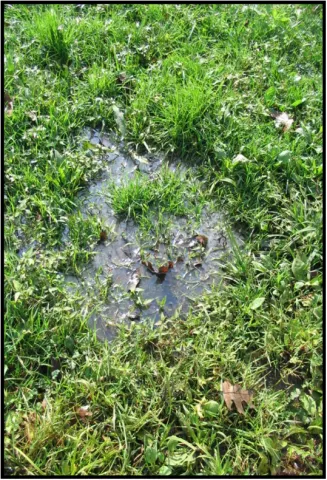
- Odors, surfacing SEWAGE, or wet spots in the soil treatment area.
- Plumbing or septic tank backups (often a black liquid with a disagreeable odor).
- Slow draining fixtures.
- Gurgling sounds in the plumbing system.
- If you have a well and tests show the presence of coliform bacteria or nitrates, your soil treatment system may be MALFUNCTIONING.
- Standing liquid over the soil treatment system, even during dry weather. This may indicate an excessive amount of WASTEWATER is moving up through the soil, instead of downward.
Onsite systems fail when partially treated WASTEWATER comes into contact with groundwater. This type of failure is not easy to detect, but can result in the pollution of wells, nearby streams, or other bodies of water.
If you notice any of these signs or you suspect your system may be having problems, contact a qualified SERVICE PROVIDER or the local onsite WASTEWATER ADMINISTRATIVE AUTHORITY for assistance.
Gravity Distribution Do’s and Don’ts
Proper OPERATION and MAINTENANCE of your onsite system can prevent costly repairs or replacement and can protect your property value. Observing the following recommendations will help to keep your system operating properly.
Do’s
- Obtain the necessary permits from the appropriate ADMINISTRATIVE AUTHORITY before making any repairs.
- Use REGISTERED ONSITE WASTEWATER TREATMENT SYSTEM PROFESSIONALS and qualified SERVICE PROVIDERS.
- Know where the soil treatment system and replacement area are located. It is easier to protect the system when you know where the components are.
- Conserve water to avoid overloading the soil treatment system; use high-efficiency fixtures and promptly repair any leaky faucets or toilets. Soil treatment systems do not have an unlimited capacity to disperse WASTEWATER.
- Keep heavy equipment off the soil treatment area. Cars and equipment must not be driven or parked over the soil treatment system.
- Divert other sources of water, like roof drains, house footing drains, and sump pumps away from the soil treatment system.
- Keep detailed records regarding the system, its location, make/model, contract service agreement, service visits, and MAINTENANCE performed.
- Landscape the system properly. Plant grass over and near the soil treatment system to prevent soil erosion; roots from nearby trees or shrubs might clog and damage the system.
- Contact a qualified SERVICE PROVIDER if you experience problems with your system, such as surfacing WASTEWATER in your yard or other warning signs the system may be MALFUNCTIONING.
- Plan ahead—soil treatment systems do not last forever. If you have additional space, consider reserving some area from development so that it can be used for a replacement soil treatment system when needed.
Don’ts
- Don’t build over the soil treatment system; this includes patios, carports, and other structures.
- Don’t pave or use landscaping plastic over the soil treatment system; bacteria in the soil need oxygen to properly treat WASTEWATER.
- Don’t allow large animals and livestock to roam over the soil treatment system. Soil compaction prevents oxygen from getting into the soil and prevents water from flowing away from the soil treatment system.
- Don’t dig in the soil treatment area, as damage to the pipes may occur.
- Don’t plant more trees and shrubs in or near the soil treatment area.
- Don’t plant a garden over the soil treatment system. You risk the possibility of food contamination.
- Don’t install an irrigation system in the soil treatment area or allow the irrigation water to run toward the soil treatment system.