
Introduction – Adult Brain Injury Program
Adult Brain Injury Program Provider Manual
Purpose
The ABI Program provides assistance in locating, coordinating, and purchasing rehabilitation and psychological services for individuals who are twenty-one (21) to sixty five (65) years of age, and who are living with a traumatic brain injury (TBI). RSMo Section 192.735 defines a TBI as “a sudden insult or damage to the brain or its coverings, not of a degenerative nature. Such insult or damage may produce an altered state of consciousness and may result in a decrease of one (1) or more of the following: mental, cognitive, behavioral, or physical functioning resulting in partial or total disability. Cerebral vascular accidents, aneurysms, and congenital deficits are specifically excluded from this definition.”
The ABI Program provides two primary services: service coordination and rehabilitation services.
Service Coordination includes:
- Evaluation and assessment of needs
- Development, regular evaluation and updates of a treatment plan (applies to rehabilitation services only)
- Assistance in locating and accessing resources such as medical care, housing, counseling, transportation, rehabilitation, vocational training, and cognitive/behavior training
- Information, education, and advocacy (applies to rehabilitation services only) Service Coordination is provided to all ABI Program participants, regardless of financial status.
Rehabilitation Services
Are provided to participants who meet financial guidelines and when it has been determined, the services are necessary to facilitate a long-term goal as indicated in the ABI Treatment Plan. ABI Treatment Rehabilitation services as listed in this manual are available to individuals who are medically eligible and whose income is 185% of Federal Poverty Guidelines or lower. Certain limitations apply and this manual outlines operational procedures for use of Department of Health and Senior Services (DHSS) ABI funds.
Rehabilitation services include:
- Neuropsychological Evaluation and Consultation
- Adjustment Counseling
- Transitional Home and Community Support Training
- Pre-vocational/Pre-employment Training
- Supported Employment/Follow Along
- Special Instruction
- Consultation Visit
The ABI Service Coordinator will assist the participant to apply for any other payment resources before submitting requests for use of ABI funds to purchase these services, since it is a requirement that the participant utilize other resources first.
- When DHSS funds are used to purchase services, costs of the proposed rehabilitation services will be projected;
- Services will be initiated only when adequate funds are available to achieve an expected outcome goal; and
- When the demand for services exceeds available funds, the ABI Program will implement a waiting list for services.
History
The ABI Program was created in 1985 when the Missouri General Assembly appropriated $500,000 for community services for individuals with TBI and their families. Funds are appropriated annually by the legislature.
DHSS put into place two ABI Service Coordinators dedicated to the ABI Program in 1994. This allowed the beginnings of a case management service delivery system. In FY99, statewide coverage became a reality with a service coordination team of eight (8) specialized ABI Service Coordinators. There are currently eleven (11) ABI Service Coordinators located throughout Missouri.
Service Delivery Model
The ABI Program is neither an entitlement program nor an entitlement to lifelong care and treatment. The ABI Program utilizes a person-centered approach that palces the ABI Service Coordinator with the participant and family at the center of the assessment, planning, and service delivery efforts for each individual. Just-in-time, rehabilitative services shall be scheduled around the participant/family’s goals and resources thereby enhancing the individual’s opportunity to achieve a successful outcome of community integration and productive lifestyle.

Role/Responsibility of the ABI Service Coordinator
The ABI Service Coordinator is the entry point into ABI Program. Upon referral, each participant is assigned an ABI Service Coordinator, based on the individual’s county of residence. The ABI Service Coordinator assesses the participant’s immediate needs and assists the individual to access resources that may be available, such as public programs or natural supports.
The ABI Service Coordinator, together with the individual, family, and provider develops a Treatment Plan. The Treatment Plan outlines a long-term projected outcome goal, such as return to work or independent living, and the steps to achieve this goal. These steps may include referral for any public programs, development of skills through rehabilitative services or development of other supports that will assist the individual to reach the maximal level of independent community functioning. Together the ABI Service Coordinator and the family identify key people to form the Person-Centered Planning Team. The planning team that works with the individual should always include: the participant, the ABI Service Coordinator, Provider Agency, involved family member(s), significant other(s), and/or the legal guardian. Other members will be added at appropriate times given changing needs as the participant moves through services toward functional independence. The ABI Service Coordinator actively assures the ongoing coordination and functioning of the planning team. The ABI Service Coordinator assures that at least a bi-annual review of the Treatment Plan is scheduled. The ABI Service Coordinator also assures that a transition plan is in place when unmet needs continue beyond the scope of the ABI Program.
Provider Enrollment and Role/Responsibility
The Provider must meet certain qualifications to be enrolled with Special Health Care Needs (SHCN) to provide ABI Program rehabilitative services. These qualifications and the process for enrollment are listed elsewhere in this manual. The Provider is an active member of the planning team while involved with an individual, and as such is expected to collaborate with the entire team. Collaboration across programs and services is a key component of the person-centered service delivery model, and requires effective and timely communication between all agencies and participants involved.
Purpose of the Provider Manual
The Provider Manual outlines operational guidelines for participating in the ABI Program, and use of DHSS funds for rehabilitative services. The manual is divided into the following sections:
- Introduction;
- Services Mission, Philosophy and Values;
- General Program Guidelines;
- Program Entry Procedures;
- Rehabilitation Services Available;
- Billing/Claims Procedures;
- Provider Enrollment Procedures; and
- Appendices.
The Provider Manual is reviewed for changes by DHSS staff. Providers will be notified of any revisions to the Provider manual. The Provider Manual is available on the ABI Program Provider website.
Communication
Communication from DHSS may occur through a variety of methods. To assure that the Provider receives communications in a timely manner, the Provider should identify a contact person to receive program-related information. The Provider should specify if the contact person is at a different location than the main address/billing location. Examples of the types of expected communications are listed below:
- Regular Mail: Implementation of a waiting list; copy of response to Prior Authorization request; significant procedural changes, that affect all providers;
- Phone or email: Specific participant questions/concerns or procedural questions (DHSS encryption required to be utilized for Protected Health Information (PHI) correspondence);
- Fax: Early responses to Prior Authorization requests (see Prior Authorization Procedures); and General Program informational updates.
DHSS – SHCN – Adult Brain Injury Program
Adult Brain Injury Program Provider Manual
Mission
To provide for the identification and integration of resources for all eligible Missouri residents who sustain a Traumatic Brain Injury (TBI), thereby enhancing their opportunity to obtain the necessary supports that will enable them to return to a productive lifestyle in their community.
Philosophical Statement
The ABI Program respects the human dignity of each individual and recognizes that each person should function as independently as possible within the community.
Core Values
ABI Program decisions are guided by the following core values:
- Person-centered;
- Outcome-oriented;
- Community integration;
- Family/significant others’ involvement in immediate and long-term goal planning;
- Personal responsibility for functional improvements;
- Resumption of a productive lifestyle;
- Responsible resource management; and
- Supportive partnerships.
Core Value Definitions
Person-centered: Each individual has the right to participate in the planning and design of his/her services to the best of his/her capability. The participant’s abilities, wishes, and desires are primary in making decisions about Brain Injury sponsored goals.
Outcome-oriented: Each individual’s program goals and objectives are regularly evaluated by the ABI Service Coordinator to assure benchmarks are being accomplished toward the long-term goal as stated in the Treatment Plan.
Community integration: Goals, objectives, and all associated activities sponsored by the ABI Program are designed to encourage community integration in age-appropriate life activities.
Family/Significant others’ involvement in immediate and long-term goal planning: While the participant is at the center of the planning process, the family/significant others’ goals and special knowledge of the participant are considered and incorporated into all decision making, whether for short-term or long-term goals. The family is expected to be willing to actively participate in the individual’s functional improvement.
Personal responsibility for functional improvements: Participants shall be actively involved in decisions about their care and to perform recommended activities toward the agreed-upon long-term goal.
Resumption of a productive lifestyle: Participants are expected to engage in specific goals of resuming a lifestyle of productivity such as return to work (paid or unpaid), school, independent living (supported or non-supported), and contributing family member.
Responsible resource management: The ABI Program is committed to the responsible management of all financial or programmatic resources available to the participant to assure maximum benefit from each.
Supportive partnerships: The ABI Program requires that all parties involved in assisting participants collaborate and plan together for transitions from service to service and toward community reintegration.
General Guidelines
Adult Brain Injury Program Provider Manual
Participants served must meet established financial and medical eligibility requirements. (See Participant Eligibility section of this manual)
Staff and facility must meet established requirements described in this document.
A Treatment Plan and Monthly Progress Report form will be required for all services as described in this document.
Before providing services, all Providers must:
- Enroll as a Provider by completing a Provider Application Form-CC-35, sign a Participation Agreement for Professional and Special Services Provider (DH-74A); and
- Obtain written approval for services requested. Department of Health and Senior Services (DHSS) will not reimburse Providers for services that are not prior approved. Verbal approvals will not be given.
The Provider may terminate services with a participant by giving written notice at least thirty (30) calendar days prior to the effective date of such termination.
Approval of prior authorization request is subject to availability of appropriated funds.
The ABI Program is neither an entitlement program nor entitlement to lifelong care and treatment.
The Department may maintain a waiting list for rehabilitation services in the event requests for services exceed available funds.
All Providers must submit claims according to established Billing Guidelines as described in this document.
The Department will not make payment for any services for which payment has been made under any State compensation program including MO HealthNet, any insurance policy, any Federal, State, or County Program, or any third party resources. When reimbursement is available from any of these sources, claims must be submitted to these sources before submitting a claim to the ABI Program.
The Program does not duplicate services available through other public human service agencies, but works cooperatively and advocates with appropriate public and private programs to ensure that individuals have access to benefits for which they may be eligible.
All billings for services provided to approved participants must be submitted to the Department no later than sixty (60) days following the date services are provided or no later than (60) days following receipt of payment determination by a third party payer. At the close of a State fiscal year, the ABI Program shall request that the provider submit claims at an earlier date in order to ensure timely payment. The Department has the authority to review participant records and Provider billings to assure that program guidelines as written herein are followed.
Facility Requirements
If the Provider’s program involves a physical plant, the Provider shall provide a facility which:
- Meets American Disabilities Act (ADA) standards for accessibility;
- Has an effective plan in place for emergency egress;
- Meets local fire and safety codes; and
- Is maintained in good repair and is in safe, clean, and orderly condition.
Staff Requirements
The Provider shall provide qualified personnel to adequately staff the Provider’s program. Requirements for staff members offering each service are listed in each service description and summarized in a quick reference guide in the ABI Program Provider Qualifications section.
The Provider will be responsible for accurate and complete documentation of staff credentials. This documentation must demonstrate the necessary certification, licensure, education, training, and skills required to provide each service for which payment is made by DHSS. Provider’s onsite records are subject to review by DHSS in accordance with the Provider Participation Agreement.
Documentation Requirements
Providers must retain for three (3) years, from the last date of service, fiscal and treatment records that coincide with and fully document services billed to DHSS, and must furnish or make the records available for inspection or audit by the Department or its representative upon request. Failure to furnish, reveal, and retain adequate documentation for services billed to the Department may result in recovery of the payments for those services not adequately documented and may result in sanctions to the Provider's participation in Department programs. This policy continues to apply in the event of the Provider’s discontinuance as an actively participating DHSS Provider through change of ownership or any other circumstance.
Entry Procedures
Adult Brain Injury Program Provider Manual
The ABI Service Coordinator is the entry point for new participants to enroll in the ABI Program.
Referrals should be made directly to the ABI Service Coordinator responsible for the county in which the participant resides.
Upon referral the ABI Service Coordinator will:
- Contact the participant or family member;
- Complete an ABI Screener Form
- Schedule a face-to-face visit;
- Conduct an initial assessment of needs and goals;
- Explain the program and benefits available;
- Obtain a signed Application for Enrollment Form (CC-1);
- Obtain a signed Authorization for Disclosure of Consumer Medical/Health Information (MO 650-2616) to gather written documentation of Traumatic Brain Injury (TBI);
- Obtain a signed Rights & Responsibilities Acknowledgement Form
- Obtain a signed Privacy Policies Form
- Supply to participant a Role of Service Coordination Form
- Enroll in service coordination
- Determine financial eligibility (185% of federal poverty guidelines) by one of the following two methods:
- Obtaining a copy of the participant’s current income year, federal income tax form, if the form is reflective of the participant’s current income. The adjusted gross income and the number of family members are used to determine eligibility; and
- Obtaining a signed statement of the participant’s family income for the last three months and projected income for the remainder of the year.
- Refer the participant to any other public or private resources for which the participant may be eligible;
- Identify key persons for the Person-Centered Planning Team; and
- Develop an initial Treatment Plan.
Until the participant’s medical and financial eligibility are documented and the enrollment process is complete, no rehabilitative services shall be approved.
If a requested service is also covered by a third party payer for which the participant may be eligible, no rehabilitative services will be approved until determination of eligibility for such service has been resolved and provided to the ABI Program in writing.
Participant Eligibility
Adult Brain Injury Program Provider Manual
Participants eligible for payment of rehabilitative services under the ABI Program shall meet the following criteria:
- Have written verification or history of a "brain injury" or "traumatic brain injury" as defined under RSMo Section 192.735 - a sudden insult or damage to the brain or its coverings, not of a degenerative nature. Such insult or damage may produce an altered state of consciousness and may result in a decrease of one (1) or more of the following: mental, cognitive, behavioral, or physical functioning resulting in partial or total disability. Cerebral vascular accidents, aneurysms, and congenital deficits are specifically excluded from this definition;
- Be residents of the State of Missouri;
- Are between ages 21 and 65;
- Apply for MO HealthNet or other state agency services, if eligible;
- Have a signed Application for Enrollment form (CC-1) on file;
- Have documentation that current taxable income does not exceed 185% of the federal poverty guidelines. This documentation shall be provided initially at the time of enrollment, and thereafter must be provided annually to maintain eligibility for rehabilitative services; and
- Meet State Department of Elementary and Secondary Education and Federal eligibility for supported employment, if receiving long-term extended supported work services.
Prior Authorization
Adult Brain Injury Program Provider Manual
All participants must be enrolled with the ABI Program before services can be authorized. All services must have prior authorization before provision of service. Services are authorized on a monthly basis up to thirteen months from one month past SCA date.
All Prior Authorization requests must be submitted on the most current ABI Program Prior Authorization form. Prior authorization requests may be sent to the ABI Service Coordinator via mail, fax or e-mail.
A treatment plan is required for all services and must be submitted with the Prior Authorization request. The treatment plan must address goals that match the participant’s functional level for the time of the Prior Authorization request. Participant/family participation in development of the plan should be documented.
Providers will not be reimbursed for any services delivered before approval.
Neither the ABI Program nor the participant/family shall be responsible for payment for a service when the Provider fails to complete the prior authorization process.
Approval of services is contingent upon the services being necessary to achievement of the participant’s goal(s) and the availability of funding.
Services will be approved for a definite period as indicated on the Prior Authorization form.
Written notification of approval or denial will be sent to the Provider.
Prior Authorization Procedures
Prior Authorization forms are due to the Service Coordinator within 10 days from the completion of a treatment plan for all services except for Adjustment Counseling which will need to be submitted within 30 days from completion of treatment plan.
The individualized treatment plan for the current authorized period must be attached to the Prior Authorization that is sent to the ABI Service Coordinator (with the exception of neuropsychological evaluation). The treatment plan and goals must be developed by a Qualified Head Injury Professional, and be on the most current treatment plan form which addresses the following:
- Reflect input from the participant’s planning team;
- Reflect services essential to the expected participant outcome;
- Specify the frequency, expected duration of treatment;
- Specify the expected function the participant will achieve if service is approved;
- Specify the methods to be used or strategies to be taught to address the participant’s unique barriers to independence;
- Incorporate information from previous services received; and
- Document participant/family participation in the plan.
Note: Refer to Treatment Plan and Progress Report section for specific requirements.
Prior authorization requests for participants that have ongoing treatment plans in place requiring services for an expected duration of a twelve-month period are submitted on an annual basis.
Services will be approved for participants if funds are projected to be available after funding has been allocated for participants;
- whose rehabilitation programs are in progress or
- who have had a rehabilitation service paid in the last six months, or last paid claim services
When the demand for services exceeds available funds, a waiting list will be maintained.
When services requested are also covered by MO HealthNet or another third party payer, a copy of the denial for coverage of the service must be attached to each Prior Authorization that is sent to the ABI Service Coordinator. The original denial or a fax copy of the denial is acceptable. If the third-party payer refuses to issue a written decision, a written statement dated and signed by the Provider documenting the third-party payer’s verbal decision will be acceptable as evidence of no coverage for the requested service.
Upon receipt of the Prior Authorization, the participant’s ABI Service Coordinator will:
- Review the request;
- Ensure medical and financial eligibility are met;
- Ensure that all other payment resources have been utilized;
- Ensure units authorized are achievable at time of Service Coordination approval;
- Review the Treatment Plan and Monthly Progress Report (as applicable);
- Review the participant’s long-term goals; and
- Advocate for the participant’s needs as funding decisions are made by the ABI Program.
The Prior Authorization Form and Treatment Plan are to be submitted to the ABI Program Manager. The ABI Program Manager is responsible for final approval. A copy of the approved Prior Authorization will be sent to the Provider by the ABI Program. Services should not be rendered until this authorization is received by the Provider.
Prior Authorization Request
The ABI Program Prior Authorization Form must be submitted to obtain prior approval to provide any rehabilitation service. No payment will be made for services rendered without prior approval. The form must be completed according to the instructions listed on the back of the form. Prior authorization requests for participants in services are due to the ABI Service Coordinator by the 10th of the month prior to services being delivered. The ABI Service Coordinator will coordinate due dates for authorization requests for participants coming off the waiting list. For example, authorizations for services beginning in January 2020, will be submitted by December 10, 2019 for the months of January 2020 through February 2021.
Adult Brain Injury Prior Authorization Modification
Adult Brain Injury Program Provider Manual
If a participant’s needs should change during the originally authorized time frame, it may be appropriate to request an increase or decrease in services as appropriate to the participant’s situation. In this event, the Provider shall complete an ABI Prior Authorization Modification/Monthly Progress Report form which is submitted to the ABI Service Coordinator for review. The ABI Service Coordinator will submit the ABI Program Prior Authorization Modification/Monthly Progress Report Form to the ABI Program Manager for final approval of the modification request. This approval is based upon the recommendation of the ABI Service Coordinator regarding appropriateness and the availability of funding if the modification requires an increase in services.
The ABI Service Coordinator and Provider will receive a copy of the ABI Program Prior Authorization Modification Form, once processed by the ABI Program Manager.
All requests for increases in services originally authorized require the submission of the ABI Program Prior Authorization Modification/Monthly Progress Report Form. The request should be submitted prior to delivering the additional services. The ABI Program is not responsible for services delivered that are not authorized.
Requests for a decrease in services originally authorized is required when the amount of service delivered is less than the original amount of services authorized. The request for a decrease in authorization is also submitted on the ABI Program Prior Authorization Modification/Monthly Progress Report Form. This form should be submitted to the ABI Service Coordinator by the 10th of the month following the month of service.
Available Services
Adult Brain Injury Program Provider Manual
The following services are available through the ABI Program:
Service Coordination includes:
- Evaluation and assessment of needs;
- Information, education and advocacy (applies to rehabilitation services only) Service Coordination is provided to all ABI Program participants, regardless of financial status.
- Development, regular evaluation and updates of a service plan (applies to rehabilitation services only)
- Assistance in locating and accessing resources such as medical care, housing, counseling, transportation, rehabilitation, vocational training, and cognitive/ behavior training
- Information, education and advocacy (applies to rehabilitation services only) Service Coordination is provided to all ABI Program participants, regardless of financial status.
Rehabilitation Services
Rehabilitation services are provided to participants who meet financial guidelines and when it has been determined the services are necessary to facilitate a long-term goal as indicated in the Treatment Plan. Rehabilitation services as listed in this manual are available to individuals who are medically eligible and whose income is 185% of Federal Poverty Guidelines or lower. Certain limitations apply and this manual outlines operational procedures for use of Department of Health and Senior Services (DHSS) ABI funds. No more than two services may be authorized for a participant during the same time period. All rehabilitation services must be prior authorized. All resources must be exhausted prior to accessing program funded services. ABI Service Coordinator will assist the participant to apply for any other payment resources before submitting request for use of program funds.
Rehabilitation services include:
- Neuropsychological Evaluation and Consultation
- Adjustment Counseling
- Transitional Home and Community Support Training
- Pre-vocational/Pre-employment Training
- Supported Employment/Long Term Follow Along
- Special Instruction
- Consultation Visit
Neuropsychological Evaluation and Consultation
Service Description
Neuropsychological evaluation and consultation consists of the administration and interpretation of a standardized battery of neuropsychological tests to provide information about a participant’s cognitive strengths and weaknesses following a Traumatic Brain Injury (TBI). This service includes consultation with the participant, family, or other significant key person designated by the participant, and ABI Service Coordinator for information gathering and/or interpretation of results.
Evaluations must be adapted to the cultural, ethnic, linguistic and communication background of the participant and family.
Service Guidelines
Neuropsychological evaluation may be provided under the following circumstances subject to the availability of funds:
- A neuropsychological evaluation has not been previously completed, and information is needed by the planning team to assist in identifying a feasible long-term goal; and
- Significant changes in participant’s functional status have occurred and information from a previous neuropsychological evaluation is not representative of present functioning, and information is needed by the planning team to assist in identifying a feasible long-term goal.
Written assessment questions will be developed by the planning team and submitted at the time of referral for neuropsychological evaluation.
Provider Requirements
The Provider must:
- Have a Department of Health and Senior Services (DHSS) Provider Participation Agreement for the provision of Neuropsychological Evaluation and Consultation services;
- Be licensed as a Psychologist with the State of Missouri with a specialty in neuropsychological, and
- Have one year’s experience in working directly with persons with TBI.
Unit Of Service
One Complete Battery Of Testing*
*The following tests are approved as usual and customary:
- Wechsler Adult Intelligence Scale (WAIS-IV)
- Stroop
- Test of Premorbid Functioning (TOPF)
- Trails A & B
- Symbol Digit Modality Test (SDMT)
- Wechsler Memory Scale (WMS-IV)
- California Verbal Learning Test (CVLT-2)
- Category Test
- Brief Memory Test (BVMTR)
- Judgement of Line Orientation (JOLO)
- Rey Complex Figure (Copy)
- Grooved Peg Board
- Finger Agnosia
- Grip Strength
- Boston Naming Test (BNT)
- Controlled Oral Word Association Test (COWAT)
- Animal Naming
- Beck Depression Inventory (BDI-II)
- Halstead-Reitan Battery
- Luria-Nebraska Battery
- NEPSY
*The following abilities must be addressed in the evaluation report:
- Intelligence
- Academic functions
- Memory
- Attention
- Language
- Visual-Spatial skills
- Executive functions
- Motor skills
- Sensory perception
- Emotional-behavioral functioning
- Speed of information processing
Reimbursement Flat Fee: $625.00
Service Product
Written detailed evaluation report that includes a thorough review of all assessment and treatment records to date. Evaluation report must address written referral questions and must indicate:
- Participant’s functional cognitive strengths/weaknesses;
- Level of effort for testing session;
- Preferred learning style; and
- Specific, individualized recommendations to facilitate accomplishment of long-term goals.
This service shall include a follow-up meeting for consultation with the participant, family, or other significant key person designated by the participant, and ABI Service Coordinator for interpretation of results.
Documentation Requirements
Providers must retain for three (3) years, from the last date of service, fiscal and treatment records that coincide with and fully document services billed to DHSS, and must furnish or make the records available for inspection or audit by DHSS or its representative upon request. Failure to furnish, reveal, and retain adequate documentation for services billed to DHSS may result in recovery of the payments for those services not adequately documented and may result in sanctions to the Provider's participation in DHSS programs. This policy continues to apply in the event of the Provider’s discontinuance as an actively participating DHSS Provider through change of ownership or any other circumstance.
Referral Indicators
A Neuropsychological Evaluation may be requested when:
- A Neuropsychological Evaluation has not been previously completed, and information is needed by the planning team to assist in identifying a feasible long-term goal; and
- Significant changes in participant’s functional status have occurred and information from a previous Neuropsychological Evaluation does not represent present functioning.
Desired Outcomes
- Feasible long-term outcome goal is identified; and
- The ABI Service Coordinator will provide direction to the planning team that facilitates long-term goal accomplishments.
Adjustment Counseling
Service Description
Adjustment counseling services are brief, skilled therapeutic face-to-face or telehealth interventions provided to the participant/family to address specific goals related to the experience of adjusting to the effects of Traumatic Brain Injury (TBI). This service may be provided to an individual or an individual and key family/significant other.
Emphasis for this service is on coping with grief and adjustment issues related to loss of function and adjustment to changes required in family/life roles due to the TBI. Counselors may make referrals for medical management of specific behaviors that interfere with function; however, such medical management is not included in this service. Therapy must be adapted to the cultural, ethnic, linguistic and communication background of the participant and family. Therapeutic intervention must be related to specific goals in the individual’s Treatment Service Plan.
Service Limitations
This service:
- Is limited to 26 one-hour sessions lifetime (104 units) per participant. The initial treatment plan shall contain recommendations regarding the schedule of therapeutic sessions;
- These services may be used to address mental health and substance abuse disorders co– occurring with brain injury but due to the limited nature of these services referrals may be needed for ongoing care. The ABI Service Coordinator will refer such individuals to other counseling services, and will arrange for a resource person knowledgeable about TBI to assist the mental health agency’s staff; and
Provider Requirements
The Provider must:
- Have a Department of Health and Senior Services (DHSS) Provider Participation Agreement for the provision of counseling;
- Be licensed as a Psychologist, Social Worker, Addiction or Professional Counselor within the State of Missouri; and
- Have either:
- One year experience in counseling with persons/families whose lives have been affected by TBI; or
- 15 hours of in-service training addressing the following:
- Characteristics of TBI;
- Family grief responses to TBI;
- Behavioral techniques effective for persons with TBI;
- Compensatory strategies effective for persons with TBI; and
- General knowledge of TBI programs.
| Profession | Unit of Service | Reimbursement Rate |
|---|---|---|
| Psychologist | 1/4 Hour | $22.00 |
| Social Work | 1/4 Hour | $20.00 |
| Licensed Professional Counselor (LPC) or Licensed Addiction Counselor (LAC) | 1/4 Hour | $20.00 |
Service Product
- Written detailed, individualized assessment of TBI related issues that include a thorough review of all assessment and treatment records to date.
- Assessment report must contain recommendations for:
- Brief therapeutic intervention;
- Methods/strategies to be implemented;
- Persons to be included in therapy;
- Proposed schedule;
- Potential community resources for long-term follow-up and expected outcome with timeframe for accomplishment;
- Ongoing assessment of participant progress must be reported monthly to the ABI Service Coordinator; and
- A monthly progress report to the ABI Service Coordinator indicating the participant and/or family’s functional changes in ability to cope with changes due to TBI during the period; successful coping strategies identified, barriers to acquisition of coping strategies, potential indicators for future counseling and intervention/mental health services.
Note: Refer to the Treatment Plan and Monthly Progress Report.
Documentation Requirements
Providers must retain for three (3) years, from the last date of service, fiscal and treatment records that coincide with and fully document services billed to DHSS, and must furnish or make the records available for inspection or audit by DHSS or its representative upon request. Failure to furnish, reveal, and retain adequate documentation for services billed to DHSS may result in recovery of the payments for those services not adequately documented and may result in sanctions to the Provider's participation in DHSS programs. This policy continues to apply in the event of the Provider’s discontinuance as an actively participating DHSS Provider through change of ownership or any other circumstance.
Referral Indicators
Adjustment Counseling may be requested when:
- Participant and/or family exhibit difficulty in adjusting to losses associated with TBI;
- Participant demonstrates ability to perform abstract reasoning and has verbal processing skills necessary to benefit from counseling interventions; and
- Participant and/or family demonstrate ability to apply information learned within counseling sessions to daily life.
Desired Outcomes
- Participant/family report improved psychological functioning;
- Participant/family demonstrate improved overall adjustment relative to residual effects of TBI; and
- Long-term follow up community resources have been identified for ongoing needs.
Transitional Home and Community Support Training (THCS)
This service provides training and practice with activities related to daily living and maintenance of a household. The assumption is that the natural environment of a survivor’s home and community can afford effective opportunities for learning and practicing skills. Survivors may acquire and retain functional living skills best when these skills are taught in an environment that most closely resembles, or is the environment in which they will use these skills. Actual home and community-based activities shall be used in training.
Emphasis is on teaching strategies directly to the participant and family so that they can successfully manage roles and responsibilities for daily living and household operations independently.
The family’s ability to assist in this learning process and/or to reinforce the learned skills in the natural environment is considered an integral component of this service.
Services are provided by a Qualified Head Injury Professional (QHIP) directly, or under the supervision of a QHIP. The planning team will determine the composition of the service and assure that it does not duplicate, nor is duplicated by, any other service provided to the individual.
Activities included in this service are:
- Evaluating the family/home environment;
- Identifying strategies that enable the participant to effectively compensate for cognitive and/or physical impairments that are barriers to the performance of the types of activities required for independent living and household management. Examples of strategies are: memory notebooks, systematic calendar notes, alarm watches, timers, tape recorders, adaptive writing instrument, etc.;
- Providing instruction/training in acquisition of strategies and skills the participant requires to independently care for his/her personal needs, to plan, organize and carry out activities appropriate for lifestyle and family role. Examples of training activities are: directing personal care, performing household management chores, menu planning, grocery shopping, meal preparation, budgeting, auto/lawn care, creating and maintaining a weekly schedule, developing emergency contingency plans, arranging and accessing public transportation, scheduling and keeping appointments with social service agencies, attorneys, physicians, etc.;
- Training shall occur in the home and community settings;
- Training the key family member/person how to support the participant in acquisition of habitual use of strategies and self-sufficiency skills; and
- Assisting the family to make adjustments to changes in roles by direct training in techniques, suggesting alternative solutions to common problems, identifying natural supports, or referring family members to appropriate services.
Provider Requirements
The Provider must have a Department of Health and Senior Services (DHSS) Participation Agreement for Professional and Special Services Provider form (DH-74A) and a Provider.
Application (CC-35) for the provision of THCS. Agencies certified by the Department of Social Services or Department of Mental Health for Personal Care Assistance, Day Habilitation, or licensed in Missouri, as Home Health Care Providers will be accepted by DHSS as long as direct care staff fulfills the requirements for direct care staff as listed below. Provider staff serving in the supervisory role:
Must be a Qualified Head Injury Professional (QHIP) with a bachelor’s or master’s degree in Occupational Therapy, Recreational Therapy, Social Work, Psychology, Rehab Counseling, Counseling, Rehab Services, Education, Special Education, and Nursing. (Additional qualifying experience may be substituted on a year-for-year basis for deficiencies in the required education, upon ABI Program Manager approval.)
- Must be responsible for development of treatment goals. Activities may be carried out by a direct care staff worker that meets qualifications listed below; and
- Must ensure that the direct care staff worker is trained in intervention methods for specific participants in daily activities identified by the planning team.
- Must submit documentation and billing on time
Provider staff performing direct care:
- Must have a high school diploma or equivalent;
- Must have completed training in the Primary Skills from the Direct Care Worker Competency List within six months of employment.
The Primary skills would include the following six domains:- General Overview;
- Working with the Consumer in His/Her Environment;
- Professional Role and Job Skills of the Direct Care Worker;
- Learning About Community Resources;
- Safety and Welfare of the Consumer; and
- Policies of the Direct Care Worker’s Organizational System.
- Must complete the quizzes on The Brain Injury Guide & Resources web based training on TBI.
- Must complete a minimum of five hours per year of continuing education specifically related to job duties, after the first year of employment.
| Unit of Service | Reimbursement Rate |
|---|---|
| 1/4 Hour | $12.50 |
Documentation Requirements
Providers must retain for three (3) years, from the last date of service, personnel qualification and training records for services provided, documentation of supervision provided according to the unique needs of the individual, and must furnish or make the records available to inspection or audit by DHSS or its representative upon request.
Providers must retain for three (3) years, from the last date of service, fiscal and treatment records that coincide with and fully document services billed to DHSS, and must furnish or make the records available for inspection or audit by DHSS or its representative upon request. Failure to furnish, reveal, and retain adequate documentation for services billed to DHSS may result in recovery of the payments for those services not adequately documented and may result in sanctions to the Provider’s participation in DHSS programs. This policy continues to apply in the event of the Provider’s discontinuance as an actively participating DHSS Provider through change of ownership or any other circumstance.
Documentation must include evidence of participant and family’s agreement with and participation in goal setting, and must document regular clinical supervision consistent with the overall service plan.
Service Product
Initial written assessment and treatment plan listing specific behavioral objectives directed towards independent living skills. The initial treatment plan must:
- Incorporate information from current and previous assessment of the participant’s independent living skills;
- Show how the Provider plans to work with the family/significant others to train the participant towards mastery in specific skills essential to safe independent living. Documentation must include evidence of the family’s/significant other’s agreement with and participation in activities to ensure sustainable natural supports;
- Include a monthly progress report to the ABI Service Coordinator indicating the participant’s functional changes in targeted independent living skills during the period, successful methods used, barriers to acquisition of skills, and maximum achievement expected;
Note: Refer to Treatment Plan and Progress Report.
- Provide documentation of regular clinical staff supervision directing the development of compensatory strategies consistent with the overall treatment service plan and goals; and
- Include an exit transition plan that represents a discussion with the participant, family/significant other, and ABI Service Coordinator before withdrawing paid supports. A copy of the transition plan shall be provided to the participant/family. The transition plan shall show how the skills acquired through this service will be sustained. The transitional plan shall identify potential areas of ongoing needs that may require lifelong support for consideration by the planning team.
- All billable hours must be provided face to face with the participant.
- Limited exceptions may be made with ABI Program Manager written prior approval.
Service Limitations
This service:
- Is limited to 4000 lifetime units (1000 hours) per participant;
- May not be authorized more than six (6) hours per week unless an assessment indicates an exceptional short-term need that is approved by the ABI Program Manager, and
- Is not intended to provide personal care services, but rather assist participant in learning strategies to function independently.
Referral Indicators
The typical participant appropriate for this service has:
- Specific needs identified for training in functional tasks necessary for successful independent living in the home and community;
- An assessment that recommends the participant receive training in a home/community based setting rather than a facility-based setting in order to promote the optimal generalization of skills for independent living; and
- Demonstrated the ability to learn and incorporate strategies to make changes in functioning relative to independent living and community participation.
Desired Outcomes
- Participant resumes previous life role, or role activities are redistributed to other family members/natural supports;
- Participant is independent in household management, and/or natural supports are in place;
- Participant has acquired identified adaptive equipment and has demonstrated proficiency in its use;
- Compensatory strategies are identified and incorporated that enable the participant to effectively manage everyday self-care and household management tasks as independently as possible;
- Community transportation access is identified and available to the participant as needed to live independently;
- Participant is able to plan at least one week ahead for normally scheduled events;
- Participant demonstrates ability to adjust plans for unexpected events;
- Participant has developed a plan and identified contact persons for assistance during unusual circumstances and/or emergency situations; and
- Ongoing unmet needs are identified and referrals have been made for lifelong supportive services as indicated.
Pre-Vocational/Pre-Employment Training
Service Description
This service uses actual work experience to promote the participant’s utilization of behavioral and/or cognitive compensatory strategies in a facility-based or a community site work setting. Specific target goals are identified for interventions such as production rate, inappropriate social behavior, or fatigue that are barriers to direct vocational placement or entry into Division of Vocational Rehabilitation (DVR) services. The Qualified Head Injury Professional (QHIP) directly supervises the participant at all times. Supervision may be provided for a group of participants, however, the staff/participant ratio must allow for individualized feedback to each participant regarding specific behavioral objectives.
Service Limitations
This service is limited to 180 lifetime units (3 or 6 hour day) of training per participant. This service is provided to participants who:
- Express an interest in vocational pursuits;
- Are not currently eligible for services through the DVR; and
- Have the capacity to improve function relative to potential competitive employment after completion of training.
Provider Requirements
The Provider must have a Department of Health and Senior Services (DHSS) Participation Agreement for Professional and Special Services Provider form (DH74-A) and a Provider Application (CC-35) for the provision of pre-vocational/pre-employment training services;
- Have a formalized relationship with DVR and/or other local employment agencies; and
- Have documented policies and procedures in place to safeguard the safety and well-being of the participants served.
Provider staff serving in the supervisor role:
- Must be a Qualified Head Injury Professional (QHIP), with a bachelor’s or master’s degree in Vocational Rehabilitation Services or an individual with a degree in Rehabilitation Services, Rehabilitation Counseling, Education, or Special Education, Psychology, Social Work, or closely related field with at least two years’ experience working with persons with brain injury on employment issues. CBIS Certification is preferred.
- Must be responsible for development of treatment goals. Activities may be carried out by a direct care staff worker that meets qualifications listed below; and
- Must ensure that direct care staff receives training on intervention methods in preemployment activities that the planning team identified for specific participants.
Provider staff performing direct care:
- Must have a high school diploma or equivalent;
- Have completed training in the Primary Skills from the Direct Care Worker Competency List within six months of employment.
The Primary Skills would include the following six domains:- General Overview;
- Working with the Consumer in his/her Environment;
- Professional Role and Job Skills of the Direct Care Worker;
- Learning About Community Resources;
- Safety and Welfare of the Consumer; and
- Policies of the Direct Care Worker’s Organizational System.
- Must complete the quizzes on The Brain Injury & Resources web based training on TBI.
- Must complete a minimum of five (5) hours per year of continuing education specifically related to job duties after the first year of employment.
| Unit of Service | Reimbursement Rate |
|---|---|
| One six-hour day | $143.00 |
| One three-hour half-day | $ 74.00 |
Service Product
Initial written detailed assessment and treatment plan listing specific behavioral objectives directed toward preparing the participant for potential employment. The initial treatment plan must:
- Incorporate information from current and previous assessment of the participant’s employment readiness; and
- Show how the Provider plans to work with the participant to address specific barriers to readiness for DVR services or direct employment; and
- Show how the Provider plans to incorporate input from the participant, family, and DVR counselor.
- Documentation of regular staff supervision directing the development of compensatory strategies consistent with the overall treatment service plan and goals; and
- Documentation showing ongoing participation by DVR.
- A monthly progress report to the ABI Service Coordinator indicating the participant’s functional changes in work readiness skills during the period, successful methods used, barriers to acquisition of skills, and maximum achievement expected.
- All billable hours must be provided face to face with the participant.
Note: Refer to Treatment Plan and Monthly Progress Report.
Documentation Requirements
Providers must retain for three (3) years, from the last date of service, fiscal and treatment records that coincide with and fully document services billed to DHSS, and must furnish or make the records available for inspection or audit by DHSS or its representative upon request. Failure to furnish, reveal, and retain adequate documentation for services billed to DHSS may result in recovery of the payments for those services not adequately documented and may result in sanctions to the Provider's participation in DHSS programs. This policy continues to apply in the event of the Provider’s discontinuance as an actively participating DHSS Provider through change of ownership or any other circumstance.
Referral Indicators
The typical participant appropriate for this service meets the following guidelines:
- Stated interest in vocational pursuit is expressed by participant/family;
- Participant is of working age (21-65);
- Participant is able to provide independent routine self-care, or arrangements have been made for assistance during time at the training facility;
- Assessments indicate potential to identify specific vocational goal;
- Assessments indicate ability to learn with constructive feedback, modeling, behavioral interventions; and
- Assessments indicate ability to improve performance rate to the level of competitive employment.
Desired Outcomes
- Identification of performance relative to competitive employment standards, and recommendation for an appropriate work setting for the future;
- Clarification of feasible vocational goal and specific occupational areas for further exploration;
- Participant’s current specific work related strengths and weakness are identified for consideration by DVR and planning team when making future vocational plans;
- Identification of accommodations necessary to obtain and maintain competitive employment; and
- Entrance into DVR services such as Supported Employment Program, or competitive employment within a year from entry into this service.
Supported Employment/Long Term Follow Along
Service Description
Supported Employment/Long Term Follow Along is a service that provides continued support and training in an integrated work setting for participants who have completed the Supported Employment Program through the Division of Vocational Rehabilitation (DVR) and require additional intervention. Written documentation of the participant’s completion of the DVR Supported Employment Program, Employment Services Plus (ESP), or have a DVR accepted business plan.
Activities included in this service are:
- Problem solving specific on-the-job situations;
- Job coaching/training in required duties;
- Educating employer/coworkers on strategies/support techniques, including behavioral management;
- Participant advocacy that will enhance job retention, for example, evaluating the work environment for possible task sharing with coworkers; and
- Monitoring job performance including spot-checking, ongoing contact with employer to assure success.
- Self-Employment: assistance with organization, financial management, marketing Emphasis is on:
- Maintenance of skills acquired through the time-limited DVR Supported Employment Program;
- Extended support and follow along while completing on-the-job skill training; and
- Development of natural supports in the workplace that will ultimately replace paid supports and assure successful long-term job retention.
This service may also include preventive assistance when the participant’s job is in jeopardy because of a failure to adjust to changing circumstances, such as the following:
- A change has occurred within the work environment, for example, a different supervisor or procedure; and
- The participant’s job duties have changed, for example, because of a promotion or previously unidentified need for accommodation that requires additional training.
Service Limitations
- This service may cover a maximum of 25% of the participant’s hours worked not to exceed a 40 hour work week;
- The DVR Program staff identified specific skills/strategy needs and the participant and/or staff shall receive extended training to assure that the treatment plan refers to long-term job retention.
- It is preferential that service provision occurs in the work setting. Services may occur off site as outlined in the treatment plan. The participant should be re-referred to DVR if they experience significant changes that disrupt their success within the ABI Supported Employment Program that requires more than 25% of service provision.
Recipient Eligibility
Individuals employed by an outside employer or self-employed individuals receiving supported employment services must have applied for services through the DVR and successfully completed the DVR Supported Employment Program, Employment Services Plus (ESP) or have an accepted business plan by DVR.
Documentation of successful completion of DVR program identifying specific unmet needs must be sent with the prior authorization. The name of the participant’s DVR contact must also be submitted.
Provider Requirements
The Provider must
- Have a DHSS Participation Agreement for Professional and Special Services Provider form (DH74-A) and Provider Application (CC-35) for the provision of Supported Employment Services; and be part of an established program that has a formalized relationship with Vocational Rehabilitation.
Provider staff serving in the supervisor role:
- Must be a Qualified Head Injury Professional (QHIP), with a bachelor or masters’ degree in Vocational Rehabilitation Services or an individual with a degree in Rehabilitation Services, Rehabilitation Counseling, Education, Special Education, Psychology, Social Work, or closely related field with at least two years’ experience working with persons with brain injury on employment issues. CBIS Certification is preferred.
- May supervise up to 12 direct care staff;
- Must be responsible for development of treatment goals. Activities may be carried out by a direct care staff worker that meets qualifications listed below; and
- Must ensure that the direct care staff is trained in intervention methods for specific participants in daily activities identified by the planning team.
Provider staff performing direct care:
- Must have a high school diploma or equivalent;
- Must have completed training in the Primary Skills from the Direct Care Worker Competency List within six months of employment
The Primary skills would include the following six domains:- General Overview;
- Working with the Consumer in His/Her Environment;
- Professional Role and Job Skills of the Direct Care Worker;
- Learning About Community Resources;
- Safety and Welfare of the Consumer; and
- Policies of the Direct Care Worker’s Organizational System.
| Unit of Service | Reimbursement Rate |
|---|---|
| 1/4 Hour | $12.50 |
Service Product
A written detailed assessment and treatment plan listing specific behavioral objectives directed towards job retention skills. The treatment plan must;
- Incorporate information from previous DVR Supported Employment services received;
- Show how the Provider plans to work with the employer and coworkers to decrease the participant’s dependence on state funding;
- Document regular staff supervision directing the development of goals focused on training in compensatory strategies to enhance successful job retention;
- Document continuing information exchange with DVR, if DVR case is opened. Goals must be consistent with the participant’s Treatment Plan.
- Include a monthly progress report to the ABI Service Coordinator indicating:
- The participant’s functional changes in work-related skills during the period;
- Successful methods used with individual and coworkers;
- Barriers to acquisition of skills; and
- Maximum achievement expected.
Note: Refer to Treatment Plan and Monthly Progress Report
A written exit transition plan will be discussed with the participant, work supervisor, and ABI Service Coordinator before withdrawing paid supports. Copies of the transition plan shall be provided to the participant/family, DVR, and employer, and shall include:
- Potential areas for troubleshooting, including likely solutions;
- Potential behaviors or events that should trigger re-contact with staff; and
- The person to contact in the event of problems requiring intervention.
Documentation Requirements
Providers must retain for three (3) years, from the last date of service, fiscal and treatment records that coincide with and fully document services billed to DHSS, and must furnish or make the records available for inspection or audit by DHSS or its representative upon request. Failure to furnish, reveal, and retain adequate documentation for services billed to DHSS may result in recovery of the payments for those services not adequately documented and may result in sanctions to the Provider's participation in DHSS programs. This policy continues to apply in the event of the Provider’s discontinuance as an actively participating DHSS Provider through change of ownership or any other circumstance.
Referral Indicators
The participant who enters this service:
- Must have successfully completed DVR Supported Employment program, Employment Services Plus (ESP) or have an accepted business plan from DVR;
- Must be in competitive employment in an integrated work setting; and
- Must have specific behaviors and/or job retention skills identified by DVR Supported Employment Program requiring targeted intervention beyond the time-limited DVR services.
Desired Outcomes
- Natural work supports are in place – employer and coworkers consistently demonstrate useful support methods and techniques for typical job situations;
- Quality and quantity of work are within agreed upon expectations;
- Employer reports satisfaction with participant’s work;
- Participant demonstrates good attendance and punctuality;
- Participant demonstrates positive work attitude and work behavior;
- Paid services are weaned gradually until phased out completely; and
- Employer and coworkers have been informed of possible events that may provide challenges for the participant and warrant further contact with DVR;
- Increased independence, resolution of identified barriers, increased productivity/income.
Special Instruction
Service Description
This service consists of tutoring/instruction by qualified staff for specific subjects, targeted compensatory strategies, or skills related to achievement of the long-term goal in Program Treatment Service Plan. Examples of this service include special tutoring for:
- College courses;
- General Education Diploma (GED) preparation,
- An adaptive skill such as one-handed typing;
- Driver’s license exam; and
- Learning the use of assistive technology devices, etc.
Service Limitations
This service:
- Is limited to 1000 lifetime units (250 hours) per participant.
- May not duplicate any service covered by another state agency;
- Does not take the place of general education to improve basic skills, such as reading and mathematics, beyond achievement before injury;
- May include consultation/training with a key family member in order to maximize learning; and
- All billable units must occur face to face with participant.
Provider Requirements
The Provider must have a Department of Health and Senior Services (DHSS) Participation Agreement for Professional and Special Services Provider form (DH-74A) and Provider Application (CC-35) for the provision of Special Instruction;
Provider staff serving in the supervisor role:
- Be a Qualified Head Injury Professional (QHIP), with a bachelors or masters’ degree in Education, Special Education, or Speech Therapy; and
- Have one year of experience working directly with persons with brain injury.
| Unit of Service | Reimbursement Rate |
|---|---|
| 1/4 Hour | $10.50 |
Documentation Requirements
Providers must retain for three (3) years, from the last date of service, fiscal and treatment records that coincide with and fully document services billed to DHSS, and must furnish or make the records available for inspection or audit by DHSS or its representative upon request. Failure to furnish, reveal, and retain adequate documentation for services billed to DHSS may result in recovery of the payments for those services not adequately documented and may result in sanctions to the Provider’s participation in DHSS programs. This policy continues to apply in the event of the Provider’s discontinuance as an actively participating DHSS Provider through change of ownership or any other circumstance.
Service Product
A written detailed report that includes a thorough review of all assessment and treatment records to date. Report should include assessment of current functioning relative to desired competency identified in the ABI Treatment Plan. The report must include the scope, frequency, and duration of educational intervention required for acquisition of competency. The monthly report must be forwarded to the ABI Service Coordinator within ten working days of visit. Monthly Progress reports are required for all months of authorized services on the current Treatment Plan and Monthly Progress Report form.
A monthly progress report to the ABI Service Coordinator indicating:
- The participant’s function related to the treatment plan goals and outcomes;
- Successful teaching strategies used;
- Barriers to learning achievement;
- Maximum achievement expected; and
- Identification of available natural supports to sustain learned information and/or skills.
Note: Refer to Treatment Plan and Monthly Progress Report.
Referral Indicators
Participants appropriate for this service have:
- Specific educational intervention indicated as a need in ABI Treatment Plan as intermediate step in accomplishing long-term goal; and
- The ability to incorporate compensatory strategies to facilitate acquisition of new learning.
Desired Outcomes
- Participant is able to participate successfully in college course(s) using targeted compensatory strategies;
- GED is successfully obtained;
- Functional skill such as one-handed typing is acquired at level required for sheltered employment or volunteer placement;
- Driver’s license exam is taken successfully; and
- Participant is able to master assistive technology device/equipment required to facilitate accomplishment of long-term goal.
Consultation Visit
Service Description
This service would allow participants to consult with providers to discuss any of the services they are eligible to receive. The Consultation Visit is applicable to all ABI Program services.
For example, a participant requesting Adjustment Counseling services would be able to consult with the therapist prior to services beginning to schedule visits, develop the Treatment Plan, etc. The visit would allow providers to submit an invoice for the Consultation Visit without affecting the participants’ lifetime units.
The reimbursement rate for this service would be $60.00.
A Prior Authorization is not required for reimbursement of this service. Once the visit has occurred, a claim submission will be made to the ABI Claims email account for reimbursement. See Billing Guidelines.
A related service code must be included within the client id/notes column on the claims submission spreadsheet when billing for the consultation visit.
Consultation Visits may be billed:
- After initial provider selection and/or change of provider, or
- Upon a restart of a paid service with the same provider after a 12 month interruption of service.
Telehealth
ABI Providers may be considered to provide services through telehealth for ABI participants that have the capabilities of doing so.
Telehealth services may be used for Transitional Home & Community Services (THCS), Adjustment Counseling and Special Instruction services.
Approval to deliver telehealth services must be granted by the ABI Service Coordinator as well as the ABI Program Manager.
The Provider must provide a detailed explanation in writing as to how services will be delivered.
The explanation must be submitted to the Service Coordinator for review, who will then send to the ABI Program Manager for approval.
Telehealth approvals will be granted on a month to month basis. If at any time the participant, ABI Service Coordinator, or ABI Program Manager feels that services aren’t being provided appropriately, telehealth services will be terminated effective immediately.
Ineligible Services
Adult Brain Injury Program Provider Manual
Ineligible services include, but are not limited to:
- Educational services as listed on an Individualized Education Plan;
- Vocational rehabilitation services covered by the Division of Vocational Rehabilitation (DVR), Rehabilitation Services for the Blind, or any other government agency;
- Acute hospital care/surgery;
- Outpatient medical care, such as physician’s office visits, and therapies;
- Equipment, medical supplies, medication;
- Nursing home care;
- Recreation and respite services;
- Services covered by MO HealthNet, private insurance, or other resources, public or private;
- Substance abuse programs; and
- Services offered through a Provider not active in SHCN or by a current Provider who is not approved to offer that service, a current SHCN Provider who has not received prior authorization or who has not followed guidelines in the manual.
Billing Guidelines
Adult Brain Injury Program Provider Manual
All claims must be submitted on the most recent approved ABI claims submission spreadsheet. Downloadable as a XLSX File.
All claims must be submitted on the most recent approved ABI claims submission spreadsheet linked above. Each spreadsheet should:
- Cover no more than one month of services for all participants served by the Provider;
- List each participant’s Department Client Number (DCN);
- Indicate the date service was provided;
- Indicate the service code and number of units for the service provided; and
- Email to ABIClaims@health.mo.gov
- Note: Consultation visits require a related service code to be entered in the Client ID/Notes column in order to be reimbursed.

Determining Billing Units
- Use the attendance record for the participant for the date of service;
- Add the number of units that most closely approximates the time the participant received the service; and
- Multiply the Reimbursement Rate for the service received by the number of units the participant received on that date. (Contact time-see examples below).
- All billable units must occur face to face with the participant, unless prior approved by the ABI Program Manager.
When the time of service exceeds a unit time, the Provider is entitled to bill for the next unit up to the total number of units approved.
- Example 1: The participant attended the scheduled service the entire week, however, missed one entire afternoon for a medical appointment. The participant was prior approved for five (5) full days. The billable number of units is: Five (5) full days. Since there are two different codes for full and half days, even though the participant did not attend for a full day, a half-day unit has not been approved, and will be rejected.
- Example 2 (1/4 hour unit): The participant attended the scheduled service for 50 minutes. The participant was prior approved for four (4) units. The billable number of units is four (4) units, since the participant attended for a portion of the fourth unit of the approved time.
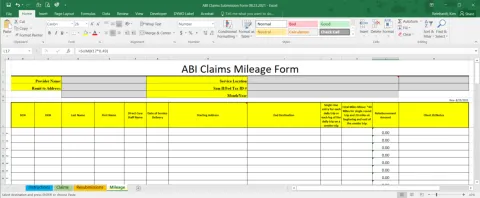
Mileage Reimbursement
Mileage shall be reimbursed to ABI Providers at the State of Missouri’s current standard mileage reimbursement rate. ABI Providers will be reimbursed for services delivered outside of a 20 mile radius of the direct care staff worker delivering services or the ABI Provider’s local office, whichever is closer. An ABI Provider can only bill up to a total of 150 miles for a round trip per participant, per visit.
The current standard mileage reimbursement rate is subject to change at any time and can be found here.
- The direct care staff worker must be outside of a 20 mile radius (one-way) to the participant receiving services.
- If the Provider agencies local office (closest office to the participant) is within a 20 mile radius (one-way) of the participant receiving services, mileage will not be reimbursed.
- Mileage will not be reimbursed while the direct care staff worker is delivering services to the participant.
- Trips that are 40 miles or less (round trip) should not be submitted.
- Mileage reimbursement submissions must include the entire trip (including the 20 miles). If multiple visits are conducted within the same trip, please complete a separate line entry.
- Acceptable supporting documents can be requested at any time and should be made available upon request. Examples of acceptable supporting documents are as follows:
- Google map printout along with a picture of the odometer reading at the time of service delivery.
- Map Quest printout along with a picture of the odometer reading at the time of service delivery.
- Tracking log approved/submitted by the direct care staff and approved by the direct care staff supervisor.
- Details of the mileage reimbursement request must be entered on the claims submission spreadsheet on the mileage reimbursement tab.
- If mileage is submitted for a participant receiving services but the participant is not included on the Claims tab for services, the Provider must include an explanation for the mileage in the Notes column on the Mileage tab in order to be reimbursed.
- Refer to the Mileage scenarios for reimbursement within the claims submission spreadsheet on the instructions tab.
Submitting The ABI Claims Submission Spreadsheet
The ABI claims submission spreadsheet should be submitted to ABIClaims@health.mo.gov.
All billings for approved services provided to approved participants must be submitted to the Department no later than sixty (60) days following the date services are provided. At the close of a state fiscal year, Providers shall be notified by the ABI Program to submit the ABI claims submission spreadsheet at an earlier date to ensure timely payment.
The ABI Program will not provide co-payment for services covered under any other program (MO HealthNet, Medicare, or private insurance).
When participants are covered by third-party payers that also cover the billed service, approval can be considered for payment only if a written denial has been submitted with each request for approval of services (Prior Authorization Form).
ABI claims will be reimbursed at established rates outlined in the Provider Manual and as prior authorized. When the claim has been processed, a voucher will be sent at the time of payment to the address listed during Provider enrollment. Payment is typically issued 30-45 days from receipt of the ABI claims submission spreadsheet.
If a claim is rejected for any reason, an explanation will be printed on the voucher. Typical reasons for rejection may include:
- Service not prior authorized
- Claim not filed within 60-day timeline
- Adjusted to prior authorization
Resubmissions
If claims staff identify a billing issue for a specific participant that cannot be resolved immediately, a notification will be sent to the Provider requesting a resubmission. The Provider will make the needed corrections on the Resubmissions tab of the most recent ABI Claims submission spreadsheet and submit to ABIClaims@health.mo.gov.

Credit Claims/Recoupments
Adult Brain Injury Program Provider Manual
Credit claims will be processed in the following circumstances:
- Duplicate payments;
- Insurance payments;
- MO HealthNet payments;
- Payments made in error
- Overpayments.
The credit/recoupment will be reflected on the next payment and voucher processed to the Provider. Refunds should not be sent unless requested from the Department of Health and Senior Services (DHSS).
Correspondence
Any correspondence or payment sent by the DHSS will be sent to the address shown on the Provider Participation Agreement. It is the responsibility of the Provider to notify SHCN if the contact person, address or county coverage changes. Organizational charts or employee listing should be provided to the ABI Program Manager upon request.
Monitoring
Providers must maintain accurate participant claims files. DHSS has the authority to review participant records and Provider billings. Program Staff will monitor all providers periodically.
Provider Appeal Process
Special Health Care Needs (SHCN) enrolled providers have the right to appeal decisions regarding denial of payment for services. To appeal a decision made by SHCN, the provider must submit the following documentation to the ABI Program Manager within thirty (30) calendar days of the SHCN warrant/voucher date:
- A letter describing the reason for the appeal;
- Documentation to support overturning the denial; and
- A copy of the claim being appealed.
The ABI Program Manager will review the documentation and render a written decision to the provider within thirty (30) business days of the receipt of the appeal. If the decision is unsatisfactory, the provider may submit a second appeal letter addressed to the Bureau Chief. The appeal and supporting documentation must be received by SHCN within thirty (30) calendar days of the ABI Program Manager’s written decision date. The Bureau Chief will review the documentation and render a written decision to the provider within thirty (30) business days of the receipt of the appeal. If the decision is unsatisfactory, the provider may submit a final appeal letter to the Department Director, or designee. The appeal and supporting documentation must be received by SHCN within thirty (30) calendar days of the Bureau Chief’s written decision date. The Department Director will make a final decision based on the evidence and documentation submitted with the appeal. A letter outlining the Director’s decision will be mailed to the provider within thirty (30) business days of the receipt of the appeal.
Provider Application/Approval Process
Adult Brain Injury Program Provider Manual
Provider Application Process
Individuals, Agencies, or Rehabilitation Organizations may apply to be Providers for the ABI Program.
Provider qualifications vary for each service, and are listed on each service description page and summarized on the ABI Program Provider qualifications section of the Provider Manual. Contact the Provider Services Representative at (573)751-6246 for an application packet, visit the Adult Brain Injury Program Provider website [NEEDS LINK], or email shcnproviders@health.mo.gov.
The Provider Application Process is as follows:
Provider Responsibility
- Complete and return Provider Application (CC-35), Participation Agreement (DH-74A), Vendor Input /ACH-EFT Application. See instructions for assistance in completion. Send only one per agency, not one per service;
- Submit copies of current certification/licensure and educational transcripts;
- Maintain complete and current information. Inaccuracies in information submitted will jeopardize application or continuation of the Provider Participation Agreement and payment of claims;
- Assure that qualified individuals are hired and trained following the guidelines for each service for which approved.
- Note: The Provider must notify the Provider Service Representative if:
- Business name, payment/mailing address, or county coverage changes; or
- Tax ID Number changes
- Financial/banking information
Provider Approval Process
The Provider Service Representative will process the Provider Application (CC-35), Participation Agreement (DH-74A) and Vendor Input/ ACH-EFT Application in the following manner:
- The Provider Service Representative will evaluate the information submitted against requirements for service(s) for which the Provider is requesting approval;
- Any questions or incomplete information remaining upon review of material submitted will be summarized in writing within two weeks of the date received to the Provider for a response. If possible, minor questions may be handled with a phone call;
- A signed copy of the Participation Agreement (DH-74A) and approval letter will be forwarded to the Provider when the approval process has been completed;
- Providers should allow approximately four weeks for the approval process to be completed, assuming all application forms and documentation are in order; and
- No claims will be reimbursed for services provided before the date the Provider is officially approved (date Participation Agreement is fully executed).
- Renewal of Participation Agreements must follow guidelines as documented on the most current Participation Agreement (DH-74A) form.
Treatment Plan And Monthly Progress Report
Adult Brain Injury Program Provider Manual
The Treatment Plan and Monthly Progress Report form provided by the ABI Program shall be used with the exception of Consultation Visit and Neuropsychological Evaluation and Consultation services.
Treatment Plan
A treatment plan must be submitted by the provider for each participant and service they provide for the ABI Program. The treatment plan shall be developed with the input of the participant’s planning and treatment team, which includes the ABI Service Coordinator. The ABI Service Coordinator serves as the central point of knowledge about the participant’s functioning and needs, and shall assure that the provider’s treatment plan matches the needs of the participant at the time of service.
A treatment plan that coincides with the dates of authorized services must be submitted to the ABI Service Coordinator upon the submission of a prior authorization for the services. When a new participant is referred for services, the provider has 30 days from the first date of services authorized to complete and submit the treatment plan. Subsequent treatment plans must be submitted along with the request for authorization for continued services. The ABI Service Coordinator may deny authorization of services if an acceptable treatment plan is not received from the provider.
Treatment plans are due to the ABI Service Coordinator by the 10th of the month, prior to the authorized service period. When the 10th falls on a weekend, treatment plans are due by close of business on the Friday before the 10th. The following is a schedule of treatment plan and prior authorization due dates for participants in continuous services:
| SCA Treatment Plan Meeting | Prior Authorization Begin | Prior Authorization End |
|---|---|---|
| January | March 1 | February 28 |
| February | April 1 | March 31 |
| March | May 1 | April 30 |
| April | June 1 | May 31 |
| May | July 1 | June 30 |
| June | August 1 | July 31 |
| July | September 1 | August 31 |
| August | October 1 | September 30 |
| September | November 1 | October 31 |
| October | December 1 | November 30 |
| November | January 1 | December 31 |
| December | February 1 | January 31 |
The treatment plan shall be provided using the Treatment Plan provided by the ABI Program. The following are minimum elements contained in the treatment plan:
- Participant identification (name, DCN, etc.)
- Provider identification (name of provider agency, direct care worker contact information, etc.)
- Service dates (covers the time period of the authorization request)
- Identification of overall participant goals (independent living, community participation, and/or vocational/educational)
- Identification of specific participant goals to be worked on during the service dates requested (what are the barriers keeping the participant from independent living, community participation, and/or vocational/educational goals)
- Identification of specific activities/strategies/techniques planned for the service date period
- Identification of any anticipated obstacles/barriers in achieving the participant goals and strategies planned to overcome them
- Target date for expected completion of specific goals (expected duration of service to meet goals)
Monthly Progress Reports
A progress report (after each month of service provided) must be submitted to the ABI Service Coordinator by the 10th of the month following the month the services were received. When the 10th falls on a weekend, the monthly progress reports are due by close of business on the Friday before the 10th. The following is a schedule of progress report due dates:
| Month of Service | Progress Report Due Date |
|---|---|
| January | February 10 |
| February | March 10 |
| March | April 10 |
| April | May 10 |
| May | June 10 |
| June | July 10 |
| July | August 10 |
| August | September 10 |
| September | October 10 |
| October | November 10 |
| November | December 10 |
| December | January 10 |
The progress report is an update on the participant that communicates timely and relevant issues to the ABI Service Coordinator. The ABI Service Coordinator’s knowledge of these issues is key to enabling the ABI Service Coordinator to assist in the comprehensive service coordination needs of the participant. Significant changes in participant’s status or identification or concerns for the participant should be reported immediately to the ABI Service Coordinator without waiting for the submission of a progress report.
The following are minimum elements of the progress report:
- Participant identification (name, DCN, etc.)
- Provider identification (name of provider agency, direct care worker contact information, etc.)
- Reporting Month of Service
- Utilization of Services Authorized (Units Authorized, Units Delivered)
- Specific activities and strategies worked on during the month
- Overall progress toward participant goals and any goals completed during the month
- Any barriers (anticipated or unexpected) experienced
- Any linkages to other community resources or agencies
- Any changes in participant’s status and/or natural supports (e.g., change in address, illness of participant/family member, etc.)
- Any concerns of the provider relevant to the participant (participant attitude, participation, attendance, etc.)
The above requirements for monthly progress reports apply for Adjustment Counseling, Transitional Home and Community Support Training, Pre-Vocational/Pre-Employment Training, Special Instruction, and Supported Employment/Follow Along services provided.
A clinical evaluation report of a neuropsychological examination must be submitted to the ABI Service Coordinator following the examination.
The treatment plan and progress reports must be submitted typewritten or in legible handwriting. If submitted in handwriting that is not legible, the ABI Service Coordinator may request a type-written report. The ABI Service Coordinator may request additional information from the provider if needed to consider continuation of the service.
Participant Treatment Plan/Progress Meeting
In order to facilitate effective services for the participant, the ABI Service Coordinator, provider and participant shall have a team meeting at least once every six (6) months to discuss progress and further treatment plans. This meeting shall be facilitated by the ABI Service Coordinator. A ABI ServiceCoordinator, provider or the participant may request the team to meet more often.
Qualified Head Injury Professional (QHIP)
Adult Brain Injury Program Provider Manual
The following represents the minimum requirements for individuals to be considered a QHIP:
Neuropsychologist:
A person with a Ph.D. in Psychology from an accredited school, with a specialty in Neuropsychology, licensure with the state of Missouri, and at least one (1) year of experience in working directly with persons with brain injury.
Vocational Specialist:
- Neuropsychiatrist: A doctor of Psychiatry, who has at least one (1) year of experience in working directly with persons with brain injury, and who has expertise in medical management of conditions related to brain injury.
- Physiatrist: A person with a M.D. with a specialty in Physiatrist, licensure with the state of Missouri, and who has at least one (1) year of experience in working directly with persons with brain injury.
- Psychologist: A person with a Ph.D. in Psychology from an accredited school, licensure with the state of Missouri, and at least one (1) year of experience in working directly with persons with brain injury.
- Social Worker: A person who holds a graduate degree from an accredited school of social work, licensure as a Social Worker, and at least one year of experience in working directly with persons with brain injury.
- Professional Counselor: A person who holds a graduate degree from a school or university accredited program in counseling, eligible for licensure as a professional counselor with the state of Missouri, and who has at least one (1) year of experience in working directly with persons with brain injury.
- Occupational Therapist: A person who holds a bachelor’s or master’s degree in Occupational Therapy from an accredited program in occupational therapy, and who has at least one year of experience in working directly with persons with brain injury.
- Recreational Therapist: A person who holds a bachelor’s degree in Recreational Therapy from a school or university accredited program in recreational therapy, and who has at least one (1) year of experience in working directly with persons with brain injury.
- Educational Specialist: A person who holds a bachelor’s degree or graduate degree in Education or Special Education from a school or university accredited program, and who has at least one (1) year of experience in working directly with persons with brain injury. A person who holds a bachelor’s degree or graduate degree in vocational rehabilitation services, and who has at least one (1) year of experience in working directly with persons with brain injury.
- Human Services Professional: A person who has at least a bachelor’s degree in a human services field (including, but not limited to: sociology, rehabilitation services, counseling and psychology), and who has at least one (1) year of experience in working directly with persons with brain injury
- Human Services Direct Care Worker: A person who has a high school diploma or equivalent, and prior to providing direct care without the presence of a supervisor must have completed training in the Primary Skills from the Direct Care worker Competency List, including all six domains:
- General Overview;
- Working with the Consumer in his/her Environment;
- Professional Role and Job Skills of the Direct Care Worker;
- Learning about Community Resources;
- Safety and Welfare of the Consumer; and
- Policies of the Direct Care Worker’s Organizational System.
Must complete the quizzes on The Brain Injury Guide & Resources web based training on TBI.
After the first year of employment, must have completed a minimum of five (5) hours per year of continuing education specifically related to job duties.
ABI Program Provider Qualifications
| Brain Injury Service | Education & Experience Requirements | SHCN Enrollment & Documentation requirements *Send at time of SHCN enrollment ** Retain as on-site documentation |
|---|---|---|
| Adjustment Counseling | An individual who holds a current Missouri license as a Professional Counselor, Psychologist, or Licensed Clinical Social Worker. |
|
| Neuropsychological Evaluation and Consultation | An individual who holds a current Missouri license as a Psychologist, specializing in Neuropsychology, and one year of experience working directly with persons with brain injury. |
|
Pre-Vocational/Pre-Employment Training
| Facility: Facility must have a formalized relationship with DVR and/or other local employment agencies; must have documented policies and procedures in place to safeguard the safety and wellbeing of the participants served.
See Direct Care Worker Competency List. Must complete the quizzes on the brain injury guide and resources web based training on TBI. A minimum of 5 hours per year of continuing education specifically related to job duties, after the first year of employment. | Facility
Supervisor
Direct Care Worker
|
| Special Instruction | An individual who holds a bachelor’s or master’s degree in Occupational Therapy, Recreational Therapy, Social Work, Psychology, Rehab Counseling, Counseling, Rehab Services, Education, Special Education, or Nursing and one year of experience working with persons with brain injury. Additional qualifying experience may substitute on a year-for-year basis for deficiencies in the required education, upon ABI Program Manager approval. |
|
Supported Employment/Long Term Follow Along
| Facility: Agency that provides specialized vocational support services for persons with disabilities. Supervisor: An individual who holds a bachelor’s or master’s degree in Vocational Rehab Services and has one year of experience working with persons with brain injury on employment issues Direct Care Worker An individual who holds a high school diploma or GED and prior to providing direct care without the presence of a supervisor has completed training in the Primary Skills from the Direct Care Worker Competency List, including all six domains:
See Direct Care Worker Competency List. | Facility
Supervisor
Direct Care Worker
|
Transitional Home & Community Support
| Agency that provides specialized home and community-based assistance to persons with disabilities. Supervisor: Direct Care Worker:
See Direct Care Worker Competency |
Direct Care Worker
|
ABI Reimbursement Schedule
Adult Brain Injury Program Provider Manual
(No more than two rehabilitation services may be authorized for the same time period for each participant)
| Service Code | Description | Unit | Rate | Cap |
|---|---|---|---|---|
| 0107 | Consultation Visit | Flat Fee | $60.00 | |
| Adjustment Counseling - Individual | 26 one-hour sessions, lifetime 104 units | 26 one-hour sessions, lifetime 104 units | 26 one-hour sessions, lifetime 104 units | |
| 0010 | Individual Adjustment Counseling – Psychologist | 15 minutes | $22.00 | 104 |
| 0011 | Individual Adjustment Counseling – Social Work | 15 minutes | $20.00 | 104 |
| 0012 | Individual Adjustment Counseling – LPC | 15 minutes | $20.00 | 104 |
| Cognitive/Behavioral | ||||
| 0005 | Neuropsychological Evaluation and Consultation | Flat fee | $625.00 | 2 per lifetime when medically justified |
| Community Integration | Lifetime limit of 1,000 hours or 4000 units | Lifetime limit of 1,000 hours or 4000 units | Lifetime limit of 1,000 hours or 4000 units | |
| 0004 | Transitional Home and Community Support | 15 minutes | $12.50 | 4000 |
| Educational/Vocational | See each individual limit | See each individual limit | ||
| 108 | Pre-Vocational/Pre-Employment Training | 3-hour day | $74.00 | Lifetime limit of 180 units (3 or 6 hour day) |
| 0007 | Special Instruction | 15 minutes | $10.50 | Lifetime limit of 250 hours or 1000 units |
| 0008 | Pre-Vocational/Pre-Employment Training | 6-hour day | $143.00 | Lifetime limit of 180 units (3 or 6 hour day) |
| 0009 | Supported Employment/Long Term Follow Along | 15 minutes | $12.50 | Covers a maximum of 25% of work hours, not to exceed 40 hr. work week. |
| Interpreter | Fees based on units and time | Fees based on units and time | Fees based on units and time | |
| 0105 | Telephone Interpreter | 15 minutes | $8.00 | (1) Unit = 15 minute minimum |
| 0105H | In-Home Interpreter – 2 hour minimum | 15 minutes | $12.00 | (1) Unit = 15 minute with 2 hour minimum |
Direct Care Worker Competency List
Adult Brain Injury Program Provider Manual
| General Skill Area 1 | General Overview |
|---|---|
| Primary Skill A | Identify major legislative trends affecting service delivery for persons with disabilities. |
| Defining Elements |
|
| Primary Skill B | Identify the key characteristics of TBI. |
| Defining Elements |
|
| Primary Skill C | Identify the key components of service delivery |
| Defining Elements |
|
| General Skill Area 2 | Working with the Consumer in His/Her Environment |
|---|---|
| Primary Skill A | Establish a positive, professional relationship with the consumer. |
| Defining Elements |
|
| Primary Skill B | Identify the consumer's internal and external supports. |
| Defining Elements |
|
| Primary Skill C | Determine the unique physical, emotional, and cognitive abilities of the consumer. |
| Defining Elements |
|
| General Skill Area 3 | Professional Role and Job Skills of the Direct Care Worker |
|---|---|
| Primary Skill A | Participate as a member of a person-centered planning team. |
| Defining Elements |
|
| Primary Skill B | Promote self-sufficiency of the consumer in everyday life. |
| Defining Elements |
|
| Primary Skill C | Recognize opportunities for the use of compensatory strategies. |
| Defining Elements |
|
| Primary Skill D | Employ effective communication skills. |
| Defining Elements |
|
| Primary Skill E | Establish and maintain appropriate boundaries of the relationship between the direct care worker and the consumer. |
| Defining Elements |
|
| General Skill Area 4 | Learning About Community Resources |
|---|---|
| Primary Skill A | Identify general community resources and their purposes. |
| Defining Elements |
|
| Primary Skill B | List community service agencies/personnel that the direct care worker may encounter (state and local agencies, ABI Service Coordinators, support groups, etc.). |
| Primary Skill C | Determine local leisure and social opportunities available for the consumer. |
| General Skill Area 5 | Safety and Welfare of the Consumer |
|---|---|
| Primary Skill A | Recognize situations that require the care worker to take urgent action. |
| Defining Elements |
|
| Primary Skill B | Demonstrate proficiency in First Aid, CPR, or other emergency care. |
| Defining Elements | Complete American Red Cross training or other comparable program (including choking prevention). |
| General Skill Area 6 | Policies of the Direct Care Worker’s Organizational System |
|---|---|
| Primary Skill A | State the mission and the philosophy of the employing agency. |
| Defining Elements | Describe the person-centered approach to service delivery. |
| Primary Skill B | Describe the agency’s organizational structure and policies. |
| Defining Elements |
|
| Primary Skill C | Recognize and comply with the agency’s policy on confidentiality. |
| Defining Elements |
|
| Primary Skill D | Practice effective liability and risk management. |
| Defining Elements |
|