
Meal Pattern Substitutions and Processed Food Documentation
CACFP Manual for Emergency Shelters
Meal Pattern Substitutions and Processed Food Documentation
Emergency shelters participating in CACFP must provide reasonable modifications to meals and snacks to accommodate disabilities that restrict a participant’s diet.
Food Substitutions and Variations
Program regulations require program operators to make reasonable modifications to meals and snacks, including providing special meals at no extra charge to accommodate disabilities that restrict a participant’s diet. In many cases, disabilities can be managed within the Child and Adult Care Food Program (CACFP) meal pattern requirements when a well-planned variety of nutritious foods is available to participants. However, in other cases, the needs of a participant with a disability may involve requests for accommodations that result in the service of meals that do not meet the meal pattern requirements.
Program regulations require CACFP operators to provide modifications for participants with disabilities on a case-by-case basis only when requests are supported by a written statement from a registered dietitian or a state-licensed healthcare professional, which is defined as an individual authorized to write medical prescriptions under state law. In Missouri, state-licensed healthcare professionals include physicians, physician assistants, and nurse practitioners. Meals that do not meet the meal pattern requirements are not eligible for reimbursement unless supported by a medical statement. However, CACFP operators may choose to accommodate requests related to a disability that are not supported by a medical statement if the requested modifications can be accomplished within the meal pattern requirements. Such meals are reimbursable. (Reference CACFP 14-2017 Policy Memorandum on Modifications to Accommodate Disabilities in the Child and Adult Care Food Program and Summer Food Service Program)
Medical Statement Requirements
In order to claim a meal that does not conform to the regulatory meal pattern, there must be a medical reason or a special dietary need and a signed statement on file. Use of the Medical Statement to Request Special Meals and/or Accommodations (CACFP-227) is recommended; however, an equivalent form provided by a medical authority that documents the requirements is acceptable. The CACFP-227 form is available at the CACFP website [NEEDS LINK] under Forms.
Disability
When a child has a disability that affects the food the child can consume, the parent or guardian must provide a medical statement form signed by a physician, physician assistant, nurse practitioner, or registered dietitian. The statement must be kept on file, handled confidentially, and include the following:
- A description of the participant’s physical or mental impairment that is sufficient to allow the program operator to understand how it restricts the participant’s diet.
- An explanation of what must be done to accommodate the child’s disability.
- The food or foods to be omitted from the participant’s diet.
- The appropriate food substitutions
Emergency shelters participating in the CACFP are required to make substitutions or modifications to the meal pattern when a disability restricts the diet. Substitutions must be made only when supported by a written statement signed by a physician, physician assistant, nurse practitioner, or registered dietitian.
If it is necessary for a parent to furnish a particular food item(s) for medical reasons as described in 7 CFR 226.20(g), the meal may still be claimed for reimbursement if the request is supported by a written statement signed by a physician, physician assistant, nurse practitioner, or registered dietitian and the shelter supplies at least one required meal component.
Note: Reimbursement for meals served with documented food substitutions is claimed at the same reimbursement rate as meals that meet the meal pattern. The shelter may not charge for the substituted food item. Substitutions that exceed program reimbursement are at the shelter’s expense.
Modifications for Dietary and Cultural Preferences
Meal or meal service modifications, such as food or beverage substitutions, may be made at the sponsor's discretion for children with dietary and cultural preferences that are not considered a disability. Any modification that does not meet the meal pattern requirements is not reimbursable unless supported by a medical statement signed by a registered dietitian or recognized medical authority (licensed physician, physician’s assistant, or nurse practitioner). The written statement must contain the information detailed above. While sponsors are not required to accommodate dietary and cultural preferences, such as vegetarian diets, sponsors are highly encouraged to do so within the existing meal patterns. The CACFP meal pattern allows for a variety of food items within the required
Fluid Milk (Non-Dairy) Substitutions
Milk substitutions that are made due to special dietary needs that are not a disability must be nutritionally equivalent to fluid milk. The facility may make such substitutions at its discretion, but it is not required. A written request for a fluid milk substitution may be made by a physician, physician assistant, nurse practitioner, registered dietitian, or parent or guardian. The request must identify the medical or other special dietary need that restricts the child's diet. Fluid milk substitutes must contain all nutrients in the minimum quantities specified to be considered nutritionally equivalent to fluid cow’s milk:
Fluid Milk Substitute - Minimum Nutrient Requirements*
| Nutrient | Per one (1) cup, 8 ounces |
|---|---|
| Calcium | 276 mg. |
| Protein | 8 gm. |
| Vitamin A | 150 mcg retinol activity equivalents (RAE) |
| Vitamin D | 2.5 mcg. |
| Magnesium | 24 mg. |
| Phosphorus | 222 mg. |
| Potassium | 349 mg. |
| Riboflavin | 0.44 mg. |
| Vitamin B-12 | 1.1 mcg. |
* Fluid milk substitutes served to children 1 through 5 years old must be unflavored
A medical statement is required for non-dairy substitutions due to a disability that does not meet the nutritional standards of cow’s milk as described above.
Non-dairy beverages that meet USDA Substitution criteria per eight fluid ounces include:
- 8th Continent: Original Soy Milk
- Silk: Original Soy Milk
- Bettergoods: Plant-Based Original Soymilk
- Pacific Foods: Original Ultra Soy Milk
- Kikkoman: Pearl Organic Soymilk
- Ripple: Original Plant-Based Milk
Note: The Missouri Department of Health and Senior Services-Community Food and Nutrition Assistance (DHSS-CFNA) does not endorse the companies or products listed. This list is not all-inclusive. Read the nutrition facts panel or contact the manufacturer to ensure that product formulations are current. Non-dairy beverages served to children 1 through 5 years old must be unflavored due to the higher sugar content of flavored varieties. (Reference: CACFP 17-2016)
Fluid milk substitutes are not required to be low-fat or fat-free when served to children 2 years old and older and adults. Non-dairy beverages must be fortified to meet the nutrient requirements for fluid milk substitutes, and some fat is often needed to help mask the flavor of the nutrient packet added. To ensure that sponsors have access to a variety of fluid milk substitutes that are nutritionally equivalent to cow’s milk, and thus, the special dietary needs of participants are more likely to be met, there is no standard for fat content in fluid milk substitutes.
Any reasonable parent or guardian's written request for a non-dairy milk substitution that is nutritionally equivalent to fluid milk could be accepted at the shelter's discretion without providing a medical statement. For example, if a parent has a child who follows a vegan diet, the parent can submit a written request to the child’s caretaker asking that soy milk be served in lieu of cow’s milk. The written request must identify the medical or other special dietary need that restricts the diet of the child. Non-dairy milk substitutions are an option and an expense for the facility. Other examples that may be considered reasonable written requests would be for religious, cultural, or ethical reasons. However, a request that only states that a child “does not like milk” would not be a reasonable request for a fluid milk substitute.
Medical Statement to Request Special Meals and/or Accommodations
Mini-List of Non-Creditable Foods
The foods listed below are non-creditable in the Child and Adult Care Food Program (CACFP) because they do not meet the requirements as a component in the meal pattern. Non-creditable foods cannot be counted toward meeting the requirements for a reimbursable meal. The alphabetical list is not all-inclusive. The use of a product brand name is not an endorsement, but is used for clarity. Refer to the Crediting Handbook for the CACFP and USDA’s Food Buying Guide for Child Nutrition Programs for a comprehensive list of creditable and non-creditable food.
Processed Food Documentation
Child and Adult Care Food Program (CACFP) sponsors are responsible for ensuring that their menus fulfill meal pattern requirements. Therefore, they must maintain documentation demonstrating how a food item meets the program requirements in 7 CFR 226.
Some centers choose to purchase commercially processed meat/meat alternate (m/ma) products rather than prepare these main dish items on site, which is commonly referred to as “homemade” or “cooked from scratch.” Some reasons a center may purchase these convenience items are due to the lack of skilled labor or inadequate kitchen preparation equipment. The quality of commercially processed foods varies widely from manufacturer to manufacturer and product to product. Because the meal pattern contribution for commercially processed foods cannot be verified, all centers must maintain documentation to verify the meal pattern contribution to the Child and Adult Care Food Program (CACFP).
If the processed (commercially prepared) food item is not found in the “Food Buying Guide for Child Nutrition Program” (FBG), then documentation should be obtained from the manufacturer prior to purchasing and serving/claiming the food item.
In November 2024, the United States Department of Agriculture (USDA) released an updated policy memo (CACFP 04-2025 Guidance and Clarification on CN Label Effective Dates) regarding the documentation of processed foods, which supersedes previous guidance. This memo details the two types of acceptable documentation approved to verify meal pattern compliance: Child Nutrition (CN) label OR a manufacturer’s Product Formulation Statement (PFS).
The CN label and a manufacturer’s PFS are documents that provide a way for a manufacturer to demonstrate how a processed food product contributes to the meal pattern requirements. Both a CN label and PFS are voluntarily provided by manufacturers at the request of program sponsors.
A CN label is authorized by the USDA and provides a warranty of a product’s meal pattern contribution when the processed product is used according to the manufacturer’s instructions. A PFS is typically provided for processed products that do not have a CN label. It is the program operator’s responsibility to request and verify that the supporting documentation for the PFS is accurate.
CN Labels
The Child Nutrition Labeling Program is administered by the United States Department of Agriculture, Food and Nutrition Service (USDA, FNS) in cooperation with the following agencies: Agriculture Marketing Service (AMS), Food Safety and Inspection Service, and National Marine Fisheries Service. Main dish products that contribute to the meat/meat alternate component of the meal pattern requirements are eligible for a CN label. Examples of these products include beef patties, cheese or meat pizzas, meat or cheese and bean burritos, egg rolls, and breaded fish portions
Advantages of using a CN-labeled product include:
- A CN label statement clearly identifies the contribution of a product toward the meal pattern requirements. It protects Child Nutrition program sponsors from exaggerated claims about a product.
- A CN label provides a warranty against audit claims if the CN-labeled product is used according to the manufacturer’s directions.
- CN labels simplify cost comparisons of like products.
CN-labeled products will always contain:
- The CN logo, which has a distinct border;
- The meal pattern contribution statement;
- A unique 6 digit product identification number assigned by USDA/FNS appearing in the upper right hand corner of the CN label
- The USDA/FNS authorization statement;
- The month and year of the final approval.
- Plus the remaining required label features: product name, inspection legend, ingredient statement, signature/address line, and net weight.
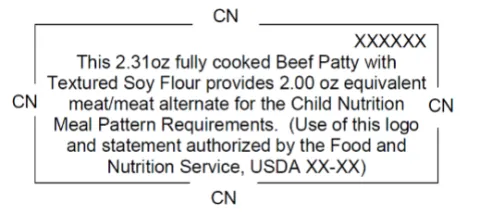
Note: The X’s in the sample CN Logo are only used to demonstrate the placement of the CN identification number and the final date. If you receive a CN-labeled product containing all X’s (all zeroes or non-number symbols) for the CN identification number, the label is not valid. If a CN label is not valid, FNS cannot provide a warranty for its use toward meal pattern requirements.
The CN label is the gold standard for verifying the crediting of menu items and provides a warranty against audit claims when the product is used according to the manufacturer’s instructions.
Acceptable and valid documentation for the CN label includes:
- The original CN label removed from the product carton.
- A photocopy of the CN label shown attached to the original product carton.
- A photograph of the CN label shown attached to the original product carton.
- A CN label copied with a watermark displaying the product name and CN number provided by the vendor and the Bill of Lading (invoice).
CN labels that are photocopied or photographed must be visible and legible.
CN Label Verification System
The CN Label Verification System is available at the USDA website to assist the CACFP sponsors in verifying the status of a CN label as well as the crediting information.
Dates related to CN Labels
Once authorized, CN labels are valid for five years under the condition that the manufacturer remains an authorized CN producer and the product formulation does not change. The date printed on the CN label is the original date of authorization or the date of the most recent authorization for use of that CN label. This is different from the “Valid Until” date shown on the CN Label Verification Report, which indicates when the current authority to use the label expires. Manufacturers may choose to leave the original authorization date on the label when they receive reauthorization of their CN label so that the label inventories do not go to waste. For example, if a CN label was originally authorized on February 15, 2024, it is valid until February 15, 2029. The manufacturer may resubmit the same product for reauthorization of the CN label. If reauthorization is granted, the “Valid Until” date is updated to five years from the most recent date of the authorization on the CN Label Verification Report, but the date on the CN label may remain as 02/24.
Requirements for Documenting Watermarked CN Labels
A CN label copied with a watermark is used when the CN logo and contribution statement are presented on product information separate from the actual product carton. Manufacturers may provide program sponsors with a watermarked CN label during the bidding process. (Note: original CN labels on product cartons will not have a watermark.) Program sponsors should be aware that product information on the watermarked CN label can be changed. Therefore, program sponsors are encouraged to verify that the watermarked CN label came from a product that was purchased and accurately reflects that product.
A watermarked CN label, along with the Bill of Lading (invoice), is acceptable documentation for a state agency monitoring process. Valid and acceptable documentation for the watermarked CN label includes:
- a hard copy of the CN label copied with a watermark displaying the product name and CN number provided by the vendor; or
- an electronic copy of the CN label with a watermark displaying the product name and CN number provided by the vendor.
Product Formulation Statements (PFS)
The PFS should only be requested when reviewing a processed product without a CN label. PFSs are written and provided by individual manufacturers and are not commonly seen with CACFP sponsors. It is the sponsor’s responsibility to request and verify that the processed food documentation is accurate prior to purchasing processed products.
PFS templates for each meal component are available on USDA’s CN labeling website. Manufacturers may use PFS templates as a guide to help develop a PFS, which are available at the USDA website. However, they are not required to use the same format as the USDA’s template, but they must present the same information on their company letterhead. It should be noted that a PFS does not provide any warranty against audit claims. Unlike CN labels, a PFS that claims a meal pattern contribution is not a guarantee of USDA meal pattern compliance and can be disputed during a CACFP monitoring review.
The answer to each of the following questions should be yes:
- Is the PFS on signed company letterhead? The signature can be handwritten, stamped, or electronic.
- Does the PFS include product name, product code number, and serving/portion size?
- Do the creditable ingredients listed on the PFS match or have a similar description to the ingredients listed on the product label? For example, if the PFS lists ground beef (not more than 20% fat), the product label should also list ground beef (not more than 20% fat).
- Do the creditable ingredients listed on the PFS match or have a similar description to a food item listed in the USDA Food Buying Guide for Child Nutrition Programs?
- If the product is a meat/meat alternate, does it contain an Alternate Protein Product (APP) such as soy concentrate? If yes, does the manufacturer provide supporting documentation that meets USDA APP requirements?
- Does the PFS demonstrate how creditable ingredients contribute toward the meal pattern requirements?
- Are the manufacturer’s calculations correct and verified?
The PFS should include:
- Weight of raw portion; percent of raw meat or poultry; percent of fat of raw meat.
- Weight of an APP, if applicable; percent of an APP on an as-is basis for the as-purchased product; certification that an APP meets the USDA, FNS requirements.
- Product’s total creditable amount of product per portion towards the meal pattern.
- Certification statement that the PFS is an accurate verification of meal pattern compliance.
- Original signature and title of company official and date.
Helpful Resources
Additional guidance and technical assistance related to CN labels and PFS may be found on the USDA website, particularly on “Manufacturer Documentation: Child Nutrition Labels and Product Formulation Statements” and “Tips for Evaluating a Manufacturer's Product Formulation Statement.”
USDA’s CN Labeling Website includes a general background of the CN Labeling Program and provides helpful information for food manufacturers and child nutrition programs. It can be accessed at the USDA website or from the USDA Food Buying Guide for Child Nutrition Programs - Appendix C.
The CN Label Verification Reporting System can also be accessed from the link and from Appendix C. The system was developed to assist state reviewers, program sponsors, and the food industry in verifying the status and validity of a CN label. The system produces two reports monthly:
- The CN Label Verification Report includes all information pertaining to the valid CN label, which includes the crediting information (meal pattern contribution statement), label expiration date, and the manufacturer’s establishment number.
- The CN Label Manufacturers Report includes contact information for manufacturers that are authorized to produce CN labeled products. This report allows users to link the manufacturer’s list from the CN Label Verification Report.
These reports can be found at the USDA website.
Product Formulation Statement (PFS) – Approved Example:

All documentation regarding processed foods must be maintained in the sponsor files. If no information is available at the time of a monitoring review, meals containing processed foods may be disallowed.