
Introduction
CACFP Manual for Emergency Shelters

Missouri Department of Health & Senior Services
Community & Public Health
Community Food & Nutrition Assistance
P.O. Box 570
Jefferson City, MO 65102
Telephone: 800-733-6251
Fax: 573-526-3679
E-mail: CACFP@health.mo.gov
www.health.mo.gov/cacfp [NEEDS LINK]
Missouri Department of Health & Senior Services Child & Adult Care Food Program Manual for Emergency Shelters
In accordance with federal civil rights law and USDA civil rights regulations and policies, the USDA, its agencies, offices, employees, and institutions participating in or administering USDA programs are prohibited from discriminating based on race, color, national origin, religion, sex, disability, age, marital status, family/parental status, income derived from a public assistance program, political beliefs, or reprisal or retaliation for prior civil rights activity, in any program or activity conducted or funded by USDA (not all bases apply to all programs). Remedies and complaint filing deadlines vary by program or incident.
Persons with disabilities who require alternative means of communication for program information (e.g., Braille, large print, audiotape, American Sign Language, etc.) should contact the state or local agency that administers the program or contact USDA through the Telecommunications Relay Service at 711 (voice and TTY). Additionally, program information may be made available in languages other than English.
To file a program discrimination complaint, complete the USDA Program Discrimination Complaint Form, AD-3027, found online at How to File a Program Discrimination Complaint and at any USDA office or write a letter addressed to USDA and provide in the letter all of the information requested in the form. To request a copy of the complaint form, call (866) 632-9992. Submit your completed form or letter to USDA by:
- Mail:
U.S. Department of Agriculture
Office of the Assistant Secretary for Civil Rights
1400 Independence Avenue, SW, Mail Stop 9410,
Washington, D.C. 20250-9410; - Fax: (202) 690-7442; or
- Email: program.intake@usda.gov.
USDA is an equal opportunity provider, employer, and lender.
Overview of CACFP
CACFP Manual for Emergency Shelters
CACFP serves nutritious meals and snacks to eligible children and persons with disabilities, as defined under 7 CFR 226.2, who reside in participating emergency shelters. Emergency shelters participating in CACFP must follow program regulations.
Training Objectives
- Understand the staff and director's responsibilities for the emergency shelters or sponsoring organization’s (SO) participation in the Child and Adult Care Food Program (CACFP).
- Understand the responsibilities of the Department of Health and Senior Services Community Food and Nutrition Assistance (DHSS-CFNA) in administering the CACFP.
- Understand how sponsors meet and comply with CACFP performance standards.
- Understand the importance of accurate recordkeeping and its role in verifying the shelter’s claims for reimbursement.
- Identify the records that must be maintained by shelter staff to meet regulatory requirements. Explain the procedures for completing each record.
- Understand Civil Rights compliance requirements.
- Use the meal pattern requirements and menu planning process to create nutritious and creditable meals.
- Explain how to use the United States Department of Agriculture Food Buying Guide (FBG) for Child Nutrition Programs and the Crediting Handbook for the CACFP to assist with menu planning.
- Explain the importance of good nutrition in the emergency shelter setting.
Benefits of the Child and Adult Care Food Program
The Child and Adult Care Food Program (CACFP) can be an important resource to emergency shelters that provide residential and food services to children and persons with disabilities who are experiencing homelessness.
The CACFP is a federal program that provides reimbursements for nutritious meals and snacks to children ages birth to 18 years of age and persons with disabilities as defined under 7 CFR 226.2 who reside in participating emergency shelters. CACFP contributes to the wellness, healthy growth, and development of young children in the United States.
CACFP plays a vital role in improving the quality of the meals served in the emergency shelters, making it more affordable for the organization. Benefits include:
- Shelters may be approved to claim up to three meals or two meals and one snack for each resident participant per day.
- Training and technical assistance are available on nutrition, food service operations, program management, nutrition education, and recordkeeping.
- Improved health and well-being of infants and children through age 18 and persons with disabilities by providing nutritious, well-balanced meals.
- Development of healthy eating habits in children that will last through their lifetime.
Key points To Remember About CACFP
- Providing nutritious meals and snacks is the primary goal. The mission of the Food and Nutrition Service (FNS) is to provide children and families better access to food and a more healthful diet through its food assistance programs, such as CACFP, and nutrition education efforts in compliance with 7 CFR 226.
- CACFP is a supplementary program, not an entitlement program, which requires accurate recordkeeping and program compliance.
- United States Department of Agriculture’s (USDA) FNS administers the CACFP at the national level, and the Department of Health and Senior Services-Community Food and Nutrition Assistance (DHSS-CFNA) is the State Agency (SA) that administers the program in Missouri.
- The DHSS-CFNA is regulated by Congress and the USDA.
- The DHSS-CFNA will conduct CACFP monitoring reviews at all participating emergency shelters and sponsoring organizations pursuant to 7 CFR 226.
Performance Standards
Financial Viability, Administrative Capability, Program Accountability
The executive director and the board chair or owner of the child care facility or sponsoring organization (SO) and those named as a responsible individual and food program contact must, due to their position in the facility, accept final administrative and financial responsibility for the Child and Adult Care Food Program (CACFP) and ensure that the CACFP is operated with program integrity.
Each new independent facility, SO of two or more facilities, or renewing facility must submit information sufficient to document that it is financially viable, is administratively capable of operating the program in accordance with CACFP regulations, and has internal controls in place to ensure accountability. To document this, any new sponsor, which may include an independent facility or an SO of two or more facilities, must demonstrate in its application that it is capable of operating in conformance with the CACFP performance standards.
The Department of Health and Senior Services-Community Food and Assistance (DHSS-CFNA) must only approve the applications of those new sponsors that meet these performance standards and deny the applications of those new sponsors that do not meet the standards. In ensuring compliance with these performance standards, the DHSS-CFNA establishes rules and procedures and makes decisions based on information from internal controls at the federal and state level that includes information obtained during the application process, information from audits and complaints, results of edit checks, claim reviews, monitoring reviews; and notice of civil and criminal action.
Each new independent facility, SO of two or more facilities, or renewing facility must submit information sufficient to document that they are operating in accordance with the CACFP Performance Standards – Viability, Capability, and Accountability (VCA) outlined in 7 CFR 226.6(b)(1):
- The organization must be Financially Viable. The facility must have a budget and demonstrate it has adequate financial resources to operate the CACFP on a daily basis, has adequate sources of funds to continue to pay employees and suppliers during periods of temporary interruptions in CACFP payments and/or to pay debts when fiscal claims have been assessed against the sponsor, and can document financial viability through audits or financial statements. Sponsors must ensure that CACFP funds are expended and accounted for in accordance with CACFP regulations, 2 CFR 400, and the requirements in FNS Instruction 796-2, rev. 4.
The organization should expect that DHSS-CFNA will review the SO’s financial records at least annually. - The organization must be Administratively Capable. The facility must have appropriate and effective management practices in place to provide program benefits to all participants and an adequate number and type of qualified staff to operate the CACFP. An SO of two or more facilities must document in its management plan that it employs staff sufficient to meet the ratio of monitors to facilities, taking into account the factors that DHSS-CFNA will consider in determining an SO’s staffing needs, as set forth in CACFP regulations. An SO must have written program policies and procedures that assign program responsibilities and duties. An SO’s policies and procedures must also ensure compliance with civil rights requirements.
- The organization’s program must be Accountable. The facility must have internal controls and other management systems in effect to ensure fiscal accountability and ensure that the CACFP will operate in accordance with requirements. To demonstrate program accountability, the sponsor must document that it meets the following criteria:
- Board of Directors – have adequate oversight of the program by an independent governing board of directors.
- Fiscal Accountability – have a financial system with management controls specified in writing. These written operational policies must ensure the following:
- Fiscal integrity and accountability for all funds and property received, held, and disbursed.
- The integrity and accountability of all expenses incurred.
- Claims will be processed accurately and in a timely manner.
- Funds and property are properly safeguarded and used.
- Expenses incurred are for authorized program purposes.
- A system of safeguards and controls is in place to prevent and detect improper financial activities by employees.
- Recordkeeping - maintains appropriate records to document compliance with CACFP requirements, including budgets, accounting records, approved budget amendments, management plans, and appropriate records on facility operations. There must be documentation in the management plan that the organization will provide adequate and regular training of its staff and sponsored facilities.
- Documents that prove compliance with CACFP regulations, including, but not limited to, menus, production records, delivery receipts, income eligibility forms, meal count records, and attendance records, shall not be altered. If additions/corrections are required, they must be made using ink. The incorrect information must be crossed out using one line so that the original information can still be read. Changes using pencils or white out shall be prohibited. All changes must be initialed and dated by the person making the correction.
- SO operations - documentation in the management plan that the SO will perform monitoring to ensure the sponsored facilities accountably and appropriately operate the program, and have a system in place to ensure that administrative costs do not exceed the regulatory 15 percent limitation.
- Meal Service and other operational requirements - follow the practices that result in the operation of the program in accordance with the meal service, recordkeeping, and other operational requirements of the federal regulations. These practices must be documented and must demonstrate that the independent facility or sponsored facilities will:
- Provide meals that meet meal pattern requirements.
- Comply with licensure or approved requirements.
- Have food service that complies with applicable state and local health and sanitation requirements.
- Comply with civil rights requirements.
- Maintain complete and appropriate records on file.
- Submit claim reimbursement only for eligible meals.
Program Integrity
CACFP regulations define Seriously Deficient (SD) as the status of an independent facility or SO of two or more facilities that has been determined to be non-compliant in one or more aspects of its operation of the program. If a sponsor is unwilling or incapable of correcting serious problems, the SD process protects program integrity by removing the institution from the program.
The chairman of the Board of Directors, the executive director, or owner, as well as other person(s) responsible for the Child and Adult Care Food Program (CACFP) operation, such as the responsible individual and the food program contact, noted on the Center and/or Sponsor Info Sheets on the Application/Claims database are considered the “responsible individual(s)” or “responsible principal(s)” of the organization. By virtue of the management position as a “responsible principal,” you have administrative and financial responsibility for the oversight, management, and integrity of the CACFP and compliance with applicable regulations.
Should a sponsor ever be classified as SD and terminated due to mismanagement of the CACFP, the name(s) of the “responsible principal(s)” and “responsible individual(s)” will be placed on the United States Department of Agriculture’s (USDA) National Disqualified List (NDL). Once on the NDL, the responsible parties named would not be able to work in another organization that participates in the CACFP or any other Child Nutrition Program for up to seven years.
Financial Review
In August of 2023, the USDA-FNS published a final rule on program integrity to ensure that child nutrition programs are properly operated and managed to protect federal taxpayer dollars. As part of this final rule, the state agency is required to review your financial records at least annually. The following records must be made available upon request:
- At least one month of all bank account activity associated with CACFP will be reviewed against other associated records to verify that the financial transactions meet program requirements.
- The actual expenditures of CACFP funds and the amount of reimbursement funds retained from unaffiliated centers to support the sponsoring organization’s administrative costs will be reviewed.
- The reported expenditures will be reconciled with program payments to ensure that funds are accounted for fully.
Management Tools and Resources
CACFP sponsors enter into a contract with the Department of Health and Senior Services Community Food and Nutrition Assistance (DHSS-CFNA) to participate in the CACFP. The following management tools and resources are available on the Missouri CACFP website. [NEEDS LINK]
- CACFP Income Eligibility Guidance for Child Care Centers
- United States Department of Agriculture Food Buying Guide for Child Nutrition Programs
- Crediting Handbook for the Child and Adult Care Food Program
- Child & Adult Care Food Program Manual for Child Care Centers
- “And Justice For All” poster
- Building for the Future flyer and pamphlet
- Missouri WIC outreach poster
Single Audit Compliance
Under 2 CFR 200.501—Audit Requirements, SFSP Sponsors are required to submit a Single Audit within nine months of the close of your fiscal year for any fiscal year in which you expend $1,00,000.00 or more in federal funds.
A Single Audit is when a professional auditor goes over a grantee’s financial management processes, including its financial management system and its compliance with all of its federal grant requirements. It is called a Single Audit because it combines one audit covering all of a grantee’s federal grants. The purpose is to ensure that grantees receiving federal grant funds use the funds in compliance with the government’s requirements. It was created to promote sound financial management, promote uniform guidelines for audits and deploy audit resources efficiently.
Failure to comply will result in a declaration of Serious Deficiency by the state and possible program termination.
Discovering Problems
The following is a management assessment tool that describes some of the more common indicators of program mismanagement identified through federal and state-level internal controls.
Child and Adult Care Food Program Institutions Indicators of Potential or Existing Problems (Red Flags!)
Budget/Claim for Reimbursement
- Year-to-date claims do not reflect the approved budget.
- Questionable or potentially fraudulent meal-claiming practice (e.g., meals claimed when the facility is closed).
- Expenditures charged to the nonprofit food service that are not listed on the budget approved by the state agency.
Operational Oversight
- No qualified accountant or adequate accounting information system.
- Lack of internal controls (e.g. inadequate separation of duties, position held by family member limits internal control).
- Related party transactions (e.g., when the director or family member is the owner of the catering company used for contracted meals or the owner of the rented property housing the CACFP facility).
- Absentee management.
- Substantial difference between the number of participants observed at meal time during the monitoring review and the Average Daily Participation (ADP) for the same meal for the review month.
Audits
- Required audits or monitoring reviews are not performed by SOs.
- The Management/Board of Directors does not follow up on corrective action taken.
Other
- Health and safety concerns reported from any source.
CACFP Records
CACFP Manual for Emergency Shelters
Emergency shelters participating in CACFP are required to maintain records to verify that the meals and snacks served to resident participants meet guidelines and to justify the claim for reimbursement.
Eligibility Requirements
Participation
An emergency shelter is defined as a public or private nonprofit organization or its site that provides temporary shelter and food services to homeless children, including a residential child care institution (RCCI) that serves a distinct group of homeless children who are not enrolled in the RCCI's regular program. (CFR 226.2)
Any facility whose primary purpose is to provide a temporary shelter to homeless families with children is eligible to participate in CACFP. In most cases, an eligible shelter is one that combines overnight facilities with day programs, such as congregate meal services, for homeless children and their parents or guardians. Facilities meeting this description include family shelters, domestic violence shelters, shelters for runaways, and other facilities that provide temporary shelter to homeless children. Emergency shelters that offer temporary housing in a different location from the meal service are also eligible to participate in the Child and Adult Care Food Program (CACFP).
While it is recognized that homeless service agencies target and serve homeless individuals and families in different ways, not all temporary living situations are eligible for CACFP. For example, transitional apartments, independent living facilities, single room occupancy (SRO) residences (such as SRO hotels that provide a small private room for one person), and housing units where families double or triple up with friends or relatives are generally not eligible for CACFP.
Participation During Disasters
Emergency shelters that provide temporary housing to displaced families are eligible to participate in CACFP. Where significant numbers of persons are being temporarily housed, state agencies may designate any appropriate facility as an emergency shelter and may waive facility application requirements in these situations. When state agencies have designated a facility as an emergency shelter, all children through age 18 and persons with disabilities as defined under 7 CFR 226.2 may receive up to three free meals (breakfast, lunch, and supper) each day.
An “appropriate facility” may include a school or an institution that, although it is not providing actual shelter, is nevertheless providing meals to displaced families who are being temporarily housed elsewhere in locations that may not have the means to provide meal services to these temporary residents. (Reference: Policy Memo SP 46-2014, CACFP 12-2014, SFSP 18-2014 Disaster Response)
Eligibility Requirements
To participate in the CACFP, the shelter does not have to offer formal child care as recognized by the licensing authority. There is no federal requirement for emergency shelters to have federal, state, or local licensing as a condition of eligibility to participate in the CACFP. In the absence of a license, shelters must meet all applicable state and local health, fire, and safety standards and requirements.
Eligible Participants
Meals served to children 18 years of age or younger and persons with disabilities as defined under 7 CFR 226.2 who are residents in an emergency shelter may be claimed for reimbursement. Emergency shelters that serve individuals who are disabled over the age of 18 must serve a majority of participants who are aged 18 and under. Therefore, more than 50% of the CACFP participants should be children 18 years of age and younger. Persons with disabilities over the age of 18 must be 50% or fewer of the CACFP participants.
Providers of meals to homeless children often serve a diverse clientele that includes homeless and non-homeless adults and children. Shelters must differentiate between children residing in the shelters and those who may be served meals as walk-ins. In those situations where a shelter’s total food service is not conducted exclusively for the benefit of eligible residential children, the shelter must keep separate records of the meals it serves. Meals served to noneligible adults and children are not reimbursable. Exception: the meals/snacks consumed by a child who is visiting a parent (who is a resident at the shelter) may be claimed for reimbursement if the child is also a resident at another emergency shelter. Sometimes family members are separated and reside at different emergency shelters. Such exceptions must be explained on the resident roster.
Meal Service
All participating shelters must serve meals that meet the CACFP meal pattern requirements and must maintain a non-profit food service. Reimbursable meals include breakfast, lunch, supper, and/or snacks seven days a week. Shelters may receive reimbursement for up to three meals (breakfast, lunch, and supper) or two meals and one snack for each resident participant each day. Resident children and persons with disabilities, as defined under 7 CFR 226.2, are automatically eligible for meals and or snacks at the free reimbursement rate. The shelters may not charge or collect payments for the CACFP meals and snacks served to eligible participants.
Shelter residents may prepare and serve their own meals if the shelter provides supervision of the meal preparation and service, and the shelter can ensure that:
- The meal is served in a congregate setting.
- The meal meets the CACFP meal pattern requirements.
- An accurate meal count is recorded.
Only meals served in congregate meal settings are eligible for reimbursement. Meals consumed in private family quarters in an emergency shelter are not reimbursable. An exception can be made for infants from birth through 11 months of age fed in the private family quarters of the shelter residence, and when the infant is documented on the resident roster, including when a mother directly breastfeeds in her room. Mothers are required to tell shelter staff that they fed their infant, and then that infant’s meal can be counted. No other documentation is required. When an infant is in residence during the meal service period, the shelter must offer the infant a meal that meets program requirements.
Reporting and Recordkeeping
Shelters must keep records that support the claims for reimbursement, the non-profit status of the organization, and the proper utilization of CACFP funds to support meal costs. Shelters must maintain a monthly roster of participants in residence that is updated daily. Creditable meals must be served in a congregate setting, and point-of-service meal counts must be documented by meal type, such as breakfast, lunch, supper, and snack. All meal counts must be documented at the point of service, except for infants when fed in private family quarters.
Emergency shelters are not required to keep CACFP-specific child enrollment information, such as the usual days, hours, and meals when the child is typically present. Emergency shelters are not required to distribute and collect household income information. No media release is required for a battered women’s shelter due to the secrecy of the location.
Commodities and Funds from Other Federal Programs
An approved shelter may receive CACFP reimbursement and cash-in-lieu of commodities for lunch and supper meals served to eligible participants. A shelter may continue to receive and use commodity foods from The Emergency Food Assistance Program (TEFAP) for the meals it serves to adults and children (walk-ins) who are not eligible for CACFP, provided that its records are sufficient to establish the shelter’s allotments of commodities under each program.
Shelters participating in CACFP are not allowed to supplement the reimbursement they receive for a meal with funds from another USDA child nutrition program. However, they may obtain funds from other federal program sources to support their food service operations. Shelters that receive grants through FEMA’s Emergency Food and Shelter Program (EFSP), HUD's Emergency Shelter Grant Program, and other "non-child nutrition" programs may continue to use them to purchase food, even for meals for which they claim CACFP reimbursement, and to operate more than one federal program, independently, at the same facility. In many cases, those sources of funds are less restrictive than child nutrition program funds.
The only restriction on the use of those funds, for food or for other purposes, is in the definition of "income to the program" in section 226.2 of the regulations. The shelter cannot claim a meal under two programs, but it can use other available funds to enhance the meal service. In most cases, the shelter will be able to shift its other federal grants to support the types of functions that are not reimbursable under CACFP. For example, the shelter could use its EFSP funds to serve meals to adults or to nonresidential children whose meals would not be eligible for CACFP reimbursement.
Resident Roster
Resident rosters are a requirement of the Child and Adult Care Food Program (CACFP). CACFP Memorandum 11-2007 Accommodations for Non-Traditional Program Operators, which can be found at the USDA website, clearly states that non-traditional programs, such as emergency shelters, must maintain a list of participants by name, date of birth, and dates of residency. Resident rosters must be updated daily to ensure that there is an accurate record of attendance for all participants claimed for reimbursement. All participants recorded as receiving meals and claimed for reimbursement must be on the resident roster for that date. Accurate records of CACFP-eligible participants in residence are very important for the completion of the monthly claim for reimbursement. Meals served to participants not on the resident roster will not be reimbursed.
Shelters can opt to create their own roster form, providing the following information is included:
- List all CACFP participants* residing at the shelter, preferably in alphabetical order by last name, then first name.
- List the participant’s date of birth (month/date/year) and the date the participant entered the shelter; also, list the date the participant left the shelter.
- Do not use meal count records as resident rosters.
- The resident roster should be completed for each month and updated daily. The shelter director or designee must sign and date the form.
- File completed resident rosters in the monthly folder with other CACFP documentation for the month.
*Per the Stewart B. McKinney Homeless Assistance Act, any victim service provider may not disclose “personally identifying information” or “personal information” about an individual, including a first and last name; a home or other physical address; contact information; a social security number; any other information, including date of birth, racial or ethnic background, or religious affiliation, that, in combination with any other non-personally identifying information, would serve to identify any individual.
Although first and last names and date of birth may be omitted from the resident roster and meal count records for privacy protection at a shelter that is a victim service provider, there must be a way to identify each participant using initials or other discreet methods on the resident roster. The first and last names and date of birth must be made available to the reviewer during a monitoring review.
Shelter Resident Roster By Month. Must Be Updated Daily.
Meal Count Record
Daily Meal Count Records are a requirement for the Child and Adult Care Food Program (CACFP). All shelters must record and maintain daily counts of the number of meals served to resident participants, taken manually at the time of service. The meal count records must contain the number of meals served by each meal type (breakfast, lunch, snack, and supper) for a shelter to consolidate and submit a justifiable monthly claim for reimbursement accurately.
Meal Counting Methods – Each meal must be recorded at the time it is served to each participant, which is called the “point of service” (POS) meal count. An exception may be made for meals served in private family quarters that are part of an emergency shelter to infants from birth through 11 months. Meal count records must document the name of each eligible participant and the meal(s) to be claimed for reimbursement on a daily basis.
The shelter may choose to enter the original handwritten meal counts into an electronic accounting system for ease of consolidation, although the original paper document must be retained with the monthly records.
If a shelter would like to use an electronic system for both POS meal count and monthly consolidation, prior Department of Health and Senior Services-Community Food and Nutrition Assistance (DHSS-CFNA) approval is required to ensure CACFP requirements are met. If an electronic system is implemented, the shelter must establish a backup system.
The original source documentation must be retained for three fiscal years plus the current year.
Completing The Meal Count Form CACFP-225B
- Enter the shelter name.
- Enter the calendar “week of” including month, date range, and year.
- Print legibly or type each participant’s full name (no nicknames)*, preferably in alphabetical order by last name.
- For each meal served, place a checkmark in the box under the appropriate meal on the meal count form.
- Record the meal as it is served to each participant, referred to as a POS meal count. A total headcount or headcount by category is not acceptable.
- Add the total daily meals by type - breakfast, lunch, dinner, or snack.
- At the end of the week, calculate the total weekly meals by type.
The 7-day Meal Count form for shelters (CACFP 225-B) is available at the CACFP website [NEEDS LINK] - Forms.
**Per the Stewart B. McKinney Homeless Assistance Act, any victim service provider may not disclose “personally identifying information” or “personal information” about an individual, including a first and last name; a home or other physical address; contact information; a social security number; any other information, including date of birth, racial or ethnic background, or religious affiliation, that, in combination with any other non-personally identifying information, would serve to identify any individual.
Although first and last names and date of birth may be omitted from the resident roster and meal count records for privacy protection at a shelter that is a victim service provider, there must be a way to identify each participant using initials or other discreet methods on the resident roster. The first and last names and date of birth must be made available to the reviewer during a monitoring review.
The 7-day Meal Count Form For Shelters
Claim for Reimbursement
Claims for meal reimbursement are filed via the internet.
Each user of the Child and Adult Care Food Program (CACFP) web-based system must have a personal user ID and password, referred to as User Access. User IDs and passwords may not be shared. It is recommended that two key people from each center have access to submit claims and make system changes. If you want to add User Access or change current access when a user is no longer employed, you must submit a Network User Access Request Form (MO 580-1854) available at the CACFP website [NEEDS LINK] under Forms.
In this web-based system, each independent center is considered a sponsor of one center!
Basic Claiming Steps are available on the CACFP website [NEEDS LINK] under Links to Important Information.
Please read all instructions before entering your first claim.
Tips for Moving in the Web-Based System
- Do not use the “Back” button; use the menu in the orange section at the top left of the screen or use the “breadcrumb trail” (orange bar) to navigate from screen to screen.
- Each time you save the claim, no matter if it has errors, it is saved on the server and will be there if you need to leave or log off and come back.
- Use the “Tab” key to navigate from field to field, or use your cursor to click into the field you want to complete. Try not to use the “Enter” key; if you do, the claim will be saved in error status.
- If you are in “View” mode, changes will not be saved. If you want to make changes, make sure you are in “Edit” or “Revise” mode.
- Claims are saved at the site level or center level before saving a sponsor-level claim.
- Revisions can only be filed after the original or previous revision is in “Paid” status.
User Notes
- Click the “Users” tab to view individuals who have access to submit applications and claim information for your organization.
- User Access IDs and passwords are assigned to individuals and are not to be shared.
- Inform the state office immediately if an individual with access is leaving your organization so their access can be revoked.
- Submit a Network User Access Request form to request online access for new users.
Payment Notes
- Click the “Payments” tab to view upcoming and past payments for CACFP claims.
- If a claim has been approved but has not yet been processed for payment, the payment information will show in the Open Balance Transactions section. All other payments are shown in the next section.
- When checking the payments, the processed date shown is approximately 4 to 5 business days prior to the electronic funds deposit date. It is the date it was processed and the information was sent to the State of Missouri payment system.
- Deductions, if any, made from claim reimbursements due to downward revisions are reflected in the information under the “Payments” tab only, not in the claim amount under the “Claims” tab.
Filing a Claim for Reimbursement
- A center has 60 calendar days from the end of the claim month to file a claim for reimbursement. It is not the last day of the month; it is 60 calendar days. If a claim is filed online late, the center may not be paid for that month.
- Submit the completed claim online after you have reviewed your entries and are satisfied that the claim is completed accurately. The system has built-in checks that should decrease the chance of errors in the claim being submitted.
- You cannot enter a claim before the first day of the next month. For example, an October claim cannot be entered until November 1.
The Department of Health and Senior Services-Community Food and Nutrition Assistance (DHSSCFNA) processes claims on the 10th of each month for payment by check or automatic deposit by around the 28th of the month. A second processing for claims is done on the 25th of the month for claims received from the 11th through the 25th. The second payment is made around the 13th of the following month.
| DHSS Receives Claim By | Projected Payment Date |
|---|---|
| 10th of the month | 28th of the month |
| 25th of the month | 13th of the next month |
DHSS-CFNA cannot guarantee an exact date; this is a projected date only.
CACFP payments are typically directly deposited. This avoids payment delays and lost checks. If you have not received your payment within 15 days of the projected payment date, please contact DHSS-CFNA. Per CACFP regulations, DHSS-CFNA will provide payment of valid claims within 45 days of receipt.
60 Day Deadline for CACFP Claims
| Month | 60 Day Deadline for Original Claims | 60 Day Deadline for Original Claims “Leap Year” |
|---|---|---|
| October | December 30 | |
| November | January 29 | |
| December | March 1 | February 29 |
| January | April 1 | March 31 |
| February | April 29 | |
| March | May 30 | |
| April | June 29 | |
| May | July 30 | |
| June | August 29 | |
| July | September 29 | |
| August | October 30 | |
| September | November 29 |
Additional Meal Claim Information
- Creditable meals may be claimed for children ages birth through 18 and eligible persons with disabilities who reside in the center and are in attendance each day: three meals or two meals and one snack per participant per day. Non-eligible adults and children may never be claimed for CACFP meal reimbursement in centers.
- Meals prepared or packed at the center and served off the center grounds, such as a picnic, that were supervised by center personnel may be claimed.
- Meals prepared or packed at the center and sent with a participant to eat at another location without the supervision of center personnel are not eligible to be claimed for CACFP reimbursement.
- Food items provided by parents or other unapproved food sources cannot be counted as fulfilling any of the CACFP required meal or snack components, although parents of infants are allowed to provide one component. However, there are exceptions described in CFR 226.20(g) for participants who cannot consume regular meals because of medical or special dietary needs, either due to disability or non-disability reasons.
Meal Service Times and Duration
Reimbursement will only be made for meals served within the center’s approved meal times, as documented on the Center Information Sheet in the CACFP web-based system. Meal times may be changed with CFNA approval.
Meal service times for infants are not restricted since infants should be fed “on demand.” Each enrolled participant, from birth through age 12 months, may be claimed for no more than three meals or two meals and one snack per child in attendance each day.
When scheduling meal times, the following guidelines will be used for approval:
Breakfast
- The duration of the breakfast meal service may take no longer than two hours from start to finish.
- The breakfast meal must be served at a time traditionally considered as the normal serving time for breakfast.
Snack
- The duration of the snack service may take no longer than two hours from start to finish.
- A snack may be approved for midmorning, afternoon, or evening.
- A snack may be scheduled no earlier than two hours after the completion of the previous meal or snack.
- The midmorning snack may be served at a time less than two hours following completion of the breakfast meal, only in situations where the children served morning snacks are totally different children who arrive at the center too late for the scheduled breakfast.
Lunch
- The duration of the lunch meal service may take no more than two hours from start to finish.
- Lunch must be served at a time traditionally considered to be the normal serving time for lunch.
- Lunch may be served no earlier than two hours after the completion of the previous meal or snack.
Supper
- The duration of the supper meal service may take no more than two hours from start to finish.
- The supper meal must be served at a time traditionally considered as the normal serving time for supper.
- The supper meal may be scheduled no earlier than two hours after the completion of the previous meal or snack.
Financial Management
CACFP Manual for Emergency Shelters
Emergency shelters participating in CACFP must demonstrate fiscal management and nonprofit food service.
Financial Management and Nonprofit Documentation
Meal Reimbursement Information
Children and persons with disabilities who reside in emergency shelters are automatically eligible for free meals and snacks, so shelters are reimbursed at the highest rate. The reimbursement rates are effective from July 1st through June 30th. The reimbursement rate for the breakfast, lunch, and snack meals includes the USDA-established cash-in-lieu of commodity rate. The current meal reimbursement rates are located on the Child and Adult Care Food Program (CACFP) website [NEEDS LINK] under Rates.
Financial Management
The purpose of the financial management review is to verify all financial information related to the nonprofit meal service. The purpose is also to ensure costs charged to the nonprofit food service are used to meet CACFP meal requirements and that costs claimed for reimbursement under CACFP are allowable, meaning they are necessary and reasonable for the effective and efficient operation of the food service. All costs charged to the nonprofit food service must be listed in the budget approved by the state agency.
The review of the sponsor’s financial management includes a review of all income and expenses of the organization, whether it is an independent (single) facility or a sponsoring organization (SO) of multiple facilities. Organizations and facilities must maintain and retain the required documentation. Failure to maintain these records may be grounds for the denial of reimbursement.
However, it is recognized that shelters are often run by volunteers and operate with a limited budget. Therefore, the intent is to avoid the creation of undue record-keeping burdens. A simple record of revenues and expenditures for food service operations is all we are seeking. These records will serve to ensure that reimbursement is used only to support food service to eligible children.
Nonprofit Food Service
Nonprofit food service is defined as food service operations conducted by a sponsor principally for the benefit of enrolled participants, from which all the program reimbursement funds are used solely for the operations of improvement of such food service. (CFR 226.2)
Due to the nature of their operations, emergency shelters may have difficulty demonstrating a non-profit food service. CACFP policy stipulates that a simple record of food service revenues and expenditures is sufficient to document a non-profit food service. Therefore, if an emergency shelter satisfactorily demonstrates a non-profit food service at the point of application/renewal, a State agency shall not require additional documentation except as necessary for corrective action. (Resource: Policy Memo CACFP 11-2007 - Accommodations for Non-Traditional Program Operators)
Operating Costs
Operating Costs represent allowable expenses incurred by the sponsor for the preparation and service of meals under CACFP. Allowable operating costs include, but are not limited to, food and non-food supplies (e.g., napkins, cooking and eating utensils), compensation for food service labor costs, and costs for purchases or services.
Food Costs
Food Costs are expenditures for the food used in all meals under CACFP. Original, itemized food and milk records or receipts must be maintained to support monthly claims for 25 reimbursement and to document nonprofit food service operations. Receipts must be machine-generated, dated, itemized, and legible. If meals are provided by a caterer or food service management company, the facility must maintain original expense documentation of catered meals and any incidental food and non-food purchases.
The Department of Health and Senior Services-Community Food and Nutrition Assistance (DHSS-CFNA) will examine original food and milk receipts and invoices to determine if the facility purchased adequate amounts of food and milk to meet the minimum meal pattern requirements and that the receipts support the menu for the review month. Food items, especially perishables, must be purchased or delivered on a regular basis due to their limited shelf life. If donated foods are used to prepare program meals, document those foods on the Monthly Donated Food Log. Receipts and donation logs should verify that the menu items were purchased or received prior to the date the menu items are on the daily dated menu.
Fluid Milk Is A Required Meal Component At Breakfast, Lunch, And Supper Meals
Program regulations require that at least the minimum amount of all components be served to allow the meals to be claimed for reimbursement. Unflavored whole milk must be served to children 1 year old. Unflavored low-fat (1%) or fat-free (skim) milk must be served to children 2 through 5 years old. Unflavored/flavored low-fat (1%) or fat-free (skim) milk must be served to children 6 years old and older and adults.
Document the type of milk served on the menu. Inadequate milk purchase amounts and noncompliant milk purchase types will result in meal disallowances at CACFP monitoring reviews.
Milk purchase requirements for breakfast, lunch, and supper are as follows:
| Amount | Servings per Gallon | Age of Participants |
|---|---|---|
| 4 oz. or ½ cup | 32 servings | 1 through 2 years |
| 6 oz. or ¾ cup | 21 servings | 3 through 5 years |
| 8 oz. or 1 cup | 16 servings | 6 years and older |
Food Service Labor Costs
Facilities must document the cost of food service labor needed for the operation of the CACFP. This may include wages, salaries, employee benefits, and the share of taxes paid by the independent facility necessary to perform the following tasks: menu planning and purchasing, meal preparation, serving, and clean-up of program meals; supervision of day-to-day food service operations, including supervision of children during the meal service; and on-site preparation of daily program meal service records.
Non-Food Supply Costs
Non-Food Supply Costs include small kitchen equipment, paper goods, such as napkins and straws, and cleaning supplies used directly for the food service operation. Itemized receipts must be kept on file as documentation.
Purchased Services – Indirect Costs
Purchased Services – Indirect Costs are items such as prorated utilities (shared services), equipment rental, rental of facilities and minor repairs. Refer to the Sponsor’s Budget tab on the CACFP web-based system for indirect expenses approved for your facility. Independent facilities and Sponsoring Organizations must submit updated budgets annually during the CACFP renewal process. CFNA will provide assistance on which records are needed to support these costs.
Administrative Costs
Administrative Costs are expenses and allowable costs incurred by an organization in planning, organizing, and managing the food service operation under CACFP. These costs may include labor for management, fringe benefits, traveling, and other costs necessary to manage and implement the program [FNS Instruction 796-2, Rev. 4 (VII D 2)]. The portion of the administrative costs to be charged to the program may not exceed 15 percent of the meal reimbursements estimated or actually earned during the budget year [(7 CFR 226.16(b)(1)].
Miscellaneous Food Purchasing Information
Food Sources
All food must originate from a source that is in compliance with Missouri Food Code laws. These traditional (approved) food sources include food purchased from food service distributors, supermarket chains, convenience stores, local grocers, and other retail stores selling food and non-food items in compliance with Missouri Food Code laws. Some examples of non-traditional (approved) food sources that may be used as part of a reimbursable meal include, but are not limited to:
- Facility Gardens - costs associated with growing food that will be used in the CACFP, either as part of a meal service or for activities related to nutrition education, are allowable. These costs may include seeds, fertilizer, labor, plot rental, etc. However, the facility must maintain documentation of costs incurred.
- Food Bank and Food Pantries - nonprofit, faith-based and public facilities may be eligible to purchase food from approved sources with appropriate documentation. Itemized receipts with the agency price per pound, for instance, price extension and food name, must be maintained. Contact CFNA to ensure food bank and pantry purchases are creditable.
- Farmers Market or Roadside Produce Stands are limited to the purchase of fresh and unpackaged, unprepared (whole, uncut) locally grown fruits, vegetables, in-shell nuts, and fresh herb sprigs. Garden donations of fresh produce grown in gardens other than the facility garden may be used as part of a reimbursable meal and include the same items.
For additional information prior to purchasing items from approved and unapproved sources, refer to the USDA Food Buying Guide for Child Nutrition Programs (FBG).
Donated Food Sources
Donated foods, including donated restaurant-prepared meals served to eligible resident participants, may be claimed for reimbursement as long as they meet CACFP meal pattern requirements. Many facilities are charitable organizations that may depend entirely on donations of food from the USDA, food banks, corporations, restaurants, caterers, private charities, and individual donors. Reimbursable meals and snacks made from donated foods must contain creditable amounts of each required food component. The facility may have to add other food items to the meal service to ensure that it contains the minimum amounts of meat or meat alternates, vegetables, fruit, grains or bread, and fluid milk to be eligible for reimbursement. All donated food must be recorded on the Monthly Donated Food Log, which is available at the CACFP website under Forms.
Income and/or Additional Funding
Sources of funding can vary by organization type, size, and structure. In addition to the reimbursement from CACFP, some sponsors fund their operation from tuition fees and fundraising activities, while others may have other funding streams generated from activities outside of CACFP. Program income is the gross income generated from activities, local government sources, any facility funds used to subsidize the food service program, any income for adult meals and any other income, including loans and donations to the food program. Regardless of the source, all income must be maintained in the nonprofit food service account and used only for approved costs. Please contact DHSS-CFNA if you need further guidance.
Documentation of Nonprofit Foodservice (CACFP-214)
This form may be used to document monthly food service costs and expenses, the amount of labor, and indirect costs attributable to the food service.
How to Use CACFP-214:
- Compare the total expenditure on food costs to the CACFP monthly reimbursement. If the food cost expenditures for the month are greater than the monthly CACFP reimbursement, the facility does not need to document other operating costs. If the food costs for the month are less than the monthly CACFP reimbursement, the facility must document food service labor costs (+ non-food supplies, if needed) on form CACFP-214.
- NOTE: The food, non-food, and labor costs total typically exceeds the reimbursement, and no further action needs to be taken; however, if the food costs + labor costs + non-food costs are less than the monthly CACFP reimbursement, then expendable and non-expendable must be calculated.
- Expendable food service equipment has a durability of under two years and costs $5,000 or less.
- Non-expendable food service equipment has a durability of two years or more with a cost exceeding $5,000.
- NOTE: The food, non-food, and labor costs total typically exceeds the reimbursement, and no further action needs to be taken; however, if the food costs + labor costs + non-food costs are less than the monthly CACFP reimbursement, then expendable and non-expendable must be calculated.
- Add total labor costs, total food costs, non-food costs, and total indirect costs (if applicable) on CACFP-214 to get the “Grand Total” sum. Compare this amount to the monthly CACFP reimbursement, plus meal income (if applicable), to the program.
When a food donation is made to your agency, document the information below.
This form may be used to document monthly food service costs and expenses, the amount of labor, and indirect costs attributable to the food service.
View a correct example of Documentation of Nonprofit Foodservice.
Training and Civil Rights
CACFP Manual for Emergency Shelters
Emergency shelters participating in CACFP must provide training to all staff and operate in compliance with CACFP and Civil Rights regulations.
Training Requirements
Documentation of annual Child and Adult Care Food Program (CACFP) training is required. Independent centers and sponsoring organizations are responsible for the annual program training of staff. They must include instruction appropriate to the level of staff experience and duties on the following (CACFP) required topics:
- The CACFP meal pattern requirements.
- Recordkeeping requirements.
- Meal count procedures.
- Reimbursement system.
- Claim submission and review procedures.
- Adherence with Civil Rights requirements.
Reference: [7 CFR 226.15(e)(14) and FNS Instruction 113-1, XI].
All volunteers at an emergency shelter who come to help with food service must be trained on Civil Rights at a minimum. If volunteers are not trained on all the required training, they must work with and be supervised closely by staff who have completed all of the required training.
Your training can be formal or informal; however, it must be documented and per 7 CFR 226.15(e)(12) include:
- The training session dates.
- The training location.
- The CACFP topics presented.
- The names of each staff member trained (legible, printed names) and position/title.
The Annual CACFP Training Documentation form (CACFP-222) may be used to document your CACFP training, or you may develop a form to include the training requirements. The CACFP222 is located at CACFP website [NEEDS LINK] under Forms.
Online Civil Rights training is also available at the CACFP website [NEEDS LINK].
The Annual CACFP Training Documentation form may be used to document your CACFP training, or you may develop a form to include the training requirements.
Civil Rights Compliance and Other Requirements
All sponsors participating in the Child and Adult Care Food Program (CACFP) are required to comply with the following civil rights obligations and to provide information as follows:
- Display the “And Justice For All” poster in a prominent location (visible to the public). Please contact our office for additional posters.
- Collection of Ethnicity and Race Data: Sponsors are required to collect ethnicity and race data once a year for the CACFP. Visual observation and identification are not allowable practices in collecting data. The preferred method is self-identification and self-reporting. CACFP sponsors should explain the importance of this data to participants as they encourage them to self-identify and self-report.
- Emergency shelters may obtain ethnicity and race data from other sources in which the respondent has self-identified ethnicity and race, such as school databases. Another method that an emergency shelter may use to gather the required ethnic and racial data, in which the participant or parent/guardian of the participant provides this data, is by completion of the Outreach and Beneficiary Data Survey. Completion of the survey is voluntary. The data collected is used to improve outreach efforts and to ensure compliance with USDA nondiscrimination requirements. The completion of or lack of completion has no impact on program participation.
- Compile the Ethnic and Racial Data on the Beneficiary Data Report. Once a year, sponsors must compile the ethnic and racial data, as completed by the participant or guardian, into this report. This report must be kept on file at the shelter.
- The Outreach and Beneficiary Data Survey and the Beneficiary Data Report are both available at the CACFP website [NEEDS LINK] under Forms.
- Display the “Building for the Future” flyer in a prominent location or “Building for the Future” pamphlet. This pamphlet explains the CACFP, who is eligible, the kinds of meals served, and the types of facilities that serve the meals. Both are available at the CACFP website [NEEDS LINK] - Posters, Flyers, & Pamphlets.
- Annual Civil Rights training for all CACFP sponsors, staff, and volunteers. Online training is available on our website at the CACFP website [NEEDS LINK].
- Services must be provided for limited English proficient (LEP) persons. Take reasonable steps to ensure meaningful access to services for LEP persons by providing information in the frequently encountered, non-English language of individuals eligible to be served or likely to be affected by the program.
Ensure that translations are accurate concerning the availability and nutritional benefits of the program.
Sponsors must ensure that interpretive services are available and that LEP participants do not have to rely on family, friends, or children as interpreters.
Make reasonable modifications in policies and procedures to ensure individuals with disabilities have equal access and effective communication when accessing the program. - USDA nondiscrimination statement and civil rights complaint information are required on program material directed to the parents/guardians or adult participants. If the facility has a parent handbook or a policy booklet that indicates that the facility is participating in the CACFP, the nondiscrimination statement and procedure for filing a complaint must be included and are available at the CACFP website [NEEDS LINK] under USDA Nondiscrimination Statement.
- Discrimination Complaint Filing. The USDA prohibits discrimination in Child Nutrition Programs (CNPs) based on race, color, national origin, age, sex (including gender identity and sexual orientation), disability, and religion. If you believe you experienced discrimination when participating in a USDA program, you may file a complaint. Civil rights complaint filing information is located at the USDA website.
- Forward complaints of alleged discrimination to the Department of Health and Senior Services-Community Food and Nutrition Assistance (DHSS-CFNA). All complaints of discrimination, written or verbal, including anonymous complaints, must be forwarded to the DHSS-CFNA within four days of receipt. Provide all available information and details. The toll-free number is 800-733-6251.
Once a year, sponsors must compile the ethnic and racial data, as completed by the participant or guardian, into this report. This report must be kept on file at the shelter.
Completion of the survey is voluntary. The data collected is used to improve outreach efforts and to ensure compliance with USDA nondiscrimination requirements.
State Agency Monitoring Review Process
CACFP Manual for Emergency Shelters
Emergency shelters participating in CACFP will be reviewed to monitor compliance with program regulations.
State Agency Monitoring Review Process
The United States Department of Agriculture (USDA) requires the Missouri Department of Health and Senior Services-Community Food and Nutrition Assistance (DHSS-CFNA) to ensure that the sponsors, which include both CACFP facilities and Sponsoring Organizations (SOs), are accountable for all reimbursements received in compliance with program regulations. Each program will be reviewed for compliance with the Child and Adult Care Food Program (CACFP) Regulations 7 CFR 226 and other pertinent federal regulations. Sponsors will also be reviewed to ensure that they follow the guidelines in this manual and the guidelines in the CACFP contract and Scope of Work.
Technical Assistance Visit
DHSS-CFNA wants you to be successful, so we recommend that new sponsors receive a technical assistance review within the first six months of operation. Your District Nutritionist will contact you to offer a Technical Assistance (TA) Review within the first three to six months after you submit at least one claim.
This technical assistance review is conducted similarly to a monitoring review and will provide feedback that will help you be more successful on your first monitoring review. A technical assistance review is not required, but sponsors that have a TA review often have fewer findings at their first monitoring review.
Your technical assistance review will include a review of your records and menus, as well as your Civil Rights compliance. It may also include an observation of a meal service and a sanitation inspection.
The purpose of the TA Visit is to review your records and procedures with you for program compliance, answer any program questions you might have, and provide you with the guidance needed to help you be successful with CACFP. A TA visit is not punitive in nature and is strictly meant to help facilitate your organization’s success. This visit can help reduce findings and the need for corrective actions in the future during monitoring reviews.
State Agency Monitoring Reviews
To ensure compliance, each sponsor will be reviewed by DHSS-CFNA at least once every three years in a CACFP monitoring review, although most will be reviewed a minimum of every two years. A sponsor may be reviewed for compliance at any time.
Program monitoring reviews may or may not be announced in advance. If announced in advance, the sponsor will receive a letter, and the review will be conducted within the week specified in the letter. No advance notification will be given for unannounced reviews. The center may contact our office (800- 733-6251) if there are days that they know they will not be available.
The USDA requires sponsors to maintain complete and accurate original Child and Adult Care Food Program (CACFP) records. Records must be kept at the physical location noted on the Management Plan for independent facilities and multi-site SOs. It is preferable that the records be stored at the independent facilities when possible.
During monitoring reviews, all original program records must be maintained on location and made available for review within one hour of arrival by state and/or federal officials. Failure to have CACFP records available will result in findings, corrective action and/or overclaims; DHSS-CFNA may disallow up to twelve months of claims for reimbursement the center or SO must repay.
Sponsors must maintain all required original records, not copies, on file for a period of three full fiscal years after the final claim for reimbursement for the fiscal year was submitted or longer if audit findings have not been resolved. The federal fiscal year begins October 1 and ends September 30.
The Materials Needed for a CACFP Monitoring Review checklist, on the next page, is provided to help organizations prepare for the review.
The monitoring review will include a review of your records and menus, as well as your Civil Rights compliance. It will also include an observation of a meal service and a sanitation inspection.
If the State Agency (SA) reviewer finds that the sponsor did not comply with the CACFP regulations during the monitoring review, the sponsor will be given “findings” for each incident of non-compliance. Immediately after the monitoring review, the SA reviewer and sponsor will meet for an exit review to discuss the results of the review, including positive observations and non-compliant findings.
Some findings may result in the disallowance of meals that were claimed during the month of review. There could be many reasons for this, including, but not limited to:
- Errors in counting and meal consolidation
- Not counting meals at the point of service
- Serving meals that did not include all of the required meal components
- Serving foods that are not creditable
- Not purchasing enough of certain foods, especially milk, for the number of meals that were claimed
The balance owed to CACFP will be recovered by deducting the funds owed from your remaining monthly CACFP claims for reimbursement payments until paid in full. If funds are owed and no additional claims are submitted, the sponsor must remit payment of the amount owed by check or money order. Failure to repay a debt will lead to a sponsor being declared seriously deficient.
After the SA reviewer has conducted the monitoring review, a letter indicating that a review has been conducted will be sent to the sponsor. If no findings are found during the review, the sponsor will receive a “No Findings” letter with a certificate celebrating this achievement.
If there were findings associated with the review, the letter will include instructions on how to view and address the findings by submitting a Corrective Action Plan (CAP) in the CNPWeb under the eReviews tab.
Corrective Action Plan
A CACFP sponsor is responsible for responding to monitoring review findings (instances of noncompliance) by completing a Corrective Action Plan (CAP).
On the “Corrective Action Responses” link on the eReviews tab of the CNPWeb, the sponsor will address each finding indicated on the report, explaining how each finding will be corrected, who will be responsible for correcting the finding, and the date by which the finding will be corrected. You will also need to upload any supporting documentation as required.
Each CAP will have a due date. The sponsor will have three weeks from the date of the review letter to respond to the findings. Failure to respond to the review letter could affect the sponsor’s ability to participate in the CACFP and may result in the sponsor being classified as Seriously Deficient. After the SA reviewer has reviewed and approved the CAP, a closeout letter will be sent to the sponsor.
How to Complete a CAP
Before the center can submit its corrective actions, it must determine what the problem is and why it is occurring.
The CAP must clearly state the following:
- How the problem can be prevented or eliminated. Do not merely restate the finding or assure that the mistake will not happen again. The solution must be a process – include specific steps that have been taken to correct the finding, and what extra steps will be taken to make sure this problem does not occur again.
- When the problem was corrected.
- Who will be responsible for ensuring the corrections were made and that written policies and/or procedures will be maintained.
Recommendations:
- It is critical that the CAP be completed thoughtfully and thoroughly.
- It is wise to send the CAP in early in case corrections are recommended.
Serious Deficiency Process
If serious violations are found during a monitoring review or a sponsor fails to pay a debt, the sponsor must be determined as Seriously Deficient (SD). USDA regulations define Seriously Deficient (SD) as the status of a sponsor that has been determined to be non-compliant in one or more aspects of its program operation. A sponsor that is determined to be currently SD or has been terminated from any federal child nutrition program may not enter into an agreement to participate in the CACFP.
The individuals noted on the Sponsor and Center Information Sheets on the Application in the CNP web-based system are considered responsible individuals or responsible principles of the program.
By virtue of the management position, the “responsible person” has administrative and financial responsibility for the oversight, management, integrity, and compliance of the CACFP and applicable regulations.
As a contracted provider of the CACFP, sponsors must maintain records and provide access to any records or documents to authorized representatives of the Department, State, and Federal government for inspection upon request.
If you are found to be seriously deficient, you will be given the opportunity to correct the findings that led to this determination. However, if an adequate CAP is not submitted on time and implemented fully at the facility, the CACFP will move to terminate the sponsor from the program.
Materials Needed for a CACFP Monitoring Review. All records must be retained for 3 full fiscal years. All facilities must retain original records.
Appeal Procedure
The request for administrative review (appeal) of adverse action taken by Department of Health and Senior Services-Community Food and Nutrition Assistance (DHSS-CFNA) must be submitted in writing to DHSS-CFNA no later than 15 calendar days after the date the notice of action is received.
Appeals of the Department of Health and Senior Services (DHSS) actions are conducted before an independent administrative hearing officer in the DHSS Appeals Unit. To contact the DHSS Appeals Unit, call (573) 522-1699, fax (573) 751-0247, or email DHSS.Appeals@health.mo.gov.
What Can Be Appealed?
A sponsor may appeal any of the following actions the DHSS takes relating to its participation in the Child and Adult Care Food Program (CACFP) or claims for reimbursement [7 CFR § 226.6(k)(2)]:
- Denial of a new or renewing sponsor’s application for participation.
- Denial of an application submitted by a sponsoring organization on behalf of a facility.
- Notice of proposed termination of a sponsor’s agreement.
- Notice of proposed disqualification of a responsible principal or responsible individual.
- Suspension of a sponsor’s participation in the program.
- Denial of a sponsor’s application for start-up or expansion payments.
- Denial of a request for an advance payment.
- Recovery of all or part of an advance in excess of the claim for the applicable period.
- Denial of all or a part of a sponsor’s claim for reimbursement (except for a denial based on a late submission under 7 CFR § 226.10(e)).
- Decision by the DHSS not to forward to the USDA’s Food and Nutrition Services (FNS) an exception request by a sponsor for payment of a late claim, or a request for an upward adjustment to a claim.
- Demand for the remittance of an overpayment.
- Any other DHSS action affecting a sponsor’s participation or its claim for reimbursement.
What Cannot Be Appealed?
A sponsor cannot appeal any of the following actions [7 CFR § 226.6(k)(3)]:
- A decision by the FNS to deny an exception request by a sponsor for payment of a late claim, or for an upward adjustment to a claim.
- A determination that a sponsor is seriously deficient.
- A determination by the DHSS that the corrective action taken by a sponsor or by a responsible principal or responsible individual does not completely and permanently correct a serious deficiency.
- Disqualification of a sponsor or a responsible principal or responsible individual, and the subsequent placement on DHSS’ Seriously Deficient List and the FNS National Disqualified List (NDL).
- Termination of a participating sponsor’s agreement, including termination of a participating sponsor’s agreement based on the disqualification of the sponsor by another state agency or the FNS.
- A determination, by either the DHSS or by the FNS, that the corrective action taken by a sponsor or a responsible principal or responsible individual is not adequate to warrant the removal of the sponsor or the responsible principal or responsible individual from the NDL.
- The DHSS’ refusal to consider a sponsor’s application when either:
- the sponsor or one of its principals is on the NDL list; or
- the facility or one of its principals is on the NDL.
How Can A Sponsor Appeal?
- Appeal requests must be in writing.
- A sponsor can either:
- Email the appeal request to CACFP@health.mo.gov.
- Fax the appeal request to 573-526-3679.
- Mail the appeal request to:
Missouri Department of Health and Senior Services
Community Food and Nutrition Assistance
ATTN: CACFP Appeals
PO Box 570
Jefferson City, MO 65102
- The DHSS must receive the appeal request no more than 15 calendar days after the sponsor receives the notice of DHSS’ action.
What Should A Sponsor Include In Its Appeal Request?
- The sponsor’s name, telephone number, and mailing address.
- The name and title (printed or typed) of the sponsor’s contact person or authorized representative (if applicable).
- The DHSS action(s) that the sponsor is appealing, the reason(s) the sponsor is appealing, and the action(s) the sponsor wants the DHSS to take instead (i.e., the remedy the sponsor is seeking).
- Whether the sponsor is requesting an abbreviated administrative review and/or an administrative hearing, unless the action being appealed is one that must go through abbreviated review.
What Are The Types Of Administrative Review?
- Abbreviated administrative review: a review of written documentation only.
- In an abbreviated review, both the sponsor and the DHSS submit written documentation and information for the hearing officer to consider when deciding the appeal.
- A sponsor requesting a written review may choose to have an abbreviated administrative review even if it is entitled to a full, in-person hearing.
- If the DHSS denies the sponsor’s application or proposes to terminate a sponsor’s CACFP participation based on any of the following reasons, the appeal must be an abbreviated administrative review:
- Submission of false information on the application.
- The sponsor or one of its principals or its facilities is on the NDL.
- The sponsor or one of its principals or one of its facilities is ineligible to participate.
- The sponsor or one of its principals or one of its facilities has been convicted for any activity that indicates a lack of business integrity.
- To be considered by the hearing officer, the sponsor must submit all written documentation and information in support of its appeal to the hearing officer within 30 calendar days from the date the sponsor receives the notice of DHSS’ action.
- A sponsor cannot request an in-person administrative hearing after the abbreviated administrative review has taken place.
- Administrative hearing: an in-person hearing at which the sponsor and the DHSS submit verbal testimony and evidence.
- The Appeals Unit hearing officer can hold a hearing in addition to, or instead of, an abbreviated administrative review only if it qualifies for an administrative hearing and the sponsor requests a hearing in its appeal request.
Additional Information
- The DHSS will send the sponsor a letter acknowledging receipt of the appeal request within 10 days of receiving the request.
- The Appeals Unit hearing officer will send the sponsor a letter giving the date, time, and location of the administrative hearing (if an administrative hearing was requested) and/or the date any written documentation and information in support of the sponsor’s appeal is due and submission information.
- If the sponsor requests an administrative hearing and fails to appear at the hearing, the sponsor waives the right to an in-person appearance before the Appeals Unit hearing officer unless the hearing officer agrees to reschedule the hearing.
- The sponsor may retain private legal counsel or may be represented by another person. 7 CFR 226.6(k)(5)(iii).
- The DHSS will have legal counsel representation for both in-person hearings and abbreviated administrative reviews.
- The Appeals Unit hearing officer must make a decision within 60 days of the date DHSS receives the sponsor’s appeal.
Remember These Deadlines
- The DHSS must receive the sponsor’s appeal request within 15 calendar days of the sponsor receiving notice of the DHSS’ action(s).
- The sponsor must submit any written documentation to the hearing officer within 30 calendar days of receiving the DHSS notice of action.
For more information: Call the DHSS at 800-733-6251.
Menu Planning and Meal Pattern Requirements
CACFP Manual for Emergency Shelters
Emergency shelters participating in CACFP must provide meals that meet meal pattern requirements.
Healthy Meals and Nutrition Environment
The first few years of a child’s life are critical years for growth and brain development. It is also a time when children begin forming eating and exercise habits that last a lifetime. Emergency shelters can serve an important role in helping the children residing in their shelters develop good eating and physical activity habits.
Children in shelter settings may receive most of their daily nutritional needs while in care. Since these meals and snacks supply such a major portion of a child’s total intake, the food and the environment in which the foods are offered impact children’s health, not only today but also in the future.
Emergency shelters have a major responsibility to provide healthy food in a supportive environment. Mealtimes can be a time for learning about nutrition, hand washing, table manners, conversation and motor skills, as well as an opportunity to try new foods.
The Dietary Guidelines for Americans (DGAs) are jointly issued and updated every five years by the United States Department of Agriculture and the Department of Health and Human Services. They are designed for policymakers and nutrition and health professionals. The aim of the DGAs is to promote health and prevent disease. The DGAs provide four overarching guidelines that encourage healthy eating patterns at each stage of life and recognize that individuals will need to make shifts in their food and beverage choices to achieve a healthy pattern.
The 2025-2030 DGAs recommend that Americans to prioritize diets built on whole, nutrient-dense foods – protein, dairy, vegetables, fruits, healthy fats, and whole grains, paired with a reduction in highly processed foods, laden with refined carbohydrates, added sugars, excess sodium, unhealthy fats, and chemical additives.
The Key Recommendations call for Americans to:
- Eat the Right Amount for You
- Prioritize Protein Foods at Every Meal
- Consume Dairy
- Eat Vegetables & Fruits Throughout the Day
- Incorporate Healthy Fats
- Focus on Whole Grains
- Limit Highly Processed Foods, Added Sugars, & Refined Carbohydrates
- Limit Alcoholic Beverages
More information about the 2025-2030 DGAs is available at https://cdn.realfood.gov/DGA.pdf.
Water Availability
Drinking water must be offered and available to participants upon their request throughout the day, including at meal times. While water must be made available to participants during meals, it is not part of the reimbursable meals and cannot be served in lieu of milk. Water can be made available to participants in a variety of ways, including simply providing water when it is requested. (CACFP 20-2011 Child Nutrition Reauthorization 2010: Water Availability in the Child Care and Adult Care Food Program, May 11, 2011)
Division of Responsibility
Ellyn Satter is a recognized authority on the nutrition and feeding of infants and children. In her book Child of Mine, she recommends that instead of trying to control and manage your child’s eating and weight, parents and caregivers need to think about “optimizing.” Optimizing means feeding children in the most helpful and supportive way possible by a facility honoring the responsibility of providing food and supporting children to observe a “division of responsibility” in feeding.
Child care providers and parents are responsible for the what, when, and where of feeding. Children are responsible for how much and whether to eat. Fundamental to our job is trusting children to determine how much and whether to eat from what we provide. When we do our job with feeding, children do their job with eating!
As a child care provider, you are responsible for:
- Controlling what foods are offered;
- Making and presenting meals that are tasty and safe to eat;
- Insisting that children show up for meals;
- Teaching children to behave at meals;
- Regulating meal times; and
- Making meal times pleasant.
As a child care provider, you are not responsible for:
- How much a child chooses to eat;
- Whether the child decides to eat at all; or
- How the child’s body turns out.
Each child knows how much to eat and has a genetic blueprint for growth. Always provide a variety of foods but never force or bribe a child to eat a food. Help children trust their own internal signals of hunger and satisfaction. Allow each child to determine how much to eat or whether to eat or not.
Never make a child clean their plate!
Family Style Meal Service
Family style meal service is a type of meal service that allows participants to serve themselves from serving bowls and common platters of food with assistance from supervising adults as needed. Family style meal service allows participants to be introduced to new foods, new tastes, and new menus while developing a positive attitude toward healthy foods, sharing in group eating situations, and developing good eating habits. Family style meal service can increase participants’ acceptance of offered foods and their willingness to try new foods. This is because they will see other participants choosing certain food items and feel a sense of control over choosing foods and how much to take. Family style meal service also provides an opportunity for children to practice positive social interactions and develop their motor skills.
Unlike preset meal service methods (unitized meals), family style meals afford some latitude in the initial portion of food that is served. Additional servings of each food are readily available at each table, and more can be served at any time. Serving meals family style is optional and may be used in any CACFP setting. If a center chooses to serve meals in a family style, they must comply with the following practices.
- A sufficient amount of prepared food must be placed on each table to provide the full required portions of each of the meal components for all participants at the table and to accommodate the supervising adults. Note: meals for program and non-program adults may never be claimed for reimbursement.
- Participants must be allowed to serve the meal components themselves, except for fluids (such as milk and juice). During the meal, it is the responsibility of the supervising adults to actively encourage each participant to serve themselves the full required portion of each meal component of the meal pattern.
- Supervising adults who choose to serve the fluids (including milk and juice) directly to the participants must serve the required minimum quantity to each participant. For example, children three to five years old must be served six fluid ounces of milk at breakfast, lunch, and supper meals.
- If the participant initially refuses a component or does not take the full portion size required for their age, the supervising adult is responsible for actively encouraging the participant to take a trial portion or offering a second helping of the meal component during the meal. However, it is ultimately the participant’s decision on how much or if they will take a meal component. Never use acceptance or denial of food as a reward or punishment.
In line with the nutritional goals of the CACFP, family style meal service encourages a pleasant eating environment, promotes mealtime as a learning experience by allowing participants to serve themselves from common platters of food (with assistance from supervising adults), and provides educational activities that are centered around food.
Even when a complete family style meal service is not possible or practical, it may be useful to offer one component or multiple components in a family style manner. Supervising adults should provide assistance to participants as needed when serving food from communal platters. This practice can help young children develop motor skills and the dexterity and hand strength needed to serve food. For more information on family style meal service, including training slides, an operator handbook, and classroom posters, visit the Team Nutrition website.
Menu Planning Guidelines
The Child and Adult Care Food Program (CACFP) Meal Pattern Requirements, the Crediting Handbook for the CACFP, and the United States Department of Agriculture (USDA) Food Buying Guide (FBG) for Child Nutrition Program ensure that participants participating in the CACFP are served foods that supply the nutrients they need. Shelter menus have a major influence on the development of participants’ eating habits. It is important that menus help establish patterns for healthy eating.
Follow These Guidelines When Developing Menus:
- Select a form to document your daily menus. The menu template is recommended; these forms list the meal components required for each meal and snack. A five and seven-day version is available at the CACFP website [NEEDS LINK] under Forms.
- Choose the type of menu format you will use; a three-to-four-week cycle menu format is recommended. A cycle menu is a set of menus that are repeated in the same order for a period of time, typically two, three, or four weeks. Cycle menus provide variety by offering different foods and/or different food combinations each day during the cycle.
- When there are substitutions from the planned menu, mark through the original menu item and enter the substitution. The original daily dated menu that notes substitutions must be kept with the monthly records and retained for three years plus the current year.
- Know the cooking abilities of the person(s) preparing the meals. Review the menu and recipes with the cook and provide training as necessary. Select or develop standardized recipes for menu items.
- Plan menu items based on the equipment available in the shelter’s kitchen.
- Include all meal components in at least the minimum portion sizes required for reimbursement. It is usually easiest to start by planning the main dish or entrée.
- Plan menus that keep the nutritional needs of participants in focus. Be sure to include a good source of iron and Vitamins A and C.
- Iron sources include asparagus, lima beans, sweet potatoes, squash, 100% vegetable juice, turkey, tuna, apricots, cherries, dried fruit, dried peas, eggs, meat, and green beans.
- Vitamin A sources include apricots, cantaloupe, cherries, plums, egg yolk, asparagus, broccoli, carrots, kale, peas, and sweet potatoes.
- Vitamin C sources include citrus fruit and juice, broccoli, asparagus, Brussels sprouts, cauliflower, snow pears, peppers (green and red), cantaloupe, honeydew melon, mango, papaya, kiwi, and strawberries.
- Limit high-fat and sodium meat to no more than one time per week. This includes, but is not limited to, hot dogs, sausage, lunchmeat, and processed meats.
- Grain-based desserts do not count toward the grain requirement with the exception of sweet crackers, which includes graham crackers of all shapes and animal crackers.
- Specify the type of fruit, juice, or vegetables on your menus to ensure a variety of food is served and to document the nutritional value of the meal.
- Specify the type of cereal and yogurt to ensure sugar requirements are met. Maintain documentation with the CACFP records.
- Make sure the meals look and taste good. Introduce new foods along with familiar foods that participants already like.
- Include foods that are different shapes: round, square, rectangular, and different colors: yellow, orange, red, and green.
- Combine foods that have different textures: soft, crunchy, crisp, creamy, and smooth, and different tastes: sweet, sour, tart, salty, spicy, and mild.
- Consider the different ethnic and cultural food habits and preferences of participants.
- Fat-free or low-fat milk is required at each meal for participants who are two years of age or older. Milk served to one-year-olds must be unflavored whole milk. Serve breastmilk or iron-fortified infant formula to infants through 11 months of age. Flavored fat-free or low-fat milk may be served to participants six years old or older. Document the type of milk served on the menu. This includes listing the fat content (whole, low-fat/1%, fat-free/skim) and whether the milk is flavored.
- The facility may not add syrup or other forms of flavoring to unflavored milk or sugar to the unflavored milk because doing so would turn the beverage into flavored milk. Flavored milk is not allowed as part of a CACFP reimbursable meal for children 1 through 5 years old.
- Use fats and oils sparingly in food preparation and limit the use of salt and high-sodium foods.
Standardized recipes: A standardized recipe is one that has been tried several times using the same method and equipment. A standardized recipe produces consistency in product quality and yields the same number of servings every time it is used if the same procedures, equipment, and ingredients are used. Because standardized recipes specify exact amounts of ingredients, it is easier to manage the cost and storage of foods. A link to the USDA Standardized Recipes is available on the CACFP website [NEEDS LINK].
The USDA FBG for Child Nutrition Programs is available as an interactive web-based tool, as a mobile app, and as a downloadable PDF. USDA resources help you determine the right amount of food and the appropriate type of food to purchase for your program. These resources aid in determining the specific meal contribution each food makes towards the meal pattern requirements, as well as providing information on recipe analysis. The FBG, Web-based Interactive FBG, The FBG Mobile App, and The FBG Calculator are available online at the USDA website. The Crediting Handbook for CACFP is a companion guide to the FBG that contains additional information on creditable foods served in adult day care centers. Links to both resources are also available on the CACFP website [NEEDS LINK].
Five Meal Components in Menu Planning
Five Meal Components for the CACFP Program. Including Milk, Meat/Meat Alternatives, Vegetables, Fruits, and Grains
Drinking milk is an important habit for young children and serving them milk at meals is a CACFP requirement.
Choose Yogurt That is Lower in Added Sugars in the Child and Adult Care Food Program
Contained in this infographic are a few ways to help identify if a product is whole grain-rich.
Choosing Breakfast Cereals That Are Lower in Added Sugars in the Child and Adult Care Food Program
Grain-Based Desserts in the Child and Adult Care Food Program
Using Ounce Equivalents for Grains in the Child and Adult Care Food Program
Grain Ounce Equivalent Requirements for the Child and Adult Care Food Program
Food Chart for Ages 1 to 18 for Breakfast
Food Chart for Ages 1 to 18 for Lunch and Supper
Food Chart for Ages 1 to 18 for Snacks
Meal Menu for 6 Meals a Day for 7 Days
Meal Menu for 6 Meals a Day for 5 Days
Correct Example of USDA Requirements 6 Meal Menu Template for 7 Days
Infant Feeding
CACFP Manual for Emergency Shelters
Emergency shelters participating in CACFP must provide meals that meet meal pattern guidelines to infants enrolled in care.
Infant Feeding
Infants enrolled for care at a participating Child and Adult Care Food Program (CACFP) emergency shelter must be offered a meal that complies with the CACFP infant meal pattern requirements (7 CFR 226.20(b)). Shelters must make reasonable modifications, including substitutions for meals and snacks, for infants with a disability and whose disability restricts their diet (7 CFR 226.20(g)(1)).
Infant Feeding Highlights
- At least one brand of iron-fortified infant formula must be on hand at the shelter. This is considered the “house” formula and must be offered as a choice. The “house” formula should be one that is used by most infants in care.
- Complete a daily Infant Meal Record for each infant and serve them food per the Food Chart for Infants according to age group: birth to 5 months and 6 through 11 months. Infant Meal Records are available on the CACFP webpage [NEEDS LINK] at under Menus. File Infant Meal Records with other monthly records.
- Infants must be recorded on the resident roster, which must be updated daily, and daily meal count records. They must be claimed for reimbursement the same as for older children: three meals or two meals and one snack per infant per day.
- Serve infant meals that meet the minimum requirements by age group listed on the Food Chart for Infants.
- Infants may get hungry at times outside of typical mealtimes. For this reason, it is recommended that infants be fed on demand, which means feeding them when they show signs of being hungry. Infant meals must not be disallowed solely due to the fact that they are not served within the shelter’s established mealtime periods. To learn more about hunger and satiety cues, see the Feeding Infants in the CACFP guide, available at the USDA website.
- Since infants eat on demand when hungry, record each meal if it contains all the required meal components. The meal components do not have to be served as a unit; foods served at different times may be grouped together for a reimbursable meal.
- When infants from birth through 11 months of age are fed in the private family quarters of the shelter residence, and the infant is documented on the resident roster, these infant meals may be claimed for reimbursement. This includes when a mother directly breastfeeds in her room. Mothers are required to tell shelter staff that they fed their infant, and then that infant’s meal can be counted. No other documentation is required. When an infant is in residence during the meal service period, the shelter must offer the infant a meal that meets program requirements.
- Meals containing parent or guardian-provided expressed breastmilk or creditable infant formula served to the infant by the child care provider are eligible for reimbursement, including meals when an infant is only consuming breastmilk or infant formula.
- Shelters may claim reimbursement of meals when a mother directly breastfeeds her infant at the shelter. This includes meals when an infant is only consuming breastmilk.
- When a parent or guardian chooses to provide breastmilk (expressed breastmilk or by directly breastfeeding on site) or creditable infant formula and the infant is consuming solid foods, the shelter must supply all the other required food components for the meal to be reimbursable.
- Introduce solid foods of appropriate texture and consistency when each infant is developmentally ready. The parent or guardian should update the Infant and Toddler Feeding and Care Plan form or the Infant Feeding Preference form as their infant becomes developmentally ready for solid foods.
Creditable Infant Formulas
As part of offering a meal that is compliant with the CACFP infant meal pattern requirements, centers with infants in their care must offer at least one type of iron-fortified infant formula (7 CFR 226.20(b)(2)). The Food and Drug Administration (FDA) defines iron-fortified infant formula as a product “which contains 1 milligram or more of iron in a quantity of product that supplies 100 kilocalories when prepared in accordance with label directions for infant consumption” (21 CFR 107.10(b)(4)(i)). The number of milligrams (mg) of iron per 100 kilocalories (calories) of formula can be found on the Nutrition Facts label of infant formulas.
The following criteria may be used to determine whether a formula is eligible for reimbursement:
- Ensure the formula is not an FDA-exempt infant formula. An exempt infant formula is labeled for use by infants who have inborn errors of metabolism or low birth weight or who otherwise have unusual medical or dietary problems defined in 21 CFR 107.3. The FDA has a webpage, Exempt Infant Formulas Marketed in the United States By Manufacturer and Category, that provides more information and a list of FDA-exempt infant Formulas.
- Look for “Infant Formula with Iron” or a similar statement on the front of the formula package. All iron-fortified infant formulas must have this type of statement on the package.
- Use the Nutrition Facts as a guide to ensure the formula is iron-fortified. The nutritive values of each formula are listed on the product’s Nutrition Facts label. To be considered iron-fortified, an infant formula must have 1 mg of iron or more per 100 calories of formula when prepared in accordance with label directions.
Additionally, to be creditable for reimbursement, infant formula must meet the definition of an infant formula in section 201(z) of the Federal Food, Drug, and Cosmetic Act (21 U.S.C. 321z) and meet the requirements for an infant formula under section 412 of the Federal Food, Drug, and Cosmetic Act (21 U.S.C. 350a) and the regulations at 21 CFR parts 106 and 107. Requiring an infant formula to comply with the FDA regulatory standards on infant formula is consistent with the Special Supplemental Nutrition Program for Women, Infants, and Children’s (WIC) infant formula requirements. It also ensures that all infant formulas served in the CACFP meet nutrient specifications and safety requirements.
If a formula is purchased outside of the United States, it is likely that the formula is not regulated by the FDA. Infant formula that is imported into the U.S. as a result of the 2022 FDA Infant Formula Enforcement Discretion Policy may be served in the CACFP as detailed in CACFP 01- 2023. Infant formulas that the FDA does not regulate are not creditable in the CACFP.
Formulas classified as Exempt Infant Formulas by the FDA may be served as a part of a reimbursable meal if the substitution is due to a disability and is supported by a medical statement signed by a registered dietitian or a state-licensed healthcare professional, which is defined as an individual authorized to write medical prescriptions under state law. In Missouri, state-licensed healthcare professionals include physicians, physician assistants, and nurse practitioners. Medical statements must be submitted and kept on file in a secure location by the center. For more information on providing meal accommodations for participants with disabilities, see CACFP 14-2017, SFSP 10-2017 Modifications to Accommodate Disabilities in the Child and Adult Care Food Program and Summer Food Service Program.
Parent or Guardian Provided Breastmilk or Formula
An infant’s parent or guardian may, at their discretion, decline the infant formula offered by the shelter and provide expressed breastmilk or a creditable infant formula instead. Meals containing parent or guardian-provided expressed breastmilk or creditable infant formula that are served to the infant by the child care provider are eligible for reimbursement, including meals when an infant is only consuming breastmilk or infant formula. In recognition of the numerous benefits of breastfeeding, including the recommendation of the American Academy of Pediatrics (AAP) and the Dietary Guidelines for Americans (DGAs) to feed infants human milk (breastmilk) exclusively for approximately six months after birth, if possible, and continue to feed infants breastmilk, along with complementary foods through at least the first year of life, and longer if desired, shelters may claim reimbursement of meals when a parent directly breastfeeds their infant at the shelter. This includes meals when an infant is only consuming breastmilk. This added flexibility in the infant meal pattern is consistent with FNS efforts to support and encourage breastfeeding. Therefore, meals when a parent directly breastfeeds their infant on-site are eligible for reimbursement. When a mother directly breastfeeds in the private family quarters, she is required to tell the shelter staff that she fed her infant, and then that infant’s meal can be counted.
While shelters must maintain menus showing what foods an infant is served, there is no Federal requirement to document the delivery method for breastmilk (e.g., if it was served in a bottle or if the parent breastfed on-site). A shelter may simply indicate on the menu that the infant was offered breastmilk. Additionally, shelters do not need to record the amount of breastmilk a parent directly breastfeeds their infant.
When a parent or guardian chooses to provide breastmilk (expressed breastmilk or by directly breastfeeding on-site) or creditable infant formula and the infant is consuming solid foods, the shelter must supply all the other required meal components for the meal to be reimbursable.
Breastmilk and Formula Food Safety Considerations
Expressed Breastmilk Storage
In the Pediatric Nutrition Handbook, 8th Edition, the American Academy of Pediatrics (AAP) generally recommends storing expressed breastmilk in the refrigerator for up to four days. This recommendation may vary if the breastmilk is to be fed to an infant who is either preterm or ill. For general CACFP purposes, breastmilk may be stored at the shelter in a refrigerator for up to four days from the date the breastmilk was expressed. The previously established standard was 72 hours (or three days) from the time it was expressed. Bottles of expressed breastmilk must be stored in a refrigerator at 40°F (4°C) or below. Previously frozen breastmilk that is thawed and stored in the refrigerator should be used within 24 hours and should never be refrozen. This is consistent with recommendations from the AAP and the Centers for Disease Control and Prevention. Shelters should continue to follow all other breastmilk handling and storage guidelines listed in the Feeding Infants in the CACFP guide. If your local authorities have stricter health and safety regulations for handling and storing food, including breastmilk or formula, follow those stricter regulations.
Formula Food Safety Considerations
The Food and Drug Administration (FDA) strongly advises against homemade formula, stating that recipes are often not safe, do not meet infants’ nutritional needs, and, in some cases, can be life-threatening. Homemade infant formulas are not regulated by the FDA and are not creditable under any circumstances in the CACFP.
When preparing infant formula, only use water from a safe source. If you are not sure if your tap water is safe to use for preparing infant formula, contact your local health department or use bottled water. Use the amount of water and number of powder scoops listed on the instructions on the infant formula label when preparing the formula from powder. Be sure to use the scoop provided by the manufacturer. Always measure the water first and then add the powder. Using more or less water and powdered formula than instructed changes the amount of calories and nutrients in the bottle, which can affect an infant’s growth and development.
Formula that is not prepared correctly cannot be credited towards a reimbursable meal or snack in the CACFP unless the change is due to a disability and is supported by a medical statement signed by a registered dietitian or a state-licensed healthcare professional, which is defined as an individual authorized to write medical prescriptions under state law. In Missouri, state-licensed healthcare professionals include physicians, physician assistants, and nurse practitioners. The statement must be submitted and kept on file in a secure location by the shelter. For more information on providing meal accommodations for participants with disabilities, see CACFP 14-2017, SFSP 10-2017 Modifications to Accommodate Disabilities in the Child and Adult Care Food Program and Summer Food Service Program.
Use prepared infant formula within two hours of preparation. If the prepared infant formula is not being fed within two hours, refrigerate it right away in a refrigerator kept at 40°F (4 °C) or below, keep refrigerated until feeding, and use within 24 hours. Once you start feeding an infant, make sure the infant formula is consumed within one hour. Throw away any leftover formula that is in the bottle.
Do not buy or use infant formula if the container has dents, bulges, pinched tops or bottoms, puffed ends, leaks, rust spots, or has been opened. The formula in these containers may be unsafe. Check the infant formula “use by” date. The “use by” date is the date up to which the manufacturer guarantees the nutrient content and the quality of the formula. After this date, a package or container of infant formula should not be fed to infants. Store unopened containers of infant formula in a cool, dry, indoor place – not in a refrigerator or freezer, or in vehicles, garages, or outdoors.
Facilities should prepare, use, and store infant formula according to the product directions on the container or as directed by the infant’s health care provider. More information on formula handling and storage can be found in the Feeding Infants in the CACFP guide.
Solid Foods (Complementary Foods)
The Child and Adult Care Food Program (CACFP) infant meal pattern includes two infant age groups: birth through the end of 5 months and the beginning of 6 months through the end of 11 months. These infant age groups are consistent with the infant age groups in the Special Supplemental Nutrition Program for Women, Infants, and Children (WIC) program. In addition, the infant age groups will help delay the introduction of solid foods until around 6 months of age. It is important to delay the introduction of solid foods until around 6 months of age because most infants are typically not developmentally ready to consume solid foods until midway through the first year of life. The Dietary Guidelines for Americans (DGAs) state that human milk (breastmilk) can support an infant’s nutrient needs for about the first 6 months of life, except for Vitamin D and potentially iron. At about age 6 months, infants should be introduced to nutrient-dense, developmentally appropriate foods to complement breastmilk or iron-fortified infant formula. Some infants show developmental signs of readiness before age 6 months, but introducing complementary foods before age 4 months is not recommended. According to the AAP, 6 to 8 months of age is often referred to as a critical window for initiating the introduction of solid foods to infants. In addition, by 7 to 8 months of age, infants should be consuming solid foods from all food groups (vegetables, fruits, grains, protein foods, and dairy).
Solid foods must be served to infants around 6 months of age, as it is developmentally appropriate for each individual infant. Once an infant is developmentally ready to accept solid foods, the shelter is required to offer them to the infant. However, as solid foods are introduced gradually, new foods may be introduced one at a time over the course of a few days, and as an infant’s eating patterns may change. For example, an infant may eat a cracker one week and not the next week. Shelters must follow the eating habits of the infant. Meals should not be disallowed simply because one food was offered one day and not the next, if that is consistent with the infant’s eating habits. In addition, solid foods served to infants must be of a texture and consistency that is appropriate for the age and development of the infant being fed.
There is no single, direct signal to determine when an infant is developmentally ready to accept solid foods. An infant’s readiness depends on their rate of development, and infants develop at different rates. Shelters should be in constant communication with infants’ parents or guardians about when and what solid foods to serve while the infant is in their care. As a best practice, it is recommended that parents or guardians request in writing when a shelter should start serving solid foods to their infant. When talking with parents or guardians about when to serve solid foods to infants in care, the following guidelines from the American Academy of Pediatrics (AAP) can help determine if an infant is developmentally ready to begin eating solid foods:
- The infant is able to sit in a high chair, feeding seat, or infant seat with good head control;
- The infant opens their mouth when food comes their way. The infant may watch others eat, reach for food, and seem eager to be fed;
- The infant can move food from a spoon into their throat; and
- The infant has doubled their birth weight and weighs about 13 pounds or more.
Allowing solid foods to be served when the infant is developmentally ready (around 6 months of age) better accommodates infants’ varying rates of development and allows shelters to work together with the infant’s parents or guardians to determine when solid foods should be served.
Shelters are required to make substitutions to meals for participants when the substitution is due to a disability and is supported by a medical statement signed by a registered dietitian or a state-licensed healthcare professional, which is defined as an individual authorized to write medical prescriptions under state law. In Missouri, state-licensed healthcare professionals include physicians, physician assistants, and nurse practitioners. The statement must be submitted and kept on file in a secure location by the facility. For more information on providing meal accommodations for participants with disabilities, see CACFP 14-2017, SFSP 10-2017 Modifications to Accommodate Disabilities in the Child and Adult Care Food Program and Summer Food Service Program.
Shelters may receive reimbursement for a meal modification request without a medical statement when the accommodation can be made within the program meal pattern. For example, if an infant has an allergy to one fruit or vegetable, the shelter can substitute another fruit or vegetable. Shelters are not obligated to meet requests unrelated to a participant’s disability; however, they are encouraged to meet and consider participants’ dietary preferences when planning and preparing meals and snacks, and use flexibilities whenever possible. Variations must be consistent with the meal pattern requirements. In situations where the facility does not obtain a medical statement, they are encouraged to make note of the actions taken in acknowledging children’s accommodations.
For more information and best practices on serving solid foods to infants, including food safety considerations and for infants with special dietary needs, please see the Feeding Infants in the CACFP guide.
For more information and best practices on serving solid foods to infants with non-disability related dietary requests, please refer to CACFP 14-2017, SFSP 10-2017 Modifications to Accommodate Disabilities in the Child and Adult Care Food Program and Summer Food Service Program.
Vegetables and Fruits
The primary goal of the CACFP meal pattern is to help children establish healthy eating patterns at an early age. Offering a variety of nutrient-dense foods, including vegetables and fruits (cooked, mashed, pureed, or small diced, no larger than ½ inch, as needed to obtain the appropriate texture and consistency), can help promote good nutritional status in infants. Additionally, the AAP recommends infants consume more vegetables and fruits. Vegetables, fruits, or a combination of both are required at breakfast, lunch, and supper meals, as well as snacks for infants that are developmentally ready to accept them (around 6 months of age). However, fruit juice, vegetable juice, or a combination of both juices cannot be served as part of a reimbursable meal for infants of any age under the infant meal pattern.
Grains
Grains are an important part of meals and snacks in the CACFP. To ensure infants get enough grains, the required amounts of grain items are listed in the infant meal pattern as ounce equivalents (oz eq). Ounce equivalents approximate the amount of grain in a portion of food. Iron-fortified infant cereal is the only grain that may count towards a reimbursable breakfast, lunch, or supper in the CACFP infant meal pattern. Serving infant cereal in a bottle is not allowed. Neither the infant cereal nor the breast milk or formula in the bottle may be claimed for reimbursement when infant cereal is added to breast milk or formula in a bottle unless it is supported by a signed medical statement. Facilities may serve bread/bread-like items, crackers, iron-fortified infant cereal, or ready-to-eat cereal as part of a reimbursable snack to infants who are developmentally ready to accept them. The ounce equivalent requirements vary for the different grain items. For more information on crediting grains in ounce equivalents, please see the Feeding Infants Using Ounce Equivalents for Grains in the CACFP worksheet.
As a reminder, all ready-to-eat cereals served to infants must meet the same sugar limit as breakfast cereals served to children and adults in the CACFP. The product-based sugar limits for breakfast cereals have been updated to replace total sugar limits with added sugar limits. By October 1, 2025, breakfast cereals must contain no more than 6 grams of added sugars per dry ounce. Ready-to-eat cereals must also be whole grain-rich, enriched, or fortified to be creditable in the CACFP. For more information on the breakfast cereal sugar limit and creditable grains, please see memorandum CACFP 05-2025, Grain Requirements in the Child and Adult Care Food Program; Questions and Answers, December 19, 2024.
Meats and Meat Alternates
Meats and meat alternates are good sources of protein and provide essential nutrients, such as iron and zinc, for growing infants. Since yogurt is often served to infants as they are developmentally ready, the infant meal pattern allows yogurt, including soy yogurt, as a meat alternate for older infants who are developmentally ready to accept them. The product-based sugar limits for yogurt have been updated to replace total sugar limits with added sugar limits. By October 1, 2025, yogurt must contain no more than 12 grams of added sugars per 6 ounces.
In addition, while cheese food and cheese spread are creditable for children one year and older, the infant meal pattern does not allow cheese food or cheese spread as a creditable meat alternate. This is due to these products’ higher sodium content, and the AAP and DGA recommend that caregivers choose products that are lower in sodium. Natural or processed cheese is creditable, while cheese products are not creditable in the CACFP for infants or any other age group.
Tofu may credit as a meat alternate in the CACFP infant meal pattern. Tofu must be commercially prepared and meet the following definition, established in 7 CFR 226.2: “a soybean-derived food...basic ingredients [in tofu] are whole soybeans, one or more food-grade coagulants (typically a salt or acid), and water.” Noncommercial tofu and soy products are not creditable. The minimum serving amount of tofu for infants 6 through 11 months is 0- 4 tablespoons (¼ cup), or 2.2 oz., containing at least 5 grams of protein. For more information refer to CACFP 02-2024, Crediting Tofu and Soy Products in the School Meals Programs, Child and Adult Care Food Program, and Summer Food Service Program, November 29, 2023.
DHA Enriched Infant Foods
Docosahexaenoic acid, known as DHA, is an omega-3 fatty acid that may be added to infant formulas and infant foods. While more research on the benefits of DHA and ARA (arachidonic acid, an omega-6 fatty acid) is needed, some studies suggest they may have positive effects on visual function and neural development.
Since 2015, infant foods containing DHA have been creditable in the CACFP infant meal pattern. Infant foods containing DHA may be served and claimed as part of a reimbursable meal, as long as they meet all other crediting requirements. Infants with a known DHA allergy should not be served foods containing DHA.
Food chart for different infant age ranges.
5 Day Individual Infant Meal Record for Infants Birth to 5 Months
5 Day Individual Infant Meal Record for Infants Birth to 5 Months
Example Infant Meal Record using the 5 Day Form for 6 to 11 Month Old Infants.
Infant Feeding: Questions and Answers
Memorandum CACFP 06-2025: Feeding Infants and Meal Pattern Requirements in the Child and Adult Food Program; Questions and Answers (Revised December 2024) provides updated guidance on feeding infants and the infant meal pattern requirements in CACFP. Included below are excerpts from this memorandum. New or updated questions are preceded by three asterisks (***)
Infant and Toddler Resources
Feeding Infants in the Child and Adult Care Food Program
Feeding Infants in the Child and Adult Care Food Program (CACFP) guide is a training tool for CACFP operators who have infants enrolled at their child care site. It covers topics such as the infant meal pattern, developmental readiness, hunger and fullness signs, handling and storing breastmilk and infant formula, solid foods, what is creditable in the infant meal pattern, and much more. Find parent communication tools, child care provider handouts, practice scenarios, and check your knowledge questions in this guide as well.
Please note that as of April 2024, this resource is under revision to reflect the current CACFP policies related to breastmilk storage guidelines, ounce equivalents, and crediting soy-based products such as soy yogurt and tofu.
Mealtimes with Toddlers in the Child and Adult Care Food Program
The Mealtimes with Toddlers in the Child and Adult Care Food Program (CACFP) resource assists CACFP operators in meeting meal pattern requirements and creating positive mealtime environments for children 1-2 years.
A separate Mealtimes with Toddlers Family Handout is available at this link for CACFP operators to share information with parents and guardians.
Feeding Infants in the Child and Adult Care Food Program and Mealtimes with Toddlers in the Child and Adult Care Food Program are available in both English and Spanish.
Feeding Infants Using Ounce Equivalents for Grains in the Child and Adult Care Food Program
Meal Pattern Substitutions and Processed Food Documentation
CACFP Manual for Emergency Shelters
Emergency shelters participating in CACFP must provide reasonable modifications to meals and snacks to accommodate disabilities that restrict a participant’s diet.
Food Substitutions and Variations
Program regulations require program operators to make reasonable modifications to meals and snacks, including providing special meals at no extra charge to accommodate disabilities that restrict a participant’s diet. In many cases, disabilities can be managed within the Child and Adult Care Food Program (CACFP) meal pattern requirements when a well-planned variety of nutritious foods is available to participants. However, in other cases, the needs of a participant with a disability may involve requests for accommodations that result in the service of meals that do not meet the meal pattern requirements.
Program regulations require CACFP operators to provide modifications for participants with disabilities on a case-by-case basis only when requests are supported by a written statement from a registered dietitian or a state-licensed healthcare professional, which is defined as an individual authorized to write medical prescriptions under state law. In Missouri, state-licensed healthcare professionals include physicians, physician assistants, and nurse practitioners. Meals that do not meet the meal pattern requirements are not eligible for reimbursement unless supported by a medical statement. However, CACFP operators may choose to accommodate requests related to a disability that are not supported by a medical statement if the requested modifications can be accomplished within the meal pattern requirements. Such meals are reimbursable. (Reference CACFP 14-2017 Policy Memorandum on Modifications to Accommodate Disabilities in the Child and Adult Care Food Program and Summer Food Service Program)
Medical Statement Requirements
In order to claim a meal that does not conform to the regulatory meal pattern, there must be a medical reason or a special dietary need and a signed statement on file. Use of the Medical Statement to Request Special Meals and/or Accommodations (CACFP-227) is recommended; however, an equivalent form provided by a medical authority that documents the requirements is acceptable. The CACFP-227 form is available at the CACFP website [NEEDS LINK] under Forms.
Disability
When a child has a disability that affects the food the child can consume, the parent or guardian must provide a medical statement form signed by a physician, physician assistant, nurse practitioner, or registered dietitian. The statement must be kept on file, handled confidentially, and include the following:
- A description of the participant’s physical or mental impairment that is sufficient to allow the program operator to understand how it restricts the participant’s diet.
- An explanation of what must be done to accommodate the child’s disability.
- The food or foods to be omitted from the participant’s diet.
- The appropriate food substitutions
Emergency shelters participating in the CACFP are required to make substitutions or modifications to the meal pattern when a disability restricts the diet. Substitutions must be made only when supported by a written statement signed by a physician, physician assistant, nurse practitioner, or registered dietitian.
If it is necessary for a parent to furnish a particular food item(s) for medical reasons as described in 7 CFR 226.20(g), the meal may still be claimed for reimbursement if the request is supported by a written statement signed by a physician, physician assistant, nurse practitioner, or registered dietitian and the shelter supplies at least one required meal component.
Note: Reimbursement for meals served with documented food substitutions is claimed at the same reimbursement rate as meals that meet the meal pattern. The shelter may not charge for the substituted food item. Substitutions that exceed program reimbursement are at the shelter’s expense.
Modifications for Dietary and Cultural Preferences
Meal or meal service modifications, such as food or beverage substitutions, may be made at the sponsor's discretion for children with dietary and cultural preferences that are not considered a disability. Any modification that does not meet the meal pattern requirements is not reimbursable unless supported by a medical statement signed by a registered dietitian or recognized medical authority (licensed physician, physician’s assistant, or nurse practitioner). The written statement must contain the information detailed above. While sponsors are not required to accommodate dietary and cultural preferences, such as vegetarian diets, sponsors are highly encouraged to do so within the existing meal patterns. The CACFP meal pattern allows for a variety of food items within the required
Fluid Milk (Non-Dairy) Substitutions
Milk substitutions that are made due to special dietary needs that are not a disability must be nutritionally equivalent to fluid milk. The facility may make such substitutions at its discretion, but it is not required. A written request for a fluid milk substitution may be made by a physician, physician assistant, nurse practitioner, registered dietitian, or parent or guardian. The request must identify the medical or other special dietary need that restricts the child's diet. Fluid milk substitutes must contain all nutrients in the minimum quantities specified to be considered nutritionally equivalent to fluid cow’s milk:
Fluid Milk Substitute - Minimum Nutrient Requirements*
| Nutrient | Per one (1) cup, 8 ounces |
|---|---|
| Calcium | 276 mg. |
| Protein | 8 gm. |
| Vitamin A | 150 mcg retinol activity equivalents (RAE) |
| Vitamin D | 2.5 mcg. |
| Magnesium | 24 mg. |
| Phosphorus | 222 mg. |
| Potassium | 349 mg. |
| Riboflavin | 0.44 mg. |
| Vitamin B-12 | 1.1 mcg. |
* Fluid milk substitutes served to children 1 through 5 years old must be unflavored
A medical statement is required for non-dairy substitutions due to a disability that does not meet the nutritional standards of cow’s milk as described above.
Non-dairy beverages that meet USDA Substitution criteria per eight fluid ounces include:
- 8th Continent: Original Soy Milk
- Silk: Original Soy Milk
- Bettergoods: Plant-Based Original Soymilk
- Pacific Foods: Original Ultra Soy Milk
- Kikkoman: Pearl Organic Soymilk
- Ripple: Original Plant-Based Milk
Note: The Missouri Department of Health and Senior Services-Community Food and Nutrition Assistance (DHSS-CFNA) does not endorse the companies or products listed. This list is not all-inclusive. Read the nutrition facts panel or contact the manufacturer to ensure that product formulations are current. Non-dairy beverages served to children 1 through 5 years old must be unflavored due to the higher sugar content of flavored varieties. (Reference: CACFP 17-2016)
Fluid milk substitutes are not required to be low-fat or fat-free when served to children 2 years old and older and adults. Non-dairy beverages must be fortified to meet the nutrient requirements for fluid milk substitutes, and some fat is often needed to help mask the flavor of the nutrient packet added. To ensure that sponsors have access to a variety of fluid milk substitutes that are nutritionally equivalent to cow’s milk, and thus, the special dietary needs of participants are more likely to be met, there is no standard for fat content in fluid milk substitutes.
Any reasonable parent or guardian's written request for a non-dairy milk substitution that is nutritionally equivalent to fluid milk could be accepted at the shelter's discretion without providing a medical statement. For example, if a parent has a child who follows a vegan diet, the parent can submit a written request to the child’s caretaker asking that soy milk be served in lieu of cow’s milk. The written request must identify the medical or other special dietary need that restricts the diet of the child. Non-dairy milk substitutions are an option and an expense for the facility. Other examples that may be considered reasonable written requests would be for religious, cultural, or ethical reasons. However, a request that only states that a child “does not like milk” would not be a reasonable request for a fluid milk substitute.
Medical Statement to Request Special Meals and/or Accommodations
Mini-List of Non-Creditable Foods
The foods listed below are non-creditable in the Child and Adult Care Food Program (CACFP) because they do not meet the requirements as a component in the meal pattern. Non-creditable foods cannot be counted toward meeting the requirements for a reimbursable meal. The alphabetical list is not all-inclusive. The use of a product brand name is not an endorsement, but is used for clarity. Refer to the Crediting Handbook for the CACFP and USDA’s Food Buying Guide for Child Nutrition Programs for a comprehensive list of creditable and non-creditable food.
Processed Food Documentation
Child and Adult Care Food Program (CACFP) sponsors are responsible for ensuring that their menus fulfill meal pattern requirements. Therefore, they must maintain documentation demonstrating how a food item meets the program requirements in 7 CFR 226.
Some centers choose to purchase commercially processed meat/meat alternate (m/ma) products rather than prepare these main dish items on site, which is commonly referred to as “homemade” or “cooked from scratch.” Some reasons a center may purchase these convenience items are due to the lack of skilled labor or inadequate kitchen preparation equipment. The quality of commercially processed foods varies widely from manufacturer to manufacturer and product to product. Because the meal pattern contribution for commercially processed foods cannot be verified, all centers must maintain documentation to verify the meal pattern contribution to the Child and Adult Care Food Program (CACFP).
If the processed (commercially prepared) food item is not found in the “Food Buying Guide for Child Nutrition Program” (FBG), then documentation should be obtained from the manufacturer prior to purchasing and serving/claiming the food item.
In November 2024, the United States Department of Agriculture (USDA) released an updated policy memo (CACFP 04-2025 Guidance and Clarification on CN Label Effective Dates) regarding the documentation of processed foods, which supersedes previous guidance. This memo details the two types of acceptable documentation approved to verify meal pattern compliance: Child Nutrition (CN) label OR a manufacturer’s Product Formulation Statement (PFS).
The CN label and a manufacturer’s PFS are documents that provide a way for a manufacturer to demonstrate how a processed food product contributes to the meal pattern requirements. Both a CN label and PFS are voluntarily provided by manufacturers at the request of program sponsors.
A CN label is authorized by the USDA and provides a warranty of a product’s meal pattern contribution when the processed product is used according to the manufacturer’s instructions. A PFS is typically provided for processed products that do not have a CN label. It is the program operator’s responsibility to request and verify that the supporting documentation for the PFS is accurate.
CN Labels
The Child Nutrition Labeling Program is administered by the United States Department of Agriculture, Food and Nutrition Service (USDA, FNS) in cooperation with the following agencies: Agriculture Marketing Service (AMS), Food Safety and Inspection Service, and National Marine Fisheries Service. Main dish products that contribute to the meat/meat alternate component of the meal pattern requirements are eligible for a CN label. Examples of these products include beef patties, cheese or meat pizzas, meat or cheese and bean burritos, egg rolls, and breaded fish portions
Advantages of using a CN-labeled product include:
- A CN label statement clearly identifies the contribution of a product toward the meal pattern requirements. It protects Child Nutrition program sponsors from exaggerated claims about a product.
- A CN label provides a warranty against audit claims if the CN-labeled product is used according to the manufacturer’s directions.
- CN labels simplify cost comparisons of like products.
CN-labeled products will always contain:
- The CN logo, which has a distinct border;
- The meal pattern contribution statement;
- A unique 6 digit product identification number assigned by USDA/FNS appearing in the upper right hand corner of the CN label
- The USDA/FNS authorization statement;
- The month and year of the final approval.
- Plus the remaining required label features: product name, inspection legend, ingredient statement, signature/address line, and net weight.
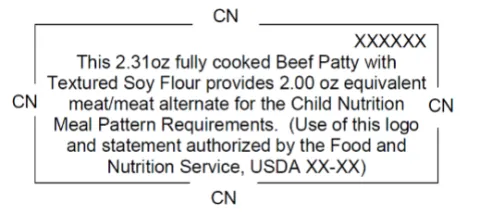
Note: The X’s in the sample CN Logo are only used to demonstrate the placement of the CN identification number and the final date. If you receive a CN-labeled product containing all X’s (all zeroes or non-number symbols) for the CN identification number, the label is not valid. If a CN label is not valid, FNS cannot provide a warranty for its use toward meal pattern requirements.
The CN label is the gold standard for verifying the crediting of menu items and provides a warranty against audit claims when the product is used according to the manufacturer’s instructions.
Acceptable and valid documentation for the CN label includes:
- The original CN label removed from the product carton.
- A photocopy of the CN label shown attached to the original product carton.
- A photograph of the CN label shown attached to the original product carton.
- A CN label copied with a watermark displaying the product name and CN number provided by the vendor and the Bill of Lading (invoice).
CN labels that are photocopied or photographed must be visible and legible.
CN Label Verification System
The CN Label Verification System is available at the USDA website to assist the CACFP sponsors in verifying the status of a CN label as well as the crediting information.
Dates related to CN Labels
Once authorized, CN labels are valid for five years under the condition that the manufacturer remains an authorized CN producer and the product formulation does not change. The date printed on the CN label is the original date of authorization or the date of the most recent authorization for use of that CN label. This is different from the “Valid Until” date shown on the CN Label Verification Report, which indicates when the current authority to use the label expires. Manufacturers may choose to leave the original authorization date on the label when they receive reauthorization of their CN label so that the label inventories do not go to waste. For example, if a CN label was originally authorized on February 15, 2024, it is valid until February 15, 2029. The manufacturer may resubmit the same product for reauthorization of the CN label. If reauthorization is granted, the “Valid Until” date is updated to five years from the most recent date of the authorization on the CN Label Verification Report, but the date on the CN label may remain as 02/24.
Requirements for Documenting Watermarked CN Labels
A CN label copied with a watermark is used when the CN logo and contribution statement are presented on product information separate from the actual product carton. Manufacturers may provide program sponsors with a watermarked CN label during the bidding process. (Note: original CN labels on product cartons will not have a watermark.) Program sponsors should be aware that product information on the watermarked CN label can be changed. Therefore, program sponsors are encouraged to verify that the watermarked CN label came from a product that was purchased and accurately reflects that product.
A watermarked CN label, along with the Bill of Lading (invoice), is acceptable documentation for a state agency monitoring process. Valid and acceptable documentation for the watermarked CN label includes:
- a hard copy of the CN label copied with a watermark displaying the product name and CN number provided by the vendor; or
- an electronic copy of the CN label with a watermark displaying the product name and CN number provided by the vendor.
Product Formulation Statements (PFS)
The PFS should only be requested when reviewing a processed product without a CN label. PFSs are written and provided by individual manufacturers and are not commonly seen with CACFP sponsors. It is the sponsor’s responsibility to request and verify that the processed food documentation is accurate prior to purchasing processed products.
PFS templates for each meal component are available on USDA’s CN labeling website. Manufacturers may use PFS templates as a guide to help develop a PFS, which are available at the USDA website. However, they are not required to use the same format as the USDA’s template, but they must present the same information on their company letterhead. It should be noted that a PFS does not provide any warranty against audit claims. Unlike CN labels, a PFS that claims a meal pattern contribution is not a guarantee of USDA meal pattern compliance and can be disputed during a CACFP monitoring review.
The answer to each of the following questions should be yes:
- Is the PFS on signed company letterhead? The signature can be handwritten, stamped, or electronic.
- Does the PFS include product name, product code number, and serving/portion size?
- Do the creditable ingredients listed on the PFS match or have a similar description to the ingredients listed on the product label? For example, if the PFS lists ground beef (not more than 20% fat), the product label should also list ground beef (not more than 20% fat).
- Do the creditable ingredients listed on the PFS match or have a similar description to a food item listed in the USDA Food Buying Guide for Child Nutrition Programs?
- If the product is a meat/meat alternate, does it contain an Alternate Protein Product (APP) such as soy concentrate? If yes, does the manufacturer provide supporting documentation that meets USDA APP requirements?
- Does the PFS demonstrate how creditable ingredients contribute toward the meal pattern requirements?
- Are the manufacturer’s calculations correct and verified?
The PFS should include:
- Weight of raw portion; percent of raw meat or poultry; percent of fat of raw meat.
- Weight of an APP, if applicable; percent of an APP on an as-is basis for the as-purchased product; certification that an APP meets the USDA, FNS requirements.
- Product’s total creditable amount of product per portion towards the meal pattern.
- Certification statement that the PFS is an accurate verification of meal pattern compliance.
- Original signature and title of company official and date.
Helpful Resources
Additional guidance and technical assistance related to CN labels and PFS may be found on the USDA website, particularly on “Manufacturer Documentation: Child Nutrition Labels and Product Formulation Statements” and “Tips for Evaluating a Manufacturer's Product Formulation Statement.”
USDA’s CN Labeling Website includes a general background of the CN Labeling Program and provides helpful information for food manufacturers and child nutrition programs. It can be accessed at the USDA website or from the USDA Food Buying Guide for Child Nutrition Programs - Appendix C.
The CN Label Verification Reporting System can also be accessed from the link and from Appendix C. The system was developed to assist state reviewers, program sponsors, and the food industry in verifying the status and validity of a CN label. The system produces two reports monthly:
- The CN Label Verification Report includes all information pertaining to the valid CN label, which includes the crediting information (meal pattern contribution statement), label expiration date, and the manufacturer’s establishment number.
- The CN Label Manufacturers Report includes contact information for manufacturers that are authorized to produce CN labeled products. This report allows users to link the manufacturer’s list from the CN Label Verification Report.
These reports can be found at the USDA website.
Product Formulation Statement (PFS) – Approved Example:

All documentation regarding processed foods must be maintained in the sponsor files. If no information is available at the time of a monitoring review, meals containing processed foods may be disallowed.
Procurement and Contracting for Food Services
CACFP Manual for Emergency Shelters
Emergency shelters participating in CACFP who plan to purchase meals or services from outside sources must follow procurement procedures.
Procurement Methods
Sponsors participating in the Child and Adult Care Food Program (CACFP) who plan to purchase meals or services from outside sources must follow proper procedures in purchasing these services.
All procurement of food, supplies, goods, and other services with program funds must comply with procurement standards in 2 CFR 200.317-326, 2 CFR part 400 and part 415, and Food and Nutrition Services (FNS) Instruction 796-2, Rev. 4, program-specific regulations in 7 CFR 226.22, as well as State Regulations and local policies. These standards ensure that such materials and services are obtained for the program efficiently and economically and in compliance with applicable laws and executive orders.
Important Terms
- Bid means an offer to perform for a fixed price in accordance with the specifications and conditions set forth in an invitation for bids.
- Food Service Management Company (FSMC) Under the CACFP, an FSMC means an organization other than a public or private nonprofit school with which a sponsor may contract for preparing and, unless otherwise provided for, delivering meals, with or without milk for use in the program (7 CFR 226.2).
- Procurement means the process of obtaining goods and/or services in accordance with applicable rules and regulations.
- School Food Authority (SFA) means the governing body that is responsible for the administration of one or more schools and has legal authority to operate the National School Lunch Program (NSLP) or School Breakfast Program (SBP) therein or be otherwise approved by FNS to operate the program.
- Vendor means a merchandiser of complete meals, meal components, or raw materials.
Methods of Procurement
There are three types of procurement methods described in this section: informal procurement methods (for micro-purchases and simplified acquisitions); formal procurement methods (through sealed bids or proposals); and noncompetitive procurement methods. For any of these methods, the recipient or subrecipient must maintain and use documented procurement procedures, consistent with the standards of this section and 7 CFR 200.317, 7 CFR 200.318, and 7 CFR 200.319.
- Informal Procurement Methods for Small Purchases - These procurement methods expedite the completion of transactions, minimize administrative burdens, and reduce costs. Informal procurement methods may be used when the value of the procurement transaction under the Federal award does not exceed the simplified acquisition threshold as defined in 7 CFR 200.1. The CACFP sponsor may also establish a lower threshold. Informal procurement methods include:
- Micro-purchases are those purchases that do not exceed $15,000 per transaction. These purchases can be awarded without soliciting competitive quotations if the price is reasonable based on research, experience, purchase history, or other information, and the sponsor maintains related documentation on file. The sponsor should also equitably distribute purchases among qualified suppliers rather than buying all supplies from one source.
- Simplified Acquisitions (Small Purchases) are those between $15,000 and $350,000 per transaction. These purchases can be made using informal methods, such as price or rate quotations for securing products or services. The methods used must ensure free and open competition. The sponsor must contact at least three reputable companies to obtain price quotations for any purchase they plan to make. This information must be documented. If an aggregate purchase exceeds $50,000 or the selected bid is not the
lowest price, it must be submitted to the State Agency for approval before acceptance. These quotes/bids must meet all federal regulations, including not contracting with a company that poses a conflict of interest.
A bid packet that includes the informal competitive bid procedures and forms for meal service contracts $350,000 or less can be found at the CACFP website [NEEDS LINK] under Food Service Management Contracts. All food service management contracts must be submitted to the State Agency for approval before acceptance.
- Large Purchases or Competitive Sealed Bids: When purchases are estimated to exceed the simplified acquisition threshold of $350,000, a sponsor must conduct a price analysis and follow a formal competitive sealed bid process. Bids are publicly solicited from two or more responsible bidders, and a bid opening evaluation must be completed by the Department of Health and Senior Services, Community Food and Nutrition Assistance (DHSS-CFNA). Competitive sealed bid procedures include preparing the invitation for bid, publicly announcing not less than 14 days before bids are opened, notifying the DHSS-CFNA of the time and place at least 14 days before bid opening, publicly opening all bids, and submitting a selected bid to the DHSS-CFNA before accepting the bid. These bids must be approved by the State Agency before the final acceptance. These bids must meet all federal regulations, including not contracting with a company that poses a conflict of interest.
A bid packet that includes the formal competitive bid procedures and forms for meal service contracts greater than $350,000 can be found at http://health.mo.gov/cacfp under Food Service Management Contracts.
When using vended meals, FSMC contracts must be current to receive reimbursement for those meals. Be proactive about renewing your FSMC contract to avoid the expiration of the contract. Ensure that your FSMC contract and supporting documentation are fully completed and accurate prior to submitting them. Submit them to the State agency as soon as possible to allow time for processing and approval of the contract.
If your FSMC contract expires, vended meals served during the period without a valid FSMC contract may not be eligible for reimbursement. Meal reimbursement will only resume after your FSMC contract is renewed and approved by the State agency.
Procurement Standards
Sponsors participating in the Child and Adult Care Food Program (CACFP) who plan to purchase meals or services from outside sources must follow proper procedures in purchasing these services.
All procurement of food, supplies, goods, and other services with program funds must comply with procurement standards in all state and local laws and regulations, as well as the Federal Standards identified in 7 CFR 226.22, 2 CFR 200.317-326, 2 CFR parts 400 and 415, and Food and Nutrition Services (FNS) Instruction 796-2, Rev. 4. These standards ensure that such materials and services are obtained for the program efficiently and economically and in compliance with applicable laws and executive orders.
Federal regulations 2 CFR 200 require that all sponsors of federally funded child nutrition programs maintain written procurement documents, which include a code of conduct and procurement procedures. These can be written in two separate documents or combined into one document.
Code of Conduct
Sponsors must maintain written standards of conduct covering conflicts of interest and governing the actions of their employees engaged in the selection, award, and administration of contracts as described in 2 CFR 200.318(c).
- No employee, officer, agent, or board member with a real or apparent conflict of interest may participate in the selection, award, or administration of a contract supported by the Federal award.
- A conflict of interest includes when the employee, officer, agent, or board member, any member of their immediate family, their partner, or an organization that employs or is about to employ any of the parties indicated herein, has a financial or other interest in or a tangible personal benefit from an entity considered for a contract.
- An employee, officer, agent, or board member of the sponsor may neither solicit nor accept gratuities, favors, or anything of monetary value from contractors. However, the sponsor may set standards for situations where the financial interest is not substantial or a gift is an unsolicited item of nominal value.
- The sponsor’s standards of conduct must also provide for disciplinary actions to be applied for violations by its employees, officers, agents, or board members.
If the CACFP sponsor has a parent, affiliate, or subsidiary organization that is not a state, local government, or Indian Tribe, the sponsor must also maintain written standards of conduct covering organizational conflicts of interest. Organizational conflicts of interest mean that, because of relationships with a parent company, affiliate, or subsidiary organization, the CACFP sponsor is unable or appears to be unable to be impartial in conducting a procurement action involving a related organization.
Procurement Procedures
Sponsors must maintain and use written procurement procedures that are consistent with state and local laws and regulations, as well as the Federal Standards identified in 7 CFR 226.22, 2 CFR 200.317-326, and Food and Nutrition Services (FNS) Instruction 796-2, Rev. 4, for all procurements made with CACFP funds. The procedures must also conform to procurement requirements that may be established by the State agency, with the approval of FNS, to prevent fraud, waste, and Program abuse.
Sponsors may use their own procurement procedures that reflect applicable State and local laws and regulations, if procurements made with Program funds conform with the provisions of this section and with procurement requirements that may be established by the State agency, with the approval of FNS, to prevent fraud, waste, and Program abuse.
The written procurement procedures should include the applicable method(s) of procurement. The following information, as well as additional information found in 7 CFR 226.22, 2 CFR 200.317-326, and Food and Nutrition Services (FNS) Instruction 796-2, Rev. 4 should also be included in the written procedures as appropriate to the needs of the sponsor:
Oversight of Contractors/Vendors
2 CFR 200.318(b)
CACFP sponsors must also maintain oversight to ensure that their contractors perform according to the terms, conditions, and specifications of their contracts or purchase orders.
Avoidance of Unnecessary or Duplicative Items
2 CFR 200.318(d)
The sponsor's procedures must avoid the acquisition of unnecessary or duplicative items. Consideration should be given to consolidating or breaking out procurements to obtain a more economical purchase. When appropriate, an analysis should be made between leasing and purchasing property or equipment to determine the most economical approach.
Procurement Arrangements Using Strategic Sourcing
2 CFR 200.318(e)
When appropriate for the procurement or use of common or shared goods and services, CACFP sponsors are encouraged to enter into State and local intergovernmental agreements or inter-entity agreements for procurement transactions. These or similar procurement arrangements using strategic sourcing may foster greater economy and efficiency. Documented procurement actions of this type (using strategic sourcing, shared services, and other similar procurement arrangements) will meet the competition requirements of this part.
Use of Excess and Surplus Federal Property
2 CFR 200.318(f)
Sponsors are encouraged to use excess and surplus Federal property instead of purchasing new equipment and property when it is feasible and reduces project costs.
Responsible Contractors/Vendors
2 CFR 200.318(h)
CACFP sponsors must award contracts only to responsible contractors who possess the ability to perform successfully under the terms and conditions of a proposed contract. When conducting a procurement transaction, the sponsor must consider contractor integrity, public policy compliance, proper classification of employees (see the Fair Labor Standards Act, 29 U.S.C. 201, chapter 8), past performance record, and financial and technical resources. See also 2 CFR 200.214.
Procurement Records
2 CFR 200.318(i)
The CACFP sponsor must maintain records sufficient to detail the history of each procurement transaction. These records must include the rationale for the procurement method, contract type selection, contractor selection or rejection, and the basis for the contract price.
The following records will be maintained for a period of three years plus the current year:
- Written rationale for the method of procurement;
- Copy of the IFB or RFP;
- The selection of contract type;
- The bidding and negotiation history and working papers;
- The basis for contractor selection;
- Approval from the State agency to support a lack of competition when competitive bids or offers are not obtained;
- The basis for award cost or price;
- The terms and conditions of the contract;
- Any changes to the contract and negotiation history;
- Billing and payment records;
- A history of any contractor claims; and/or any contractor breaches.
- Logs of all emergency and noncompetitive purchases
Settlement of Contractual and Administrative Issues
2 CFR 200.318(k)
The CACFP sponsor is responsible for the settlement of all contractual and administrative issues arising out of its procurement transactions. These issues include but are not limited to, source evaluation, protests, disputes, and claims. These standards do not relieve the sponsor of any contractual responsibilities under its contracts. The Federal agency will not substitute its judgment for that of the sponsor unless the matter is primarily a Federal concern. The sponsor must report violations of law to the Federal, State, or local authority with proper jurisdiction.
Inclusion of Small Businesses, Minority Businesses, Women’s Business Enterprises, Veteran-Owned Businesses, and Labor Surplus Area Firms
2 CFR 200.321
Sponsors must follow the practices specified in 2 CFR part 200 Subpart D and USDA implementing regulations 2 CFR part 400 and part 415, as applicable, with respect to small businesses, minority businesses, women's business enterprises, veteran-owned businesses, and labor surplus area firms:
- These business types are included on solicitation lists,
- These business types are solicited whenever they are deemed eligible as potential sources,
- Dividing procurement transactions into separate procurements to permit maximum participation by these business types,
- Establishing delivery schedules that encourage participation by these business types,
- Utilizing organizations such as the Small Business Administration and the Minority Business Development Agency of the Department of Commerce, and
- Requiring a contractor under a Federal award to apply this section to subcontracts.
Contract Cost and Price
2 CFR 200.324
The CACFP sponsor must perform a cost or price analysis for every procurement transaction, including contract modifications, in excess of the simplified acquisition threshold of $250,000. The method and degree of analysis conducted depend on the facts surrounding the particular procurement transaction, but as a starting point, the sponsor must make independent estimates before receiving bids or proposals. Costs or prices must be allowable and must comply with 7 CFR 226 and 2 CFR Part 200 Subpart E. The use of “cost plus a percentage of cost” and “percentage of construction costs” methods of contracting is not allowed.
Competition Requirements in Procurement
2 CFR 200.319
All CACFP procurement transactions must be conducted in a manner that provides full and open competition and is consistent with the standards of 2 CFR 200.319 and 2 CFR 200.320. The sponsor must have written procedures for procurement transactions that ensure that all solicitations:
- Are made to ensure objective contractor performance and eliminate an unfair competitive advantage; contractors that develop or draft specifications, requirements, statements of work, or invitations for bids must be excluded from competing on those procurements. Examples of situations that may restrict competition include, but are not limited to:
- Placing unreasonable requirements on firms for them to qualify to do business.
- Requiring unnecessary experience and excessive bonding.
- Noncompetitive pricing practices between firms or between affiliated companies.
- Noncompetitive contracts to consultants that are on retainer contracts.
- Organizational conflicts of interest.
- Specifying only a “brand name” product instead of allowing “an equal” product to be offered and describing the performance or other relevant requirements of the procurement.
- Any arbitrary action in the procurement process.
- Incorporate a clear and accurate description of the technical requirements for the property, equipment, or service being procured. The description may include a statement of the qualitative nature of the property, equipment, or service to be procured. When necessary, the description must provide minimum essential characteristics and standards to which the property, equipment, or service must conform. Detailed product specifications should be avoided if possible. When it is impractical or uneconomical to describe the technical requirements clearly and accurately, a “brand name or equivalent” description of features may be used to provide procurement requirements. The specific features of the named brand must be clearly stated.
- Identify any additional requirements that the offerors must fulfill and all other factors that will be used in evaluating bids or proposals.
The sponsor must ensure that all prequalified lists of persons, firms, or products used in procurement transactions are current and include enough qualified sources to ensure maximum open competition. When establishing or amending prequalified lists, the sponsor must consider objective factors that evaluate price and cost to maximize competition. The sponsor must not preclude potential bidders from qualifying during the solicitation period. To the extent consistent with established practices and legal requirements applicable to the sponsor, the sponsors are not prohibited from developing written procedures for procurement transactions that incorporate a scoring mechanism that rewards bidders that commit to specific numbers and types of U.S. jobs, minimum compensation, benefits, on-the-job-training for employees making work products or providing services on a contract, and other worker protections. Sponsors are also not prohibited from making inquiries of bidders about these subjects and assessing the responses. Any scoring mechanism must be consistent with the U.S. Constitution, applicable Federal statutes and regulations, and the terms and conditions of the Federal award.
In accordance with 2 CFR 200.320(c), non-competitive procurement may only be used if one of the following circumstances applies:
- The aggregate amount of the procurement transaction does not exceed the micropurchase threshold (see paragraph (a)(1) of this section);
- The procurement transaction can only be fulfilled by a single source;
- The public exigency or emergency for the requirement will not permit a delay resulting from providing public notice of a competitive solicitation;
- The sponsor requests in writing to use a non-competitive procurement method, and the Federal agency or State agency provides written approval
- After soliciting several sources, the competition is determined to be inadequate.
Federal Agency or State Agency Review
2 CFR 200.325
The Federal agency or State agency may conduct a procurement review as described in 2 CFR 200.325. The CACFP sponsor must submit documents when requested for the procurement review.
Bonding Requirements
2 CFR 200.326
Large purchases that exceed the simplified acquisition threshold of $250,000 have the following bonding requirements:
- A bid bond must be provided at the bid in an amount not less than five (5) percent and not more than ten (10) percent, as determined by the sponsor, of the value of the contract for which the bid is made.
- A performance bond must be provided in an amount not less than 10 percent or more than 25 percent of the value of the contract for which the bid is made.
Contract Provisions
2 CFR 200.327
The sponsor’s contracts must contain the applicable provisions contain the applicable provisions described in Appendix II to Part 200 – Contract Provisions for Non-Federal Contracts Under Federal Awards.
Geographic Preference
7 CFR 226.22(c)
Sponsors participating in the Program may apply a geographic preference when procuring unprocessed locally grown or locally raised agricultural products, including the use of “locally grown,” “locally raised,” or “locally caught” as procurement specifications or selection criteria for unprocessed or minimally processed food items. When utilizing the geographic preference to procure such products, the sponsor making the purchase has the discretion to determine the local area to which the geographic preference option will be applied, so long as there are an appropriate number of qualified firms able to compete.
For the purpose of applying the optional geographic preference, “unprocessed locally grown or locally raised agricultural products” means only those agricultural products that retain their inherent character. The effects of the following food handling and preservation techniques shall not be considered as changing an agricultural product into a product of a different kind or character:
- Cooling; refrigerating; freezing.
- Size adjustment made by peeling, slicing, dicing, cutting, chopping, shucking, and grinding.
- Forming ground products into patties without any additives or fillers.
- Drying/dehydration.
- Washing.
- Packaging (such as placing eggs in cartons), vacuum packing and bagging (such as placing vegetables in bags or combining two or more types of vegetables or fruits in a single package).
- Addition of ascorbic acid or other preservatives to prevent oxidation of produce.
- Butchering livestock and poultry.
- Cleaning fish.
- The pasteurization of milk.
Meal Preparation and Contracting for Food Services
The best method of meal preparation will depend on factors such as the type of menu desired, the availability of food service equipment, space and personnel, and the budget of the organization.
Meal Preparation Methods
- On-Site: On-site preparation, commonly called “self-prep,” is the most commonly used food service method. Meals are prepared at the same physical location where they are served. This is the most economical method when the center has a kitchen, sufficient food preparation equipment, and available staff. The sponsor will follow the basic recordkeeping requirements of the Child and Adult Care Food Program (CACFP).
All or part of the food may be prepared on-site, and the remainder purchased by the sponsor from an outside source, such as a school, hospital, commercial vendor, or farmers market. The Food and Nutrition Service (FNS) Instruction 796-2, Rev. 4 provides guidance for funding food grown by and used in the child care center’s meals. This option offers education opportunities and may decrease food costs. - Central Kitchens: Meals are prepared in a kitchen at one of the sponsor’s physical locations or sites by the sponsor’s employees and delivered to one or more of the sponsor’s sites. The sponsor will follow the basic recordkeeping requirements of the CACFP. When applicable, the central kitchens should use daily meal delivery tickets when delivering food to the sites, such as the Daily Meal Receiving Log, which is available on the CACFP webpage at www.health.mo.gov/cacfp under Forms. Contact the Department of Health and Senior Services- Community Food and Nutrition Assistance (DHSS-CFNA) for specific requirements for your circumstances.
- Vended: Meals are purchased from a School, a Food Service Management Company (FSMC), or a Commercial vendor. This includes an FSMC that operates within a school.
- Purchasing from a School: Meals may be purchased from a public or private nonprofit school that participates in the National School Lunch Program (NSLP) or the School Breakfast Program (SBP), either in bulk or as individually packaged units. An independent center that receives meals from a school must enter into a written agreement with that school or district. An example of this type of agreement is when a school provides meals to a Head Start center.
This annual agreement must contain the basic provisions of the program requirements and the non-competitive bid process. A sponsor may use the Sponsor Agreement with a School or Affiliated Organization to Furnish Food Service for the CACFP located on the CACFP website. Federal regulations exempt organizations from having to bid competitively for catered meals when those meals are purchased through schools participating in the NSLP or SBP. Signing an agreement with a school to provide meals does not relieve the independent center of its program responsibilities for monitoring and recordkeeping. Additional recordkeeping is required when a sponsor obtains meals from a school; recordkeeping requirements are listed below. - Purchasing from another Department within the Organization: Organizations that receive meal services obtained through a competitive process by another department of the same organization, such as a university child care center whose meal services are provided by the campus dining hall or campus student union, may also use a non-competitive process to obtain CACFP meals. Such organizations may sign an agreement with the food service caterer contracted by the organization to provide meals for the entire organization. This type of situation is common in large organizations such as hospitals, nursing homes, schools, governmental entities, and universities, where food services are centralized. As long as the meals provided to the centralized food service were obtained through a competitive manner within a formal bid process, those same services may be used by the CACFP organization. A sponsor may use the Sponsor Agreement with a School or Affiliated Organization to Furnish Food Service for the CACFP located on the CACFP website when obtaining meals in this manner.
- Purchasing from a Food Service Management Company: Food service management companies are organizations that prepare and deliver meals. An independent center that purchases meals from an FSMC must enter into a written contract with the company. The bid prototypes and CACFP guidance on meeting procurement standards are located on the CACFP website. Signing a contract with an FSMC does not relieve the center of its program responsibilities for monitoring and recordkeeping. Regulations require that a copy of the contract be submitted to DHSS-CFNA before the beginning of program operations under the contract, and all bids totaling over $350,000 shall be submitted for state agency approval before the sponsor accepts and signs any contract. In addition, all bids shall be submitted to the state agency for approval before accepting a bid that exceeds the lowest bid. DHSS-CFNA shall respond to any request for approval within ten working days of receipt (7 CFR 226.21).
- Purchasing from a Commercial Vendor: Commercial vendors are public organizations, hospitals, college cafeterias, etc., private commercial enterprises, caterers, or individuals that provide non-food items or individual food items but not complete meals. An independent center that purchases from a commercial vendor must enter into a written contract with the vendor following the guidelines for the formal or informal competitive bid process, depending on annual meal expenditures.
- Purchasing from a School: Meals may be purchased from a public or private nonprofit school that participates in the National School Lunch Program (NSLP) or the School Breakfast Program (SBP), either in bulk or as individually packaged units. An independent center that receives meals from a school must enter into a written agreement with that school or district. An example of this type of agreement is when a school provides meals to a Head Start center.
Additional recordkeeping is required when a CACFP sponsor obtains meals from a school. The school or school district that provides meals to sponsors under an agreement must provide the following documentation to the CACFP contractor on a weekly or no less than a monthly basis:
- Food costs to substantiate the reimbursement.
- Daily dated menus using a minimum of a two-week menu cycle.
- Daily meal delivery tickets to verify the amount of food and/or number of meals provided to the center.
- Food Production Records.
In addition to the records required under the agreement, the commercial vendor must provide the following documentation to the CACFP sponsor on a daily, weekly, or no more than a monthly basis:
- Documentation of paid invoices to verify contractual accountability.
- Meals per labor hour recordkeeping to document staff allocation.
Federal regulations prohibit sponsors from contracting out the management responsibilities of the CACFP, including but not limited to:
- Ordering meals.
- Maintaining program records.
- Submitting claims for meal reimbursement.
- Training and monitoring.
- Determining eligibility for free or reduced-price meals.
The sponsor must monitor the conditions set forth in the food service contract and ensure compliance with CACFP requirements. The DHSS-CFNA will not intervene in contract disputes.
Meals served must conform to the cycle menus upon which the bid was based and to menu changes agreed upon by the facility and FSMC per 7 CFR 226.6(i)(4).
In accordance with 7 CFR 226.6(i)(7), the FSMC shall not be paid for meals delivered outside of the agreed-upon delivery time, which are spoiled or unwholesome at the time of delivery, or which do not otherwise meet the meal requirements contained in the contract.
The FSMC shall maintain such records (supported by invoices, receipts, or other evidence) and shall promptly submit invoices and delivery reports to the facility no less frequently than monthly. (7 CFR 226.6(i)(2))
It is the responsibility of the sponsor to monitor the requirements of the agreement for compliance with the CACFP requirements. First-occurrence meal disallowances will be taken at the CACFP monitoring reviews in the following instances:
- There is no or inadequate processed food documentation, such as CN labels.
- There are no production records.
- The production records indicate that the caterer did not provide enough food to meet the minimum portion requirement.
A Daily Meal Receiving Log and a Meal Communication and Credit Log are available in this manual and at the CACFP website [NEEDS LINK] under Forms for sponsors to document the date and time food was received at the center, food temperatures, and any problems with the foods received.
The procedures for the informal and formal bid processes are available on the CACFP website at the CACFP website [NEEDS LINK] under Food Service Management Contracts. These include:
- Bid Packet for Contracts $350,000.00 or less
- Bid Packet for Contracts greater than $350,000.00
- Annual Extension for Contracts greater than $350,000.00
- Sponsor Agreement with a School or Affiliated Organization
Production Record for the Child and Adult Care Food Program
Daily Meal Receiving Log for sponsors to document the date and time food was received at the center, food temperatures, and any problems with the foods received.
Meal Communication and Credit Log available for sponsors to document the date and time food was received at the center, food temperatures, and any problems with the foods received.
Sponsoring Organizations
CACFP Manual for Emergency Shelters
Sponsoring organizations (SOs) oversee the operations of two or more facilities. SOs have additional responsibilities.
Sponsoring Organization Reviews
Sponsoring Organization Additional Review Requirements
A sponsoring organization (SO) is a Child and Adult Care Food Program (CACFP) contractor responsible for two or more facilities. Each SO must provide adequate supervisory and operational personnel for the effective management and monitoring of the program at all facilities it sponsors. Each SO must provide pre-approval visits, training, and ongoing monitoring to the facilities they oversee.
Pre-Approval Visits
Visits to each new facility to discuss program benefits and verify that the proposed food service does not exceed the capability of the facility.
Training
Key staff from all sponsored facilities must be trained on program duties and responsibilities prior to the beginning of program operations. At a minimum, such training must include instruction appropriate to the level of staff experience and duties on program meal patterns, meal counts, claims submission and review procedures, recordkeeping requirements, reimbursement system, and civil rights compliance.
Monitoring Review Visits
Each facility under the SO’s jurisdiction must be monitored for CACFP compliance. The SO must document all reviews and retain them in the sponsor location identified in the Management Plan. These monitoring recordkeeping requirements do not apply to independent facilities.
SOs must conduct three monitoring review visits for each facility every year:
- At least two of the three reviews must be unannounced; however, Department of Health and Senior Services-Community Food and Nutrition Assistance (DHSS-CFNA) recommends that all monitoring visits be unannounced.
- The timing of the unannounced reviews should be varied in a way that would ensure that they are unpredictable to the sponsored facility.
- At least one unannounced monitoring visit must be conducted during a meal service.
- The unannounced reviews should also vary the type of meal service that is reviewed.
- If a facility operates in the evening and/or on weekends or holidays, one review must be conducted each year on weekends, holidays, or during the supper meal when claiming meals under these conditions.
- No more than six months may lapse between monitoring visits.
- The SO must review all new facilities within the first four weeks of program operation.
- All monitoring visits must be documented on the Sponsored Centers Site Visit Report – Review by Sponsor form (CACFP-404) or a form approved by DHSS-CFNA.
- The sponsor must follow up with facilities that have been noted as having problems during monitoring visits.
- The follow-up visit must be conducted no less than one week after the initial finding, and the visit must be documented.
Reconciliation Of Meal Counts
As part of the monitoring review visits, an SO must examine the meal counts recorded by the sponsored facility for five consecutive days during the current and /or prior claiming period. For each day examined, the reviewer will compare meal count records to both attendance and enrollment records to reconcile those numbers to the number of breakfasts, lunches, suppers, and/or snacks recorded on the meal count records to determine if meal counts were accurate. A five-day reconciliation of attendance/enrollment/meal count verification is included in the Sponsored Centers Site Visit Report – Review by Sponsor form (CACFP-404).
Sponsoring Organization’s Household Contact Requirement
Household contacts, sometimes referred to as parent audits or parent contacts, are required to be made by SOs when a child care center under a SO’s jurisdiction is suspected of CACFP mismanagement.
The SO will use the survey form developed by DHSS-CFNA or develop a form of their choosing to collect information from parents. The survey method, mail, phone, or email, chosen by the SO to contact parents is up to the SO to determine. It is strongly recommended that parents be informed of the procedure to be used to contact them when the parent completes the child’s enrollment form.
Parents should be strongly encouraged to support SO efforts to contact them, as the outcome of the contacts can impact the quality of care provided to their child. Centers shall be required to cooperate in the event of a parent audit. If a parent informs a center that he/she has been contacted by the SO or state or federal officials, the center must encourage the parent to cooperate fully. Any effort on the part of a child care center to interfere in any way with a household contact would be the basis for a declaration of serious deficiency.
To assure a good response to a household contact, the SO shall survey parents as follows:
- 10 or fewer children enrolled: 100% of parents surveyed.
- 11 to 30 children enrolled: 75% of parents surveyed.
- 31 to 50 children enrolled: 50% of parents surveyed.
- 51 to 100 children enrolled: 25% of parents surveyed.
- 101 or more children enrolled: 20% of parents surveyed.
Efforts made to contact a parent by any means, including phone, must be documented.
SOs shall strive for a 50% response rate on household contacts, particularly for centers with 20 or fewer children enrolled. If a 50% response rate is not achieved for centers with 20 or fewer children enrolled, the SO must conduct additional follow-up with parents to obtain the necessary responses. Response rates for centers with larger enrollments may be less than 50%; however, a minimum of eight parent responses is required.
All monitoring visits must be documented on the Sponsored Centers Site Visit Report – Review by Sponsor form (CACFP-404) or a form approved by DHSS-CFNA.
Recordkeeping
CACFP Manual for Emergency Shelters
Maintaining accurate records is vital to ensure CACFP reimbursement accurately reflects the emergency shelter’s program operations.
Required Recordkeeping
Shelters are required to maintain records to support the monthly claim for reimbursement and comply with program regulations. All records shall be retained for a period of three years after the date of submission of the final claim for the fiscal year to which they pertain. If audit findings have not been resolved, the records shall be retained beyond the end of the three-year period for as long as may be required for the resolution of the issues raised by the audit. All records must be maintained at the shelter and must be available for audit at all times.
Shelters Shall Maintain The Following Records:
Copies Of All menus
Menus must be dated and indicate all components served. If the planned menu is changed, the food actually served must be written on the menu. Each facility must verify that the menu served to the participants meets the minimum meal pattern requirements. Food purchases, donation receipts, and invoices will be reviewed to ensure adequate food and milk purchases and donations are made and support the menu.
Resident Rosters
All participants claimed for reimbursement must be residents of the shelter. Shelters must maintain a master listing of residents*, their date of birth*, date they entered the shelter, date they left the shelter, and the signature of the director to verify the information. The resident roster must be updated daily. It is recommended that a new roster be completed each month.
Meals served in a congregate setting (group setting) to participants who reside in a shelter may be claimed for reimbursement. The shelter may serve meals to non-resident children and/or ineligible adults; however, these meals are not reimbursable under the program. The shelter will have to differentiate between participants residing in the shelter and those who may be served meals as “walk-ins.”
Children 18 years of age and younger are eligible to participate in the Child and Adult Care Food Program (CACFP). Individuals with disabilities, regardless of age, may also receive meals and snacks at the shelters where they reside.
Meals that are consumed in private family quarters in a shelter are not reimbursable. Only meals served in congregate meal settings are eligible for reimbursement. An exception may be made for infants from birth to 11 months of age served in private family quarters that are part of a shelter. Those meals may be reimbursable if the shelter provides the required meal components to the parents or guardians and maintains records documenting that sufficient food has been provided to meet the minimum meal pattern requirements for infants.
Meal Count Records
Daily meal count records must be maintained for each qualified participant who resides in the shelter. The resident rosters should support the meal count records. For example, if John Doe was claimed for a meal on May 17, the resident rosters should indicate that John Doe was present on May 17 for that meal to be accurately claimed. The meal count record must indicate the daily number of meals served by type of meal (breakfast, lunch, supper, or snack). Shelter personnel must maintain a point-of-service meal count, which means that each meal is recorded on the meal count record as the meal is served to each participant. An exception to the meals being recorded at the point of service may be made for meals served in private family quarters that are part of an emergency shelter to infants from birth through 11 months. A maximum of three meals or two meals and one snack may be claimed per participant per day, seven days a week.
Recent Fire Safety Inspection And Sanitation Inspection.
The frequency of inspections may depend on local codes and regulations.
Documentation Of Training For Staff
Staff must be trained at least annually on all mandatory CACFP topics. Volunteers must be trained on Civil Rights at a minimum.
Non-Profit Food Service Verification
The shelter must have documentation to verify that all the CACFP reimbursement is being used solely to conduct or improve the food service operations. Non-profit food service verification includes:
- Documentation of income to the program. Income to the program includes all monies received from state, federal, or local government sources, any shelter funds used to subsidize the food service program, payments for adult meals, and any other income, including loans and donations to the food program.
- Documentation of food service expenditures. Food service expenditures include food purchase receipts or invoices, labor costs supported by payroll stubs and/or time studies, cost of expendable food service equipment, cost of maintaining nonexpendable food service equipment, and indirect costs. Expendable equipment has a durability of less than two years and costs $500 or less. Non-expendable equipment has a durability of two years or more and costs more than $500. Examples of indirect costs are rent, utilities, office supplies, etc. A portion of indirect costs can be charged to the CACFP if there is documentation available to support the charge.
Civil Rights Racial/Ethnic Data
All shelters must:
- Display the “And Justice For All” poster in a location visible to the public.
- Provide the nondiscrimination statement and procedure for filing a complaint in all shelter brochures that discuss the food program.
- Collect actual beneficiary data by racial/ethnic category.
- Display a “Building for the Future” poster in a location visible to the public.
- Provide informational materials in the appropriate translation regarding the CACFP.
Miscellaneous Documentation
The following miscellaneous documentation must be retained:
- Documents submitted to the Department of Health and Senior Services – Community Food and Nutrition Assistance (DHSS-CFNA) and
- The program contract (Scope of Work, Terms and Conditions as part of the contract)
*Per the Stewart B. McKinney Homeless Assistance Act, any victim service provider may not disclose “personally identifying information” or “personal information” about an individual, including a first and last name; a home or other physical address; contact information; a social security number; any other information, including date of birth, racial or ethnic background, or religious affiliation, that, in combination with any other non-personally identifying information, would serve to identify any individual.
Recordkeeping Responsibilities
Maintaining accurate records is vital to ensuring that the Child and Adult Care Food Program (CACFP) reimbursement accurately reflects the shelter’s program operations. CACFP forms are available at the CACFP website [NEEDS LINK] under Forms, and posters are available under Posters, Flyers, & Pamphlets.
CACFP original records, not photocopies, must be maintained on-site for independent facilities, be accessible during licensed business hours, and be available for review within one hour of a state representative’s arrival. Sponsoring Organizations (SOs) of two or more facilities must maintain original records during licensed business hours at the location identified in the Management Plan and be available for review within one hour of a state representative’s arrival. Community Food and Nutrition Assistance (CFNA) reviewers will request CACFP records for one month or more and have the authority to disallow up to twelve months of claims. Program records must be retained for three full fiscal years, plus the current year (October 1 through September 30), after the final claim for the fiscal year is submitted and for longer if audit findings have not been closed.
As a reminder, documents that prove compliance with CACFP regulations, including, but not limited to, menus, production records, delivery receipts, income eligibility forms, meal count records, and attendance records, shall not be altered. If additions/corrections are required, they must be made using ink. The incorrect information must be crossed out using one line so that the original information can still be read. Changes using pencils or white out shall be prohibited. All changes must be initialed and dated by the person making the correction.
Required Records
Meal Service Records
- Daily Meal Count Records (CACFP-225 or CACFP-225A) - Daily meal count records are required and must be recorded at the time of service (Point of Service) for each meal and snack the shelter is approved to claim for reimbursement. Keep current month records on a clipboard or in a binder. File these records with the monthly resident roster. File completed records in a binder or envelope labeled with the month and year.
- Daily Menu Records - Daily dated menus are required for each approved meal to verify CACFP meal pattern compliance. The original menu, noting any substitutions, must be retained. Keep the current active menu on a clipboard or in a folder. When completed, file the menu in the binder or envelope for the month.
- Donated Food Log - Record all food donations on the Donated Food Log. File the completed monthly log with the monthly menu records in a binder or envelope labeled with the month and year.
- Medical Statement to Request Special Meals and/or Accommodations (CACFP-227) - Required when food substitutions are necessary and authorized by a medical authority for participants with a diagnosed disability and with medical or special dietary needs. Keep confidential and place in individual participant’s file.
- Commercially Processed Food Documentation - If your shelter uses commercially processed foods, documentation of meal pattern contributions is required to include a Child Nutrition label or manufacturer's Product Formulation Statement. File in the binder or envelope for the month.
- Additional Meal Requirements - A shelter must maintain documentation to verify that the whole grain-rich requirement is met. This may include the grain product’s ingredient label. A shelter must maintain documentation to verify that the cereal and yogurt served are within the required sugar limits. This may include the product’s nutrition facts label.
If the shelter provides care for infants, the following forms are required:
- Individual Infant Meal Record form (MO 580-3186, MO 580-3188, MO 580-3185, or MO 580-3187) - Keep the active menu on a clipboard or in a folder. File the menu in the binder or envelope for the month.
Participant Records
- Monthly Resident Roster Shelters must maintain a list of participants by name, date of birth, and dates of residency. Resident rosters must be updated daily to ensure that there is an accurate record of attendance for all participants claimed for reimbursement. Keep the active roster on a clipboard or in a folder. File the roster in the binder or envelope for the month.
Records Pertaining to Financial Management and Administrative Costs
- Operating Costs - Allowable expenses for the preparation and service of meals include but are not limited to, food costs, food service labor, costs for certain non-food supplies, and costs of purchased services.
- Food Costs - Original, intact and legible, itemized food and milk receipts and invoices for food service supply purchases must be kept to verify that CACFP funds are used to support the food service. Handwritten receipts are not acceptable. File in a folder or envelope labeled with the month and year.
- Food Service Labor Costs - Independent shelter must document.
- Documentation of Nonprofit Foodservice CACFP-214 - This form must be completed monthly when total food costs are less than the CACFP claim. Place in a folder or envelope labeled with month and year.
Training Records
- Annual CACFP Training Documentation CACFP-222 - Documentation of annual CACFP training for the shelter staff and volunteers is required. The use of the CACFP form is not required, but training must include the topics required by the CACFP. File in a folder or notebook.
Other Required Records
- Original Contract Agreement, along with Amendments for the sponsoring agency
- Beneficiary Data Report CACFP-226 - Documentation of the annual completion of this form is required. File in a folder or notebook.
- Sanitation and Fire Inspection Records - File in a folder or notebook.
- Catered or Vended Meals, if applicable Sponsor must maintain:
- Food service management company contract or agreement.
- Current state or local health certification.
- Production Records CACFP-223 required and meal delivery records, if applicable.
- Evidence that the contractor was obtained using fair and competitive practices.
Sponsoring Organizations (SOs)
Contractors responsible for two or more facilities, either under the sponsor’s jurisdiction (affiliated) or under the corporate umbrella (unaffiliated), are required to maintain:
- Pre-approval visits to each new shelter under an SO.
- Sponsored Centers Site Visit Report (CACFP-404) - Each SO must monitor every shelter for program compliance at least three times per year in compliance with the regulations.
- Disbursements (unaffiliated facilities only) - Documentation of the dates and amount of reimbursement disbursed to each facility within five working days from the CACFP claim processing date is required.
Organizing Records
Suggested items to help you stay organized:
- 3-ring binders
- 3 hole punch
- Clipboards
- Colored highlighters
- File folders
- File box or cabinet
- 12 large envelopes, one for each month
Daily Duties
Complete these records daily and maintain them on a clipboard or in a folder. Ensure that all documents are dated. At the end of each month, file the original dated records with monthly records in an envelope or binder.
- Resident Rosters must be updated daily and filed monthly.
- Meal count records must be documented at the point of service. (One exception is that infants served in private family quarters can be documented when the parent reports the meal or snack to staff.)
- Menus - verify that each meal served meets Child and Adult Care Food Program (CACFP) meal pattern requirements. If substitutions are made, they must be written in on the menu.
- Food Production Records are required for shelters using a caterer or contract food service management company.
- Delivery Receipts are required for shelters using a central kitchen, caterer, or contract food service management company.
- Child Nutrition (CN) Labels and Product Formulation Statements (PFS) are required for purchased commercially processed food.
- Infant Meal Records are required if the shelter serves infants.
Weekly Duties
Add daily meal counts.
Monthly Duties
Retain these legible and intact original, dated records:
- Consolidate financial records: Machine generated dated and itemized food and milk receipts; Child Nutrition (CN) labels and PFS; Donated Food Log, itemized non-food program supplies; and program labor costs; documentation of non-profit food service.
- Prepare and submit the claim for reimbursement: consolidate and determine total attendance; consolidate meal counts and determine the total number of meals served for each meal. For-profit shelters must calculate to determine if you are eligible to claim. Submit the claim via CNPweb by the 10th of the month for payment around the 28th or by the 25th for payment around the 13th of the following month.
Yearly Duties
Shelters must maintain the original dated records by fiscal year, October 1st through September 30th.
- CACFP training documentation all required topics must be covered at least once a year.
- Medical Statement to Request Special Meals and/or Accommodations Current sanitation and fire inspections.
- Beneficiary data report (ethnicity and race), completed annually.
- Shelter visit monitoring reports for Sponsoring Organizations, 3 per facility per year.
- For contracted/catered meals, the original contract or agreement and annual renewal with Food Service Management Company
CACFP Record Retention: 3 Fiscal Years Plus The Current Year
Monthly: Place in a binder or envelope labeled with the month and year
- Daily dated menus
- Monthly Resident Rosters, updated daily
- Dated point-of-service meal count records. Infant meal count – count each meal once all of the age-appropriate components have been served.
- Financial records: food service expenses; labor and indirect cost records summarized on the Documentation of Non-Profit Service Form
- Donated Food Logs
Yearly: Place in a binder or envelope labeled with the year
- CACFP training documentation
- Requests of Special Meals and/or Accommodations
- CN labels or Product Formulation Statements
- Beneficiary Data Report
- Vended/catered meal agreements or contracts and annual contract renewals, if applicable
- Site visit monitoring reports, if applicable
- Sanitation and safety inspection
Resources
CACFP Manual for Emergency Shelters
This section provides many resources available to assist shelters participating in the CACFP.
Emergency Shelter Resources
The USDA website has a “CACFP in Emergency Shelters” page with links to related policy memos.
Some of these policy memos and their links are listed below:
- SP 05 CACFP 05-2018 Providing Child Nutrition Program Benefits to Disaster Survivor Evacuees (January 18, 2018)
- SP 46-2014, CACFP 12-2014, SFSP 18-2014 Disaster Response (May 19, 2014)
- CACFP 11-2007, Accommodations for Non-Traditional Program Operators (July 3, 2007)
- Participation of Emergency Shelters in the Child and Adult Care Food Program (CACFP)— Questions and Answers (March 14, 2000)
- CACFP#5-99 Homeless Shelters Receiving Commodities in the Child and Adult Care Food Program (CACFP) (August 18, 1999)
- CACFP#5-99 Participation of Emergency Shelters Serving Homeless Children (March 30, 1999)
Online Child Care Resources
The internet has a vast amount of information that can assist emergency shelters with their food service operations and the education of staff and children. Below are some resource recommendations that can also be found at our webpage under Resources.
- A Flash of Food Safety
- Choose My Plate
- DHSS Food Safety
- Academy of Nutrition and Dietetics; eatright.org
- Farm to Early Care and Education (ECE)
- Food Product Thermometer Calibration – Food Safety
- Institute of Child Nutrition
- ICN Child Care Center Food Allergy Fact Sheets
- Food Safety Resources
- Nutrition for Kids
- Recipes for Healthy Kids
- Serving Traditional Indigenous Foods
- Team Nutrition
- CACFP Meal Pattern Training Worksheets (English and Spanish)
- Crediting Tip Sheets in Child Nutrition Programs
- Mealtimes with Toddlers in the Child and Adult Care Food Program
- Offering Water in the USDA CACFP
- Tips for Family Style Dining
- Milk Aide
- Serving Meats and Meat Alternates at Breakfast
- Serving Meats and Meat Alternates at Lunch and Supper in the USDA CACFP
- Serving Vegetables in the CACFP
- Adding Whole Grains to your CACFP Menu
- Crediting Single-Serving Packages of Grains in the CACFP
- Crediting Store-Bought Combination Baby Foods in the CACFP
- Spanish Materials Available for Team Nutrition
- Training Resources on Using Ounce Equivalents for Grains
- Team Nutrition Quizzes
- Feeding Infants in the Child and Adult Care Food Program (English and Spanish)
- USDA Child and Adult Care Food Program
- USDA Civil Rights
- USDA Food Buying Guide for Child Nutrition Programs
- USDA Procuring Local Foods
- USDA Standardized Recipes
- WIC Approved Food List
Reducing the Risk of Choking in Young Children at Mealtimes
Children under the age of 4 are at a high risk of choking while eating. Young children are still learning how to chew food properly, and they often swallow the food whole. Their small airways can become easily blocked.
You can help reduce children’s risk of choking when eating by preparing food in certain ways, such as cutting food into small pieces and cooking hard food, like carrots, until it is soft enough to pierce with a fork. Remember, always supervise children during meals and snacks.
Prepare foods so they are easy to chew:
- Finely chop foods into thin slices, strips, or small pieces (no larger than ½ inches), grate, mash, or puree foods. This is especially important when serving raw fruits and vegetables, as they may be harder to chew.
- Small, round foods such as grapes, cherries, cherry tomatoes, and melon balls are common causes of choking. When serving these items to young children, slice them in half lengthwise and then into smaller pieces (no larger than 1/2“).
- Cut tube-shaped foods, such as baby carrots, string cheese, hot dogs, etc., into thin strips, rather than round pieces.
- In addition to the foods listed, avoid serving foods that are as wide around as a nickel, which is about the size of a young child’s throat.
- Remove all bones from fish, chicken and meat.
- Cook or steam hard foods, such as carrots, until it is soft enough to pierce with a fork
- Remove seeds, pits, and tough skins/peels from fruits and vegetables.
- Spread peanut butter thinly
Avoid Choking Hazards
To help prevent choking, do not serve small (marble-sized), sticky, or hard foods that are difficult to chew and easy to swallow whole, including:
- Cheese cubes or blocks. Grate or thinly slice cheese before serving.
- Chewing gum*
- Dried fruit
- Gummy fruit snacks*
- Hard candy, including caramels, cough drops, jelly beans, lollipops, etc.*
- Ice cubes*
- Marshmallows*
- Hard pretzels and pretzel chips
- Nuts and seeds, including breads, crackers, and cereals that contain nuts and seeds.
- Popcorn
- Spoonfuls of peanut butter or other nut butters. Spread nut butters thinly on other foods (e.g., toast, crackers, etc.) Serve only creamy, not chunky, nut butters.
*Not creditable in the Child Nutrition Programs, including the Child and Adult Care Food Program (CACFP), National School Lunch Program and School Breakfast Program, and Summer Food Service Program.
Teach Good Eating Habits
Sit and eat with children at meals and snacks. Remind children to take small bites of food and swallow between bites. Eating together may help you quickly spot a child who might be choking. Other tips to help prevent choking while eating include:
- Only providing foods as part of meals and snacks served at a dining table or high chair. When serving infants, do not prop the bottle up on a pillow or other item for the baby to feed him or herself.
- Allowing plenty of time for meals and snacks.
- Making sure children are sitting upright while eating.
- Reminding children to swallow their food before talking or laughing.
- Modeling safe behavior for children to follow, including eating slowly, taking small bites, and chewing food completely before swallowing.
- Encouraging older children to serve as role models for younger children as well. All children should avoid playing games with food, as that may lead to an increased risk of choking.
Always watch or sit with children during meals and snacks!